





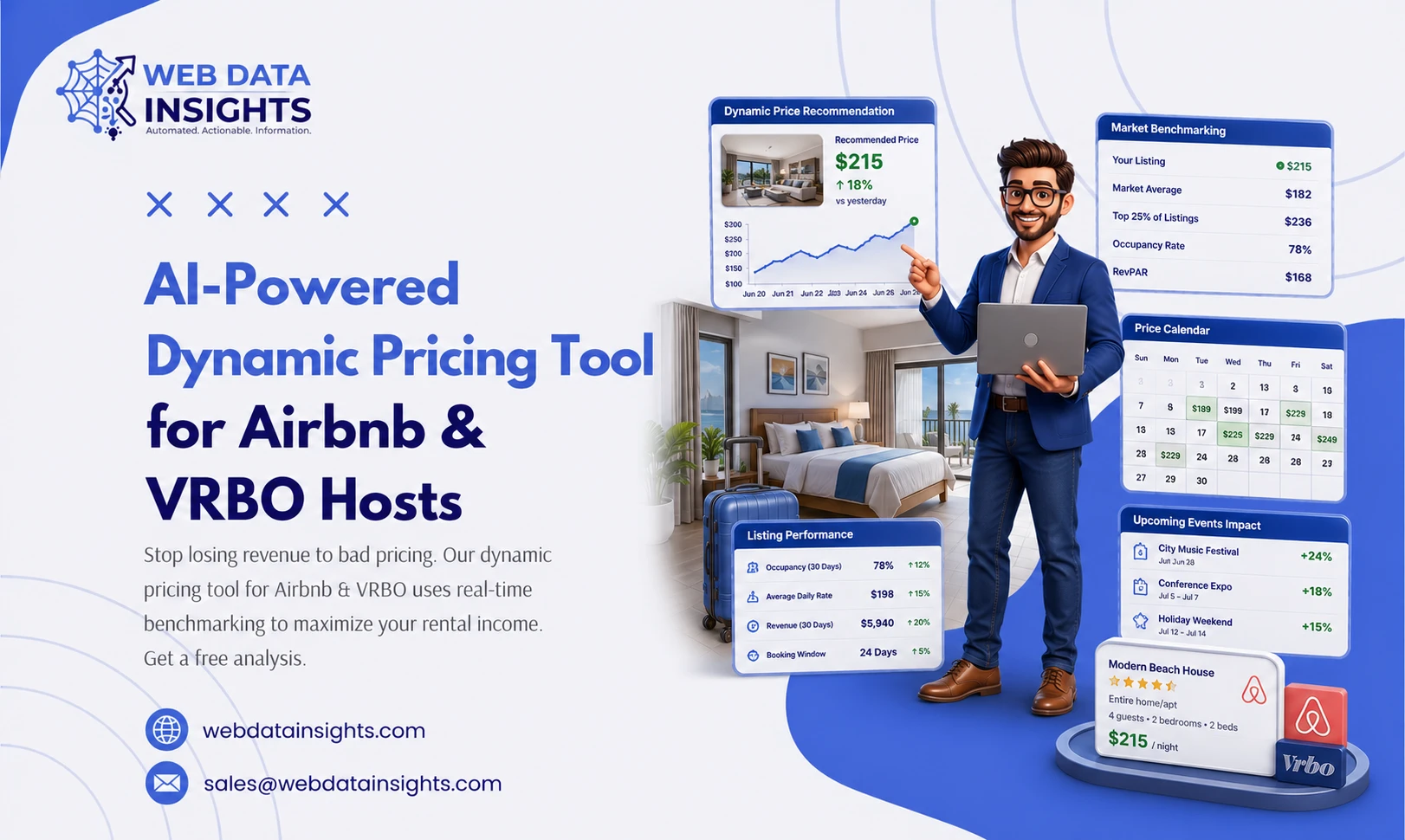
You listed your property on Airbnb or VRBO. You set a price. And then you waited. Maybe you got bookings. Maybe you didn’t. Meanwhile, a host just two streets away with a similar property is quietly earning $1,200 more per month — not because their listing is better, but because they’re using a Dynamic Pricing Tool for Airbnb & VRBO that automatically adjusts rates based on real-time demand, competition, and market trends.
This is not a coincidence. It is a data gap and in 2025, that gap is costing short-term rental hosts thousands of dollars every single month.
This guide explains exactly how a dynamic pricing tool for Airbnb and VRBO works, why real-time benchmarking is the single most important feature to look for, and how hosts exactly like you are using dynamic pricing intelligence to fill their calendars — at the right price, every night.
Hosts using dynamic pricing consistently see stronger performance across key metrics. On average, revenue increases by 47%, while bookings rise by 23% compared to fixed-rate listings. During low-demand periods, calendars fill up to three times faster, helping reduce vacancy gaps. Active users also report earning over $1,800 in additional monthly income, making dynamic pricing a powerful lever for maximizing both occupancy and profitability.
The Real Problem: Why Fixed Pricing Is Killing Your Revenue
Most Airbnb and VRBO hosts set their nightly rate once maybe when they first listed and then barely touch it. A few ambitious ones update it manually once a month, checking a competitor or two and making a gut-feel adjustment.
The problem? Your market changes every single day. Sometimes every hour.
What changes in your market right now, without you knowing:
- Local events — a concert, a festival, a corporate conference — can spike demand 300% overnight
- Competitor pricing shifts — the host down the road just dropped their rate by $40 to fill a gap week
- Seasonal microtrends — demand for your exact property type peaks 3 weeks before you expect it
- Platform algorithm changes — Airbnb actively promotes listings with competitive, frequently-updated pricing
- Last-minute booking surges — travellers book differently on Thursday vs Tuesday, and your static rate ignores this
Real Talk: A host in Miami manually priced their 2BR condo at $180/night flat. After switching to a dynamic pricing tool with real-time benchmarking, the same property averaged $247/night — with a higher occupancy rate. The “lower” prices on slow nights drove bookings that would have otherwise been empty. The higher prices on peak nights captured revenue that was previously left on the table.
Net result: +$1,560/month. Same property. Same listing. Just smarter pricing.
What Is a Dynamic Pricing Tool and How Does It Actually Work?
A dynamic pricing tool is software that automatically adjusts your nightly rate based on real-time data from your local market data analytics, competitor listings, platform demand signals, and historical booking patterns.
Think of it like a stock market trading system — but for your short-term rental. Instead of you manually checking rates once a week, the tool monitors hundreds of data points 24/7 and updates your price Monitoring to always be competitive and profitable.
A quality dynamic pricing tool does six things automatically on AI-Powered Dynamic Pricing Tool for Airbnb & VRBO:
- Competitor monitoring — scans other Airbnb and VRBO listings in your area in real time
- Demand forecasting — predicts high and low demand periods weeks in advance
- Event detection — identifies local events that drive booking spikes
- Occupancy optimization — balances your nightly rate to maximize both bookings and revenue
- Minimum price protection — ensures you never go below your floor price
- Platform sync — updates your Airbnb and VRBO calendars automatically, without manual work
Real-Time Benchmarking: The Feature That Separates Good Tools from Great Ones
Real-time benchmarking is the ability to see exactly what comparable listings in your area are charging right now, tonight and understand how your rate compares.
Not what they charged last month. Not what they charged last season. Right now.
Why real-time data changes everything:
- A competitor drops their rate for next weekend to fill open nights your tool detects it and adjusts yours accordingly, protecting your competitive intelligence scraping position.
- A major employer announces layoffs locally business travel dips your tool sees the demand signal before your calendar empties.
- A new Airbnb listing opens 3 blocks away with aggressive introductory pricing your tool benchmarks it and keeps you from losing bookings to a listing you didn’t even know existed.
Benchmarking without real-time data is like driving with last year’s GPS maps. You might know the general direction — but you’ll miss the new road, hit the closed bridge, and arrive late.
Real-time benchmarking means your pricing decisions are based on what is happening in your market right now — not what happened 30 days ago.
What real-time benchmarking shows you:
- Average nightly rate for comparable listings in your zip code tonight, this weekend, next month
- Occupancy rates of competitors are they full or sitting empty?
- Rate trends is your market pricing up or down over the next 14 days?
- Your position are you priced in the top 25%, middle, or bottom of your comp set?
- Opportunity gaps dates where your market is undersupplied and you can charge a premium
Airbnb Pricing Tool vs VRBO Pricing Tool: Do You Need Both?
If you list on both Airbnb and VRBO — which most serious hosts do — you need a dynamic pricing tool that syncs with both platforms simultaneously.
Here’s why managing them separately is a costly mistake:
- Airbnb and VRBO attract different traveller profiles families, business travellers, groups — and their demand peaks don’t always align
- Inventory that shows as available on both platforms needs to be priced identically to avoid double-bookings and guest complaints
- Airbnb’s algorithm rewards frequent price updates a tool that syncs in real time helps your listing rank higher in Airbnb search
- VRBO’s traveller base books further in advance your pricing strategy for VRBO should account for a longer booking window
A true short-term rental pricing tool treats Airbnb and VRBO as one unified inventory with platform-specific Data intelligence layered on top.
Dynamic Pricing Intelligence: Beyond Just Setting a Price
Dynamic pricing data intelligence services is a step above basic dynamic pricing. It’s not just about adjusting your rate — it’s about understanding why rates should change, when to hold firm on your price, and how to position your listing for maximum long-term revenue.
What pricing intelligence gives you that basic tools don’t:
- Market health reports – understand whether your entire market is growing or contracting
- Revenue forecasting – see projected monthly income 60-90 days out based on current booking pace
- Pacing alerts – get notified if your bookings are running behind market pace for a given date range
- Seasonal strategy insights – know which months to prioritize occupancy and which to prioritize rate
- Review correlation data – understand how your review score affects your pricing power vs. competitors
For professional property managers overseeing multiple listings, dynamic pricing intelligence becomes the difference between a profitable portfolio and a constantly underperforming one.
5 Signs You Need a Dynamic Pricing Tool Right Now
Not sure if you need one? If any of these sound familiar, the answer is yes:
- Your calendar has consistent gap nights – 2-3 night holes between bookings that never fill, costing you revenue
- You manually check competitors’ prices – and spend 30-60 minutes per week doing it, only to make a guess
- You’ve had empty weekends during what should be peak season – because your rate was slightly above market and guests booked someone else
- Your occupancy is high but your revenue feels flat – a sign you’re leaving money on peak nights
- You have no idea what your comp set charges tonight – and you’re making pricing decisions blind
Quick Math: If you’re earning $3,500/month from your rental today, a 35% revenue improvement (the average for hosts who switch to dynamic pricing with real-time benchmarking) means an additional $1,225/month.
That’s $14,700/year. From the same property. With zero additional work.
How to Choose the Right Short-Term Rental Pricing Tool
Not all dynamic pricing tools are equal. Here’s what to look for when evaluating options:
Must-have features:
- Real-time market data – not weekly or monthly data feeds; actual live benchmarking
- Airbnb AND VRBO integration – native sync with both platforms, not manual CSV uploads
- Minimum and maximum price controls – you set the floor and ceiling; the tool optimizes within your parameters
- Occupancy-based pricing logic – rates adjust based on how full or empty your calendar is, not just market averages
- Event and demand detection – automatic identification of local events that affect your market
- Mobile-friendly dashboard – you should be able to review your pricing performance from your phone
Red flags to avoid:
- Tools that use data older than 24 hours for real-time benchmarking claims
- Pricing tools that only support one platform
- Software that doesn’t let you set a minimum price (a risk to your revenue floor)
- Companies that can’t show you actual case studies from hosts in your market type
Real Host Results: What Happens When You Switch to Dynamic Pricing
Single-property Airbnb host, Nashville, TN
A 1-bedroom downtown condo, manually priced at $145/night flat rate. Result after 90 days with dynamic pricing + real-time benchmarking: Average nightly rate increased to $189, occupancy went from 71% to 84%. Monthly revenue: +$1,340.
VRBO beach property, Gulf Shores, AL
A 3-bedroom beach house listed on VRBO only, owner managed. Result after switching to a dual-platform dynamic pricing tool: Added Airbnb sync, improved gap-night fill rate by 31%, peak weekend rates captured an additional $85-$120/night during high season.
Property manager, 14 listings, Scottsdale, AZ
A professional manager struggling with inconsistent performance across their portfolio. Result after implementing dynamic pricing intelligence: Portfolio-wide revenue up 28% in first 6 months. Time spent on manual rate adjustments dropped from 8 hours/week to under 30 minutes.
Getting Started: What to Expect in the First 30 Days
Most hosts worry that switching to dynamic pricing will confuse guests or create erratic pricing. Here’s the reality:
- Week 1 – Setup and calibration. The tool learns your property’s historical performance and sets your baseline comp set
- Week 2 – First automatic adjustments. You’ll likely see gap nights start to fill as the tool optimizes for occupancy
- Week 3 – Rate increases begin on peak dates. You may see slightly higher rates on weekends and events than you’re used to
- Week 4 – First revenue comparison. Most hosts see measurable improvement within 30 days of activation
The key insight: dynamic pricing is not about charging as much as possible. It is about charging the right amount which means sometimes lower (to fill empty nights) and sometimes higher (to capture peak demand) webdatainsights.
Reliable Web Data Solutions
WebDataInsights provides clean, structured, and real-time web scraping solutions tailored to your business goals, helping automate data collection for eCommerce, market research, lead generation, and more.
Get in Touch