




Grocery Dataset: Product, Pricing & Review Data for Enterprise Intelligence
Structured, continuously refreshed grocery data across leading supermarket chains, online grocery platforms, hypermarkets, and specialty food retailers — built for enterprise teams that need decision-grade grocery market intelligence across categories, geographies, and retail channels at scale.
- GDPR-Compliant Sourcing
- SKU-Level Accuracy
- Deduplicated & Normalized
- Enterprise SLA
- AI & ML Ready






800M+
Grocery records indexed
80+
Grocery retailers & platforms
50+
Countries covered
Daily
Pricing & availability refresh
What Is the WebDataInsights Grocery Dataset?
The WebDataInsights Grocery Dataset is a comprehensive, production-ready collection of structured grocery data sourced from the world’s leading supermarket chains, online grocery platforms, hypermarket retailers, convenience store networks, and specialty food retailers. It captures the full grocery product, pricing, and consumer review landscape across all major retail grocery markets globally.
Grocery is the largest and most operationally complex segment of retail data. With tens of thousands of SKUs per retailer, weekly promotional pricing cycles, region-specific assortments, private label proliferation, and nutritional compliance requirements, grocery data demands a level of depth and normalization that only a purpose-built collection and processing infrastructure can deliver at enterprise scale.
Enterprise teams use this grocery dataset to power FMCG competitive pricing engines, monitor shelf availability and assortment gaps across grocery chains, train AI product recommendation and demand forecasting models, track consumer sentiment across online grocery platforms, conduct grocery market sizing research, and benchmark private label versus national brand performance across retail channels.
The dataset is structured around three specialized sub-datasets — each independently licensable or available as a unified grocery intelligence package — designed to serve distinct use cases across grocery product catalog intelligence, supermarket pricing analytics, and grocery customer review data.

Grocery Product Dataset
Comprehensive grocery product catalog data: SKUs, categories, brand data, pack sizes, nutritional facts, ingredient lists, dietary tags, allergen information, certifications, and private label classification across supermarkets and online grocery platforms.

Grocery Pricing Dataset
Supermarket and online grocery pricing intelligence: shelf price, promotional price, loyalty card price, multi-buy offers, private label versus national brand price comparison, and 24-month historical grocery price time-series data.

Grocery Review Dataset
Structured customer review data from online grocery platforms: product ratings, freshness feedback, quality and value sentiment scores, verified purchase flags, and NLP-derived four-dimensional sentiment analysis across all covered grocery retailers.
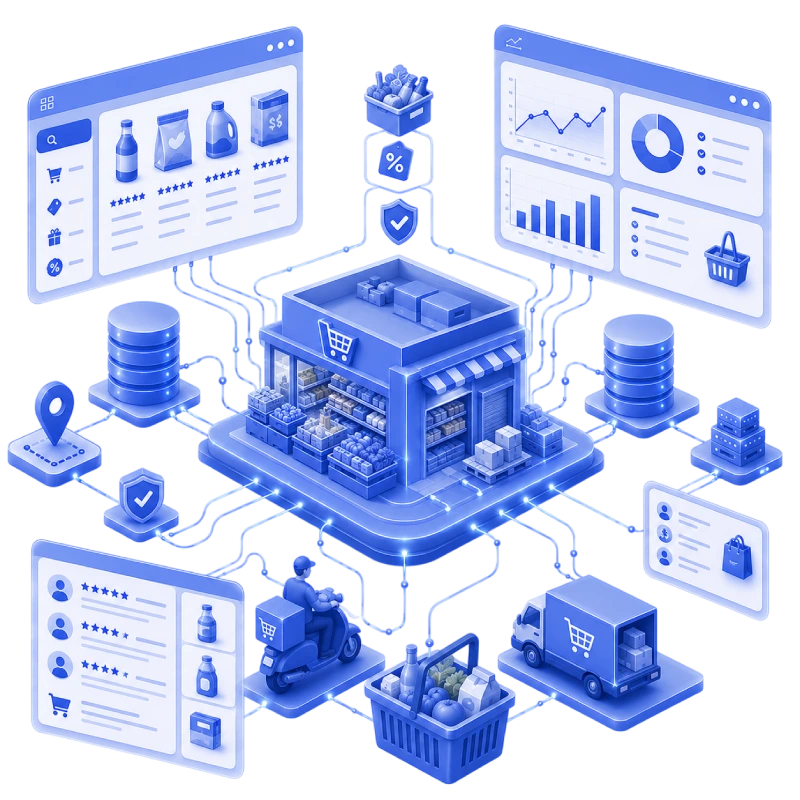
Three Specialized Grocery Sub-Datasets
Each sub-dataset is purpose-built for specific grocery industry use cases, delivered in normalized, schema-consistent format for immediate integration into your analytics, pricing, or AI infrastructure.
Grocery Product Catalog Intelligence
Complete grocery product-level data across all major retail grocery categories — fresh produce, dairy, packaged foods, beverages, household, personal care, and baby care — structured for FMCG competitive benchmarking, catalog enrichment, and AI model training.
- Product titles, descriptions & brand data
- Category hierarchy up to 6 levels (aisle to sub-category)
- SKU identifiers: EAN, UPC, GTIN, retailer PLU
- Pack size, weight, volume & unit type
- Full ingredient list & nutritional facts panel
- Dietary tags: organic, vegan, gluten-free, halal, kosher
- Allergen information (14 major allergen groups)
- Private label vs. national brand classification
- Country of origin & certifications (Fairtrade, USDA Organic)
- Product images & packaging asset URLs
Supermarket Pricing & Promotion Intelligence
Multi-dimensional grocery pricing intelligence covering shelf price, promotional pricing cycles, loyalty card rates, and private label benchmarks — built for FMCG trade pricing strategy, supermarket price monitoring, and grocery market research workflows.
- Shelf price, promotional price & loyalty card price
- Multi-buy offers (3 for 2, buy 2 get 1 free, etc.)
- Price per unit / price per 100g normalization
- Private label vs. national brand price differential
- Online grocery vs. in-store price comparison
- Historical grocery price time-series (up to 24 months)
- Price change frequency & promotional cycle patterns
- Retailer own-label pricing & tier classification
Customer Review & Grocery Product Sentiment
Millions of structured grocery customer review records enriched with NLP-derived four-dimensional sentiment analysis covering product quality, freshness, packaging, and value for money — purpose-built for FMCG brand monitoring, grocery retailer intelligence, and LLM fine-tuning.
- Star ratings (1–5) & review count per grocery SKU
- Review title & full review body text
- Product quality sentiment score & label
- Freshness & shelf-life sentiment signal
- Packaging quality sentiment score
- Value for money sentiment signal
- Verified purchase flag
- Aspect-level tags: taste, texture, freshness, portion, smell
- Review date, platform source & reviewer location
Data Schema & Field Reference
Every grocery sub-dataset ships with a standardized schema and comprehensive field documentation. Below are the core fields across all three grocery datasets — delivered in your chosen format, ready for immediate pipeline integration.
Grocery Product Schema

Grocery Pricing Schema

Grocery Review Schema
See the Grocery Data Before You Buy
A representative composite record from the Grocery Product + Pricing Dataset — normalized, enriched, and schema-consistent across all covered grocery retailers and markets.
{
  "product_id":          "WDI-GRC-UK-00598147",
  "title":               "Yeo Valley Organic Full Fat Yogurt",
  "brand":               "Yeo Valley",
  "ean":                 "5060030311234",
  "category_path":       ["Dairy", "Yogurts", "Organic Yogurt"],
  "pack_size":           "500g",
  "country_of_origin":   "United Kingdom",
  "dietary_tags":        ["organic", "vegetarian", "gluten-free"],
  "allergen_info":       ["contains-milk"],
  "certifications":      ["USDA Organic", "Soil Association"],
  "is_private_label":    false,
  "retailer_id":         "tesco_uk",
  "shelf_price":         2.75,
  "promo_price":         2.00,
  "loyalty_price":       1.90,
  "price_per_100g":      0.55,
  "is_on_promotion":     true,
  "currency_code":       "GBP",
  "overall_rating":      4.6,
  "review_count":        3284,
  "quality_sentiment":   0.88,
  "freshness_sentiment": 0.84,
  "packaging_sentiment": 0.76,
  "value_sentiment":     0.72,
  "snapshot_ts":         "2025-06-15T08:00:00Z"
}
* Sample records are illustrative. Full dataset records include all schema fields plus extended product and retailer attributes. Request a full sample export →
Global Grocery Data Coverage Across Retail Channels
Our grocery data collection infrastructure covers 80+ supermarket chains, hypermarket operators, online grocery platforms, convenience retailers, specialty food stores, and wholesale club operators across 50+ countries — capturing product catalog, pricing, and customer review data at the SKU level across all covered retail channels.
Unlike food delivery or quick commerce data, grocery data must reconcile in-store pricing with online grocery pricing, manage region-specific assortment variations, handle promotional cycle tracking, and normalize nutritional and allergen data across different national labelling standards. Our grocery data pipeline handles all of these complexities before delivery.
Coverage spans all major grocery retail categories: fresh produce, dairy and eggs, meat and seafood, bakery, frozen foods, packaged and ambient foods, beverages, snacks, confectionery, baby care, pet food, household cleaning, and personal care — with retailer-specific and category-level filtering available on request.
Enterprise clients can configure coverage by specific grocery retailer, country or regional market, product category tier, private label versus national brand scope, or individual brand monitoring perimeters — with custom collection additions available for regional grocery chains and specialist food retailers.
Grocery Retailers & Platforms We Cover
Our grocery dataset spans the world’s most commercially significant supermarket chains, hypermarket operators, online grocery platforms, and specialty food retailers — segmented by region and retail format for precision market intelligence.
Amazon Fresh
Online Grocery · Global
Walmart Grocery
Supercenter · USA

Tesco
Supermarket · UK
Sainsbury’s
Supermarket · UK
Asda
Supermarket · UK

Instacart
Grocery Delivery · US
Morrisons
Supermarket · UK

Waitrose
Premium Grocery · UK
Lidl
Discount Grocery · Europe
Aldi
Discount Grocery · Europe
Carrefour
Hypermarket · Europe

Leclerc
Hypermarket · France

Rewe
Supermarket · Germany
Target Grocery
Mass Retail · USA
Whole Foods
Premium Grocery · USA
Kroger
Supermarket · USA
Costco
Wholesale Club · USA
Trader Joe’s
Specialty Grocery · USA

Chedraui
Supermarket · Mexico

Pão de Açúcar
Supermarket · Brazil

BigBasket
Online Grocery · India

DMart
Hypermarket · India

Nature’s Basket
Premium Grocery · India

Cold Storage
Supermarket · Singapore

FairPrice
Supermarket · Singapore
Carrefour MENA
Hypermarket · MENA

Lulu Hypermarket
Hypermarket · UAE & India

Ocado
Online Grocery · UK
Walmart+ Grocery
Online Grocery · USA
Tesco Online
Online Grocery · UK

Picnic
Online Grocery · Europe

Rohlik
Online Grocery · Europe

20+ More
Custom on request
Also covers pharmacy grocery, wholesale clubs, health food chains, specialty retailers, and regional co-operatives. Request custom platform coverage →
How Enterprise Teams Use Grocery Data
From FMCG trade pricing strategy to AI-powered demand forecasting models, the WebDataInsights Grocery Dataset powers commercial and strategic decisions across the full grocery retail value chain.
FMCG Competitive Pricing & Trade Intelligence
Monitor your brand’s shelf price, promotional price, and loyalty card price across grocery retailers by country and channel — and benchmark against competitor brands and private label alternatives at the SKU level, updated daily, without relying on expensive syndicated panel data.
- SKU-level price tracking across supermarket chains
- Promotional cycle monitoring & discount depth analysis
- Private label vs. national brand price benchmarking
- Multi-buy offer & loyalty pricing intelligence
Private Label & Own-Brand Intelligence
Track how grocery retailers are expanding their own-label assortments, monitor private label pricing tiers (economy / standard / premium), benchmark private label product sentiment against national brands, and identify categories where private label is gaining share fastest across key markets.
- Private label assortment growth tracking by retailer
- Own-label pricing tier benchmarking
- National brand vs. private label sentiment comparison
- Category private label penetration analysis
AI, ML & Grocery Demand Forecasting
Large-scale structured grocery product, pricing, and review data is foundational for training grocery recommendation engines, NLP product quality classifiers, demand forecasting models, shelf space optimization algorithms, and LLM fine-tuning pipelines for grocery retail and food technology applications.
- Grocery recommendation & substitution models
- Demand forecasting & replenishment optimization
- Four-dimensional grocery sentiment NLP classification
- LLM fine-tuning for grocery & food retail domain
Grocery Market Research & Category Sizing
Quantify grocery category size by retailer and country, benchmark assortment depth across supermarket chains, identify under-served product segments, and size the addressable grocery opportunity across markets before committing to product development or market entry investment.
- Category-level grocery market sizing by country
- Retailer assortment depth benchmarking
- Shelf space & distribution gap analysis
- Emerging category & trend identification
Grocery Brand & Product Reputation Intelligence
Transform millions of grocery customer reviews into structured four-dimensional intelligence covering quality, freshness, packaging, and value for money — revealing what consumers value most in each grocery category and where specific brands are losing or winning shopper loyalty.
- Four-dimensional grocery product sentiment tracking
- Freshness & shelf-life complaint monitoring
- Packaging sustainability sentiment analysis
- Value perception benchmarking by category
Investment & Grocery Retail Due Diligence
Private equity, FMCG corporate strategy, and M&A teams use grocery datasets to validate brand distribution, assess retail channel concentration risk, benchmark SKU velocity signals, identify private label displacement threats, and monitor portfolio brand performance across retailers and markets.
- Brand distribution & shelf presence analysis
- Retail channel concentration risk assessment
- Private label displacement threat monitoring
- Portfolio brand performance benchmarking
Who Uses Grocery Datasets?
FMCG manufacturers, grocery retailers, food technology companies, investors, and strategy consultants across the grocery ecosystem rely on structured grocery data to sharpen competitive positioning, optimize trade pricing, and build AI-powered grocery experiences.

FMCG & CPG Manufacturers
Monitor brand distribution, track trade pricing compliance, benchmark competitor SKUs, and identify shelf availability gaps across grocery chains in real time across all covered markets.

Grocery Retailers & Superchains
Benchmark own-label assortment against rivals, monitor competitor promotional strategies, and analyse customer review sentiment to drive category performance and shopper loyalty.

Organic & Specialty Food Brands
Track organic, free-from, and specialty product distribution across grocery channels, monitor certification compliance visibility, and benchmark premium positioning against mainstream alternatives.

AI & Grocery Technology Companies
Train grocery recommendation, demand forecasting, and NLP quality sentiment models using large-scale labeled grocery product catalog and review data across multiple retailers and markets.

Management Consulting Firms
Deliver evidence-based grocery strategy engagements — FMCG pricing optimization, category management, and market entry analysis — backed by objective grocery market data.

Private Equity & FMCG Corporate M&A
Validate brand distribution depth, assess private label displacement risk, and benchmark portfolio brand performance across grocery channels during investment diligence and monitoring cycles.

Market Research Firms
Augment primary grocery research with objective pricing signals, SKU availability data, and consumer sentiment intelligence across categories, retailers, and geographic markets.

Supply Chain & Logistics Teams
Monitor grocery SKU availability patterns and demand signals across retailers to anticipate inventory replenishment pressure and optimize upstream supply chain planning cycles.
Grocery Delivery Data at Scale
Access comprehensive grocery delivery data across supermarkets, quick commerce platforms, product catalogs, pricing, promotions, availability, and customer insights worldwide. Drive smarter business decisions with accurate, real-time, and continuously updated data.
Start Your ProjectFlexible Grocery Data Delivery for Every Stack
Your grocery data arrives in the format your engineering and analytics teams already work with — no transformation overhead, no internal wrangling required on day one.

JSON / JSONL
API integration & streaming pipeline ready

CSV / TSV
Direct BI tool & spreadsheet compatibility

Parquet
Columnar storage for big data & ML workflows

REST API
Real-time query with retailer, SKU & category filters

Cloud Storage
S3, GCS, or Azure Blob scheduled delivery

Custom Pipeline
SFTP, webhook, or data warehouse push
Delivery cadence: one-time export · daily · weekly · real-time. All formats include full schema documentation, field dictionaries, and sample records across multiple retailers and markets.
Enterprise Grocery Data Quality You Can Depend On
We operate as a specialized grocery data engineering partner — not a generic data aggregator. Built for FMCG teams, grocery retailers, and enterprise buyers where SKU-level accuracy, nutritional data integrity, and compliance are non-negotiable.
Nutritional & Regulatory Data Integrity
Grocery data requires nutritional fact accuracy, allergen information completeness, and dietary certification verification that generic data pipelines cannot guarantee. Our grocery data includes validated nutritional facts panels, 14 allergen group classifications, and certification tags (Fairtrade, USDA Organic, Soil Association) extracted and verified at the product level before delivery.
Four-Dimensional Sentiment Analysis
Our Grocery Review Dataset uniquely provides four separate NLP sentiment scores: product quality, freshness, packaging, and value for money. This multi-dimensional structure allows FMCG teams to isolate whether negative reviews reflect a quality issue, a freshness problem, a packaging failure, or a price perception challenge — a distinction no single-score review dataset captures.
Private Label Classification at Scale
Every grocery product record includes an is_private_label boolean flag and a private_label_tier field (economy / standard / premium) — enabling direct national brand versus own-label pricing and sentiment benchmarking at scale. This is a grocery-specific data dimension that no general ecommerce dataset captures with comparable precision or completeness.
Promotional Cycle Intelligence
Grocery pricing follows weekly promotional cycles — shelf price, promotional price, loyalty card price, and multi-buy offers change on different cadences. Our Grocery Pricing Dataset captures all four price layers and includes a promo_cycle_days field revealing how frequently each SKU enters and exits promotions — essential for FMCG trade planning and category management teams.
Legal & Compliance Framework
All grocery data is collected from publicly available sources under a defensible legal framework aligned with GDPR, CCPA, and applicable data protection regulations. Customer review data is fully anonymized — no PII is included. Full source provenance documentation is available for enterprise legal and data governance review processes.
Production-Grade Data Quality
Every grocery record passes through SKU-level entity resolution, cross-retailer deduplication, pack-size and unit normalization, nutritional data validation, and schema completeness checks before delivery. You receive clean, decision-grade grocery intelligence — not raw outputs requiring internal data engineering resources to make usable for analytics or AI applications.
Frequently Asked Questions
Answers to the questions enterprise buyers, FMCG category managers, data engineers, and procurement teams ask most often about our grocery datasets.
A grocery dataset is a structured collection of data extracted from supermarket chains, online grocery platforms, hypermarket retailers, and specialty food stores. It covers three core data types: grocery product data (SKUs, categories, brand information, pack sizes, nutritional facts, ingredient lists, dietary tags, allergen information, private label classification), grocery pricing data (shelf price, promotional price, loyalty card price, multi-buy offers, price per unit/100g, historical pricing trends), and grocery review data (customer ratings, review text, product quality sentiment, freshness sentiment, packaging sentiment, value for money sentiment). Enterprise teams use grocery datasets for FMCG competitive pricing intelligence, private label benchmarking, AI model training, grocery market research, and consumer sentiment analytics across supermarkets and online grocery platforms.
The Grocery Product Dataset includes comprehensive product records covering: product titles and descriptions, brand and manufacturer data, category hierarchy up to 6 levels, SKU identifiers (EAN, UPC, GTIN, retailer PLU), pack size and weight/volume, full ingredient list, nutritional facts panel (per 100g and per serving), dietary tags (organic, vegan, vegetarian, gluten-free, halal, kosher, dairy-free), allergen information covering all 14 major allergen groups, country of origin, product certifications (Fairtrade, USDA Organic, Soil Association, Rainforest Alliance), private label versus national brand classification, private label tier (economy / standard / premium), product and packaging image URLs, availability status, and platform source attribution. All records are entity-resolved and deduplicated across retailers.
The Grocery Pricing Dataset provides multi-layered grocery pricing intelligence capturing four price layers simultaneously for the same SKU: shelf price, promotional price, loyalty card or member price, and multi-buy offer pricing. Additional fields include: price per unit, price per 100g for fair unit price comparison, private label tier classification, retailer own-label price benchmarking, online grocery versus in-store price comparison, historical grocery price time-series data up to 24 months, price change frequency, promotional cycle pattern data (promo_cycle_days field), is-on-promotion flag, and currency-normalized values across 140+ currencies. Data is captured at the retailer and store-type level across 50+ countries.
The Grocery Review Dataset uniquely provides four separate NLP-derived sentiment scores per review: product quality sentiment, freshness and shelf-life sentiment, packaging quality sentiment, and value for money sentiment. Additional fields include: overall star rating (1–5) and review count per grocery SKU, review title and full body text, verified purchase flag, aspect-level sentiment tags (taste, texture, smell, portion size, freshness, packaging integrity, expiry date accuracy), helpful vote count, reviewer location, review date, and platform source. All records are anonymized with no PII included. The four-dimensional sentiment structure enables FMCG teams to isolate the root cause of negative reviews across quality, freshness, packaging, and price perception.
Coverage spans 80+ grocery retailers and platforms globally. In the UK and Europe: Tesco, Sainsbury’s, Asda, Morrisons, Waitrose, Lidl, Aldi, Carrefour, Leclerc, and Rewe. In the USA and Americas: Walmart Grocery, Target, Whole Foods, Kroger, Costco, Trader Joe’s, Chedraui, and Pão de Açúcar. In Asia-Pacific, India, and MENA: BigBasket, DMart, JioMart, Nature’s Basket, Cold Storage, FairPrice, Carrefour MENA, and Lulu Hypermarket. Online grocery platforms: Amazon Fresh, Ocado, Instacart, Tesco Online, Walmart+ Grocery, Picnic, and Rohlik. Also covering pharmacy-led grocery, wholesale clubs, health food chains, and specialty food retailers. Custom retailer additions are available for enterprise accounts on request.
A grocery dataset differs from a general ecommerce dataset in five important ways. First, it includes grocery-specific product fields: ingredient lists, nutritional facts panels, allergen information covering 14 allergen groups, dietary certifications, and country of origin — none of which exist in a standard ecommerce product schema. Second, it captures four-layered grocery pricing: shelf price, promotional price, loyalty card price, and multi-buy offer price for the same SKU simultaneously. Third, it includes private label classification and tier data — a grocery-specific dimension tracking retailer own-brand assortments against national brands. Fourth, it provides four-dimensional review sentiment: quality, freshness, packaging, and value for money. Fifth, it captures the grocery promotional cycle dimension via promo_cycle_days, revealing how frequently grocery SKUs rotate through promotions — a trade planning tool unique to grocery intelligence.
Refresh cadence is configurable based on your use case:
- Daily snapshots: For shelf price monitoring, promotional cycle tracking, and competitive pricing dashboards — the standard cadence for most FMCG and grocery retail intelligence teams
- Weekly batches: For market research workflows, category benchmarking, and strategic reporting aligned to the typical weekly grocery promotional cycle
- Real-time / hourly: For online grocery platforms where prices update more frequently than in-store supermarket cadences
- One-time historical export: For ML training datasets, investment due diligence, and retrospective market analysis using 24-month price history archives
Yes. Nutritional data and allergen information are first-class fields in the Grocery Product Dataset — not optional additions. The nutritional facts panel is captured as a structured object with per-100g and per-serving values for calories, protein, carbohydrates, sugars, fat, saturated fat, fibre, and sodium. Allergen information covers all 14 major allergen groups defined by EU food labelling regulations (gluten, milk, eggs, fish, shellfish, tree nuts, peanuts, soya, celery, mustard, sesame, sulphites, lupin, and molluscs). Dietary tags include organic, vegan, vegetarian, gluten-free, dairy-free, halal, and kosher. Certification data covers Fairtrade, USDA Organic, Soil Association, and Rainforest Alliance where publicly displayed by retailers.
Grocery datasets power several specialized AI and ML applications in food retail and grocery technology:
- Training grocery recommendation and product substitution engines using product catalog and nutritional attribute data
- Building demand forecasting and replenishment optimization models using price history and promotional cycle pattern data
- Fine-tuning LLMs on grocery and food retail domain language for shopping assistant and meal planning applications
- Building four-dimensional NLP sentiment classifiers for quality, freshness, packaging, and value from real grocery customer review text
- Training dietary compliance and allergen detection models using structured ingredient list and allergen field data
- Developing shelf space optimization and planogram recommendation models using assortment depth and availability data
- Building private label displacement prediction models using price differential and sentiment comparison data
Data is delivered in your preferred format: JSON, JSONL, CSV, TSV, or Parquet for batch delivery. Real-time access is available via REST API with retailer-level, SKU-level, category-level, dietary tag, certification, and private label filtering. Cloud delivery is supported to Amazon S3, Google Cloud Storage, and Azure Blob Storage on configurable schedules. Custom delivery pipelines including SFTP, webhook push, and direct data warehouse ingestion (Snowflake, BigQuery, Redshift) are available for enterprise accounts. All formats ship with schema documentation, field dictionaries, and sample records across multiple retailers and markets.
Yes. All grocery data is collected from publicly available sources under a defensible legal framework aligned with GDPR, CCPA, and applicable data protection regulations. Customer review data is fully anonymized — no personally identifiable information (PII) is included in any delivery. Full source provenance documentation is available for enterprise data governance and legal review. We recommend clients conduct their own legal assessment for jurisdiction-specific use cases and downstream AI training applications.
Yes. Enterprise clients can request fully custom grocery dataset configurations including specific retailer or grocery chain coverage, country or regional market scope, product category inclusions or exclusions, dietary tag and certification filters, private label versus national brand scope, brand-level monitoring perimeters, custom field mappings, and tailored delivery schemas. Representative sample datasets — matching your target retailers, categories, markets, and delivery format — are provided during the evaluation process before any commercial commitment. Contact our data team to scope your requirements and receive a sample within 48 hours.
Ready to Evaluate the Grocery Dataset?
Request a sample export tailored to your target grocery retailers, categories, markets, and delivery format — at no cost. Our data team will scope your requirements and configure a representative sample within 48 hours.

Our Headquarters
Flatbush Avenue, Brooklyn, New York 11201, USA
Email Us
sales@webdatainsights.com
Support
Available 24/7 for custom requests.



Start Your Data Project
Get a custom quote within 15 minutes.