





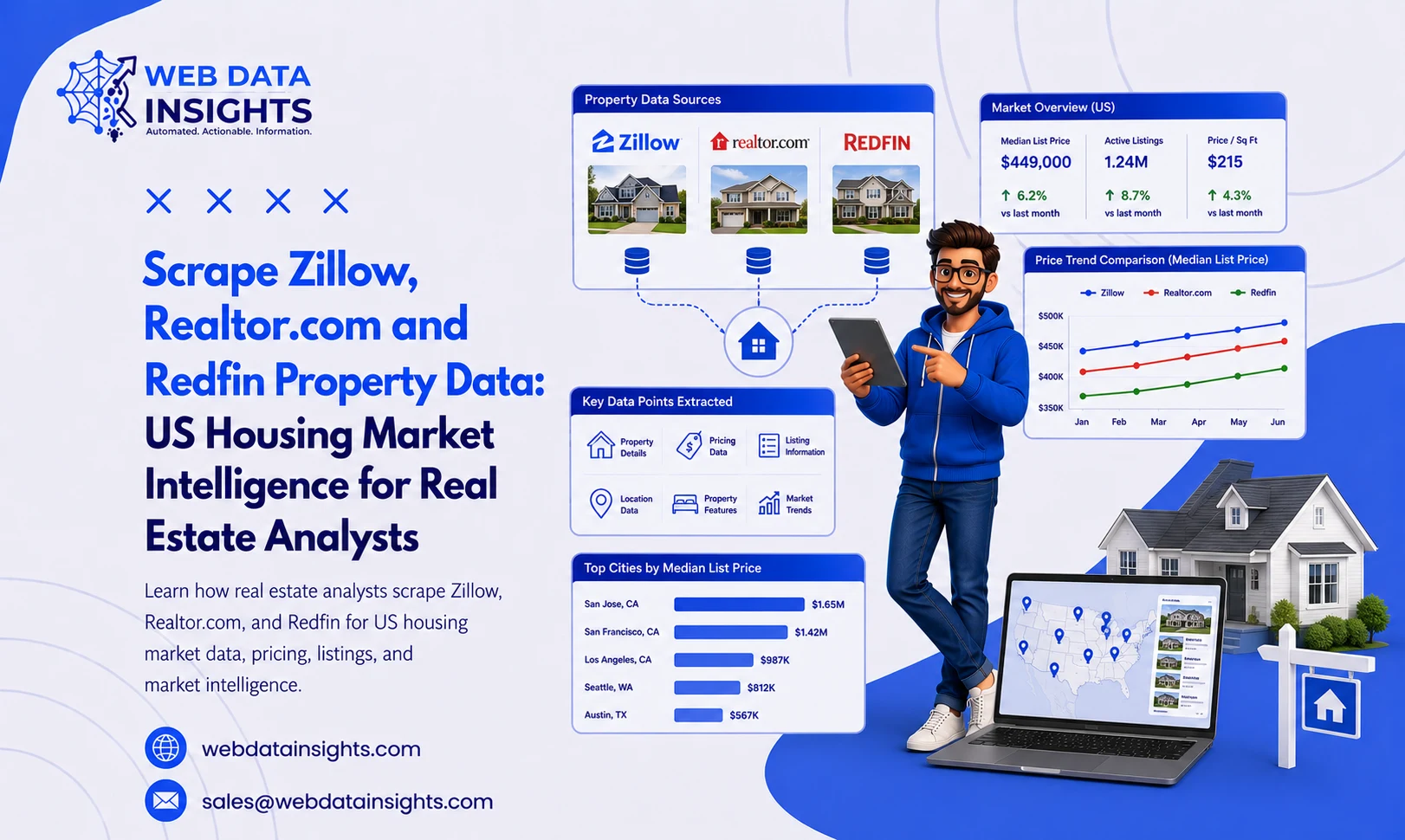
No single listing site tells the whole story of a US housing market. Zillow, Realtor.com, and Redfin each pull from different MLS feeds, update on different schedules, and calculate estimated values with their own proprietary models. For analysts who need a complete, reliable picture, the practical answer is to scrape Zillow, Realtor.com and Redfin property data together, rather than treating any one platform as a full source of truth.
QUICK ANSWER
Scraping Zillow, Realtor.com, and Redfin property data means extracting listing, pricing, and market data from all three sites and normalizing it into a single structured dataset, since each platform captures slightly different fields and coverage, and combining them gives a more complete view of the US housing market than any one source alone.
Why One Listing Site Is Never the Full Picture
Each platform sources data from its own mix of MLS feeds and direct agent submissions, which means coverage gaps are common — a property listed on one site may lag or be entirely missing on another. Estimated values also diverge, since each site runs a different valuation model on the same underlying data. Analysts building a genuine US real estate market intelligence view need to treat each platform as one input, not the definitive answer, and reconcile the differences rather than picking a favorite.
Zillow USA Data Scraping: Core Fields to Track
Zillow USA data scraping typically focuses on listing price, Zestimate-style value estimates, price history over time, days on market, and core property characteristics like square footage, lot size, and year built. Price history is particularly valuable here, since it reveals whether a property has had recent reductions — a signal that’s easy to miss from a single snapshot.
Realtor.com Data Extraction in USA: What Sets It Apart
Realtor.com data extraction in USA is useful largely because of its close ties to direct MLS feeds and agent contact information, which makes it a strong cross-check source for listing accuracy and freshness. When a listing appears on Realtor.com but shows outdated status elsewhere, that discrepancy itself is a useful data point about how current each source really is.
Redfin USA Property Data Scraping: Market-Level Signals
Redfin USA property data scraping is often valued for its market-level statistics — median sale price by neighborhood, sale-to-list price ratio, and days-on-market trends aggregated at a local level. These market-level rollups complement the property-level detail from Zillow and Realtor.com, rounding out a dataset that works at both the individual listing and neighborhood level.
US Housing Market Data Scraping: Building One Consistent Dataset
The real value in US housing market data scraping comes from combining all three sources into one schema — matching the same property across platforms by address, normalizing price and status fields, and flagging discrepancies rather than silently picking one number. This is the same discipline covered in more depth in Web Scraping Real Estate Data, which applies across the wider real estate data landscape beyond these three sites specifically.
Example: Normalized Property Record Across Multiple Listing Platforms
{
  "property_id": "US-CA-SF-94107-1024",
  "address": "1024 Market St, San Francisco, CA",
  "listing_status": "Active",
  "sources": {
    "zillow": {
      "listing_price": 1249000,
      "zestimate": 1268500,
      "days_on_market": 18
    },
    "realtor": {
      "listing_price": 1249000,
      "mls_status": "Active",
      "listing_agent": "Emily Carter"
    },
    "redfin": {
      "listing_price": 1235000,
      "median_sale_price_area": 1218000,
      "days_on_market": 16
    }
  },
  "normalized_record": {
    "current_price": 1249000,
    "bedrooms": 3,
    "bathrooms": 2,
    "living_area_sqft": 1845,
    "lot_size_sqft": 4200
  },
  "last_synced": "2026-07-15T09:42:11Z"
}
| Field | Primary Source | Why It's Tracked |
|---|---|---|
| Listing price & history | Zillow, Realtor.com | Reveals pricing trends and reduction patterns |
| Days on market | All three | Signals demand strength in a given area |
| Median sale price by area | Redfin | Provides neighborhood-level market context |
| Agent & listing freshness | Realtor.com | Cross-checks listing accuracy and recency |
US Real Estate Data Scraping in Practice
At scale, US real estate data scraping needs to account for a fast-moving market: listings go pending or sold within days in competitive metros, and prices can shift more than once during an active listing period. Analysts relying on stale or infrequently refreshed data risk basing decisions on properties that are no longer even available.
Examples: Who Uses This Data
Mortgage lenders and underwriters use comparable-sales data to support valuation and risk models. Real estate investment firms and REITs track pricing and inventory trends across target metros to time acquisitions. PropTech companies build consumer-facing valuation and search tools on top of aggregated listing data. Insurance and risk-assessment teams use property characteristics and location data to inform underwriting. Relocation and corporate housing services use cross-platform listing data to give clients an accurate, current view of a new market.
Expert Insights & Best Practices
Match properties across platforms by address, not by listing ID
Each site uses its own internal identifiers. Address-based matching, with careful handling of formatting differences, is what actually links the same property across all three sources.
Flag discrepancies instead of resolving them silently
When Zillow and Redfin disagree on days-on-market, that gap is often meaningful — a stale listing on one platform, a status update lag on another. Surface it rather than picking one value by default.
Refresh frequency should match market speed
Competitive metro markets need daily refreshes to catch new listings and status changes; slower markets can run on a weekly cycle without losing much signal.
Teams that want a faster starting point often supplement live scraping with a structured Real Estate Dataset or a source-specific Zillow Real Estate Dataset to validate pipeline output or backfill historical trends.
Common Mistakes to Avoid
- Treating one platform as the single source of truth — each site has coverage gaps the others fill.
- Matching properties by listing ID instead of address — IDs aren't shared across platforms and will miss valid matches.
- Ignoring valuation model differences — an "estimate" from one site isn't directly comparable to another without noting the methodology gap.
- Under-refreshing in fast-moving markets — a weekly cycle can miss an entire listing's lifecycle in a hot metro area.
- Skipping compliance review — scraping rules and site terms vary, and a large-scale program should be checked against each source's terms before scaling up.
Where This Is Heading
As more analysts combine scraped listing data with other public records — permits, tax assessments, demographic data — the value of a well-normalized, multi-source housing dataset keeps growing relative to any single platform's numbers. At the same time, more teams are pairing live scraping with structured historical datasets and reviewing available Top Real Estate Data APIs to decide which parts of a pipeline are worth building versus sourcing directly.
Frequently Asked Questions
What does it mean to scrape Zillow, Realtor.com, and Redfin property data?
It means extracting listing, pricing, and market data from all three sites and normalizing it into a single structured dataset, since each platform captures slightly different fields and coverage, and combining them gives a more complete view of the US housing market than any one source alone.
Why do Zillow, Realtor.com, and Redfin sometimes show different data for the same property?
Each platform pulls from different MLS feeds and updates on its own schedule, and estimated values are calculated using different proprietary models, so listing price, days-on-market, and estimated value can all vary slightly across the three sites for the same address.
What fields matter most in Zillow USA data scraping?
Listing price, Zestimate-style value estimates, price history, days on market, and property characteristics such as square footage and lot size are the core fields most analysts track when scraping Zillow data at scale.
How is Realtor.com data extraction different from Zillow or Redfin?
Realtor.com places heavier emphasis on direct MLS-sourced listing data and agent contact information, making it a useful cross-check source for listing accuracy and freshness against the other two platforms.
Is US housing market data scraping legal?
Scraping publicly available listing pages is generally treated differently from accessing password-protected or paid data, but the rules vary by jurisdiction and by each site's terms of service, so any large-scale extraction program should include a compliance review specific to the sources involved.
How often should real estate market intelligence data be refreshed?
Fast-moving metro markets often warrant a daily refresh to catch new listings and price changes, while slower markets or long-term trend analysis can rely on a weekly cycle without losing meaningful signal.
Conclusion
Zillow, Realtor.com, and Redfin each tell part of the story of a local housing market — never the whole thing on their own. At WebDataInsights, we believe analysts who combine, normalize, and reconcile data across all three get a materially clearer view of pricing trends, inventory, and market speed than anyone relying on a single platform. Treating this as an ongoing data discipline, rather than a periodic manual check, is what separates reliable market intelligence from guesswork.
Reliable Web Data Solutions
WebDataInsights provides clean, structured, and real-time web scraping solutions tailored to your business goals, helping automate data collection for eCommerce, market research, lead generation, and more.
Get in Touch