
In today’s winner-takes-all marketplace, Amazon & Flipkart Rank Scraping Services have become the most powerful weapon for brands that want to dominate organic search results. Whether you’re competing for shelf space on Amazon India’s 400M+ product listings, fighting for visibility on Flipkart, or Price Tracking hyperlocal rankings on Blinkit, BigBasket, and Zepto — knowing your exact rank position in real-time is no longer optional. It’s survival. Brands across India, USA, UAE, and UK are already using professional rank scraping services to outsmart competitors, optimize listings, and capture more revenue — before their rivals even notice the shift. Here’s a snapshot of the platforms where your ranking battle is being fought every single second:
| Platform | Monthly Active Users | Products Listed |
|---|---|---|
| Amazon India | 300M+ | 400M+ |
| Flipkart | 200M+ | 150M+ |
| Blinkit (Quick Commerce) | 10M+ | 25,000+ |
| BigBasket | 20M+ | 50,000+ |
| Zepto | 8M+ | 10,000+ |
Why E-Commerce Product Ranking Data Is Your Most Valuable Competitive Asset in 2025
In today’s hyper-competitive e-commerce landscape, the difference between page 1 and page 2 is the difference between booming revenue and digital invisibility. Whether you’re a brand selling on Amazon India, an FMCG company battling for shelf space on Blinkit, or a D2C startup trying to outrank legacy brands on BigBasket — your product’s organic rank determines everything.
E-commerce product ranking scraping — also called marketplace rank tracking, organic SERP monitoring, or competitive rank intelligence — is the systematic extraction of product position data from e-commerce platforms using automated web scraping tools, APIs, and data pipelines. This is not just a technical exercise. It is mission-critical business intelligence that directly drives revenue.
Businesses worldwide — from USA, UK, Canada, UAE, Saudi Arabia, Switzerland, Germany, and Australia — are actively investing in Amazon product rank scraping services, Flipkart data collection services, Blinkit category rank monitoring, and BigBasket product data extraction to gain the competitive edge they need in a winner-takes-all marketplace.
MARKET INTELLIGENCE: According to industry reports, brands that actively monitor their e-commerce organic rankings see an average 34% improvement in marketplace visibility within 90 days of implementing data-driven optimization strategies.
What Is Organic Rank in E-Commerce Platforms? A Deep Dive
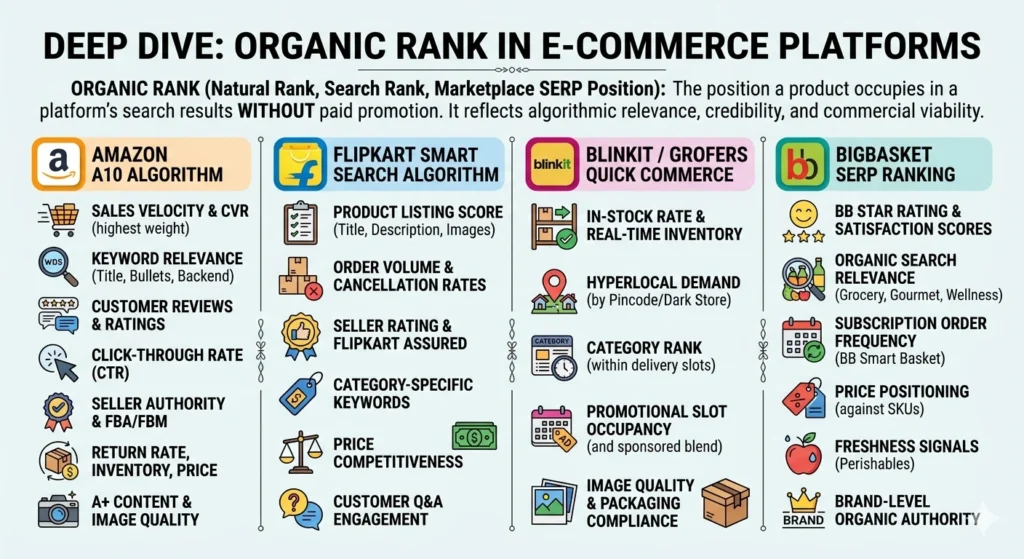
Organic rank (also called natural rank, search rank, or marketplace SERP position) is the position a product occupies in a platform’s search results without paid promotion. It is the algorithmic reflection of how relevant, credible, and commercially viable a product is — according to each platform’s unique ranking algorithm.
Unlike paid placements (Amazon Sponsored Products, Flipkart PLA ads), organic rank is earned through genuine commercial signals. Understanding and continuously tracking this metric across platforms is the foundation of e-commerce competitive intelligence.
How Organic Ranking Algorithms Work: Platform-by-Platform Breakdown
Amazon A10 Algorithm — Key Organic Ranking Factors
- Sales velocity & conversion rate (CVR) — highest weight
- Keyword relevance in title, bullet points, backend search terms
- Customer reviews, ratings, and review recency
- Click-through rate (CTR) from search results
- Seller authority, account health, and fulfillment type (FBA vs FBM)
- Return rate, inventory depth, and price competitiveness
- A+ Content and image quality signals
Flipkart Smart Search Algorithm — Ranking Determinants
- Product listing score (title, description, images, specifications completeness)
- Order volume and cancellation rates
- Seller rating and Flipkart Assured badge status
- Category-specific keyword optimization
- Price Monitoring competitiveness against similar products
- Customer reviews and question-answer engagement
Blinkit / Grofers Quick Commerce Ranking Signals
- In-stock rate and real-time inventory availability
- Hyperlocal demand signals by pincode / dark store area
- Category rank within 10-minute delivery slots
- Promotional slot occupancy and sponsored listing blend
- Image quality and packaging compliance
BigBasket SERP Ranking Algorithm
- BB Star rating and customer satisfaction scores
- Organic search relevance within grocery, gourmet, and wellness categories
- Subscription order frequency (BB Smart Basket)
- Price positioning against comparable SKUs
- Freshness signals for perishable categories
- Brand-level organic authority on platform
What Is E-Commerce Product Ranking Scraping? (And Why You Need It)
E-commerce product ranking scraping is the automated process of collecting product position data, SERP rank, category rank, pricing, reviews, ratings, and competitive metrics from marketplaces like Amazon, Flipkart, Blinkit, BigBasket, Zepto, Meesho, JioMart, Nykaa, and other digital retail platforms.
This data is extracted at scale, in real-time or at scheduled intervals, using technologies such as:
- Headless browser automation (Puppeteer, Playwright, Selenium)
- Python scraping frameworks (Scrapy, BeautifulSoup, HTTPX)
- Rotating residential and datacenter proxy networks
- Anti-bot bypass and CAPTCHA solving mechanisms
- Custom-built platform-specific parsers
- API integration where official access is available
- Cloud-native scraping pipelines (AWS Lambda, GCP Functions)
What Data Points Can Be Scraped from E-Commerce Platforms?
A professional e-commerce data scraping service extracts a comprehensive range of data fields across platforms:
| Data Point | Platforms Available | Business Value |
|---|---|---|
| Organic Search Rank / Position | All Platforms | Core competitive KPI |
| Category Best Seller Rank (BSR) | Amazon, Flipkart | Market dominance signal |
| Product Title & Listing Content | All Platforms | SEO & listing optimization |
| Pricing (MRP, Selling Price, Discount) | All Platforms | Price intelligence |
| Customer Ratings & Review Count | All Platforms | Social proof benchmarking |
| In-Stock Status & Inventory | All Platforms | Supply chain intelligence |
| Sponsored vs Organic Position | Amazon, Flipkart | Ad vs organic analysis |
| Seller Name & Fulfillment Type | Amazon, Flipkart | Competitive landscape |
| Delivery Promise & ETA | Blinkit, Zepto, BB | Quick commerce tracking |
| Brand Share of Search | Amazon, Flipkart | Market share analysis |
| Image Count & A+ Content Status | Amazon | Listing quality scoring |
Platform-by-Platform Scraping Guide: Amazon, Flipkart, Blinkit & BigBasket
1. Amazon Product Ranking Scraping Services
Amazon is the world’s largest e-commerce marketplace and the most sophisticated search platform for products. Scraping Amazon product rankings requires navigating its dynamic, JavaScript-rendered pages, handling frequent anti-bot measures, managing session tokens, and ensuring data accuracy across hundreds of millions of ASINs.
Key Amazon Data Extraction Use Cases
- Amazon organic rank tracking by keyword and ASIN
- Amazon Best Seller Rank (BSR) monitoring across categories
- Amazon Movers & Shakers and Hot New Releases scraping
- Amazon buy box winner and buy box suppression tracking
- Amazon pricing history and dynamic pricing surveillance
- Amazon review scraping — volume, rating, sentiment, and recency
- Amazon keyword SERP scraping — sponsored vs organic position mapping
- Amazon A+ Content and listing quality audit data
- Amazon seller performance and competitive seller mapping
- Amazon brand analytics proxy data via rank estimation models
Technical Approach for Amazon Scraping
- Residential proxy rotation to mimic genuine user traffic
- Cookie and session management across geographic regions
- Headless Chrome with human-like interaction patterns
- ASIN-based crawling using product detail and search pages
- Scheduled scraping at 15-minute, hourly, daily intervals
- JSON output format compatible with Tableau, Power BI, and custom dashboards
GLOBAL APPLICABILITY: Amazon rank data scraping is equally valuable for sellers on Amazon.com (USA), Amazon.co.uk (UK), Amazon.ca (Canada), Amazon.de (Germany), Amazon.ae (Middle East), Amazon.com.au (Australia), and Amazon.in (India). Our services support all Amazon marketplaces globally.
2. Flipkart Product Ranking & Data Scraping Services
Flipkart, India’s second-largest e-commerce marketplace backed by Walmart, presents unique scraping challenges including dynamic content loading, platform-specific category taxonomies, and frequent UI changes. Professional Flipkart data scraping services extract product ranking, Flipkart Assured status, pricing, and competitive intelligence at scale.
Flipkart Scraping Capabilities
- Flipkart organic search rank by keyword
- Flipkart category-wise rank and sub-category position tracking
- Flipkart seller insights and pricing competitive analysis
- Flipkart customer rating and review count scraping
- Flipkart product listing quality score extraction
- Flipkart promotional pricing and sale event monitoring
- Flipkart Assured and Flipkart Plus badge tracking
- Flipkart Plus-exclusive product rank intelligence
3. Blinkit Product Data Scraping & Rank Monitoring
Blinkit (formerly Grofers), Zomato’s quick commerce arm, operates on a hyperlocal 10-minute delivery model. Product rankings on Blinkit are intensely localized — your rank in Bandra, Mumbai can be completely different from your rank in Connaught Place, Delhi. This hyperlocal complexity makes Blinkit scraping a specialized discipline.
Blinkit Scraping Use Cases
- Blinkit category rank tracking by product and dark store zone
- Blinkit in-stock vs out-of-stock monitoring in real time
- Blinkit pricing surveillance and promotional tracking
- Blinkit hyperlocal SERP position by pincode or city
- Blinkit search position vs sponsored slot ratio analysis
- Blinkit new product launch rank velocity tracking
- Blinkit competitor brand visibility monitoring
4. BigBasket Product Ranking Scraping Services
BigBasket, India’s leading online grocery platform (now owned by Tata), carries over 50,000 SKUs across grocery, gourmet, beauty, and household categories. BigBasket data scraping provides brands with actionable rank intelligence in a category where organic visibility directly drives subscription and repeat purchase behavior.
BigBasket Data Extraction Capabilities
- BigBasket category-wise organic rank tracking
- BigBasket pricing and discount monitoring
- BigBasket BB Star ratings and review scraping
- BigBasket brand vs private label competitive analysis
- BigBasket promotional slot and featured product tracking
- BigBasket availability monitoring by city and fulfillment center
- BigBasket Smart Basket (subscription) product rank intelligence
5. Extended Platform Coverage: Zepto, Meesho, JioMart, Nykaa & More
Beyond the big four, a comprehensive e-commerce data collection strategy must include emerging and category-specific platforms:
- Zepto rank scraping — 10-minute delivery category intelligence
- Swiggy Instamart product rank and availability monitoring
- Meesho product rank tracking for value commerce segment
- JioMart product listing and rank data extraction
- Nykaa product rank scraping for beauty and personal care
- Myntra fashion rank tracking and trend intelligence
- D-Mart Ready online product data scraping
Strategic Business Intelligence from Product Rank Scraping: 7 High-Impact Use Cases
1. Competitor Analysis & Market Benchmarking
Knowing where your products rank is only half the equation. Knowing where your competitors rank — and why — is where real competitive intelligence begins. E-commerce scraping enables brands to benchmark their organic position against top competitors, identify which products are displacing theirs, and reverse-engineer winning listing strategies.
Use case: An FMCG brand in the UK uses weekly Flipkart and BigBasket rank scraping to monitor 47 competitor SKUs across 12 categories. When a competitor’s new product jumps 30 positions in 72 hours, they investigate and respond within days — not months.
2. Dynamic Pricing Intelligence & Price Monitoring
E-commerce pricing is not static. Amazon’s algorithm processes billions of price intelligence signals per day. Scraping competitor pricing data at regular intervals allows brands and retailers to implement dynamic pricing strategies that maintain competitiveness without sacrificing margin. Price scraping services provide structured pricing datasets that feed directly into pricing engine tools.
3. Listing Optimization & Keyword Gap Analysis
Products that rank higher share common listing attributes — keyword density, image count, A+ content completeness, title formatting. By scraping the top 20 organic results for target keywords and analyzing their listing composition, brands can identify exactly what listing improvements will improve rank.
4. Brand Share of Search Monitoring
Brand Share of Search (SoS) measures how often your brand appears across the top results for category-level keywords. Regular SERP scraping builds a Share of Search index that tracks brand visibility trend over time — a leading indicator of market share movement, often predicting offline sales shifts weeks before they appear in sell-out data.
5. New Product Launch Rank Velocity Tracking
The first 30 days of a new product launch on Amazon or Flipkart are critical. Hourly rank tracking during launch windows provides real-time feedback on which marketing levers are working, whether PPC is contributing to organic rank lift, and when to accelerate or course-correct promotional investment.
6. Retail Media & PPC Performance Correlation
By mapping sponsored ad positions against organic rank changes over time, brands can determine the exact halo effect their paid advertising has on organic rankings — and calculate the true blended ROI of their retail media investment on Amazon Ads, Flipkart Ads, and Blinkit Performance Marketing.
7. Category Entry Point & White Space Discovery
Scraping category pages and sub-category search results reveals emerging product opportunities — categories with high search volume but low competitive density, ideal for new product launches or listing expansion strategies. This is especially powerful in markets like the Middle East (Saudi Arabia, UAE) where quick commerce platforms are in rapid growth phases.
Technical Architecture of a Professional E-Commerce Scraping Pipeline
The 5-Layer Enterprise Scraping Infrastructure
- Layer 1 — Request Management: Rotating residential proxies (100K+ IPs), user-agent rotation, request throttling, geo-targeted IP pools by marketplace region.
- Layer 2 — Rendering & Parsing: Headless Chrome for JavaScript-heavy pages (Amazon, Flipkart). BeautifulSoup and lxml for static pages. XPath + CSS selectors for structured extraction.
- Layer 3 — Anti-Bot Evasion: Browser fingerprint randomization, mouse movement simulation, CAPTCHA bypass integration, cookie pool management, and behavioral mimicry.
- Layer 4 — Data Processing: Structured JSON/CSV output, duplicate detection, data normalization, rank delta calculation, and time-series storage.
- Layer 5 — Delivery & Integration: REST API, Google Sheets, S3/GCS data lake, BI tool connectors (Tableau, Power BI, Looker), Slack/email alerting for rank change events.
Scraping Frequency Options by Use Case
| Frequency | Best For | Data Freshness |
|---|---|---|
| Real-time (every 15 min) | Pricing & in-stock monitoring | Critical for quick commerce |
| Hourly | New product launch tracking | High-velocity rank shifts |
| Daily | Organic rank benchmarking | Standard monitoring cadence |
| Weekly | Competitor analysis & SoS | Strategic intelligence |
| Monthly | Market landscape reports | Trend & share reporting |
Global E-Commerce Scraping: Who Uses These Services and Why
USA & North America
US-based brands selling on Amazon.com use rank scraping services to monitor keyword positions across thousands of ASINs, track Buy Box ownership, and build dynamic pricing models. CPG companies, consumer electronics brands, and D2C brands rely on daily Amazon rank scraping to measure the impact of listing changes and advertising on organic visibility.
United Kingdom & Europe
UK brands and European companies selling on Amazon.co.uk, Amazon.de, Amazon.fr, and local marketplaces use rank scraping for cross-marketplace performance benchmarking. Regulatory-compliant data collection with GDPR-aware scraping infrastructure is a core requirement for European clients.
Middle East (UAE, Saudi Arabia, Qatar)
The GCC e-commerce market is growing at 25%+ annually. Amazon.ae, noon.com, Talabat, and local quick commerce platforms are seeing explosive FMCG and consumer goods competition. Brands entering the Middle East market use scraping services to understand organic rank dynamics before investing in costly marketplace advertising.
Canada & Australia
Amazon.ca and Amazon.com.au sellers leverage rank scraping to identify seasonal rank patterns, monitor emerging competitor brands, and build price intelligence models for their respective marketplaces.
Switzerland & DACH Region
Swiss and German multinational brands selling consumer goods internationally use multi-marketplace rank scraping to build a global e-commerce performance dashboard — tracking organic rank, share of search, and pricing across 15+ marketplaces simultaneously.
Ethical & Legal Compliance in E-Commerce Data Scraping
Professional e-commerce data scraping services operate on publicly visible product data — the same data visible to any consumer using a browser. Compliance best practices include:
- Strict adherence to each platform’s published Terms of Service
- Scraping only publicly accessible, non-authenticated product pages
- No collection of personally identifiable information (PII)
- GDPR and CCPA-compliant data handling practices for global clients
- Rate limiting and polite crawling to avoid server overload
- Transparent data usage policies and data retention controls
- Legal review of scraping scope by jurisdiction for enterprise clients
LEGAL NOTE: The legality of web scraping publicly available e-commerce data has been affirmed in multiple landmark US court cases (hiQ Labs v. LinkedIn, Van Buren v. US). Professional scraping services scrape only public-facing product data and do not access private or authenticated sections of any platform. We recommend all clients consult with legal counsel for jurisdiction-specific guidance.
How to Choose the Right E-Commerce Product Ranking Scraping Service Provider
With dozens of web scraping companies globally, choosing the right partner for e-commerce rank intelligence is critical. Evaluate providers on these 8 criteria:
1. Platform Coverage & Depth
Does the provider support your target platforms (Amazon, Flipkart, Blinkit, BigBasket, Zepto, Nykaa, noon.com, etc.)? Do they extract just rank, or the full complement of listing, pricing, review, and seller data?
2. Data Accuracy & Freshness Guarantees
What is the provider’s SLA on data accuracy? Can they demonstrate 98%+ accuracy on rank data? Do they validate scraped data against known benchmarks? How quickly is data refreshed — real-time, hourly, or daily?
3. Scalability & Volume Handling
Can the infrastructure scale to handle millions of product pages per day? Enterprise brands with 10,000+ ASINs need providers with proven large-scale crawling infrastructure, not freelance scrapers.
4. Anti-Bot Bypass Reliability
Amazon and Flipkart aggressively block scrapers. Providers must have proven, continuously-updated anti-detection mechanisms. Ask for uptime and success-rate SLAs.
5. Delivery Format & Integration
Can data be delivered in your preferred format — JSON, CSV, REST API, Google Sheets, S3 bucket, or BI tool connector? Enterprise clients often need turnkey data pipeline integration.
6. Global Marketplace Support
If your brand sells across Amazon India, Amazon USA, Amazon UAE, and Flipkart, you need a provider that can handle multi-marketplace, multi-region scraping from geo-appropriate IP addresses.
7. Pricing Transparency & ROI
Request clear pricing based on volume (number of products × frequency × platforms). Calculate ROI by measuring the revenue impact of the rank improvements your data intelligence enables.
8. Compliance & Data Security
Does the provider follow ethical scraping practices? Do they have data security policies? For enterprise clients in the USA, UK, EU, and Switzerland, GDPR/CCPA compliance and data residency options are non-negotiable.
The ROI of E-Commerce Rank Intelligence: Numbers That Matter
| Investment | Observed Business Outcome | Timeframe |
|---|---|---|
| Daily Amazon rank scraping (1,000 ASINs) | +23% average organic rank improvement | 60 days |
| Competitor price monitoring (50 SKUs) | 8-12% margin improvement via dynamic pricing | 30 days |
| Blinkit hyperlocal rank tracking | +40% in-stock rate in high-demand zones | 45 days |
| BigBasket listing quality optimization via scraping | +18% click-through rate improvement | 90 days |
| Share of Search tracking across 5 keywords | Identified 2 new white space opportunities | Ongoing |
Frequently Asked Questions About E-Commerce Product Amazon & Flipkart Rank Scraping Services
Is it legal to scrape product rankings from Amazon and Flipkart?
Scraping publicly available product data — including organic rank, pricing, and ratings — from e-commerce platforms has been broadly affirmed as legal in multiple jurisdictions. Professional services scrape only public, non-authenticated data. Always consult a legal professional for your specific jurisdiction and use case.
How often should I track my Amazon product rankings?
During product launches or active PPC campaigns: hourly. For steady-state brand management: daily. For strategic quarterly reviews: weekly aggregates. Blinkit and quick commerce platforms may warrant real-time monitoring given the speed of inventory and position changes.
Can I scrape rankings for all Amazon marketplaces (USA, UK, UAE, Canada)?
Yes. Professional e-commerce scraping services support all Amazon regional marketplaces — Amazon.com, Amazon.co.uk, Amazon.ca, Amazon.de, Amazon.ae, Amazon.com.au, Amazon.in, and more — using geo-appropriate IP infrastructure for accurate, localized rank data.
What is the difference between organic rank and BSR (Best Seller Rank)?
Organic rank is your position in keyword search results. BSR (Best Seller Rank) is your ranking within a product category based on recent sales velocity. Both are critical metrics. Organic rank drives discovery; BSR drives social proof and category credibility. Professional rank scraping captures both.
How does scraping help with quick commerce platforms like Blinkit and Zepto?
Quick commerce rank scraping captures hyperlocal position data — your rank within a specific pincode or dark store service area. Since quick commerce inventory and rank are intensely local and change multiple times per day, automated scraping is the only scalable way to monitor rank across all your operational geographies.
What data format is product ranking data delivered in?
Professional services deliver data in JSON, CSV, XLSX, Google Sheets, REST API (JSON/XML), or directly to cloud storage (AWS S3, GCS). Enterprise clients can receive live API feeds that integrate directly with their dashboards, pricing engines, and BI tools.
Ready to Dominate E-Commerce Search Rankings? Let’s Talk.
In 2026, e-commerce success belongs to brands that act on data — not instinct. Whether you are a global FMCG brand tracking 50,000 ASINs across Amazon, Flipkart, Blinkit, and BigBasket, or a high-growth D2C brand laser-focused on 10 core keywords, professional product ranking scraping services give you the intelligence to outperform, outrank, and outlast your competition with the help of WEBDATAINSIGHTS.
Our e-commerce data scraping services are trusted by brands, agencies, and retailers across the USA, UK, Canada, UAE, Saudi Arabia, Germany, Switzerland, Australia, and India. We deliver accurate, scalable, ethically-compliant rank intelligence for every major marketplace.