





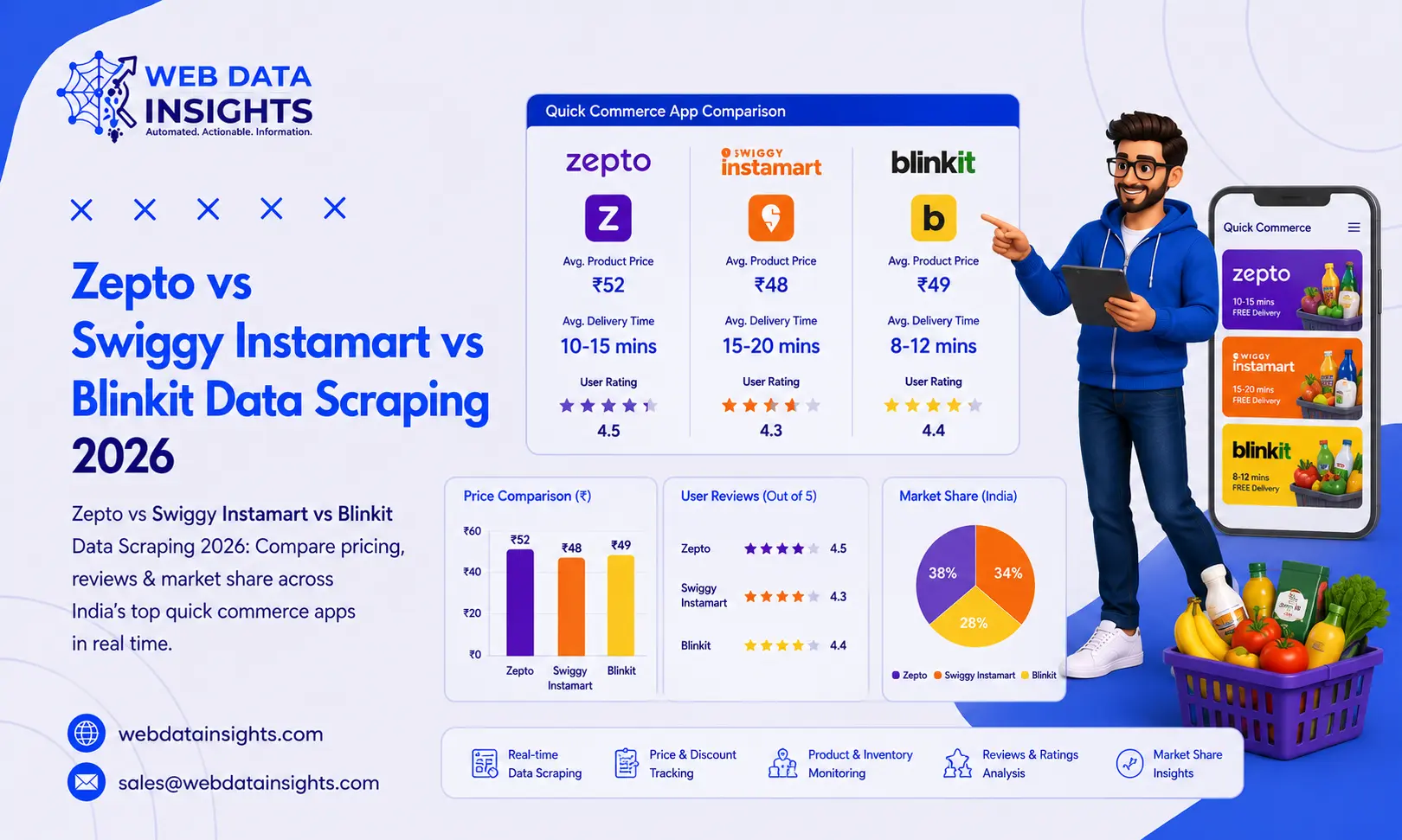
India’s quick commerce category has moved past its early growth phase into genuine price and promotional competition, with Zepto, Blinkit, and Swiggy Instamart fighting for the same customer within the same ten-minute delivery radius. For FMCG brands and distributors, understanding Zepto vs Swiggy Instamart vs Blinkit data scraping in 2026 means putting all three side by side — price, reviews, and market presence together — rather than checking each app separately and trying to remember what the other two looked like last week.
QUICK ANSWER
Zepto vs Swiggy Instamart vs Blinkit data scraping means extracting pricing, review, and product availability data from all three quick commerce apps at the same time and comparing them head to head, since each platform prices, promotes, and stocks the same SKU differently depending on dark store location and local demand.
Why Quick Commerce Pricing Doesn’t Work Like Regular E-Commerce
On a standard e-commerce marketplace, a product typically carries one price nationally, give or take a discount. Quick commerce breaks that assumption entirely. Because every order ships from a specific dark store, the same SKU can be priced, stocked, or promoted differently street by street within the same city — a structural difference that makes manual price-checking essentially useless at any meaningful scale. This is exactly the gap that dedicated Quick Commerce Data Scraping Services exist to close.
Zepto vs Swiggy Instamart vs Blinkit: Side-by-Side Comparison
Before breaking each platform down individually, it helps to see all three next to each other on the factors that actually drive pricing and category decisions: how each app positions itself on price, how deep its catalog runs, how it structures promotions, and how it’s tracking on market presence heading through 2026.
| Factor | Zepto | Blinkit | Swiggy Instamart |
|---|---|---|---|
| Pricing approach | Hyperlocal, dark-store-level pricing with frequent flash offers | Competitive base pricing with heavy bundle/combo promotions | Pricing tied closely to Swiggy’s broader delivery and loyalty ecosystem |
| Delivery positioning | Strong focus on ultra-fast delivery windows | Balanced delivery speed with wide dark store coverage | Delivery speed reinforced by integration with Swiggy’s existing rider network |
| Catalog depth | Broad grocery and daily essentials, expanding into general merchandise | Deep grocery catalog with strong FMCG and household coverage | Grocery catalog benefiting from cross-sell with Swiggy’s food delivery base |
| Promotional style | Time-boxed flash deals and app-exclusive drops | Combo pricing and bundle-led promotions | Loyalty and membership-linked offers alongside standard discounts |
| Market presence in 2026 | Aggressive expansion into tier-2 cities | Established leader in metro dark store density | Growing share via Swiggy’s existing user base and cross-platform reach |
| Review & sentiment focus | Delivery speed and app experience dominate customer feedback | Product availability and consistency are recurring review themes | Order accuracy and bundling with food delivery drive customer sentiment |
This side-by-side view is exactly what a normalized data pipeline produces on an ongoing basis — the difference is that scraped data updates this comparison daily or hourly, rather than as a one-time snapshot.
What Each Platform Adds to the Comparison
Zepto data scraping typically focuses on item-level pricing by location, live stock availability, delivery time estimates, and where a product sits within category or search placement. Because Zepto’s pricing and inventory are tied closely to its dark store network, the same product tracked from two different pin codes in the same city can legitimately show two different prices at the same moment — which is the first data point worth checking against the other two apps.
Blinkit data scraping covers largely the same ground — price, stock, delivery estimate, promotional badges — but Blinkit’s catalog and promotion formatting differ enough from Zepto or Instamart that a direct field-by-field copy of one schema won’t map cleanly onto the other. Bundle offers and combo pricing are particularly common here and need their own extraction logic rather than being treated as a single-item price, which is exactly where a naive three-way comparison tends to go wrong.
Swiggy Instamart data scraping benefits from Instamart’s tighter integration with Swiggy’s broader delivery network, which shows up in how availability and delivery-time estimates are presented. Tracking Instamart pricing and reviews alongside Zepto and Blinkit’s numbers gives a clearer read on which platform is consistently cheaper, better stocked, or better rated in a given micro-market — a comparison that only means something when all three are pulled at the same time, not on different days.
Zepto vs Blinkit vs Swiggy Instamart: Price, Reviews & Market Comparison
Put side by side, the three apps don’t just differ in branding — they differ in how price is structured, how much review and rating data is actually visible per product, and how deep their dark store coverage runs in a given city. This is the head-to-head view that matters most for a brand trying to decide where a pricing or promotional gap is actually costing them.
| Factor | Zepto | Blinkit | Swiggy Instamart |
|---|---|---|---|
| Pricing structure | Dark-store-level, pin-code sensitive | Dark-store-level, frequent combo pricing | Tied to Swiggy’s delivery zone logic |
| Delivery fee pattern | Distance and demand-based | Flat fee with demand surges | Bundled with Swiggy One benefits |
| Review & rating visibility | Product-level ratings, moderate review depth | Product-level ratings with review counts | Ratings inherited from Swiggy’s review system |
| Promotional cadence | Frequent flash and category deals | Heavy combo and bundle promotions | Cross-promoted with Swiggy food delivery offers |
| Market coverage | Strong in metro and tier-1 dark stores | Widest dark store footprint currently | Growing tier-2 expansion via Swiggy’s existing base |
| Refresh need for tracking | Multiple times/day | Multiple times/day | Daily to multiple times/day |
None of these platforms is uniformly “cheaper” or “better stocked” — the honest answer, once you actually scrape and compare all three, is that it depends on the city, the category, and even the specific dark store. That’s precisely why a one-time manual comparison goes stale within days, while a structured, repeated comparison stays useful.
Quick Commerce Data Scraping India: The Bigger Market Picture
Zoomed out, quick commerce data scraping India is really about tracking a category that behaves more like a live auction than a static catalog — prices, promotions, and stock all shift within hours rather than days. For an FMCG brand present across all three apps, this is the layer that reveals whether pricing is staying consistent with company policy or drifting apart city by city without anyone noticing. Feeding this into a continuous Competitor Price Monitoring setup is what turns scattered snapshots into an actual early-warning system.
Quick Commerce Product Data Extraction: Beyond Price
Quick commerce product data extraction extends past pricing into full catalog visibility — product titles, pack sizes, category placement, and how prominently a product appears in search or category browsing. For a brand launching a new SKU, this is often the first sign of whether a listing has actually gone live correctly across every dark store it’s supposed to reach, rather than assuming a single successful upload means uniform availability.
How to Scrape Zepto, Blinkit and Swiggy Instamart Product Data Together
The genuinely hard part of trying to scrape Zepto, Blinkit and Swiggy Instamart product data isn’t extracting from any one app — it’s making the three comparable. Product names, pack sizes, and category labels rarely match exactly across platforms, so a normalization layer that maps each app’s fields into one shared schema, keyed by brand and SKU, is what makes a genuine side-by-side comparison possible. This kind of cross-platform normalization sits within the broader discipline of Web Scraping Services, applied specifically to the structure and pace of quick commerce.
| Field | Why It Needs Normalization |
|---|---|
| Product name | Same SKU often named slightly differently per app |
| Pack size | Presented in different units or formats across platforms |
| Price | Varies by dark store, not just by app |
| Promotion type | Bundle and combo formats differ structurally between apps |
Examples: Who Actually Uses This Data
FMCG and CPG brands use it to check MAP compliance and promotional consistency across cities. Distributors use it to spot stock-out patterns before they turn into lost sales. D2C grocery and personal-care brands use it to benchmark their own pricing against category leaders in the same micro-markets. Market research firms use it to build category share and pricing trend reports across the quick commerce space. Investment and equity research desks increasingly treat this data as an early demand signal for listed and pre-IPO quick commerce players.
Expert Insights & Best Practices
Track by micro-market, not just by city
A single city-wide price average hides the pin-code-level variation that actually drives competitive dynamics in quick commerce. Granular tracking matters more here than in almost any other retail category.
Refresh frequency should match promotional pace
Categories with frequent flash deals need multiple refreshes a day. A once-daily check will consistently miss short promotional windows entirely.
Separate stock-out signal from pricing signal
A product showing as unavailable isn’t a pricing data point — treating stock status and price as two distinct fields avoids misreading a stock-out as a price change.
Teams that want a faster starting point often pair live tracking with a structured Quick Commerce Dataset to validate pipeline output or build historical baselines before scaling up live monitoring.
Common Mistakes to Avoid
- Averaging prices across a whole city — this erases the micro-market variation that actually matters.
- Treating all three apps as structurally identical — catalog and promotion formats differ enough to break naive comparisons.
- Refreshing too infrequently — quick commerce pricing moves faster than most other retail categories.
- Confusing stock-outs with price drops — an unavailable item isn’t the same signal as a discounted one.
- Skipping SKU-level matching — comparing category-level trends without confirming the exact same product is being compared across apps.
Where This Is Heading in 2026
As Zepto, Blinkit, and Swiggy Instamart keep expanding into smaller cities, pricing and promotional complexity is only increasing, not settling down. Expect more hyperlocal, dark-store-specific pricing strategies, faster promotional cycles tied to local events and weather, and growing pressure on brands to monitor compliance continuously rather than through periodic manual checks. The businesses that treat this as an ongoing data discipline will have a materially clearer view of the category than those still checking prices by hand.
Frequently Asked Questions
What does Zepto vs Swiggy Instamart vs Blinkit data scraping mean?
It means extracting pricing, product listing, and availability data from all three quick commerce apps and comparing them side by side, since each platform prices and stocks the same SKU differently depending on dark store location and local demand.
Why do the same products show different prices on Zepto, Blinkit, and Swiggy Instamart?
Quick commerce pricing is hyperlocal and tied to the specific dark store fulfilling an order, so the same SKU can carry a different price or promotion depending on the buyer’s exact location, independent of any national list price.
What data points matter most in Zepto data scraping?
Item-level pricing by location, stock availability, delivery time estimates, and promotional placement are the core fields tracked in Zepto data scraping, since all four can vary by dark store within the same city.
How is Blinkit data scraping different from tracking Swiggy Instamart?
Both track similar core fields, but Blinkit’s catalog structure and promotional formats differ from Instamart’s, which means a normalization layer is needed to compare the same product meaningfully across both apps rather than assuming identical field structures.
How often should quick commerce product data be refreshed?
Quick commerce pricing and stock levels can change multiple times within a single day due to local demand and dark store inventory, so categories with high promotional activity often need refreshes several times daily rather than once.
Who uses quick commerce data scraping in India?
FMCG and CPG brands, distributors, and market research firms are the primary users, tracking pricing compliance, promotional activity, and category share across Zepto, Blinkit, and Swiggy Instamart in specific cities and micro-markets.
Conclusion
Zepto, Blinkit, and Swiggy Instamart each run their own pricing and promotional playbook, down to the level of individual dark stores. Brands that track all three consistently — with the right granularity and refresh frequency — get an accurate, current picture of where they stand in the category. Brands still relying on occasional manual checks are, in practice, working from data that’s already outdated by the time they act on it.
Reliable Web Data Solutions
WebDataInsights provides clean, structured, and real-time web scraping solutions tailored to your business goals, helping automate data collection for eCommerce, market research, lead generation, and more.
Get in Touch