





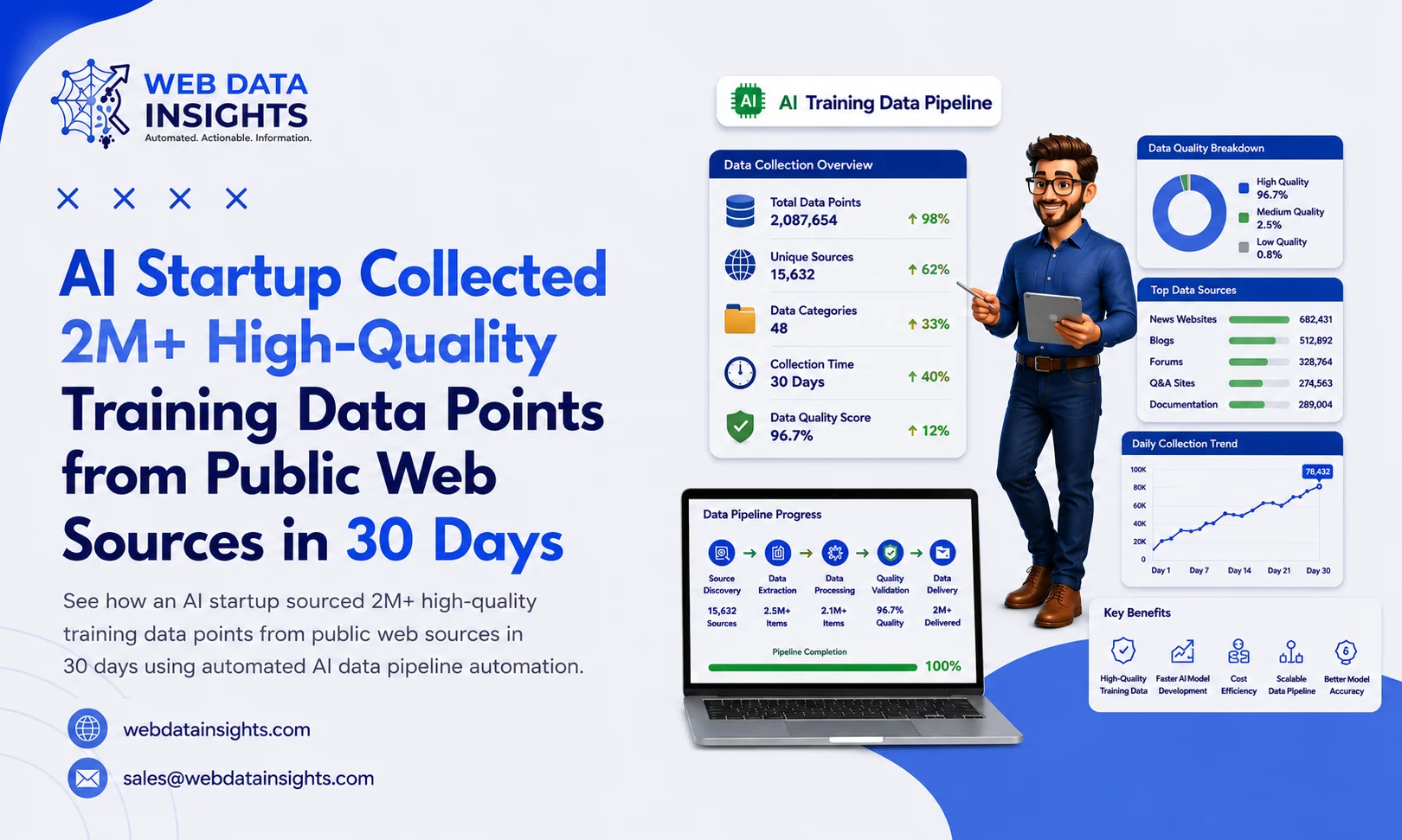
A fast-growing AI startup needed a scalable way to build a large, clean training corpus for its language model. Working with WebDataInsights, the team collected over 2 million high-quality training data points from public web sources in just 30 days — without compromising on data quality or compliance.
Executive Summary
An AI startup building a domain-specific large language model needed a dependable source of high-quality training data points from public web sources to meet an aggressive model-training deadline. Their in-house scripts couldn’t scale, and data quality was inconsistent.
WebDataInsights designed and deployed a custom AI training data collection from public web sources pipeline that combined targeted crawling, automated quality scoring, and compliance checks. The result: 2 million+ verified, deduplicated data points delivered in 30 days, ready for direct model ingestion.
Client Background
The client is an early-growth-stage AI company (identity kept confidential under NDA) building a vertical large language model for a specialized research and analytics use case. Their internal team included data scientists and ML engineers, but no dedicated data engineering function for large-scale web extraction.
Prior to this engagement, the client relied on a mix of open datasets and small internal scraping scripts — a setup that could not deliver the volume or consistency required to train a production-grade model on schedule.
Business Challenge
Sourcing High-Quality Training Data Points from Public Web Sources at Scale
The client’s core challenge was straightforward to state but hard to solve: collect millions of usable, diverse, and clean data points from the public web within one month, without triggering compliance risk. Specific pain points included:
- Slow manual collection — existing scripts required constant supervision and broke on dynamic websites.
- Inconsistent data quality — high volumes of duplicate content, boilerplate text, and low-value pages diluted the training corpus.
- No structured process for AI training data scraping across hundreds of source domains simultaneously.
- Compliance uncertainty around what public web data collection practices were safe and defensible.
- Hard deadline — the model training schedule left no room for delays.
Solution Strategy
A Purpose-Built Approach to Web Scraping for AI Training
WebDataInsights proposed a solution centered on automation, quality control, and compliance-first design rather than ad-hoc scraping. The strategy drew on our experience delivering Web Scraping Services across data-intensive industries, adapted specifically for LLM training requirements.
- Map only publicly accessible, non-gated content across relevant domains.
- Build extraction logic tuned for text richness, topical relevance, and language quality.
- Apply layered deduplication and boilerplate removal before data ever reaches the client.
- Respect robots.txt directives and site terms throughout collection.
This approach — informed by our broader AI Data Scraping Services methodology — allowed the team to prioritize source diversity, which directly improves how well a language model generalizes across topics and writing styles.
Implementation Process
From Source Mapping to LLM-Ready Data Delivery
Step 1 — Discovery & Source Mapping. Identified categories of public sources aligned with the client’s model domain and quality bar.
Step 2 — Pipeline Architecture. Built the collection system around AI Data Pipeline Automation, enabling continuous extraction across thousands of pages per day without manual intervention.
Step 3 — Execution. Ran parallelized crawlers to perform public web data collection at scale, capturing raw text alongside source metadata for traceability.
Step 4 — Quality & Compliance Layer. Applied automated deduplication, near-duplicate detection, language filtering, and PII removal checks.
Step 5 — LLM Training Data Collection Finalization. Structured the cleaned output into model-ready JSONL format with clear source lineage.
Step 6 — Delivery & Documentation. Delivered the final dataset with full documentation, using a repeatable framework consistent with our AI Training Data Collection Services.
Results & Outcomes
| Metric | Result |
|---|---|
| Total training data points collected | 2,000,000+ |
| Project timeline | 30 days |
| Source diversity | 500+ verified public domains |
| Duplicate rate after filtering | Less than 2% |
| Reduction in manual effort vs. in-house | Approximately 70% faster |
| Compliance posture | 100% publicly accessible, robots.txt-respecting sources |
Beyond raw volume, the client reported that dataset quality reduced downstream cleanup work for their ML team, shortening the path from raw collection to model fine-tuning.
Key Learnings
- Automated pipelines consistently outperform manual scraping once volume crosses a few hundred thousand data points.
- Quality filtering at the collection stage — not after — prevents noisy data from ever reaching model training.
- Source diversity matters as much as volume for model generalization.
- A compliance-first approach to public web data collection reduces legal and reputational risk without slowing delivery.
Industry Relevance
Demand for reliable AI training data collection from public web sources spans far beyond AI startups. Organizations across several industries face the same core problem: how to source enough clean, diverse data to train or fine-tune models responsibly.
Financial Services & FinTech
Firms training market-analysis or forecasting models — including those exploring AI Dynamic Pricing models — rely on continuous, well-structured public web data.
Legal & Compliance Research
Legal-tech models require large volumes of publicly available case law, filings, and regulatory text.
Healthcare & Life Sciences
Research teams use public medical literature and public health data to train domain-specific assistants.
E-commerce & Retail
Product, review, and catalog data support recommendation and search models at scale.
Media & Publishing
Content-heavy organizations use public web text to train summarization and content-generation models.
SaaS & AI Product Companies
Product teams need ongoing, high-quality training data pipelines to keep models current as their market evolves.
Frequently Asked Questions
What are high-quality training data points from public web sources?
High-quality training data points from public web sources are clean, verified, non-duplicate pieces of text or structured content collected from publicly accessible web pages, used to train or fine-tune AI and machine learning models.
How long does it take to collect 2 million AI training data points?
With an automated collection pipeline, 2 million+ well-scoped data points can typically be collected within 30 days, depending on source diversity, extraction complexity, and quality-filtering requirements.
Is public web data collection for AI training legal?
Public web data collection is generally permissible when it targets publicly accessible content, respects robots.txt directives and site terms, and avoids collecting personal or gated information. Legal requirements vary by jurisdiction and use case.
How is AI training data scraping different from general web scraping?
AI training data scraping is optimized specifically for model training: it prioritizes text quality, topical diversity, deduplication, and structured formatting, rather than simply extracting raw page content.
What role does AI Data Pipeline Automation play in LLM training data collection?
AI Data Pipeline Automation removes manual bottlenecks from LLM training data collection by continuously crawling, cleaning, deduplicating, and formatting data at scale, enabling consistent quality across millions of data points.
Reliable Web Data Solutions
WebDataInsights provides clean, structured, and real-time web scraping solutions tailored to your business goals, helping automate data collection for eCommerce, market research, lead generation, and more.
Get in TouchReady to Turn Your Data into Revenue Growth?
Partner with WebDataInsights for enterprise-grade B2B data scraping, real-time price monitoring, supplier benchmarking intelligence, and seamless API data delivery.
Solve My Problem