





Quick Answer Summary
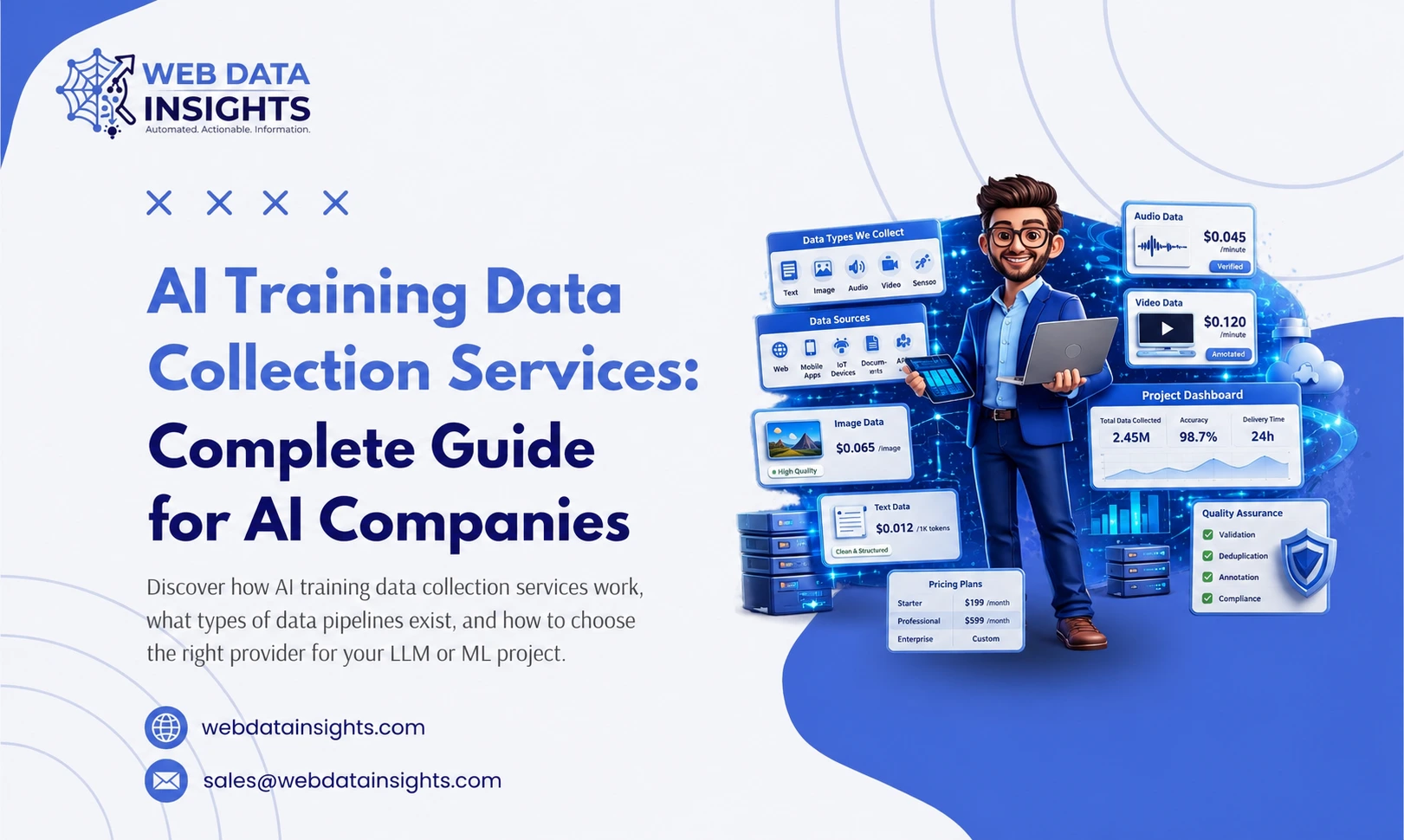
AI training data collection services help companies gather, clean, label, and deliver structured datasets for training machine learning and large language models. These services range from web scraping pipelines and human-annotated datasets to real-time data streams and synthetic data generation. Choosing the right service depends on your data type, volume, compliance requirements, and model architecture.
Key Takeaways
- AI training data collection is the foundational step for building accurate, scalable ML and LLM models.
- Services vary widely: web scraping, human annotation, synthetic data, API aggregation, and sensor/IoT feeds.
- Data quality — not just volume — directly determines model performance.
- Enterprise AI teams increasingly outsource data collection to reduce pipeline complexity and cut time-to-model.
- Licensing, consent, and data provenance are non-negotiable compliance requirements in 2024–2025.
- LLM training data collection specifically requires multilingual, diverse, and domain-specific corpora.
- AI Data Scraping Services form a critical layer of most enterprise AI data pipelines.
What Are AI Training Data Collection Services?
AI training data collection services are specialized workflows, tools, or managed service providers that source, extract, process, and deliver structured datasets used to train artificial intelligence models — including machine learning classifiers, computer vision systems, NLP pipelines, and large language models (LLMs).
Definition
AI training data collection services are end-to-end data acquisition solutions that gather raw data from the web, internal systems, or human contributors, then clean, label, and format it for use in machine learning model training. They encompass scraping infrastructure, annotation pipelines, quality assurance workflows, and compliance handling.
These services exist because building and maintaining a high-quality data pipeline in-house requires significant infrastructure, domain expertise, and ongoing operational overhead. Most AI companies — from startups to enterprises — rely on some form of external or managed data collection.
Why Does Training Data Quality Determine Model Quality?
The relationship between data quality and model performance is direct and measurable. A model trained on noisy, biased, or poorly labeled data will underperform regardless of architecture sophistication.
Key factors that affect training data quality:
- Accuracy of labels: Mislabeled data introduces noise that degrades classification accuracy.
- Diversity and balance: Underrepresented classes lead to biased predictions.
- Volume: Insufficient data causes overfitting; more data generally improves generalization.
- Freshness: Stale data trains models that fail on current real-world inputs.
- Provenance: Data of unknown origin creates legal and compliance risk.
Industry estimates suggest that data preparation — including collection, cleaning, and labeling — accounts for 60–80% of total model development time in most enterprise AI projects.
Types of AI Training Data Collection Services
1. Web Scraping and Crawling Pipelines
Web scraping is the most common method for collecting large-scale text, image, and structured data. Modern AI data scraping services use distributed crawlers, JavaScript rendering engines, and proxy rotation to collect data at scale without triggering bot detection.
Use cases:
- Collecting text corpora for LLM pretraining
- Gathering product data for price optimization models (see Competitor Price Monitoring)
- Building domain-specific knowledge bases
Technical considerations:
- Rate limiting and IP rotation management
- HTML parsing vs. headless browser rendering (Playwright, Puppeteer)
- Deduplication and near-duplicate filtering
- Crawl scheduling and incremental refresh
WebDataInsights provides enterprise-grade AI Data Scraping Services with built-in compliance checks and scalable data pipelines.
2. Human Annotation and Labeling Services
Human-in-the-loop annotation is essential for supervised learning tasks where ground truth cannot be automatically derived. Services range from crowd-sourced platforms to expert annotators for specialized domains.
Common annotation types:
- Image segmentation and bounding box labeling
- Named entity recognition (NER) tagging
- Sentiment classification
- Question-answer pair generation for RLHF (Reinforcement Learning from Human Feedback)
- Speech transcription and phonetic tagging
Quality assurance mechanisms:
- Inter-annotator agreement (IAA) scoring
- Gold standard evaluation sets
- Multi-pass review workflows
- Annotator calibration and training
RLHF-based LLM fine-tuning (as used by OpenAI’s InstructGPT and Anthropic’s Constitutional AI) relies heavily on high-quality human feedback data. This has driven significant demand for specialized annotation services.
3. Synthetic Data Generation
Synthetic data is algorithmically generated data that statistically mimics real-world data distributions without containing actual real-world records.
When to use synthetic data:
- Privacy-sensitive domains (healthcare, finance, legal)
- Rare event augmentation (fraud cases, edge cases in autonomous driving)
- When real-world data is insufficient for a specific class
- Regulatory environments where real data transfer is restricted
Generation methods:
- Generative Adversarial Networks (GANs)
- Variational Autoencoders (VAEs)
- Rule-based simulation (tabular data)
- LLM-generated synthetic text corpora
Industry estimates suggest synthetic data will account for over 60% of training data for AI models by 2030 (Gartner, 2022 projection). Current adoption is highest in computer vision and tabular ML.
4. API Aggregation and Data Feeds
Many AI training datasets are built by aggregating structured data from third-party APIs — social platforms, financial data providers, weather services, e-commerce platforms, and more.
Technical approach:
- OAuth and API key management at scale
- Rate limit handling and backoff strategies
- Schema normalization across heterogeneous sources
- Real-time vs. batch ingestion pipelines
This method is especially relevant for training models in time-series forecasting, recommendation systems, and AI-based pricing software.
5. Sensor, IoT, and Multimodal Data Collection
For AI applications in robotics, autonomous vehicles, industrial monitoring, and smart infrastructure, training data comes from physical sensors: cameras, LIDAR, accelerometers, microphones, and temperature sensors.
Challenges:
- High data volume and velocity (terabytes per hour from autonomous vehicles)
- Time synchronization across sensor streams
- Edge preprocessing before cloud ingestion
- Annotation complexity for 3D and temporal data
LLM Training Data Collection: Specific Requirements
Training large language models requires a different data strategy than standard ML. LLM datasets are typically measured in billions to trillions of tokens and require:
- Broad domain coverage: Web text, books, code, academic papers, multilingual content
- Quality filtering: Removing spam, duplicates, low-quality web content (Common Crawl filtering)
- Deduplication at scale: MinHash LSH, exact deduplication, near-dedup
- Toxicity and bias filtering: Pre-training corpora must minimize harmful content
- Domain-specific corpora: For specialized LLMs (legal, medical, finance), targeted collection is essential
Common LLM pretraining datasets:
- Common Crawl (petabyte-scale web crawl)
- The Pile (EleutherAI)
- RedPajama
- C4 (Colossal Clean Crawled Corpus)
- Books3 / BookCorpus
For fine-tuning and instruction-tuning, high-quality curated datasets (FLAN, Alpaca, ShareGPT) are used instead of raw web data.
AI Training Data Collection: Step-by-Step Workflow
Step 1: Define Data Requirements
- Target model type (classification, generation, detection)
- Required data modalities (text, image, audio, structured)
- Volume requirements (number of samples, tokens, records)
- Label schema design
Step 2: Source Identification
- Public web sources (with legal review)
- Licensed data providers
- Internal/proprietary systems
- Human contributor pools
Step 3: Data Collection
- Deploy crawlers, scrapers, or API connectors
- Collect raw data into staging storage (S3, GCS, or on-prem)
- Apply initial deduplication and format normalization
Step 4: Preprocessing
- HTML stripping and text extraction
- Language detection and filtering
- PII detection and redaction (GDPR, CCPA compliance)
- Format standardization (JSON Lines, Parquet, TFRecord)
Step 5: Annotation and Labeling
- Assign annotation tasks to human labelers or auto-labeling models
- Implement QA review workflow
- Calculate inter-annotator agreement
- Resolve label conflicts
Step 6: Quality Assurance
- Statistical sampling and audit
- Distribution analysis (class balance, domain coverage)
- Bias detection analysis
Step 7: Delivery and Versioning
- Package dataset with metadata schema
- Version control (DVC, Hugging Face Datasets)
- Deliver to model training infrastructure
Types of AI Training Data Collection Services
| Service Type | Best For | Scale | Cost Level | Turnaround | Compliance Risk |
|---|---|---|---|---|---|
| Web Scraping | Text, images, structured data | Very High | Low–Medium | Fast | Medium |
| Human Annotation | Supervised labels, RLHF | Medium | High | Slow | Low |
| Synthetic Data | Privacy-sensitive, rare events | High | Medium | Fast | Very Low |
| API Aggregation | Structured, real-time data | High | Medium | Fast | Low |
| Sensor/IoT Data | Robotics, AV, industrial AI | Very High | Very High | Variable | Low |
| Licensed Datasets | Legal, medical, enterprise | Medium | High | Immediate | Very Low |
In-House vs. Outsourced AI Data Collection
| Factor | In-House Collection | Outsourced Collection |
|---|---|---|
| Setup Time | Weeks to months | Days to weeks |
| Ongoing Cost | High (infra + headcount) | Variable (usage-based or contract) |
| Scalability | Limited by internal capacity | On-demand scaling |
| Domain Expertise | Dependent on team skill | Provider specialization |
| Data Control | Full control | Contractual controls |
| Compliance | Internal responsibility | Shared/provider-managed |
| Quality Assurance | Internal QA only | Dedicated QA workflows |
| Speed to First Dataset | Slow | Fast |
| Ideal For | Proprietary/sensitive data | Public data, scale tasks |
Key Compliance and Legal Considerations
AI training data collection operates in a rapidly evolving legal landscape. Key considerations include:
Copyright and Licensing: Training on copyrighted web content is the subject of ongoing litigation (NYT v. OpenAI, Getty Images v. Stability AI). Best practice is to use datasets with explicit open licenses (CC-BY, CC0) or negotiate data licensing agreements.
Privacy Regulations:
- GDPR (EU): Prohibits training on EU personal data without legal basis
- CCPA (California): Opt-out rights for personal information use
- PIPL (China): Strict controls on cross-border data transfer
Data Provenance: Maintaining chain-of-custody records for training data is increasingly required for enterprise AI governance and emerging AI regulations (EU AI Act).
Robot.txt and ToS Compliance: Web scraping that violates a site’s Terms of Service may create legal exposure, even where technical access is possible.
Common Mistakes in AI Data Collection
1. Prioritizing volume over quality More data does not always mean better models. A smaller, high-quality, well-labeled dataset often outperforms a large noisy one.
2. Ignoring data distribution Collecting data that reflects existing biases in the world will reproduce those biases in the model. Active sampling strategies and bias audits are necessary.
3. No versioning Training data changes. Without version control, reproducing model results becomes impossible — a critical issue for compliance and debugging.
4. Skipping PII redaction Training on personal data without consent creates regulatory liability. Automated PII detection tools (Presidio, AWS Comprehend) should be part of every pipeline.
5. Underestimating annotation complexity Label schemas that seem simple often require significant annotator guidelines, training, and arbitration workflows to achieve acceptable IAA scores.
Advanced Strategies for Enterprise AI Data Collection
Active Learning: Train an initial model on a small labeled set, use it to identify the most informative unlabeled samples, and prioritize those for annotation. This reduces labeling cost by 30–70% in some settings.
Data Flywheel: Build feedback loops where production model outputs generate new training data. This is the strategy behind products like AI Dynamic Pricing Software, where live pricing decisions generate labeled outcomes.
Federated Data Collection: For privacy-sensitive industries, federated learning allows training on decentralized data without centralizing sensitive records.
Multi-Source Fusion: Combine web-scraped, API-aggregated, and synthetic data to create balanced, comprehensive training sets that no single source could provide.
Future Trends in AI Training Data Collection
1. Synthetic data dominance As generative models improve, synthetic data will increasingly supplement or replace real-world data collection for many tasks.
2. Data marketplaces Platforms like Hugging Face Datasets, Scale AI, and Snowflake Data Marketplace are standardizing data access and licensing.
3. Regulation-driven compliance tooling EU AI Act and proposed US AI legislation will require detailed data provenance documentation, driving demand for automated compliance tools.
4. Multimodal data pipelines LLMs are evolving into multimodal systems (GPT-4V, Gemini). Training pipelines must handle image-text pairs, video, and audio at scale.
5. Real-time and streaming training data Online learning architectures require continuous data ingestion pipelines rather than static batch datasets.
FAQs: AI Training Data Collection Services
Q1: What is AI training data collection?
AI training data collection is the process of gathering, processing, and structuring raw data — from web sources, human contributors, or sensors — to create datasets used for training machine learning and AI models.
Q2: Why do AI companies outsource data collection?
Outsourcing reduces infrastructure costs, accelerates time-to-dataset, and provides access to specialized collection and annotation expertise that most in-house teams lack.
Q3: What types of data are used to train AI models?
Text, images, audio, video, tabular/structured data, code, and sensor data. The required type depends on the model’s task (NLP, computer vision, speech recognition, etc.).
Q4: How much training data does an LLM need?
Large foundation models like GPT-4 or LLaMA 3 are trained on hundreds of billions to trillions of tokens. Fine-tuning tasks can be effective with thousands to millions of high-quality examples.
Q5: What is the difference between data collection and data annotation?
Data collection involves sourcing raw data. Data annotation involves labeling that raw data with ground-truth information (e.g., marking object boundaries in images, assigning sentiment labels to text).
Q6: Is web scraping legal for AI training data?
It depends on jurisdiction, the site’s Terms of Service, and the nature of the data. Public data with open licenses is generally safe. Scraping copyrighted or personal data without consent creates legal risk.
Q7: What is synthetic data in AI training?
Synthetic data is algorithmically generated data that mimics real-world distributions without containing actual records. It is especially useful in privacy-sensitive domains or where real data is scarce.
Q8: How do I ensure data quality for AI training?
Implement multi-pass annotation review, inter-annotator agreement scoring, statistical distribution audits, bias detection, and dataset versioning throughout the pipeline.
Q9: What tools are used for large-scale AI data collection?
Common tools include Apache Scrapy, Playwright, Common Crawl, Hugging Face Datasets, Label Studio (annotation), Snorkel (programmatic labeling), and DVC (data versioning).
Q10: How long does it take to collect a training dataset?
Timeline varies widely: a small labeled dataset (10K samples) can be ready in days; a large-scale pretraining corpus (billions of tokens) may take weeks to months of scraping, filtering, and processing.
Q11: What is RLHF and why does it need special data?
RLHF (Reinforcement Learning from Human Feedback) trains models to follow human preferences. It requires high-quality human comparison data — ranking model outputs — which demands skilled annotators and careful schema design.
Q12: What compliance standards apply to AI training data?
GDPR (EU), CCPA (California), PIPL (China), and the forthcoming EU AI Act all impose requirements on how personal data may be used in AI training. Copyright law also applies to licensed content.
Conclusion
AI training data collection is not a commodity task — it is a strategic capability that directly determines the performance, fairness, and legal defensibility of your AI systems. Whether you are building a domain-specific LLM, a computer vision classifier, or a pricing optimization engine, the quality of your training data pipeline sets the ceiling on what your model can achieve.
The most effective approach for most organizations combines outsourced data collection for scale tasks with internal control over proprietary and sensitive data. As the regulatory environment tightens and model architectures grow more complex, investing in robust, compliant, and well-documented data pipelines is no longer optional.
WebDataInsights provides enterprise-grade AI Data Scraping Services and scalable data pipeline solutions designed for AI and ML teams. Explore how structured data collection can accelerate your model development.
Reliable Web Data Solutions
WebDataInsights provides clean, structured, and real-time web scraping solutions tailored to your business goals, helping automate data collection for eCommerce, market research, lead generation, and more.
Get in Touch