





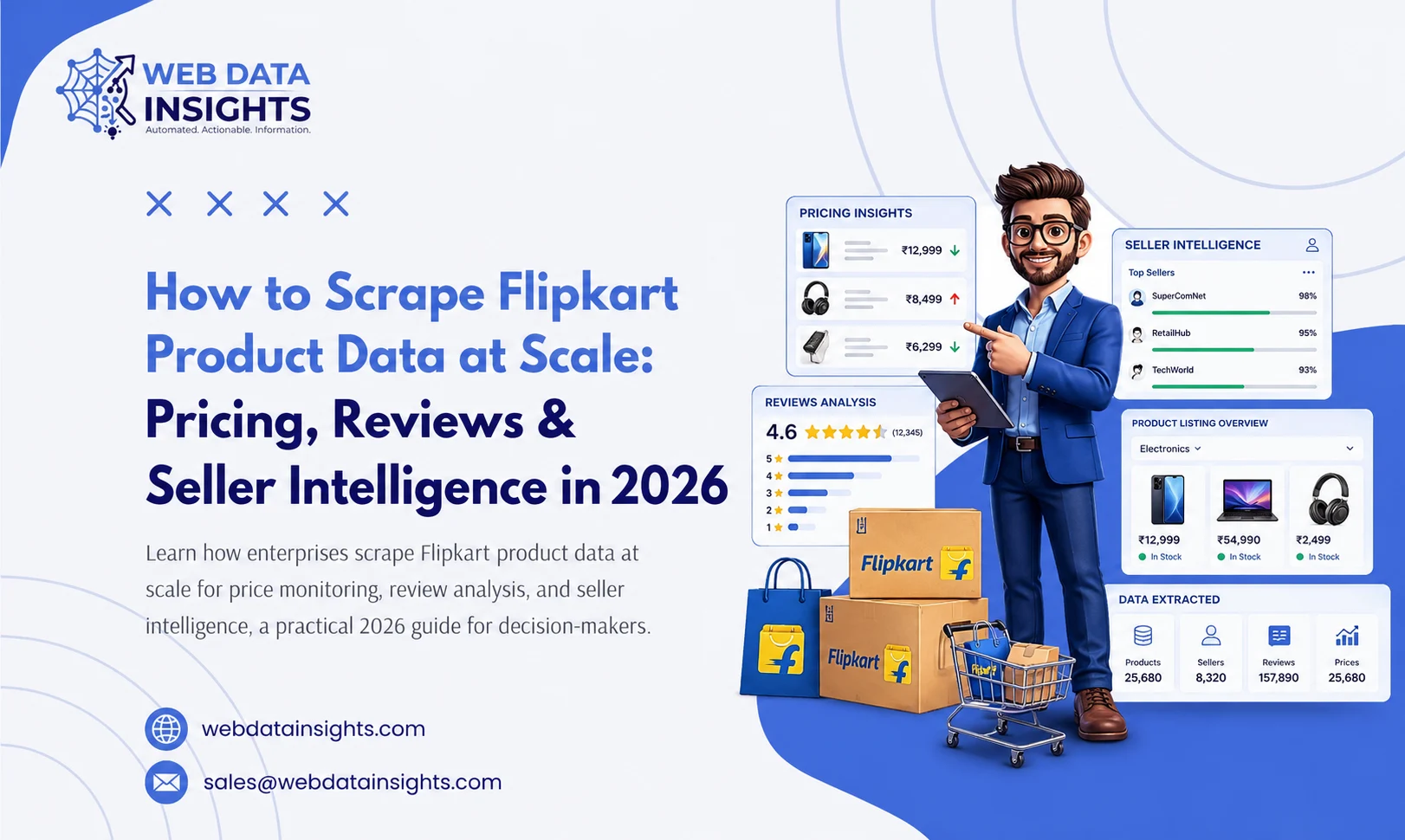
A practical guide for brands, retailers, and research teams that need to scrape Flipkart product data at scale — accurately, repeatedly, and in a form decision-makers can actually use.
Flipkart runs on scale — millions of listings, thousands of sellers, and prices that shift multiple times a day during sale events. For any brand or research team trying to track even a single category on Flipkart, checking listings by hand stopped being viable years ago. What businesses need instead is a structured way to scrape Flipkart product data at scale: pricing, listings, reviews, and seller behaviour, refreshed on a schedule that matches how fast the marketplace actually moves.
This guide breaks down what that looks like in practice — what to track, how the pieces fit together, and where most in-house attempts run into trouble.
QUICK ANSWER
Scraping Flipkart product data at scale means using automated pipelines — not manual browsing — to extract pricing, listings, reviews, and seller information across thousands of SKUs. Done properly, it feeds price monitoring, catalog audits, and seller performance tracking with data that refreshes daily or hourly instead of being reviewed occasionally by hand.
What “At Scale” Actually Means on Flipkart
A one-off price check on ten products is not the same problem as tracking two thousand SKUs across five categories, every day, with sellers changing and stock statuses flipping in between. At scale, three things change: the number of SKUs tracked, the frequency of refresh, and the need for the output to be structured — clean fields in a database or spreadsheet, not raw web pages.
This is really a specialised application of broader Ecommerce Data Scraping practice, applied specifically to Flipkart’s catalog structure, seller model, and pricing display. The entities that matter most are: product title and category breadcrumb, MRP vs. selling price, seller name and rating, fulfillment badge, stock status, and review volume with rating distribution. Everything downstream — price monitoring, seller analytics, marketplace reporting — is built on getting these fields right, consistently, across every listing.
Flipkart Product Listing Scraping: What to Capture and Why
Listing data is the foundation. Before pricing or reviews mean anything, you need a clean, deduplicated map of what is actually live on the platform in your category.
Fields that matter most
- Product title, brand, and category breadcrumb
- Specifications and variant data (size, colour, storage, pack size)
- Stock status and “Assured” or bestseller badges
- Primary images and listing URL for reference
- Number of sellers competing on the same listing
Enterprise teams typically use Flipkart product listing scraping for two recurring jobs: catalog completeness audits (are all your SKUs actually live and correctly categorised?) and competitor assortment mapping (what is a rival brand listing that you are not?). Both require the extraction to run on a schedule, since listings on Flipkart change without notice — sellers delist, relist, or get suspended constantly.
Flipkart Product Price Monitoring at Scale
Price is the single most volatile field on Flipkart, especially during Big Billion Days-style events and flash sales. Flipkart product price monitoring at scale means capturing more than the sticker price — MRP, selling price, bank offers, exchange offers, and coupon-driven effective price all need to be tracked separately, since the “real” price a customer pays often differs from the displayed one.
| Signal | Why It Matters |
|---|---|
| MRP vs. selling price gap | Detects real discounting vs. inflated-MRP tactics |
| Price history over time | Reveals sale cadence and margin pressure points |
| Restock-at-higher-price pattern | Flags stealth price increases after stockouts |
| Cross-seller price variance | Surfaces channel conflict on the same SKU |
This data pairs directly with a broader Price Monitoring strategy that spans multiple marketplaces, not just Flipkart — most brands selling across channels need a consistent view rather than a Flipkart-only snapshot.
Flipkart Product Review Scraping for Consumer Insight
Flipkart product review scraping is where quantitative tracking meets qualitative signal. Rating averages tell you little on their own — the value is in extracting review text, verified-purchase status, rating distribution, and review velocity, then running sentiment analysis to surface recurring themes.
What to extract
Review text, star rating, verified purchase flag, review date, and helpful-vote counts, at listing and variant level.
What to look for
Repeated complaint themes — sizing, delivery damage, packaging, product durability — and how sentiment shifts after a price change or new competitor entry.
For product and marketing teams, review data scraped at scale often surfaces issues weeks before they show up in return-rate reports, which makes it one of the highest-ROI use cases in this entire data category.
Flipkart Seller Data Analytics
Flipkart is a multi-seller marketplace, which means the same SKU can be listed by several sellers at different prices, with different fulfillment quality. Flipkart seller data analytics focuses on this layer specifically: seller rating and review count, fulfillment type (Flipkart Assured vs. standard), number of active sellers per listing, and how often seller rank changes for the “buy box” position.
- Identify unauthorised resellers undercutting official pricing (MAP compliance)
- Track distributor performance across regions and categories
- Flag potential counterfeit or grey-market listings tied to unusually low prices or new, low-rated sellers
- Monitor fulfillment quality signals tied to seller-level customer complaints
Brand protection and channel management teams are typically the first to invest in this layer, since seller-level issues directly affect both revenue leakage and brand reputation on the platform.
Flipkart Marketplace Data Analytics: Connecting the Layers
Listings, pricing, reviews, and seller data are only useful in isolation up to a point. Flipkart marketplace data analytics is the step where these layers are combined into category-level views — share-of-shelf by brand, average discount depth by category, promotional calendar patterns, and pricing elasticity signals that inform how a brand should respond during sale events.
This is the layer that turns raw Flipkart ecommerce data extraction into something a category manager or pricing committee can act on in a weekly review, rather than something buried in a spreadsheet nobody opens.
Scraping Flipkart Data using Python: A Technical Overview
At a technical level, most enterprise pipelines for scraping Flipkart data using Python follow a similar architecture: an HTTP or browser-automation layer to fetch pages, a parsing layer to extract structured fields, and a storage layer that normalises everything into a consistent schema.
Fetching
Rotating proxies and controlled request rates to handle Flipkart’s dynamic, JavaScript-heavy pages without triggering rate limits or blocks.
Parsing & Storage
Structured parsing into a fixed schema (SKU, price, seller, rating fields), with deduplication and change-detection logic before data lands in a warehouse.
The technical detail matters less than the operational discipline around it: monitoring for layout changes, retry logic for failed fetches, and validation checks so a broken parser doesn’t silently feed bad numbers into a pricing dashboard. This operational layer is usually where in-house scripts break down at scale, even when the initial scraper works fine on day one.
Who Actually Uses This Data — Industry Use Cases
Fashion & Apparel Brands
Track size and colour availability, MAP compliance across resellers, and review themes around sizing and fit.
Consumer Electronics & Appliances
Monitor price-war behaviour during launches, bundle and warranty offer changes, and stock-out patterns ahead of restocks.
FMCG & CPG Manufacturers
Audit distributor listing compliance and feed recurring complaint themes back into product and packaging decisions.
Market Research & Consulting Firms
Build category benchmarking reports using price, assortment, and review trends as recurring, citable data points.
Investment & Equity Research Desks
Use marketplace pricing and stock-availability trends as an alternative demand signal for listed retail and D2C companies.
Brand Protection Teams
Detect unauthorised sellers and potential counterfeit listings using seller-level and pricing anomalies.
Expert Insights & Best Practices
Prioritise data quality over raw volume
A clean, deduplicated dataset of two thousand correctly categorised SKUs is worth more than ten thousand rows with inconsistent category labels and duplicate listings. Normalise category taxonomy and SKU identifiers before anything else.
Match refresh frequency to decision speed
If pricing committees meet weekly, daily refreshes are often enough. If a category is sale-driven or flash-sale heavy, hourly refreshes during active windows matter far more than average-day tracking.
Stay within compliance boundaries
Extract only publicly visible listing data, avoid personal buyer information entirely, and build in respectful request pacing. Treat this as a data-engineering discipline, not a workaround.
Plan for structural change
Flipkart’s page structure, badges, and offer formats change periodically. Build monitoring into the pipeline so a layout change is caught within hours, not discovered a month later in a wrong dashboard number.
Teams that need a faster starting point, rather than building extraction from zero, often supplement live pipelines with a ready-structured Ecommerce Dataset to validate their own pipeline output or backfill historical trend data.
Common Mistakes to Avoid
- Ignoring seller-level nuance — tracking only the “buy box” price and missing that five other sellers are undercutting it.
- Treating MRP as a real discount baseline — some listings inflate MRP to make the discount look larger than it is.
- Under-throttled scraping — pushing request volume too high too fast, triggering blocks and creating data gaps at the worst possible time.
- No change-detection layer — a broken parser can keep running and quietly return stale or blank fields for days.
- Review volume without sentiment — counting reviews without reading the themes inside them misses most of the actionable insight.
Where This Is Heading in 2026
Dynamic and personalised pricing is becoming more common on Indian marketplaces, which means a single “current price” per SKU is increasingly an approximation rather than a fact — tracking needs to account for variation by geography and session context. Quick-commerce integration is also adding volatility to stock status and delivery-linked pricing, making real-time refresh more valuable than it was even a year ago.
At the same time, more teams are combining live scraping with structured historical datasets to train forecasting and demand models, rather than relying on scraped snapshots alone — a shift that favours businesses with both a live pipeline and a reliable historical baseline.
Frequently Asked Questions
What does it mean to scrape Flipkart product data at scale?
It means using automated pipelines instead of manual checks to extract pricing, listings, reviews, and seller details across thousands of SKUs and categories on a recurring schedule, so businesses can track marketplace changes as they happen.
Is Flipkart product price monitoring only useful for large retailers?
No. Brands, distributors, and single-category sellers all use Flipkart product price monitoring to track MRP changes, discount patterns, and competitor pricing, since pricing decisions affect margin and channel conflict regardless of business size.
What data points matter most in Flipkart seller data analytics?
Seller rating, fulfillment type, number of sellers on a listing, and price variance across sellers are the core signals, helping brands spot unauthorized resellers, channel conflict, and fulfillment quality gaps.
Can Python be used to scrape Flipkart data reliably at scale?
Yes. Scraping Flipkart data using Python typically combines HTTP requests or browser automation with parsing logic, proxy rotation, and rate limiting. At enterprise scale, teams pair this with monitoring and retry logic to handle layout or structure changes.
How often should Flipkart product listing scraping be refreshed?
Refresh frequency depends on category volatility. Electronics and flash-sale categories often need daily or hourly refreshes, while stable categories like books or home décor can be tracked weekly.
What is the biggest risk in review-based competitive analysis?
Treating raw review counts as insight without sentiment analysis. Volume without theme extraction — quality, delivery, sizing complaints — rarely translates into actionable product or marketing decisions.
Conclusion
Manual tracking cannot keep pace with a marketplace where prices, sellers, and listings change by the hour. Businesses that scrape Flipkart product data at scale — across listings, pricing, reviews, and seller behaviour — make pricing, assortment, and brand-protection decisions on current facts instead of last week’s snapshot. The teams that do this well treat it as an ongoing data discipline, not a one-time project.
Reliable Web Data Solutions
WebDataInsights provides clean, structured, and real-time web scraping solutions tailored to your business goals, helping automate data collection for eCommerce, market research, lead generation, and more.
Get in Touch