





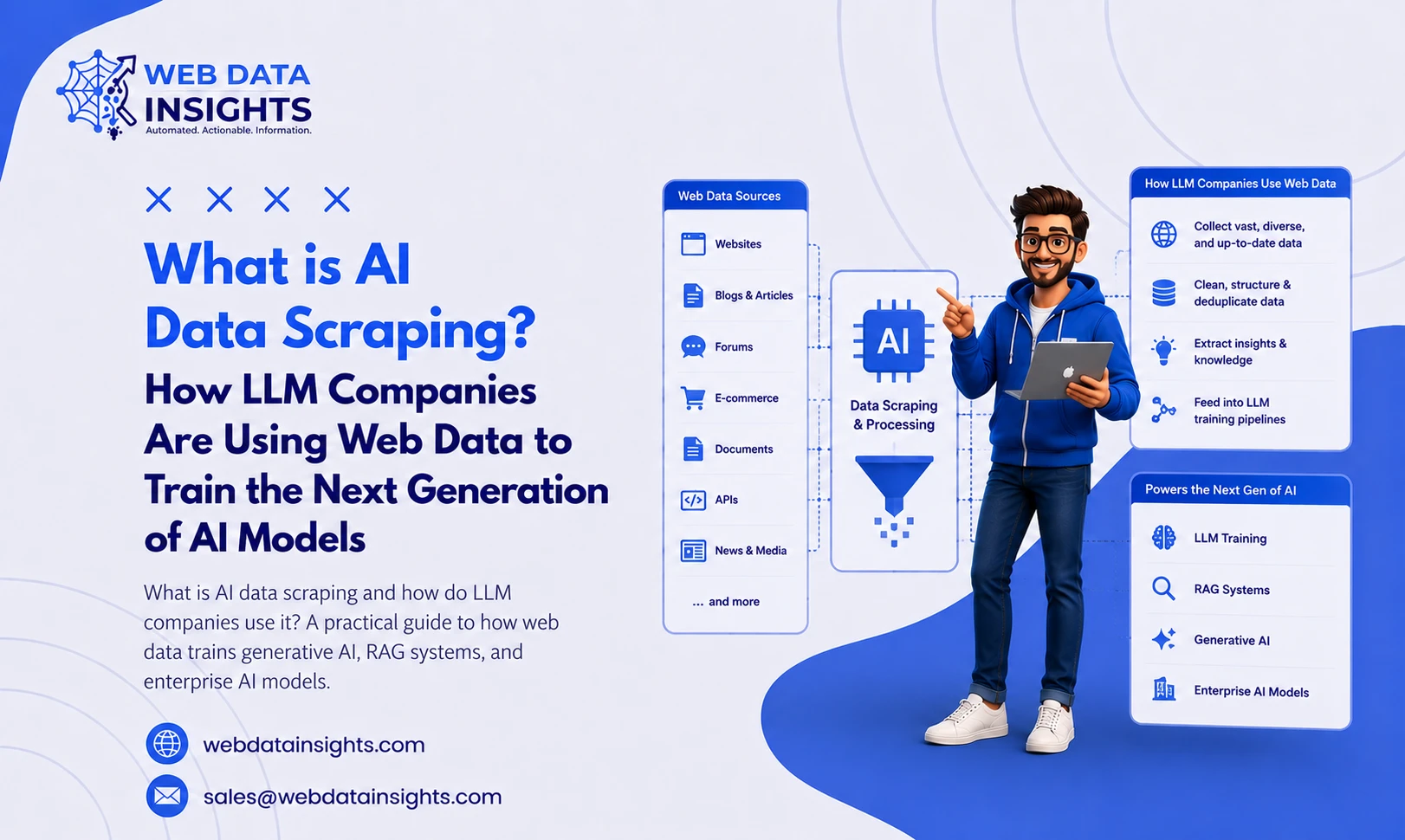
Every large language model in production today was trained on data that started somewhere on the open web. What is AI data scraping, in practical terms? It’s the automated process of collecting publicly available web content — articles, documentation, code, structured pages — and transforming it into clean, structured datasets that AI models can actually learn from. It looks similar to traditional web scraping on the surface, but the standards for what counts as “good data” are considerably higher.
QUICK ANSWER
AI data scraping is the automated extraction of publicly available web content that is cleaned, structured, and used to train or fine-tune AI models, including large language models. It differs from general web scraping in its focus on data quality, diversity, and machine-learning-ready formatting, rather than simple price or listing extraction.
Why AI Data Scraping Matters for Modern AI Development
Training a capable language model requires far more than a large volume of text. It needs breadth across topics and writing styles, depth within specialist domains, and a pipeline that keeps refreshing as the web itself changes. This is true across every stage of a model’s lifecycle: pretraining on broad web corpora, fine-tuning on narrower domain data, and increasingly, retrieval-augmented systems that pull in current information at query time rather than relying only on what a model learned during training.
Scraping remains the primary channel for this, alongside licensed data partnerships, simply because no other method captures the scale and diversity of the open web.
AI Data Scraping for LLM Training: What Makes Training Data Useful
AI data scraping for LLM training isn’t just about volume — it’s about what happens after extraction. Raw scraped pages are noisy: duplicated content across mirrored sites, boilerplate navigation text, and inconsistent formatting all need to be stripped out before a dataset is genuinely useful.
- Deduplication across sources, since repeated content can cause a model to overweight certain phrasings or facts
- Quality and toxicity filtering to remove low-value or harmful text before it reaches a training set
- Format normalization — converting HTML, PDFs, and structured pages into consistent, clean text
- License and source awareness — tracking where content came from and under what terms
Models trained on a smaller, carefully filtered dataset routinely outperform ones trained on a larger but noisier one — which is why this filtering step matters as much as the extraction itself.
Web Data Scraping for AI Models Beyond Text
Web data scraping for AI models increasingly extends past plain text. Multi-modal models need image-caption pairs, code repositories need structured code and documentation, and domain-specific models — legal, medical, financial — need scraped data that reflects the specific vocabulary and structure of that field, not just generic web text.
Web Scraping for Generative AI: Feeding Creative and Reasoning Models
Web scraping for generative AI supports two related but distinct needs. Broad, diverse web corpora build general reasoning and language ability during pretraining. Narrower, curated scraped datasets fine-tune a model for a specific task or domain afterward. Retrieval-augmented generation adds a third layer entirely: rather than baking knowledge into model weights, a RAG system scrapes and indexes content continuously, then retrieves relevant passages at the moment a query is made.
AI Data Scraping Services for Businesses: Build vs. Partner
Large foundation model labs build their own crawling infrastructure at enormous scale. Most other businesses — enterprise AI teams, startups building vertical products — don’t need to. AI data scraping services for businesses exist specifically because compliant, deduplicated, well-structured data pipelines take ongoing engineering effort well beyond the initial script, and most teams would rather spend that effort on the model itself.
Working with a dedicated AI Data Scraping partner typically means faster access to clean, structured datasets without maintaining crawler infrastructure, proxy management, and quality-filtering pipelines internally.
Real-Time Web Data for AI Training and Retrieval
Real-time web data for AI training matters most wherever a model’s usefulness depends on current information. A retrieval-augmented support assistant needs today’s documentation, not last year’s. A model powering dynamic pricing decisions needs live market data, not a historical snapshot — which is exactly the kind of continuous data feed behind systems like AI Dynamic Pricing Software, where scraped, real-time competitor and demand data directly drives automated pricing decisions.
Enterprise Web Scraping for AI Applications: Operational Considerations
Enterprise web scraping for AI applications carries a different risk profile than a one-off research project. At production scale, teams need to account for source compliance (respecting robots.txt and site terms), rate limiting to avoid disrupting source sites, deduplication across thousands of sources, and pipeline monitoring so a broken parser doesn’t silently corrupt a training run.
Examples: Who Actually Uses This Data
Foundation model companies use scraped web corpora as the backbone of pretraining, supplementing it with licensed and curated data for specific capabilities. Enterprise AI teams building internal copilots for legal, financial, or healthcare use cases rely on domain-specific scraped corpora that a general web crawl wouldn’t capture. E-commerce companies train recommendation and pricing models on continuously scraped catalog and competitor data. Market research firms build AI-powered analysis tools on top of scraped public web content across industries.
One useful illustration is a fast-moving AI startup that needed a high-quality, diverse training corpus without building crawler infrastructure from scratch — a scenario covered in more detail in this AI startup case study.
Expert Insights & Best Practices
Prioritize quality and diversity over raw volume
A smaller, well-filtered dataset consistently outperforms a larger, noisier one. Volume is not a proxy for training data quality.
Track data provenance from the start
Knowing where every piece of training data came from — and under what license — is becoming a baseline expectation, not an afterthought, as scrutiny of AI training practices increases.
Build deduplication into the pipeline, not after it
Catching duplicate and near-duplicate content before it enters a training set is far cheaper than diagnosing a model’s odd behavior after the fact.
Teams building this discipline internally often start with a structured overview like AI Training Data Collection Services, which covers the collection side of this pipeline in more depth.
Common Mistakes to Avoid
- Treating volume as a substitute for quality — more data doesn’t help if a large share of it is duplicated or low-value.
- Ignoring licensing and compliance signals — a scraping approach that disregards source terms creates legal and reputational risk later.
- Skipping deduplication across sources — repeated content can cause a model to memorize or overweight specific text.
- Using a static, one-time dataset — models trained on data that’s never refreshed grow stale as language and facts move on.
- Overlooking format diversity — text-only pipelines miss the structured, code, and multi-modal data many applications now need.
Where This Is Heading
Regulatory attention on AI training data is increasing, pushing the industry toward more compliant, licensing-aware scraping practices rather than indiscriminate collection. Real-time scraping is also shifting from a pretraining-only concern to a core part of retrieval-augmented systems that need continuously current information. At the same time, demand is growing for smaller, vertical AI models trained on carefully curated domain data rather than only massive general-purpose corpora — a shift covered in more depth in the AI Web Scraping Market 2026 report.
Frequently Asked Questions
What is AI data scraping?
AI data scraping is the automated extraction of publicly available web content that is cleaned, structured, and used to train or fine-tune AI models, including large language models. It differs from general web scraping in its focus on data quality, diversity, and machine-learning-ready formatting rather than simple price or listing extraction.
How is AI data scraping for LLM training different from regular data collection?
LLM training data collection requires deduplication, toxicity and quality filtering, license awareness, and diversity across sources and formats, since a model trained on repetitive or low-quality text tends to perform worse than one trained on a smaller, carefully filtered dataset.
Why do generative AI models need continuously scraped web data instead of a one-time dataset?
Language and factual accuracy shift constantly, and models trained on a static, aging dataset gradually fall out of date. Continuous or real-time scraping keeps pretraining corpora and retrieval-augmented systems current with recent events, products, and terminology.
What is the role of real-time web data in AI training?
Real-time web data feeds retrieval-augmented generation systems and dynamic AI applications that need current information, such as pricing or news, rather than relying solely on knowledge frozen at a model’s last training cutoff.
Do enterprises need their own web scraping infrastructure to train AI models?
Not necessarily. Many enterprises use dedicated AI data scraping services rather than building and maintaining crawler infrastructure in-house, since compliant, deduplicated, well-structured data pipelines require ongoing engineering effort beyond the initial build.
What data quality issues most commonly affect AI training datasets?
Duplicate content across sources, low-quality or spam text, inconsistent formatting, and missing provenance tracking are the most common issues, and each one can measurably degrade a trained model’s accuracy and reliability.
Conclusion
AI data scraping has become foundational infrastructure for anyone building language, retrieval, or generative AI systems — not a peripheral concern. The businesses getting real value from it, as we see at WebDataInsights, treat data quality, provenance, and refresh frequency as core engineering priorities, not afterthoughts bolted onto a crawler script. As models keep depending more on current, well-curated web data, the gap between teams who take this seriously and teams who don’t will only widen.
Reliable Web Data Solutions
WebDataInsights provides clean, structured, and real-time web scraping solutions tailored to your business goals, helping automate data collection for eCommerce, market research, lead generation, and more.
Get in Touch