





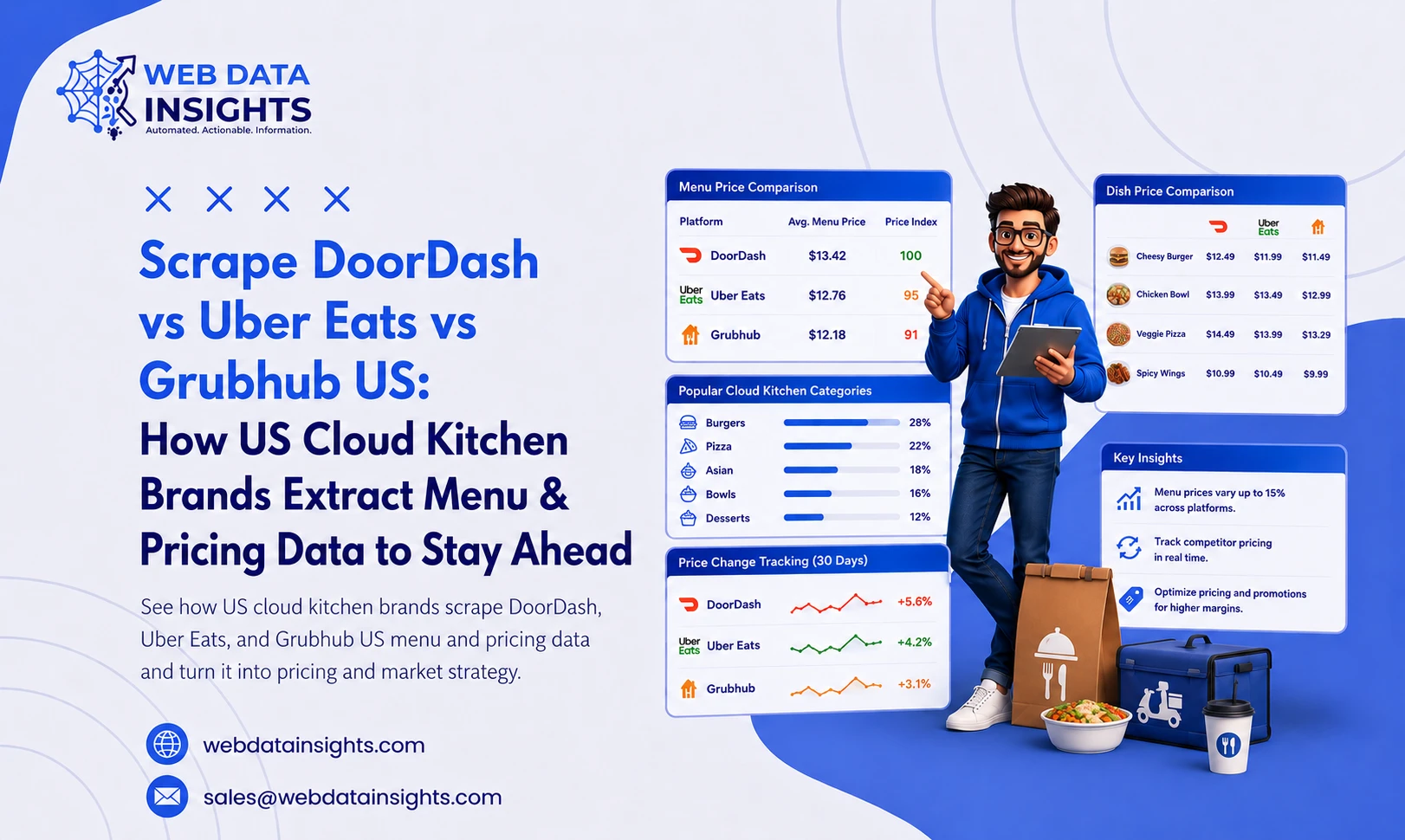
Every cloud kitchen brand operating in the US sells through the same three marketplaces. The brands that win on pricing are the ones that treat DoorDash, Uber Eats, and Grubhub as a single data problem — not three separate apps to check manually.
QUICK ANSWER
To stay competitive, US cloud kitchen brands scrape DoorDash, Uber Eats, and Grubhub to extract menu and pricing data — item prices, promotions, availability, and fees — for every competing brand in their market. This structured data feeds pricing decisions, menu engineering, and expansion planning. Importantly, DoorDash, Uber Eats, and Grubhub are not cloud kitchens; they are delivery marketplaces that cloud kitchens and virtual restaurant brands sell through.
What This Data Actually Represents
A cloud kitchen brand’s real-world pricing strategy doesn’t live in a spreadsheet or a POS system — it lives on the delivery marketplaces where customers actually order. If a competing virtual brand raises menu prices, runs a promotion, or drops an item, that change shows up first on DoorDash, Uber Eats, or Grubhub, often before it shows up anywhere else.
Extracting US cloud kitchen brands’ data from these three marketplaces means capturing that information consistently and at scale, so pricing and operations teams are reacting to real market movement instead of guessing.
Platform vs. Cloud Kitchen — What’s the Difference?
DoorDash
A food delivery marketplace, not a cloud kitchen operator. It hosts restaurant and virtual brand listings and supports the cloud kitchen model by giving these brands a storefront and delivery infrastructure.
Uber Eats
Also a delivery platform, not a cloud kitchen. Many cloud kitchens and virtual restaurant concepts reach customers through Uber Eats without owning or operating it.
Grubhub
A food delivery marketplace as well. It provides order flow and delivery to cloud kitchens but does not prepare or own any of the food itself.
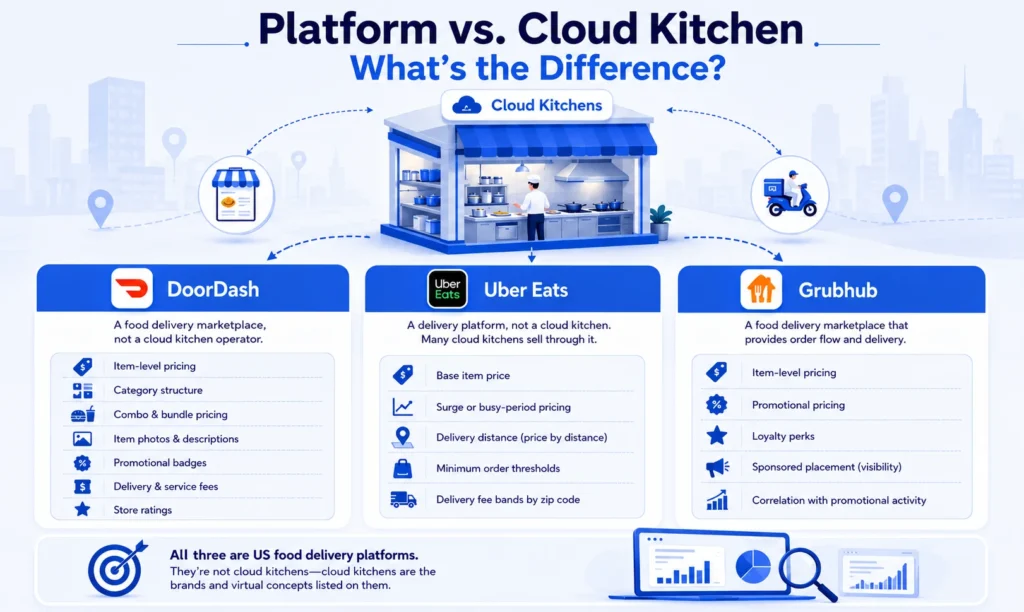
In short: DoorDash, Uber Eats, and Grubhub are US food delivery platforms that cloud kitchens sell through — the cloud kitchens are the brands and virtual concepts listed on them. Keeping this distinction clear matters, because it shapes what you should actually be measuring: not the platforms’ performance, but the pricing and menu behavior of the brands operating on them.
Extracting Menu & Pricing Data Across All Three Marketplaces
Each marketplace structures its listings a little differently, which is exactly why brands that only track one platform end up with an incomplete picture. A disciplined approach to food delivery data scraping captures the same core fields consistently across all three, so comparisons are accurate rather than approximate.
DoorDash US Cloud Kitchen Menu Data Scrape
On DoorDash, the useful signals are item-level pricing, category structure, combo and bundle pricing, item photos and descriptions, promotional badges, delivery and service fees, and store ratings. Because DoorDash carries a large share of virtual and ghost kitchen brands, it’s often the richest source for tracking new concept launches in a given market.
Uber Eats: Scrape Cloud Kitchen Price Data US
Uber Eats pricing can vary noticeably by time of day and delivery distance, so capturing snapshots at consistent intervals matters more here than on other platforms. Key fields include base item price, surge or busy-period pricing, minimum order thresholds, and delivery fee bands by zip code.
Grubhub US Cloud Kitchen Data Extract
Grubhub tends to differentiate on loyalty perks and sponsored placement, so alongside standard pricing fields, it’s worth tracking which brands are paying for visibility and how that correlates with promotional pricing. This often reveals which competitors are actively investing in growth in a specific market versus holding steady.
Turning Raw Listings Into US Cloud Kitchen Brand Market Analytics
Collecting the raw listings is only the first step. The value comes from normalizing menu categories, item names, and pricing units across all three platforms so they can be compared side by side — then rolling that into market-level analytics: average price per category, promotion frequency, and price positioning relative to competitors in the same zip code or metro area.
| Data Point | Why It Matters |
|---|---|
| Item-level pricing | Direct comparison against your own menu pricing |
| Promotions & discounts | Signals aggressive customer acquisition by competitors |
| Delivery & service fees | Affects a customer’s total-cost perception, not just menu price |
| Item availability / stockouts | Reveals supply issues or demand spikes worth reacting to |
| Geographic price variance | Shows where a brand prices differently by market |
Where This Data Gets Used
This kind of market data supports decisions well beyond the marketing team. Some of the most common applications across the industry:
Multi-Brand Virtual Kitchen Groups
Operators running several virtual brands out of one facility use competitor pricing data to set each brand’s menu independently, avoiding cannibalization between their own concepts.
QSR Chains Expanding Into Ghost Kitchens
Established restaurant chains entering the delivery-only model rely on market data to price competitively against digital-native cloud kitchen brands already established in a city.
Regional Operators Benchmarking National Brands
Independent and regional cloud kitchens use this data to see how national competitors price in their specific metro, rather than relying on national averages.
Franchise Networks Standardizing Pricing
Franchise groups use extracted pricing data to keep menu pricing consistent — or intentionally market-adjusted — across dozens or hundreds of locations.
Many of these teams also rely on a structured food delivery dataset to support broader market research, investor reporting, or category-level analysis beyond day-to-day pricing decisions.
Expert Insights & Best Practices
- Track all three platforms in parallel. A competitor’s DoorDash price rarely matches their Uber Eats or Grubhub price exactly — the gap itself is useful information.
- Set a consistent refresh cadence. Weekly is a reasonable baseline for most brands; daily or intraday refreshes matter more for teams running active price monitoring programs.
- Normalize before you analyze. Menu categories and item naming conventions differ across platforms — align them before comparing prices, or you’ll compare the wrong items.
- Segment by market, not just by brand. The same competitor can price very differently across cities; national averages hide the decisions that actually matter locally.
- Feed clean data into pricing automation. Structured, market-level pricing data is the input that powers AI dynamic pricing models — without it, automated pricing recommendations are only guesses.
Common Mistakes to Avoid
- Manual, one-off checks. Spot-checking competitor apps a few times a month misses the promotions and price changes that happen in between.
- Tracking only one marketplace. A brand that only watches DoorDash misses pricing moves happening on Uber Eats and Grubhub in the same market.
- Ignoring fee structures. Menu price alone doesn’t tell the full story — delivery and service fees change what a customer actually pays.
- Treating platforms as the competitor. The platforms are marketplaces; the actual competition is the cloud kitchen brands listed on them. Data strategy should focus there.
- Skipping data quality checks. Inconsistent extraction or stale data leads to pricing decisions based on outdated information — worse than having no data at all.
Where This Is Heading
As more cloud kitchen brands launch and compete for the same delivery real estate, market-level pricing data is shifting from a “nice to have” to a baseline requirement for pricing teams. Two trends stand out:
- Wider adoption of AI dynamic pricing — brands are moving from static menu prices to models that adjust based on real-time competitor and demand data.
- Growing multi-brand complexity — as one kitchen facility hosts more virtual concepts, tracking market pricing across brands and platforms becomes an operational necessity, not just a marketing exercise.
Frequently Asked Questions
What does it mean to scrape DoorDash vs Uber Eats vs Grubhub US data?
It means systematically collecting menu items, prices, promotions, and listing details for cloud kitchen brands as they appear on DoorDash, Uber Eats, and Grubhub, then comparing that data across all three US marketplaces to understand competitor pricing and market positioning.
Are DoorDash, Uber Eats, and Grubhub cloud kitchens themselves?
No. DoorDash, Uber Eats, and Grubhub are food delivery marketplaces, not cloud kitchen operators. Cloud kitchens and virtual restaurant brands list their menus and sell through these platforms, but the platforms do not prepare or own the food.
What data points matter most when extracting cloud kitchen menu and pricing data?
Item-level pricing, menu category structure, item availability and stockouts, promotional activity, delivery and service fees, ratings and review volume, and how listings vary by city or zip code.
How often should cloud kitchen brands refresh competitor pricing data?
Most operators track pricing weekly at minimum, since promotions and menu changes shift often. Brands running active dynamic pricing programs typically need daily or intraday refreshes.
Why compare all three platforms instead of tracking just one?
Pricing, fees, and promotions frequently differ across DoorDash, Uber Eats, and Grubhub for the same brand and market. Tracking a single platform gives an incomplete, and sometimes misleading, view of a competitor’s real pricing strategy.
How does this data support AI dynamic pricing for cloud kitchens?
Accurate, structured competitor data is the core input an AI dynamic pricing model needs to recommend price changes. Without reliable data extracted from DoorDash, Uber Eats, and Grubhub, dynamic pricing recommendations are based on incomplete market assumptions.
The Bottom Line
DoorDash, Uber Eats, and Grubhub aren’t cloud kitchens — they’re the marketplaces where cloud kitchen brands compete for the same customer. For a US cloud kitchen operator, extracting and comparing menu and pricing data across all three isn’t a nice-to-have research exercise; it’s the groundwork for every pricing, menu, and expansion decision that follows. Brands that build this into a consistent, structured process — rather than a manual, occasional check — are the ones that catch competitor moves early enough to respond to them.
Reliable Web Data Solutions
WebDataInsights provides clean, structured, and real-time web scraping solutions tailored to your business goals, helping automate data collection for eCommerce, market research, lead generation, and more.
Get in Touch