





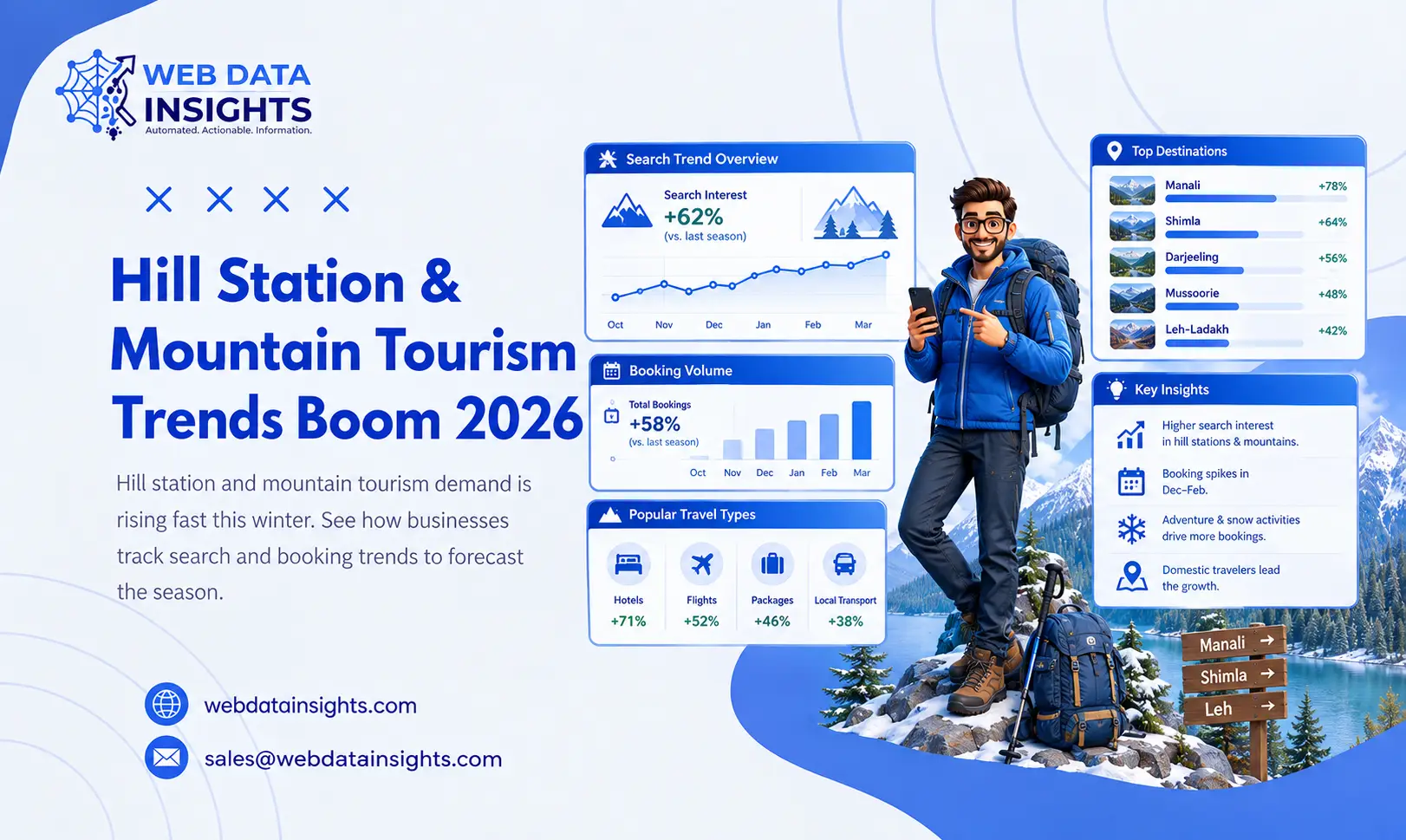
Search interest in hill stations and mountain getaways starts climbing weeks before a single booking is made. For hotels, resorts, and destination marketing teams, catching that early signal is what separates a well-planned season from one spent reacting to demand after it has already peaked. This is the story behind the Hill Station & Mountain Tourism trends Boom building ahead of this winter — and what the data actually shows about where travelers are heading next.
QUICK ANSWER
Hill station and mountain tourism demand rises sharply every winter, and the businesses that benefit most are the ones tracking rising search and booking demand early — search interest typically climbs two to four weeks before booking volume follows, giving hotels, resorts, and tourism boards a clear early-warning window.
What Is Driving the Hill Station & Mountain Tourism Trends Boom?
Rising search interest, longer weekend travel patterns, and growing appetite for offbeat destinations are the three biggest drivers behind this season’s boom. As post-monsoon weather clears and winter approaches, search volume for hill-station and mountain destinations climbs sharply, often well ahead of any visible booking spike. Remote-work flexibility has also stretched typical getaways into longer trips, and travelers are increasingly searching for lesser-known mountain towns rather than the same handful of established destinations.
How to Start Tracking Rising Search & Booking Demand
Track search interest and OTA booking pace together, on a weekly cycle, rather than watching either signal in isolation. Tracking Rising Search & Booking Demand works best as a combined view — search trend data shows where interest is building, while booking pace confirms whether that interest is actually converting. A destination showing rising search but flat bookings often signals a pricing or availability barrier worth investigating before the season is in full swing. Continuous Travel Data Scraping across search and OTA sources is what makes this kind of week-over-week tracking possible at scale.
Hill Station Booking Demand Analysis: What the Data Shows
Booking pace versus last year, average daily rate movement, and shrinking lead times are the three signals that reveal genuine demand acceleration. A proper hill station booking demand analysis compares current booking volume against the same period the previous year, tracks whether room rates are climbing faster than usual, and watches lead time — the gap between booking date and travel date. A shrinking lead time alongside rising bookings usually signals last-minute demand pressure building for a specific week or long weekend.
Mountain Resort Booking Forecast: Turning Signals Into Predictions
A reliable mountain resort booking forecast combines historical seasonal patterns with current search trend data and known demand triggers like long weekends or school holidays. This isn’t about predicting an exact occupancy number — it’s about narrowing a range confidently enough to plan staffing, pricing, and inventory ahead of the actual surge, rather than reacting once rooms are already filling up.
Winter Adventure Travel Trends Beyond Just Hill Stations
Trekking, skiing, and offbeat mountain village stays are growing faster than traditional hill-station hotel bookings this season. Winter adventure travel trends point to a broader shift: travelers increasingly want an experience tied to the destination, not just scenery from a hotel balcony. For resorts and tour operators, this means demand is shifting toward activity-led packages and smaller, less-visited mountain towns rather than concentrating entirely in the biggest-name hill stations.
Destination Demand Analytics: Building a Complete Picture
A complete demand picture combines search trend data, OTA booking pace, and pricing movement into one continuously updated view. Destination demand analytics done well doesn’t rely on any single signal — search interest alone can be noisy, and booking data alone arrives too late to act on. Combining both, refreshed weekly, is what turns raw signals into something a revenue or marketing team can actually plan around.
| Signal | What It Reveals |
|---|---|
| Search interest trend | Early indicator of building demand, weeks ahead of bookings |
| Booking pace vs. last year | Confirms whether interest is converting to real demand |
| Average daily rate movement | Shows how aggressively the market is pricing the surge |
| Lead time trend | Flags last-minute demand pressure building for specific dates |
Winter Travel Demand Forecast 2026: What to Expect
Tier-2 and lesser-known mountain destinations are expected to grow demand faster than established hill stations this winter. The winter travel demand forecast 2026 points toward travelers increasingly searching for alternatives to crowded, well-known destinations — similar scenery, lower prices, and less congestion are driving interest toward smaller mountain towns that were previously overlooked. This pattern is consistent with the kind of shift documented in this Travel Pricing Intelligence case study, where real-time pricing data revealed exactly this kind of demand migration.
Examples: Who Uses This Data
Hotel and resort revenue teams use it to set winter pricing ahead of the surge rather than reacting once occupancy is already climbing. Destination marketing organizations use search trend data to decide where to focus seasonal advertising spend. Travel agencies use booking pace data to advise clients on when to book before prices rise further. Adventure tour operators track activity-specific search trends to plan capacity for trekking and skiing packages. OTAs use combined demand data to prioritize which destinations to feature during the winter season.
Expert Insights & Best Practices
Watch search trends two to four weeks ahead of booking data
Search interest is the earliest available signal. Waiting for booking data alone means acting after competitors have already adjusted pricing.
Compare year-over-year, not just week-over-week
A single week’s spike can be noise. Comparing against the same period last year filters out normal seasonal variation from genuine demand growth.
Track lesser-known destinations, not just the obvious ones
The fastest-growing demand often shows up in tier-2 destinations before it’s visible in the most searched, most established hill stations.
Teams building this analysis from scratch often pair live tracking with a structured Travel Dataset to establish historical seasonal baselines before layering current-season signals on top.
Common Mistakes to Avoid
- Reacting only to booking data — by the time bookings confirm demand, pricing and inventory decisions are already reactive rather than proactive.
- Ignoring lesser-known destinations — demand growth in overlooked mountain towns is easy to miss if tracking stays focused only on established hotspots.
- Treating a single week’s data as a trend — short-term spikes need year-over-year context before being treated as meaningful.
- Overlooking activity-specific demand — trekking and adventure travel interest can rise independently of general hill-station search volume.
- Skipping pricing signals — search and booking data without rate movement misses half the picture of how the market is actually responding.
Where This Is Heading
Demand tracking is shifting from seasonal, after-the-fact reporting toward continuous, near-real-time monitoring that businesses can act on week by week. As more travelers search and book across a wider spread of destinations rather than a handful of established names, the value of broad, continuously refreshed Web Scraping Services covering search and booking data together will keep growing relative to relying on any single source.
Frequently Asked Questions
What is causing the hill station and mountain tourism trends boom?
Rising search interest ahead of winter, longer weekend and remote-work travel patterns, and growing interest in adventure and offbeat destinations are the main drivers, visible first in search volume spikes weeks before actual bookings occur.
How do you start tracking rising search and booking demand for a destination?
Track search interest trends and OTA booking pace together on a weekly basis, since search volume typically rises two to four weeks before booking volume follows, giving an early signal before the actual demand surge hits.
What does hill station booking demand analysis actually measure?
It measures booking pace relative to the same period last year, average daily rate movement, and lead time between booking and travel date, since these three signals together show whether demand is genuinely accelerating or just seasonal noise.
Can mountain resort booking be forecasted accurately?
Yes, within a reasonable range, by combining historical booking patterns with current search trend data and known demand triggers like long weekends or school holiday calendars, though forecasts should be treated as directional rather than exact.
What winter adventure travel trends are rising beyond traditional hill stations?
Trekking, skiing, and offbeat mountain village stays are growing faster than traditional hill-station hotel bookings, reflecting a shift toward experience-driven winter travel rather than purely scenic getaways.
What is expected in the winter travel demand forecast for 2026?
Tier-2 and lesser-known mountain destinations are expected to see faster demand growth than established hill stations, driven by search interest shifting toward less crowded alternatives with comparable scenery and lower prices.
Conclusion
The hill station and mountain tourism boom this winter is visible well before it shows up in occupancy reports — in search interest, in early booking pace, and in which destinations are gaining attention ahead of the obvious names. With WebDataInsights helping businesses track these signals continuously, hotels, resorts, and tourism boards can get a real head start on pricing, staffing, and marketing decisions, rather than waiting for the season to arrive and reacting to demand after it has already peaked.
Reliable Web Data Solutions
WebDataInsights provides clean, structured, and real-time web scraping solutions tailored to your business goals, helping automate data collection for eCommerce, market research, lead generation, and more.
Get in Touch