





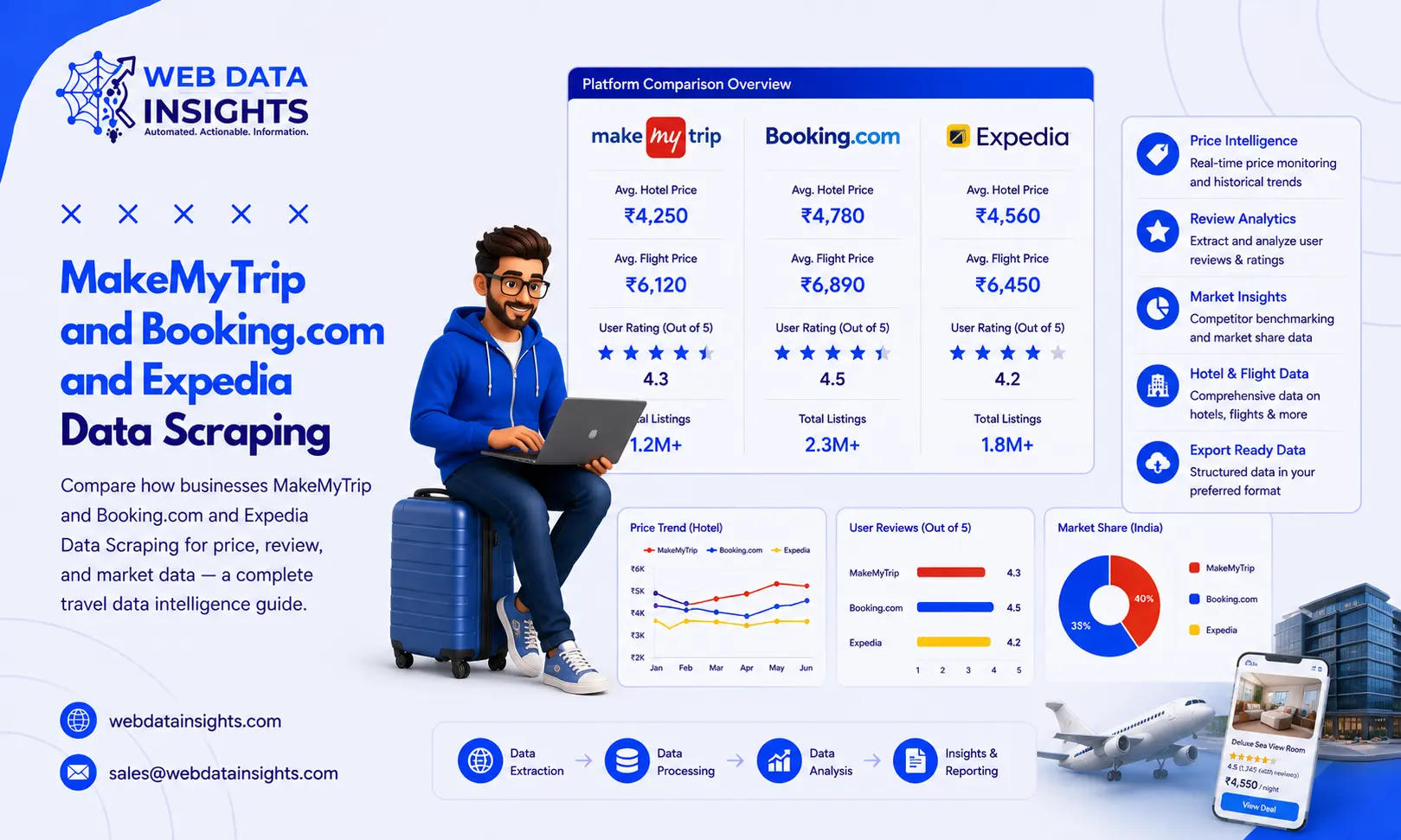
A traveler checking the same hotel room on MakeMyTrip, Booking.com, and Expedia within the same hour can see three different prices, three different review counts, and three different cancellation terms — and none of them are wrong, exactly. For hotel revenue teams, travel agencies, and OTAs trying to understand their own position, MakeMyTrip and booking.com and expedia data scraping means pulling price, review, and market data from all three platforms together, at the same moment, rather than checking each one on a different day and trying to compare from memory.
QUICK ANSWER
MakeMyTrip and booking.com and expedia data scraping means extracting pricing, review, and availability data from all three travel platforms at the same time and comparing them head to head, since each site prices the same hotel room or flight differently based on region, currency, device, and booking timing.
Why Travel Pricing Never Matches Across Platforms
Each OTA negotiates its own commission and rate terms directly with hotels and airlines, applies its own regional promotions and currency conversion, and refreshes pricing on its own schedule. Add device-based and loyalty-tier pricing into the mix, and a single “correct” price for a room simply doesn’t exist anymore — there’s only the price each platform is showing at that specific moment, to that specific user. This is exactly the kind of moving target that dedicated Travel Data Scraping is built to track continuously rather than through occasional manual checks.
MakeMyTrip, Booking.com & Expedia: Price, Reviews & Market Comparison
Rather than treating each platform as a separate silo, the comparison that actually matters puts all three side by side across the factors a revenue or research team cares about most.
Example: Cross-Platform Hotel Price Comparison Record
{
  "property_id": "HTL-DEL-45821",
  "property_name": "Sample Business Hotel",
  "location": "New Delhi, India",
  "check_in": "2026-08-20",
  "check_out": "2026-08-22",
  "room_type": "Deluxe King Room",
  "guests": 2,
  "currency": "INR",
  "platform_prices": {
    "makemytrip": {
      "base_price": 8450,
      "taxes_and_fees": 1521,
      "final_price": 9971,
      "cancellation": "Free cancellation until Aug 18"
    },
    "booking": {
      "base_price": 8720,
      "taxes_and_fees": 1395,
      "final_price": 10115,
      "review_score": 8.6
    },
    "expedia": {
      "base_price": 8290,
      "taxes_and_fees": 1658,
      "final_price": 9948,
      "member_discount": 350
    }
  },
  "captured_at": "2026-07-15T10:30:00Z"
}| Factor | MakeMyTrip | Booking.com | Expedia |
|---|---|---|---|
| Core strength | India domestic travel & bundled packages | Global independent hotel inventory | Flight-plus-hotel bundling |
| Pricing pattern | Frequent app-exclusive discounts | Rate-parity driven, promo codes | Bundle discounts on package bookings |
| Review depth | Moderate, growing verified-stay reviews | Deep, guest-verified review system | Aggregated ratings across bookings |
| Market presence | Strongest in South Asia | Strongest in Europe & global independents | Strong in North America, package travel |
| Real-time data access | Limited public API | Partner-restricted API | Partner-restricted API |
None of the three is uniformly cheaper, better reviewed, or better stocked — it depends on the property, the region, and even the day of the week. That's the core reason a one-time comparison goes stale almost immediately, while a structured, repeated comparison across all three stays genuinely useful.
MakeMyTrip and Booking.com and Expedia Price Monitoring
MakeMyTrip and booking.com and expedia price monitoring needs to look past the headline number shown in search results. Base room or fare price, taxes and fee breakdowns, cancellation policy terms, and app-exclusive or loyalty discounts all need tracking separately, since the price a traveler actually pays at checkout is rarely the same figure shown on the search page.
MakeMyTrip and Booking.com and Expedia Market Analytics
Zoomed out to the market level, MakeMyTrip and booking.com and expedia market analytics looks at where each platform's inventory strength actually lies — which regions, property types, and booking windows each one dominates. For a hotel chain or OTA, this is what reveals whether a listing gap on one platform is costing real bookings, or whether that platform simply isn't where their target traveler books in the first place.
MakeMyTrip and Booking.com and Expedia Review Dataset
Building a combined MakeMyTrip and booking.com and expedia review dataset means capturing rating distribution, review volume, verified-stay status, and recurring complaint or praise themes across all three platforms for the same property. A property that scores well on Booking.com but poorly on Expedia is a genuinely useful signal — it often points to a platform-specific service or expectation gap worth investigating.
MakeMyTrip and Booking.com and Expedia Real Time API
Direct public access through a MakeMyTrip and booking.com and expedia real time API is limited or restricted to select partners on all three platforms, which is why most businesses tracking live pricing and availability rely on structured, continuously refreshed data extraction instead. This mirrors the broader shift covered in this Travel Pricing Intelligence case study, where real-time hotel data extraction filled exactly this gap.
What Each Platform Adds to the Picture
MakeMyTrip travel data scraping is particularly valuable for businesses focused on the Indian and South Asian travel market, where MakeMyTrip's domestic flight and hotel bundling patterns differ noticeably from how Booking.com or Expedia structure similar deals internationally.
Booking.com travel data scraping stands out for its depth of independent, non-chain hotel inventory and its heavy reliance on verified guest reviews — tracking this data alongside MakeMyTrip and Expedia highlights where Booking.com's review-driven ranking gives certain properties a visibility advantage the other two platforms don't replicate the same way.
Expedia travel data scraping matters most for businesses tracking package and bundle pricing, since Expedia's flight-plus-hotel combinations often price differently from booking each component separately on MakeMyTrip or Booking.com — a gap that only becomes visible when all three are compared at once, using the same extraction and normalization approach covered under broader Web Scraping Services.
Examples: Who Uses This Data
Hotel revenue management teams use it to check rate parity compliance and adjust pricing strategy per channel. Travel agencies use it to find the best current deal across all three platforms for a client itinerary. OTAs benchmark their own listings and promotions against the other two platforms in real time. Market research firms build regional travel demand reports using combined pricing and review trends. Corporate travel management teams use it to negotiate better rates by understanding true market pricing rather than one platform's numbers.
Expert Insights & Best Practices
Compare at the same moment, not across different days
Since pricing shifts constantly, a comparison built from data pulled on different days isn't really a comparison — it's three unrelated snapshots.
Match properties precisely before comparing
The same hotel can be listed under slightly different names or room categories across platforms. Confirm the match before treating a price gap as meaningful.
Separate headline price from final price
Taxes, fees, and cancellation terms change the real cost significantly. Track both figures, not just the number shown in search results.
Teams that want a faster starting point often pair live tracking with a structured Travel Dataset to validate pipeline output or build historical pricing baselines before scaling up live monitoring.
Common Mistakes to Avoid
- Comparing prices pulled on different days — travel pricing moves too fast for this to be meaningful.
- Assuming identical room or fare categories — the same-sounding listing can differ in inclusions across platforms.
- Ignoring taxes and fees — the headline price rarely matches what a traveler actually pays.
- Treating review counts without verification status — unverified and verified-stay reviews carry different weight.
- Expecting full API access — most teams need extraction-based data collection since public APIs are limited on all three platforms.
Where This Is Heading
Personalized and loyalty-tier pricing is becoming more common across all three platforms, which means a single "market price" per room is increasingly an approximation rather than a fixed fact. At the same time, demand is growing for combined, cross-platform travel datasets that support forecasting and revenue-management models, rather than relying on any one OTA's numbers in isolation.
Frequently Asked Questions
What does MakeMyTrip, Booking.com, and Expedia data scraping mean?
It means extracting pricing, review, and availability data from all three travel platforms at the same time and comparing them head to head, since each site prices the same hotel room or flight differently based on region, currency, device, and booking timing.
Why does the same hotel room show different prices on MakeMyTrip, Booking.com, and Expedia?
Each platform negotiates its own commission and rate agreements with hotels, applies its own currency conversion and regional promotions, and updates pricing on its own refresh cycle, so the same room can carry different effective prices across all three sites at the same moment.
What should MakeMyTrip and booking.com and expedia price monitoring track?
Base room or fare price, taxes and fees breakdown, cancellation policy terms, and any member-exclusive or app-only discount, since the final price a traveler actually pays often differs from the headline rate shown in search results.
Is there a real-time API available for MakeMyTrip, Booking.com, or Expedia?
Public real-time APIs are limited or partner-restricted on all three platforms, which is why most businesses tracking live pricing and availability rely on structured, real-time data extraction instead of direct API access.
How is booking.com travel data scraping different from MakeMyTrip or Expedia?
Booking.com's inventory skews toward independent global hotel listings with a strong focus on verified guest reviews, while MakeMyTrip leans toward India-specific domestic travel and bundled packages, and Expedia emphasizes flight-plus-hotel bundling, so each requires slightly different field mapping.
Who uses combined travel platform data from MakeMyTrip, Booking.com, and Expedia?
Hotel revenue management teams, travel agencies, OTAs benchmarking their own listings, and market research firms tracking regional travel demand all use this combined data to see pricing and positioning across platforms rather than relying on one site's numbers.
Conclusion
MakeMyTrip, Booking.com, and Expedia each price, review, and position the same trip differently, and none of them tells the full story alone. Businesses that track all three together — at the same moment, with the same schema — get a genuinely accurate view of where they stand and where the real pricing gaps are. Businesses still checking one platform at a time are, in effect, always working from an incomplete picture.
Reliable Web Data Solutions
WebDataInsights provides clean, structured, and real-time web scraping solutions tailored to your business goals, helping automate data collection for eCommerce, market research, lead generation, and more.
Get in Touch