





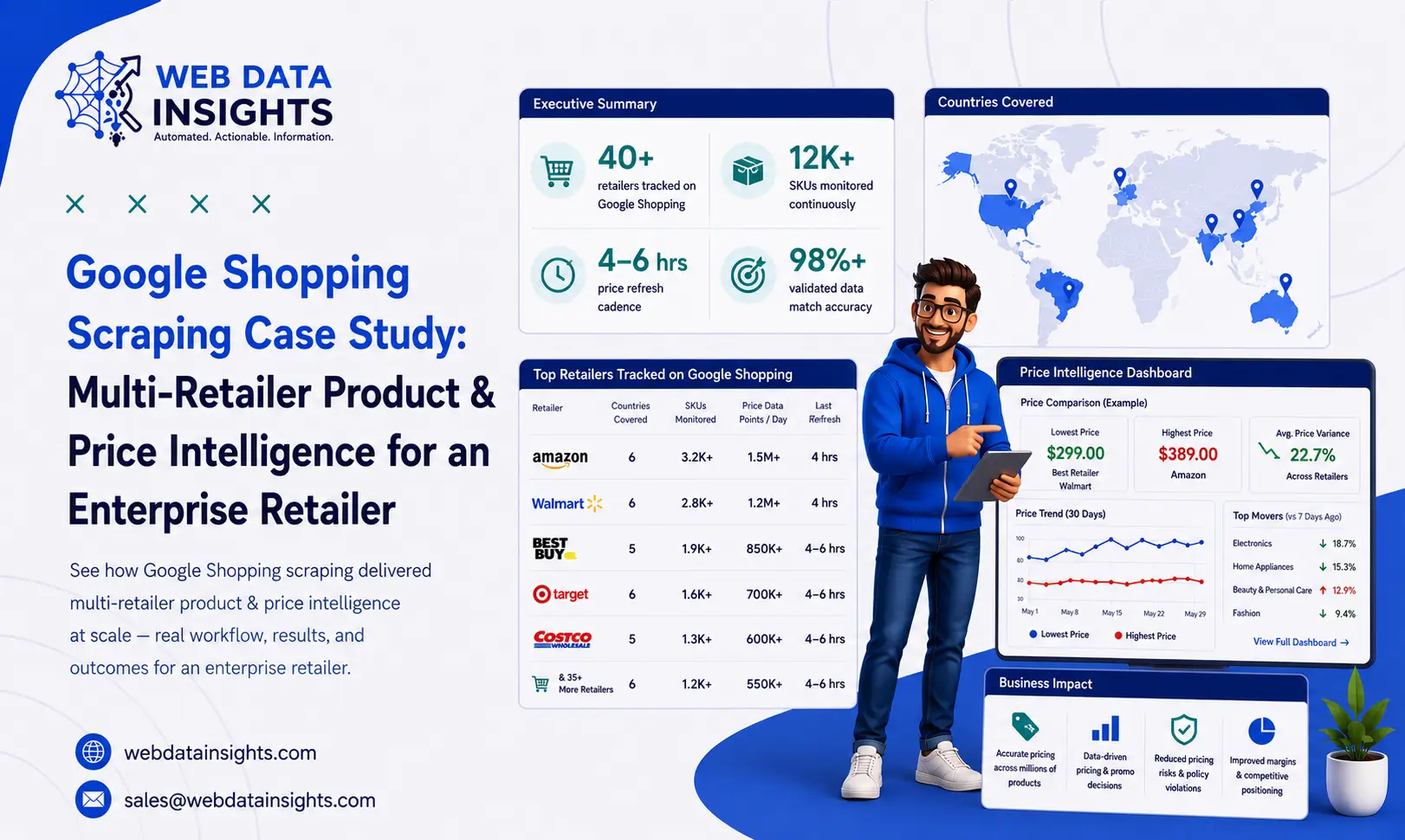
How a structured Google Shopping scraping pipeline gave a multi-category retailer continuous visibility into competitor pricing, availability, and assortment — cutting reaction time from days to hours.
Executive Summary
A multi-category e-commerce retailer needed accurate, continuously refreshed Google Shopping Product & Price Intelligence to stay competitive across a fragmented, fast-moving field of retailers. Manual price checks could not keep pace with how often listings change on Google Shopping. WebDataInsights designed and delivered a dedicated Google Shopping scraping pipeline that unified pricing, availability, and product-matching data from 40+ competing retailers into a single, structured feed — giving the client’s pricing and merchandising teams a live, trustworthy view of the market instead of a weekly snapshot.
Client Background
The client is a mid-to-large multi-category online retailer selling across electronics, home, and lifestyle segments, competing directly with national and regional retailers that also list on Google Shopping. Client details are anonymized under a standing confidentiality agreement, which is standard practice across our engagements.
Client Snapshot
- Industry: Multi-category e-commerce retail
- Team: Central pricing & merchandising function
- Prior process: Manual, spreadsheet-based competitor checks
- Core need: Reliable Google Shopping product data extraction at scale
The Business Challenge
Google Shopping listings shift constantly — price changes, stock status, and promotions can update several times a day across dozens of sellers. Without a dependable way to track this, the client was consistently reacting too late.
Operational gaps
- No structured process for Google Shopping product price scraping — checks were manual and inconsistent
- Missed repricing windows led to both margin loss and lost sales
- Product titles and variants differed across retailers, making manual matching unreliable
Technical gaps
- Google Shopping’s dynamic, JavaScript-rendered listings resisted basic scripts
- Results vary by geography and device, requiring location-aware collection
- No normalized schema existed to compare data across retailers consistently
Solution Strategy
We proposed a purpose-built Google Shopping Multi-retailer product data scraping architecture rather than a generic scraper, designed specifically for how Google Shopping renders listings and how the client’s pricing team makes decisions.
- Dedicated collectors for Google Shopping search results and product listing pages, built to handle dynamic rendering
- A retailer-agnostic normalization layer so every retailer’s product data lands in one consistent schema
- A product-matching engine using brand, model, and identifier-based matching to link the same product across different retailer listings
- Geo-targeted collection to capture regional price and availability differences
- A refresh cadence tuned to category volatility rather than a single fixed schedule
This approach extended the client’s existing competitive strategy — read more about how we support ongoing Competitor Price Monitoring Services and broader Web Scraping Services.
Implementation Process
- Discovery & Scope Definition: Mapped the client’s priority categories, the 40+ retailers to monitor, and the refresh frequency each category required.
- Data Source Mapping: Identified the exact Google Shopping surfaces to collect from, including search result listings and individual product pages, to support accurate Google Shopping product data extraction.
- Scraper Build: Built collectors capable of handling dynamic rendering, geo-targeted requests, and request patterns that respect site stability, forming the core Google Shopping scraping pipeline.
- Product Matching & Normalization: Applied brand, title, and identifier-based matching to unify multi-retailer listings into one schema: product, retailer, price, availability, and timestamp.
- QA & Accuracy Validation: Ran manual sampling and automated anomaly checks so the resulting Google Shopping Multi-Retailer Price Intelligence stayed reliable at scale.
- Delivery & Integration: Delivered the structured feed directly into the client’s pricing workflow, ready for repricing and merchandising decisions.
Results & Outcomes
| Metric | Before | After |
|---|---|---|
| Retailers tracked on Google Shopping | Handful, manual | 40+, continuous |
| Time to detect a competitor price change | ~2–3 days | Under 6 hours |
| SKUs monitored | Partial, sampled | 12,000+ |
| Data refresh frequency | Weekly | Every 4–6 hours |
| Validated data match accuracy | Not measured | 98%+ |
With reliable Google Shopping Product & Price Intelligence in place, the pricing team moved from reactive, manual checks to a repeatable process — repricing decisions that once took days were made the same day.
Key Learnings
- Google Shopping’s listing structure changes over time, so scraping pipelines need ongoing maintenance, not a one-time build.
- Product matching across retailers is the hardest part of multi-retailer price intelligence — naming conventions rarely align.
- Geo and device context materially affect pricing and availability results.
- Refresh cadence should follow category price volatility, not a single fixed schedule for every product line.
- A human QA layer is what keeps automated Google Shopping product price scraping dependable at scale.
- Structured delivery (API/feed) matters as much as collection — raw data without a usable schema slows decisions down.
Where This Applies
Multi-retailer product and price intelligence built on Google Shopping scraping supports decision-making across several industries facing the same core problem — pricing visibility at scale.
Retail & E-commerce
Competitive repricing and assortment tracking across category-level competitors.
Consumer Electronics
Minimum Advertised Price (MAP) monitoring across authorized and unauthorized sellers.
Fashion & Apparel
Seasonal price movement and assortment shifts tracked across retail partners.
CPG & FMCG Brands
Checking pricing and listing consistency across resellers and distribution partners.
Marketplaces & Aggregators
Category-level pricing benchmarks to inform commercial and merchandising strategy.
This case study connects closely to our broader work in Ecommerce Data Scraping, where the same principles apply across marketplaces beyond Google Shopping.
Frequently Asked Questions
What is Google Shopping scraping?
Google Shopping scraping is the process of systematically collecting publicly listed product data — prices, availability, retailer names, and product details — from Google Shopping listings. It turns scattered listings into structured, comparable data.
How does Google Shopping product data extraction work?
It works by collecting product listings from Google Shopping search results and product pages, then normalizing that data into a consistent schema — product name, brand, price, retailer, availability, and timestamp — so it can be compared across sellers.
What is Google Shopping Multi-Retailer Price Intelligence used for?
It’s used to monitor how multiple retailers price and stock the same or similar products on Google Shopping, supporting competitive repricing, MAP compliance checks, and assortment planning.
How often can Google Shopping product price scraping run?
Refresh frequency depends on category volatility. Fast-moving categories like electronics are often refreshed every few hours, while more stable categories may be checked daily or weekly.
Is Google Shopping scraping compliant?
We collect only publicly available listing data and build collection practices around site stability, applicable terms, and data protection principles. We’re not a law firm, so businesses with specific compliance questions should also consult their own legal counsel.
How is multi-retailer scraping different from tracking one competitor?
Multi-retailer product data scraping matches the same product across many sellers at once, giving a market-wide pricing view instead of a single competitor’s snapshot — which is what makes repricing decisions more accurate.
Reliable Web Data Solutions
WebDataInsights provides clean, structured, and real-time web scraping solutions tailored to your business goals, helping automate data collection for eCommerce, market research, lead generation, and more.
Get in TouchReady to Turn Your Data into Revenue Growth?
Partner with WebDataInsights for enterprise-grade B2B data scraping, real-time price monitoring, supplier benchmarking intelligence, and seamless API data delivery.
Solve My Problem