





Most businesses don’t evaluate a scraping vendor properly until something has already gone wrong — a pipeline breaks silently, data quietly goes stale, or a source blocks access without anyone noticing for days. Choosing a reliable web scraping service before that happens comes down to a handful of concrete criteria, not marketing claims about accuracy or scale.
QUICK ANSWER
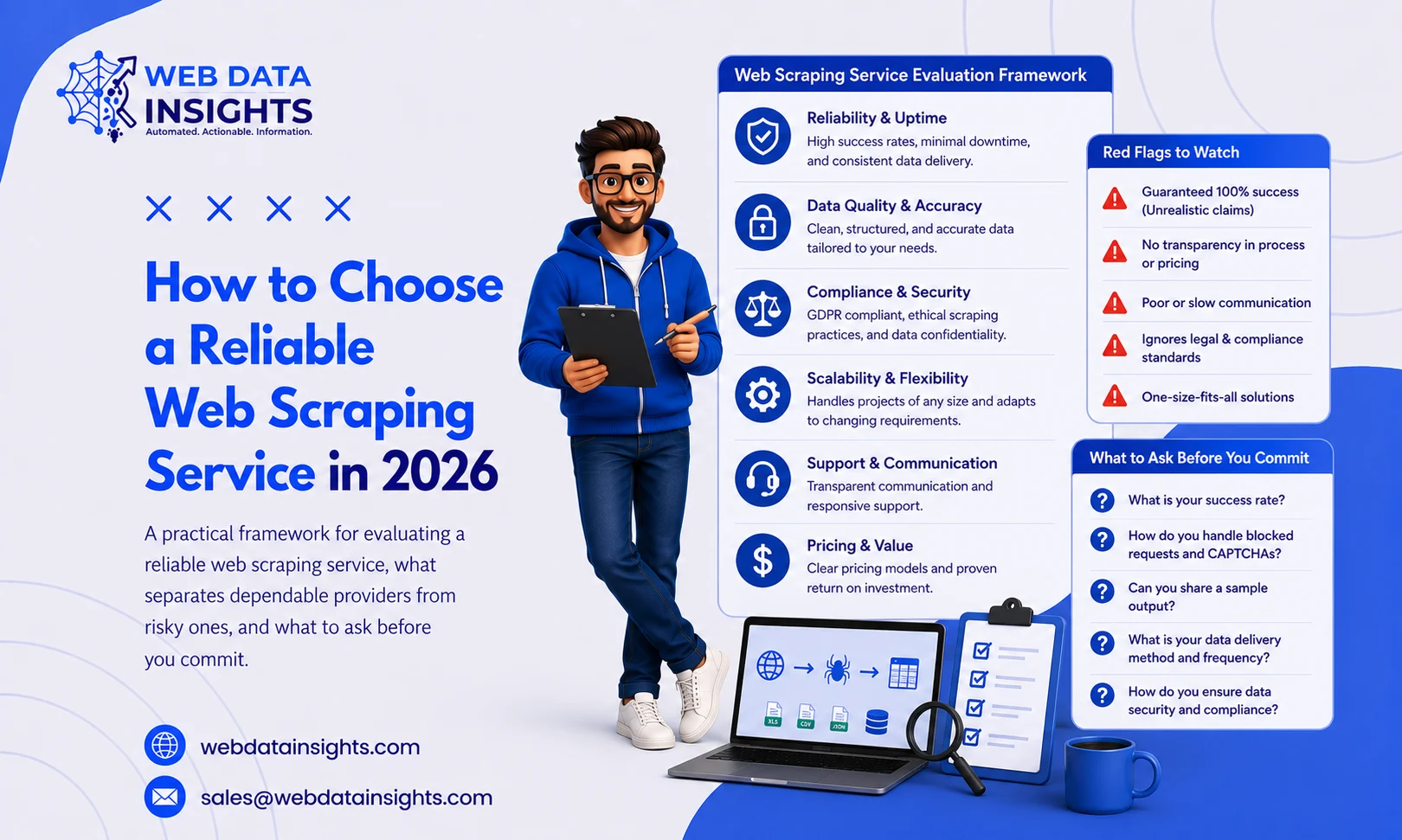
A reliable web scraping service combines consistent data accuracy, compliance-aware extraction practices, infrastructure that scales without breaking, and fast response to source website changes — evaluated through criteria like uptime, validation practices, and support responsiveness rather than price alone.
What Actually Separates a Reliable Provider From a Risky One
Reliability in this context isn’t about a provider claiming “99% accuracy” in a sales deck — it’s about what happens when a source website changes its layout overnight, or when a data field silently starts returning blanks. A dependable web scraping service provider catches these issues through monitoring before a client does, not after a report already looks wrong.
Evaluating Enterprise Web Scraping Solutions
For enterprise web scraping solutions, the evaluation goes beyond a single source or use case. Look at how the provider manages infrastructure at scale — proxy and IP rotation strategy, monitoring and alerting for pipeline failures, defined SLAs for uptime and issue resolution, and flexibility in how data is delivered (raw feed, structured API, or scheduled export).
| Criterion | What to Ask |
|---|---|
| Uptime & monitoring | How is a broken parser detected — automatically or after a client complains? |
| SLA clarity | What’s the guaranteed response time when a source blocks access? |
| Data validation | What checks run before data is delivered — schema, range, duplicate checks? |
| Delivery flexibility | Can data be delivered via API, warehouse sync, or scheduled export? |
What Makes a Company the Best Web Scraping Company for Your Needs
There’s no single “best” provider in the abstract — the Best Web Scraping Company for a given business depends on its specific mix of sources, refresh needs, and compliance requirements. What’s consistent across strong providers is a track record across similar use cases, transparent communication about methodology, and a security and compliance posture that holds up to scrutiny rather than vague assurances.
Why a Custom Web Scraping Company Matters for Complex Data Needs
Standard templates work fine for common, well-structured sites. But many businesses need to track sources with unusual layouts, non-standard fields, or specific business logic — matching products across inconsistent naming, for instance. A custom web scraping company builds and adapts extraction logic around these specifics, rather than forcing every source through the same rigid template and losing data quality in the process.
Real-Time Web Scraping: When It’s Actually Necessary
Not every use case needs real-time web scraping. A category with slow-moving prices can run comfortably on a daily or weekly refresh. But for pricing that shifts by the hour, or inventory that sells out during a flash sale, waiting for a batch cycle means acting on data that’s already outdated. This is the same logic behind continuous Price Monitoring systems — the refresh frequency should match how fast the underlying market actually moves, not a fixed default schedule.
Scalable Web Scraping Solutions: Planning for Growth, Not Just Current Volume
A provider that handles fifty sources smoothly doesn’t automatically handle five hundred the same way. Scalable web scraping solutions are defined by how gracefully a pipeline absorbs growth — whether onboarding new sources takes days or months, whether pricing scales predictably, and whether infrastructure that works at a pilot scale actually holds up once volume increases tenfold.
Web Scraping Solutions for Businesses Across Industries
Web Scraping Solutions for Businesses look different depending on the industry, but the evaluation criteria stay the same. E-commerce and retail brands need pricing and catalog accuracy at high refresh rates. Real estate and PropTech firms need multi-source reconciliation across listing sites. Market research firms need broad category coverage with consistent historical data. Travel and hospitality businesses need availability and rate data that changes constantly. In every case, the underlying question is the same: does this provider’s infrastructure genuinely match how this business’s data actually behaves?
Expert Insights & Best Practices
Ask for a sample dataset from a real source before committing
A live sample reveals far more about data quality and structure than any case study or claim on a sales page.
Check how the provider handles site layout changes
Every source website changes eventually. What matters is whether the provider catches it in hours through monitoring, or a client discovers it weeks later in a broken report.
Confirm delivery format fits your systems
A provider offering structured access through a Web Scraping API integrates far more smoothly into existing pipelines than one that only delivers periodic file exports.
Ask directly about compliance practices
A reliable provider should be able to explain, plainly, how it approaches source terms of service and data compliance — vague reassurance is itself a signal worth noting.
Common Mistakes to Avoid
- Choosing on price alone — the cheapest provider often cuts corners on validation and monitoring, and the cost shows up later as bad data.
- Assuming real-time capability without confirming it — many providers default to batch cycles regardless of what’s advertised.
- Skipping a compliance conversation upfront — this is far easier to address before signing than after a source relationship becomes a legal question.
- Not testing with a real, messy source — a clean demo site tells you little about how a provider handles your actual, harder sources.
- Ignoring integration requirements — a great data feed that doesn’t fit your existing systems creates ongoing manual work.
Where This Is Heading
AI-assisted extraction is increasingly replacing purely rule-based scrapers, since self-adjusting parsers can adapt to minor site layout changes without manual rebuilding — a shift covered in more detail in this piece on AI-Powered Web Scraping. At the same time, compliance expectations are tightening across the industry, pushing reliable providers toward more transparent, documented data-sourcing practices rather than opaque methodology.
Frequently Asked Questions
What makes a web scraping service reliable?
A reliable web scraping service combines consistent data accuracy, compliance-aware extraction practices, infrastructure that scales without breaking, and fast response to source website changes, evaluated through criteria like uptime, validation practices, and support responsiveness rather than price alone.
What is the difference between a web scraping service provider and building an in-house scraper?
An in-house scraper works well for a small, stable set of sources, but a dedicated web scraping service provider maintains infrastructure, monitoring, and parser updates across many sources continuously, which becomes more cost-effective once a business tracks dozens of sources or needs frequent refreshes.
Do all web scraping companies offer real-time data?
No. Many providers run on scheduled batch cycles, and true real-time web scraping requires different infrastructure. Businesses that need minute-by-minute pricing or inventory data should confirm this capability specifically rather than assuming it’s standard.
How do you know if a web scraping solution can scale with your business?
Ask how the provider handles a sudden increase in tracked sources or SKUs, whether pricing scales predictably, and how quickly new sources can be onboarded, since scalable web scraping solutions are defined by how gracefully they absorb growth, not just their current capacity.
Why does a custom web scraping company matter for complex data needs?
Standardized scraping templates work for common site structures, but businesses with unique data schemas, non-standard site layouts, or specific compliance requirements need a provider that can build and adapt custom extraction logic rather than forcing data into a rigid template.
What questions should you ask before signing with a web scraping provider?
Ask for a sample dataset from a real source, how they handle site layout changes, what their data validation process looks like, what compliance practices they follow, and what happens when a source blocks access, since the answers reveal more than any marketing claim.
Conclusion
The right web scraping partner isn’t the one with the boldest claims — it’s the one whose infrastructure, monitoring, and compliance practices hold up under a specific, unglamorous set of questions. At WebDataInsights, we believe businesses that evaluate providers against real criteria, rather than a pitch deck, end up with data pipelines that stay reliable long after the sales conversation ends.
Reliable Web Data Solutions
WebDataInsights provides clean, structured, and real-time web scraping solutions tailored to your business goals, helping automate data collection for eCommerce, market research, lead generation, and more.
Get in Touch