





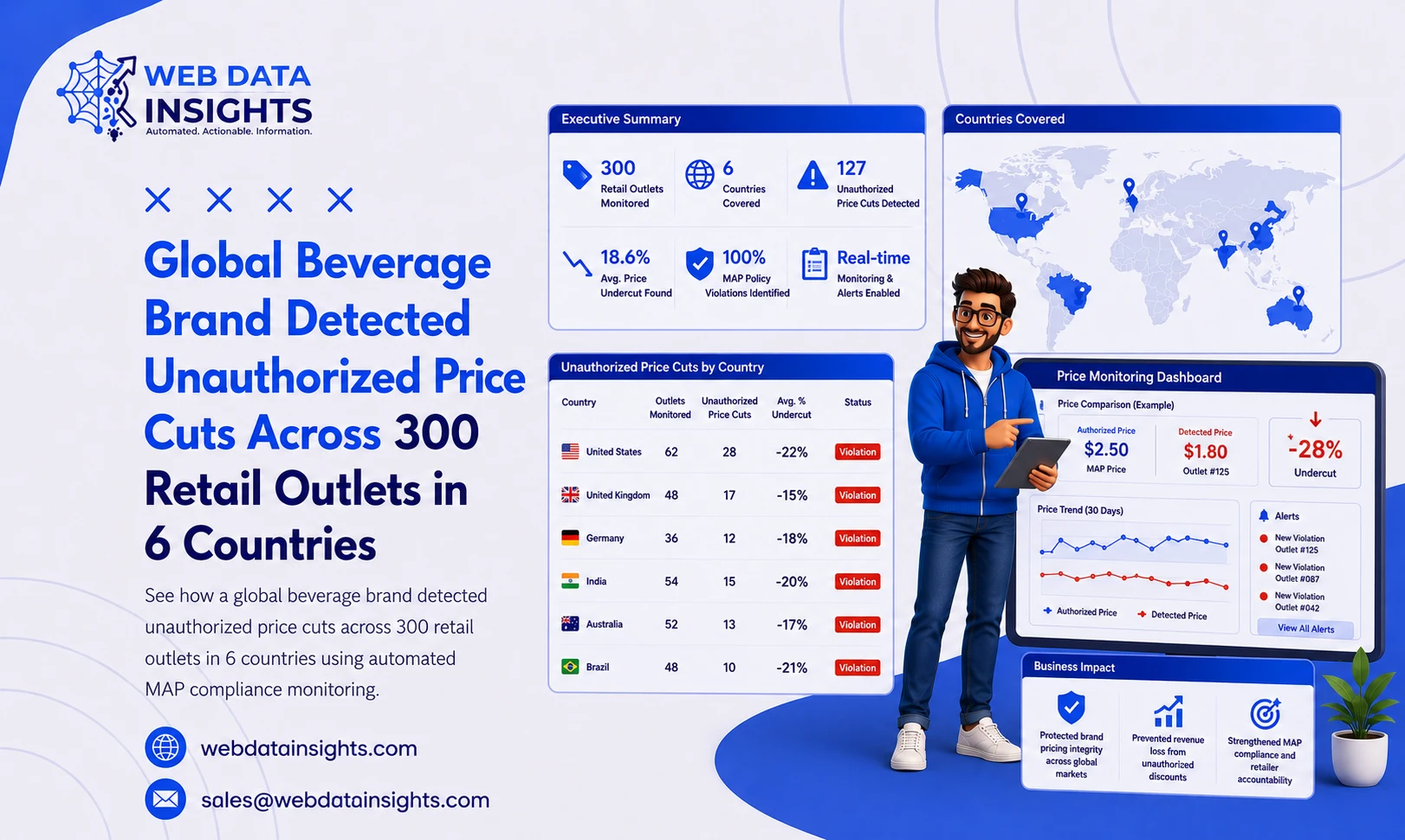
A global beverage brand detected unauthorized price cuts across 300 retail outlets spanning 6 countries, using automated, market-by-market price monitoring instead of manual field audits. Here’s how consistent, brand-wide pricing was restored across every region.
Executive Summary
A global beverage brand suspected that unauthorized price cuts in select markets were undercutting its pricing strategy and eroding brand value, but had no consistent way to confirm it across regions with different retailers, currencies, and reporting standards.
WebDataInsights deployed a Beverage Price Compliance Monitoring Across Retail Outlets program covering 300 locations in 6 countries. The result: the brand’s compliance team could see unauthorized price cut detection results daily, market by market, and act before violations spread further.
Client Background
The client is a global beverage brand (identity withheld under NDA) selling through a mix of grocery chains, convenience stores, and specialty retailers across six international markets. Pricing strategy varies by market but is governed by strict minimum advertised price (MAP) and retail price floor policies.
Before this engagement, price compliance was checked through periodic field visits and occasional retailer reports — a process too slow and inconsistent to catch violations before they affected sell-through and brand positioning.
Business Challenge
No Reliable Way to Confirm Unauthorized Price Cuts Across Six Markets
With operations spanning multiple countries, the brand’s pricing team faced a visibility gap that made global retail price monitoring nearly impossible to run manually. Core challenges included:
- No standardized MAP compliance monitoring process across markets with different retailers and price formats.
- Field audits covering only a fraction of 300 outlets at any given time, leaving most locations unchecked for weeks.
- Delayed detection meant unauthorized discounts often ran for days before being noticed.
- No centralized beverage brand price intelligence view, so regional teams worked with inconsistent, siloed data.
- Risk of retailer relationships being damaged if violations were flagged too late or based on incomplete evidence.
Solution Strategy
Automated Unauthorized Price Monitoring for Beverage Brands
WebDataInsights built a monitoring program designed around continuous, evidence-backed data collection rather than periodic checks. The foundation was a scalable Web Scraping Services layer adapted for multi-country retail price tracking.
- Standardized data collection across all 300 outlets, normalized for currency and regional pricing formats.
- Daily Price Monitoring to compare observed retail prices against approved MAP thresholds.
- Automated flagging for Beverage brand price monitoring using web scraping, reducing reliance on manual field visits.
- Documented evidence trails for each detected violation, supporting retailer conversations with clear proof.
Implementation Process
From Market Mapping to Daily Compliance Alerts
Step 1 — Market & Outlet Mapping. Catalogued all 300 retail outlets across the 6 target countries, along with each market’s approved MAP thresholds.
Step 2 — Data Collection Setup. Configured automated collection to capture shelf and online pricing at each outlet on a consistent schedule.
Step 3 — Compliance Rule Engine. Built logic to compare collected prices against market-specific MAP and promotional guidelines.
Step 4 — Violation Detection. Flagged unauthorized price cuts automatically, with outlet, date, and price variance recorded for each case.
Step 5 — Reporting & Escalation. Delivered daily compliance reports to the brand’s regional teams, prioritized by severity and recurrence.
Step 6 — Ongoing Promotion Oversight. Extended the program with Promotion Compliance Tracking to monitor sanctioned promotions alongside unauthorized discounting.
Results & Outcomes
| Metric | Result |
|---|---|
| Retail outlets monitored | 300 across 6 countries |
| Monitoring frequency | Daily, per outlet |
| Time to detect a price violation | Same-day, down from multi-week delays |
| Market coverage | 100% of target outlets, up from partial field-audit coverage |
| Evidence quality | Documented, timestamped records for every flagged violation |
With consistent visibility across all six markets, the brand’s compliance and trade marketing teams could address unauthorized price cuts within days rather than discovering them weeks after the fact.
Key Learnings
- Manual field audits cannot scale to hundreds of outlets across multiple countries without significant blind spots.
- Standardizing price data across currencies and market formats is essential for accurate cross-country compliance monitoring.
- Daily detection meaningfully shortens the window in which unauthorized pricing can affect brand positioning.
- Documented evidence trails make retailer conversations about violations faster and less contentious.
Industry Relevance
Unauthorized price cut detection and MAP compliance monitoring matter most in industries where brand value depends on consistent pricing across many retail touchpoints.
Beverage & Food Brands
Consistent shelf pricing protects brand positioning across grocery and convenience retail.
Consumer Packaged Goods (CPG)
High SKU counts and wide retail distribution make automated compliance monitoring essential.
Health & Personal Care
MAP violations can quickly erode margin across price-sensitive retail categories.
Alcohol & Spirits
Regional pricing regulations add complexity that automated monitoring helps manage.
Consumer Electronics
Unauthorized discounting across retail chains directly affects brand and reseller relationships.
Multi-National Retail Brands
Operating across several countries requires standardized, currency-normalized price tracking.
Frequently Asked Questions
What is unauthorized price cut detection?
Unauthorized price cut detection is the process of identifying instances where a retailer sells a product below an agreed minimum advertised price (MAP) or approved price floor, typically through automated monitoring rather than manual checks.
How does MAP compliance monitoring work across multiple countries?
MAP compliance monitoring across countries involves collecting retail pricing data per market, normalizing it for currency and local pricing formats, and comparing it against each market’s approved price thresholds to flag violations.
How many retail outlets can be monitored for price compliance?
With an automated monitoring pipeline, hundreds of retail outlets across multiple countries can be tracked simultaneously — as shown in this case study, which covered 300 outlets across 6 countries on a daily basis.
Why do manual price audits fail to catch unauthorized discounting?
Manual field audits can only cover a limited number of outlets at a time, leaving most locations unchecked for extended periods. This creates blind spots where unauthorized price cuts go undetected for days or weeks.
What industries benefit most from beverage brand price intelligence?
Industries with wide retail distribution and strict MAP policies — including beverages, CPG, health and personal care, and consumer electronics — benefit most from continuous beverage brand price intelligence and monitoring.
Reliable Web Data Solutions
WebDataInsights provides clean, structured, and real-time web scraping solutions tailored to your business goals, helping automate data collection for eCommerce, market research, lead generation, and more.
Get in TouchReady to Turn Your Data into Revenue Growth?
Partner with WebDataInsights for enterprise-grade B2B data scraping, real-time price monitoring, supplier benchmarking intelligence, and seamless API data delivery.
Solve My Problem