




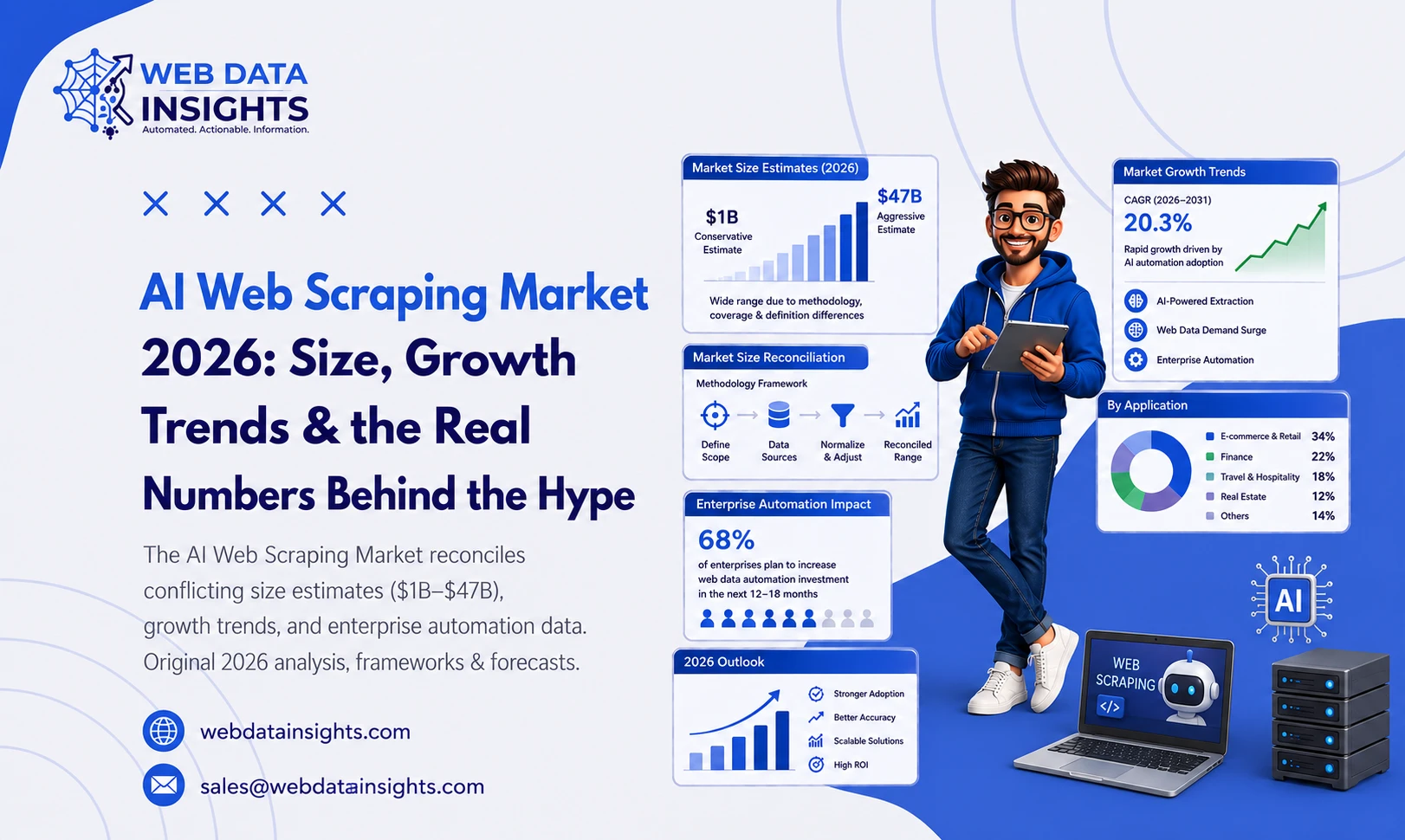
Introduction: Why the AI Web Scraping Market Doesn’t Have One True Number
Ask three market research firms how big the AI web scraping market is, and you will get three different answers — not by a small margin, but by an order of magnitude. One puts the 2026 market at just over $1 billion. Another puts it above $10 billion. A third implies a figure closer to $9 billion once its 2025 baseline is projected forward. Each report cites a CAGR in the high teens to mid-twenties, each projects healthy growth through the mid-2030s, and none of them acknowledges that the others exist.
This is not necessarily bad research. It is a scope problem. “AI web scraping market” means different things depending on whether a firm counts residential proxy revenue, cloud infrastructure spend, software licensing only, or the full stack of AI-powered data extraction services. This report treats that inconsistency as the starting point rather than glossing over it. Instead of presenting a single confident number, it reconciles the available estimates, explains why they diverge, and proposes a more defensible way to think about market size.
It also introduces a framework not found in existing market coverage: the idea that “AI web scraping market” actually describes two structurally different markets that happen to share a label — one built around enterprise business intelligence, the other built around feeding data to AI models themselves. Understanding that distinction matters more than memorizing any single CAGR.
What Is AI Web Scraping?
AI web scraping is the use of machine learning and, increasingly, large language models to automatically identify, interpret, and extract structured data from websites — without relying on fixed, hand-coded rules for each target page. Unlike traditional web scraping, which uses static CSS or XPath selectors that break when a page’s layout changes, AI web scraping systems interpret page content semantically, allowing them to continue extracting accurate data even after a website redesign.
The AI web scraping market is the commercial ecosystem of software, infrastructure, and services built around this capability — including proxy networks, headless browser platforms, AI-powered extraction APIs, and the compliance tooling that supports enterprise data-collection at scale.
- Published 2026 estimates for the AI web scraping market range from roughly $1 billion to $10+ billion, depending entirely on scope definition — there is no single agreed-upon figure.
- The market is best understood as two distinct markets: AI-powered scraping infrastructure (enterprise BI, price monitoring) and scraping for AI (training data, RAG pipelines) — the second is growing faster but is rarely sized separately.
- The real technical shift isn’t “more automation” — it’s the move from brittle CSS/XPath selectors to LLM-based, self-healing extraction, which is reshaping vendor economics and buyer expectations alike.
AI Web Scraping Market Size & Growth: A Reconciliation
The Three Estimates — And Why They Disagree
Published 2026 market-size estimates for AI-driven web scraping vary dramatically depending on what each research firm chooses to count. Some analyses restrict the market to software and subscription services sold directly under an “AI-driven web scraping” label. Others fold in adjacent infrastructure spend — residential and datacenter proxy networks, cloud compute for headless browser rendering, and anti-bot evasion tooling — which inflates the addressable market considerably. A third approach anchors the estimate to the broader “AI-driven web scraping” category as tracked across a wider set of application use cases (price monitoring, lead generation, market intelligence, data mining) and industry verticals, producing yet another baseline.
None of the publicly available estimates disclose a reconciled view against competing figures. This is an analytical judgment of this report, not a claim made by any single source: the variance is very likely attributable to differing scope boundaries (software-only vs. infrastructure-inclusive) and differing base years (2025 vs. 2026 starting points), rather than genuine disagreement about underlying market activity.
Market Size Reconciliation
| Scope Definition (as inferred from source) | 2026 Base Value (Est.) | CAGR (Est.) | Terminal Year Value (Est.) | Terminal Year |
|---|---|---|---|---|
| Narrow: services & software only, by scraping-type/subscription-model segmentation | ~$1.0 billion | ~17.3% | ~$5.1 billion | 2036 |
| Broad: full application/vertical segmentation (price monitoring, lead gen, market intelligence, data mining) | ~$10.2 billion | ~23.5–23.8% | ~$23.7 billion | 2030 |
| Mid-range: application-and-format segmentation with cloud/marketplace weighting | ~$9.3 billion (2025 baseline extrapolated) | ~19.8% | ~$47.2 billion | 2035 |
Note: figures above are drawn from publicly published third-party market research and are presented here as estimates, not verified transaction data. Readers should treat all forward-looking values as directional rather than precise.
A Defensible Market-Size Range for 2026
Given the scope inconsistencies documented above, this report’s position — an analytical synthesis, not a proprietary primary estimate — is that the AI web scraping market in 2026 most plausibly falls within a $1 billion to $10 billion range, with the wide spread explained almost entirely by whether proxy/infrastructure revenue and adjacent automation spend are included. A single-point figure implies a false precision that none of the underlying source methodologies can actually support.
Segment & Regional Growth Benchmarks
Despite disagreement on absolute size, published estimates show more convergence on relative segment and regional trends — which is itself a useful signal.
Segment Benchmark Comparison
| Dimension | Leading Segment | Reported Share (2025/2026) | Source Consensus |
|---|---|---|---|
| Scraping Type | Dynamic web scraping | ~34.7% | Consistent across sources that segment by type |
| Deployment Model | Cloud-based platforms | ~60–68% | Strong consensus |
| Application | Market intelligence | ~37% | Reported by application-segmented sources |
| Industry Vertical | E-commerce | ~32% | Strong consensus |
| Data Format | Text-based content | ~46% | Reported by format-segmented sources |
Regionally, sources converge on two consistent findings: North America currently holds the largest revenue share (estimated at roughly 39% of global market revenue), while Asia-Pacific is consistently identified as the fastest-growing region, with cited CAGR figures in the 21–25% range driven by e-commerce expansion, fintech data demand, and cloud-AI adoption across South Korea, Japan, and broader APAC markets.
Key Takeaway
- Dynamic web scraping and cloud deployment dominate the segment mix across virtually every published estimate.
- E-commerce remains the single largest industry driver, consistent with the market’s origins in price and competitive monitoring.
- Asia-Pacific’s growth rate consistently outpaces North America’s, even though North America retains the larger absolute revenue base — a gap likely to narrow, not reverse, over the next decade.
The Two Markets Hiding Inside “AI Web Scraping”
Market A: AI-Powered Scraping Infrastructure
This is the market most existing research actually measures: proxy networks, headless browser infrastructure, anti-bot evasion tooling, and extraction platforms sold to enterprises for competitive intelligence, price monitoring, and lead generation. Buyers are typically retail, e-commerce, financial services, and marketing organizations. Demand is relatively mature, tracks e-commerce and marketing budget cycles, and is served by an established vendor set (Bright Data, Oxylabs, Apify, ScrapeHero, Diffbot, and similar players).
Market B: Scraping for AI (Training Data & RAG)
This is the demand pool that existing market reports barely acknowledge, despite it plausibly being the faster-growing of the two. It consists of AI Training Data Collection and data acquisition specifically to feed AI systems: large language model pretraining corpora, retrieval-augmented generation (RAG) pipeline ingestion, and synthetic dataset construction for fine-tuning. Buyers here are AI labs, AI-native startups, and enterprise AI teams building internal knowledge systems — a fundamentally different customer profile than Market A’s marketing and competitive-intelligence teams.
The table below compares the two markets across six dimensions to illustrate why they behave — and should be measured — differently.
Market A vs. Market B: Comparative Framework
| Dimension | Market A: Enterprise Scraping Infrastructure | Market B: Scraping for AI |
|---|---|---|
| Primary Buyer | Retail, e-commerce, BFSI, marketing teams | AI labs, AI product teams, data engineering teams |
| Core Use Case | Price monitoring, competitive intelligence, lead gen | LLM pretraining, RAG ingestion, synthetic data |
| Data Format Priority | Structured (price, listings, reviews) | Unstructured text, documents, multimodal content |
| Growth Driver | E-commerce competition, marketing automation | AI model development cycles, RAG adoption |
| Cost Sensitivity | Volume/scale-based (per-request pricing) | Quality and licensing-sensitive (provenance matters) |
| Representative Vendors | Bright Data, Oxylabs, ScrapeHero, Apify | Common Crawl-adjacent providers, Diffbot, specialized data-licensing intermediaries |
| Maturity | Established, consolidating | Emerging, fragmented |
Expert Insight: Treating these as one undifferentiated market is precisely why published CAGR figures vary so widely. Market A is growing at a steady, e-commerce-correlated pace. Market B’s growth is tied to the AI model-development cycle, which has expanded far faster over the past two years than traditional enterprise software categories typically do. A market-size estimate that blends both without disclosing the mix will systematically overstate or understate depending on which segment the underlying data collection happened to sample more heavily. This is analysis and interpretation by this report, offered as a lens for evaluating future market-size claims — not a verified allocation of revenue between the two categories, which no current source publishes.
What Changed: From Rule-Based Scraping to AI-Native Extraction
The Technical Shift: Selectors → LLM-Based Extraction
The term “AI-driven” is often applied loosely to what is still fundamentally rule-based scraping with light automation layered on top. The more meaningful technical shift — one largely unexplained in existing market coverage — is the move from brittle, selector-based extraction (CSS selectors, XPath queries hard-coded against a specific page structure) to extraction methods that use large language models to interpret page content semantically.
In practical terms: a traditional scraper breaks the moment a target site changes its HTML structure, because the selector no longer matches anything. An LLM-based extractor is given a natural-language instruction (“extract the product name, price, and availability”) and can often continue functioning correctly even after a layout change, because it is interpreting meaning rather than matching a fixed structural pattern. This is what the industry means, more precisely, by “self-healing” extraction — a capability increasingly marketed by vendors offering natural-language-prompt-based scraping tools.
This shift has real cost implications. LLM-based extraction is more resilient but computationally more expensive per page than a simple selector match, which is reshaping vendor pricing models toward hybrid approaches: rule-based extraction for stable, high-volume targets, and LLM-based extraction reserved for complex or frequently changing pages.
The Scraping Maturity Model
| Stage | Description | Approximate Era |
|---|---|---|
| 1. Manual | Human-driven copy/paste or basic scripted extraction against known, stable page structures | Pre-2015 |
| 2. Scripted | Selector-based scrapers (CSS/XPath), scheduled crawling, proxy rotation for scale | 2015–2020 |
| 3. AI-Assisted | ML-assisted parsing, computer vision for layout detection, NLP for unstructured text | 2020–2023 |
| 4. Autonomous Agentic Extraction | LLM-driven agents that navigate, interpret, and extract with minimal human-defined rules | 2023–present |
Most enterprise scraping operations today sit somewhere between Stage 2 and Stage 3; genuinely autonomous, agentic extraction (Stage 4) remains an emerging capability rather than an industry default, despite vendor marketing frequently implying otherwise.
Enterprise AI Automation Adoption Context
Scraping demand does not exist in isolation — it tracks broader enterprise AI adoption. According to Eurostat, the share of EU enterprises with 10 or more employees using AI technologies rose from roughly 8% in 2023 to approximately 13.5% in 2024, a meaningful increase in a single year. This macro adoption trend is directly relevant: AI-powered decision-making tools depend on continuously refreshed, structured data inputs, and web-scraped data is one of the primary ways such tools stay current without manual data entry.
The Anti-Bot Arms Race: Defenders vs. Extractors
How Detection Systems Work
Every scraping market report discusses extraction vendors; almost none discuss the defensive side of the equation in any depth, despite it being a direct cost driver for the entire industry. Bot-management providers — Cloudflare, Akamai Bot Manager, PerimeterX, and DataDome (which appears in most vendor lists as an extraction-adjacent player but is, in fact, primarily a bot-detection company) — use a combination of behavioral fingerprinting, TLS/JA3 fingerprinting, CAPTCHA challenges, and increasingly, ML-based anomaly detection to distinguish human browsing patterns from automated extraction.
Escalation Costs on Both Sides
This creates a genuine arms-race dynamic. As detection systems get better at identifying automated traffic patterns, scraping vendors invest more heavily in residential proxy networks (which route traffic through real consumer IP addresses to appear more legitimate), browser fingerprint randomization, and human-like interaction timing. Each escalation on the defensive side increases the cost of extraction; each escalation on the extraction side increases the cost of defense. This dynamic is a structural cost driver embedded in virtually every AI scraping vendor’s pricing model, even though it is rarely named explicitly in vendor marketing or market research.
Did You Know?
Annual bot-traffic studies, such as those published by Cloudflare and Imperva’s Bad Bot Report series, have repeatedly found that automated, non-human traffic — including scrapers and crawlers — accounts for a substantial and growing minority of total internet traffic, with recent editions placing automated traffic at roughly a third or more of all web requests. Exact figures vary by measurement methodology and vendor; this report has not independently verified specific percentages and presents this as a directional industry signal rather than a precise statistic.
Data Extraction Industry Landscape: Vendors & Positioning
Vendor Categories: Infrastructure vs. Extraction-First
Vendors in the data extraction industry broadly split along two axes: whether they primarily sell infrastructure (proxies, browser rendering, IP rotation) versus extraction intelligence (AI-powered parsing, structured output generation), and whether they target enterprise buyers with dedicated support versus self-serve developer audiences.
Vendor Comparison Table
The following table compares six widely cited AI web scraping and data-extraction vendors across deployment model, AI-native extraction capability, and target buyer.
Vendor Comparison
| Vendor | Primary Focus | Deployment | AI-Native Extraction | Compliance Tooling | Target User |
|---|---|---|---|---|---|
| Bright Data | Infrastructure + extraction API | Cloud | Yes (AI-ready pipelines) | GDPR/CCPA tooling stated | Enterprise |
| Oxylabs | Infrastructure + AI Studio suite | Cloud | Yes (natural-language prompts) | Compliance-focused | Enterprise + developer |
| Apify | Extraction platform / marketplace | Cloud | Partial | Basic | Developer-first |
| ScrapeHero | No-code scrapers | Cloud/managed | Limited | Basic | SMB |
| DataDome | Bot detection (defensive) | Cloud | N/A (defender, not extractor) | N/A | Enterprise security teams |
| Diffbot | AI-based structured extraction | Cloud/API | Yes | Limited public detail | Developer + data teams |
Note: this table reflects publicly stated vendor positioning as of report publication and should not be treated as an independent capability audit.
M&A and Consolidation Signals
Merger and acquisition activity is a useful proxy for market heat that existing reports mention only in passing. A notable example: in mid-2025, Oxylabs Group acquired ScrapingBee, a France-based provider of an AI-powered web scraping API known for developer-friendly headless browser and proxy management. This kind of acquisition — a larger infrastructure player absorbing a smaller, extraction-focused, developer-oriented product — is a consolidation pattern likely to continue as larger vendors seek to offer both infrastructure and extraction intelligence under one platform, rather than requiring buyers to stitch together multiple point solutions.
Key Takeaway
- The vendor landscape is bifurcating into infrastructure providers, extraction-intelligence providers, and defensive bot-management providers — three distinct roles frequently conflated in “key players” lists.
- Consolidation (infrastructure players acquiring extraction-focused startups) is an early-stage but observable trend, not yet a dominant pattern.
- No single vendor currently offers best-in-class infrastructure, extraction intelligence, and compliance tooling simultaneously — buyers still generally trade off between these three capabilities.
Legal & Compliance Landscape
Landmark Cases Shaping the Industry
Legal precedent is arguably the single most consequential — and most underreported — factor shaping the AI web scraping market. Two U.S. cases in particular have defined the current legal boundaries.
Legal Case Summary
| Case | Year | Ruling (Summary) | Practical Implication for Scrapers |
|---|---|---|---|
| hiQ Labs v. LinkedIn | 2019 (9th Cir.); ongoing litigation history | Scraping publicly accessible data generally does not violate the Computer Fraud and Abuse Act (CFAA) | Established that scraping public data is not automatically a federal computer-crime violation in the U.S. |
| Meta v. Bright Data | 2024 | Court largely sided with Bright Data on scraping of publicly available, logged-out data; narrower findings on logged-in data | Reinforced the public/private data distinction as the key legal fault line for scraping activity |
These summaries reflect publicly reported case outcomes and are provided for general informational context, not as legal advice. Readers evaluating scraping activity for a specific use case should consult qualified legal counsel.
GDPR, CCPA & the Compliance-by-Design Shift
Beyond U.S. case law, EU and California privacy frameworks (GDPR and CCPA respectively) impose obligations that are independent of whether data was technically “public” at the point of collection. This has pushed vendors — particularly those targeting European enterprise buyers — toward compliance-by-design architecture: built-in PII detection and redaction, documented lawful-basis assessments, and data minimization controls embedded directly into extraction pipelines rather than applied as an afterthought.
The llms.txt Disintermediation Risk
An emerging trend, largely absent from existing market coverage, is the rise of llms.txt and similar machine-readable access standards — files that websites can publish to explicitly define what content is available for AI/automated consumption, potentially reducing the need for traditional scraping entirely for compliant actors. This represents a disintermediation risk to parts of the scraping industry: if enough high-value sites move toward structured, sanctioned API or llms.txt-based access, some current scraping demand could shift toward simpler, lower-cost retrieval methods.
Expert Insight: This is a forward-looking judgment, not an established market trend: llms.txt adoption is currently early-stage and voluntary, and its long-term effect on scraping demand is genuinely uncertain. That said, the direction is worth watching closely. Meaningful adoption among high-traffic publishers over the next two to three years would most plausibly compress demand in Market A (enterprise infrastructure scraping), while having comparatively little effect on Market B (AI training-data acquisition) — since llms.txt is explicitly designed around AI-consumption use cases and may, ironically, accelerate rather than reduce Market B’s growth.
Buyer & Builder Framework: Build vs. Buy
Decision Criteria: Team Size, Volume, Compliance Needs
Build-vs-Buy Decision Matrix
| Factor | Favors Building In-House | Favors Buying a Vendor Platform |
|---|---|---|
| Data Volume | Low-to-moderate, predictable targets | High-volume, many varied targets |
| Team Capability | Existing engineering team with scraping/DevOps experience | Limited engineering bandwidth |
| Compliance Complexity | Simple, well-understood data sources | Multi-jurisdiction, PII-adjacent data |
| Target Site Stability | Stable, rarely-changing page structures | Frequently changing, JS-heavy, anti-bot-protected sites |
| Time-to-Value | Flexible timeline, willing to iterate | Need production-ready extraction quickly |
| Cost Sensitivity | Fixed engineering cost preferred over recurring fees | Recurring cost acceptable in exchange for reduced maintenance burden |
Vendor Evaluation Scorecard
For organizations choosing to buy, a simple weighted scorecard helps structure vendor comparison beyond marketing claims:
| Evaluation Criterion | Suggested Weight |
|---|---|
| Compliance tooling (PII detection, jurisdiction coverage) | 25% |
| AI-extraction capability (resilience to site changes) | 25% |
| Pricing transparency and scalability | 20% |
| Support and SLA quality | 15% |
| Platform maturity and uptime track record | 15% |
Key Takeaway
- There is no universally “correct” build-vs-buy answer — the decision hinges on data volume stability, compliance exposure, and existing engineering capacity, in that order of importance.
- Buyers should weight compliance tooling and AI-extraction resilience roughly equally; pricing alone is an insufficient basis for vendor selection given how much maintenance burden shifts depending on extraction resilience.
Benchmark Snapshot: AI Web Scraping Market at a Glance
Master Benchmark Table
| Benchmark Metric | 2026 Value (Estimate/Analysis) |
|---|---|
| Market Size Range | $1 billion – $10+ billion (scope-dependent) |
| CAGR Range (across sources) | ~17.3% – 23.8% |
| Leading Scraping Type | Dynamic web scraping (~34.7% share) |
| Leading Deployment Model | Cloud-based (~60–68% share) |
| Leading Application | Market intelligence (~37% share) |
| Leading Industry Vertical | E-commerce (~32% share) |
| Largest Region by Revenue | North America (~39% share) |
| Fastest-Growing Region | Asia-Pacific (~21–25% CAGR) |
| Key Legal Precedent | hiQ v. LinkedIn (public data ≠ automatic CFAA violation) |
| Emerging Structural Risk | llms.txt-driven disintermediation of traditional scraping |
The benchmarks above summarize the report’s core findings in a single view. The glossary below defines the terminology referenced throughout, for readers who want quick clarification without returning to earlier sections.
Key Terms & Definitions
| Term | Definition |
|---|---|
| AI Web Scraping | The use of machine learning or LLMs to extract structured data from websites by interpreting content semantically rather than matching fixed page selectors. |
| Web Crawling | The process of systematically discovering and indexing web pages by following links, typically as a precursor to scraping or search indexing. |
| Self-Healing Extraction | An AI-driven scraper’s ability to continue extracting correct data after a target website’s layout or structure changes, without manual reconfiguration. |
| Residential Proxy | A proxy IP address sourced from a real consumer internet connection, used to make automated traffic appear as ordinary human browsing. |
| RAG (Retrieval-Augmented Generation) | An AI architecture that retrieves external data — often web-scraped — at query time to ground a language model’s response in current, factual information. |
| robots.txt | A long-standing, voluntary web standard that tells automated crawlers which parts of a site they may or may not access. |
| llms.txt | An emerging, voluntary standard allowing site owners to explicitly define what content is available for AI/LLM consumption, distinct from and complementary to robots.txt. |
| CFAA (Computer Fraud and Abuse Act) | The primary U.S. federal statute governing unauthorized computer access, central to major web-scraping legal disputes such as hiQ v. LinkedIn. |
| Bot Management | Defensive technology (e.g., from Cloudflare, Akamai, PerimeterX) that detects and blocks automated, non-human web traffic, including scrapers. |
Frequently Asked Questions
What is AI-driven web scraping?
AI-driven web scraping is the use of machine learning and large language models to extract structured data from websites by interpreting content semantically, rather than relying on fixed CSS or XPath selectors. This makes it more resilient to website layout changes than traditional rule-based scraping.
How big is the AI web scraping market in 2026?
Published 2026 estimates range from roughly $1 billion to over $10 billion, depending on whether the scope includes infrastructure spend like proxies and cloud compute. This report’s reconciled analysis places the most defensible range at $1–$10 billion, not a single point figure.
What is the CAGR of the AI web scraping market?
Published compound annual growth rate (CAGR) estimates for the AI web scraping market range from approximately 17.3% to 23.8% through the early-to-mid 2030s, varying by source scope and forecast horizon.
Who are the major AI web scraping companies?
Widely cited vendors include Bright Data, Oxylabs, Apify, ScrapeHero, and Diffbot for extraction infrastructure, alongside DataDome, Cloudflare, and Akamai as leading bot-detection (defensive) providers in the same ecosystem.
Is web scraping legal in the US and EU?
In the U.S., scraping publicly accessible data is generally not a federal crime under the CFAA following hiQ v. LinkedIn. In the EU, GDPR imposes separate obligations on personal data regardless of public accessibility. This is general information, not legal advice.
What’s the difference between web scraping and web crawling?
Web crawling is the systematic discovery and indexing of pages by following links, as search engines do. Web scraping is the extraction of specific structured data from targeted pages. Many modern platforms combine both functions.
Do I need a proxy for AI web scraping?
Yes, in most cases at scale. Proxy infrastructure — particularly residential proxies — is typically required to avoid IP-based blocking on sites with anti-bot protection, though small-scale or official-API-based extraction may not require one.
What is llms.txt and how does it affect web scraping?
llms.txt is an emerging, voluntary standard that lets website owners declare what content is available for AI or automated consumption. Wider adoption could reduce reliance on traditional scraping for participating sites, though its long-term market impact remains unconfirmed.
Which industries use AI web scraping the most?
E-commerce is the leading industry vertical in most published estimates, accounting for roughly 32% of market revenue, followed by financial services, retail, and marketing and advertising.
How much does AI web scraping cost?
Costs vary by volume, target complexity, and extraction method. LLM-based extraction carries higher per-page compute cost than rule-based scraping but reduces maintenance costs. No standardized public pricing benchmark currently exists across the vendor landscape.
Conclusion: Where the AI Web Scraping Market Goes From Here
The AI web scraping market is real, growing, and increasingly consequential to enterprise decision-making — but it is also less precisely measured than existing market reports suggest. The wide variance in published 2026 estimates is not evidence of bad research; it is evidence that “AI web scraping market” has not yet been consistently scoped across the research industry, and that two structurally different demand pools — enterprise infrastructure scraping and AI-training-data acquisition — are routinely blended into a single figure.
Going forward, three dynamics deserve closer attention than they currently receive: the continued shift toward LLM-native, self-healing extraction methods; the legal and compliance landscape’s growing influence on vendor architecture; and the disintermediation risk posed by machine-readable access standards like llms.txt. As companies evaluate evolving platforms and providers, including WebDataInsights, buyers are better served by understanding which of the two markets they actually need, and by applying disciplined build-vs-buy criteria, than by anchoring decisions to any single headline market-size figure.
Reliable Web Data Solutions
WebDataInsights provides clean, structured, and real-time web scraping solutions tailored to your business goals, helping automate data collection for eCommerce, market research, lead generation, and more.
Get in TouchReady to Turn Your Data into Revenue Growth?
Partner with WebDataInsights for enterprise-grade B2B data scraping, real-time price monitoring, supplier benchmarking intelligence, and seamless API data delivery.
Request Custom Dataset