





Research Summary
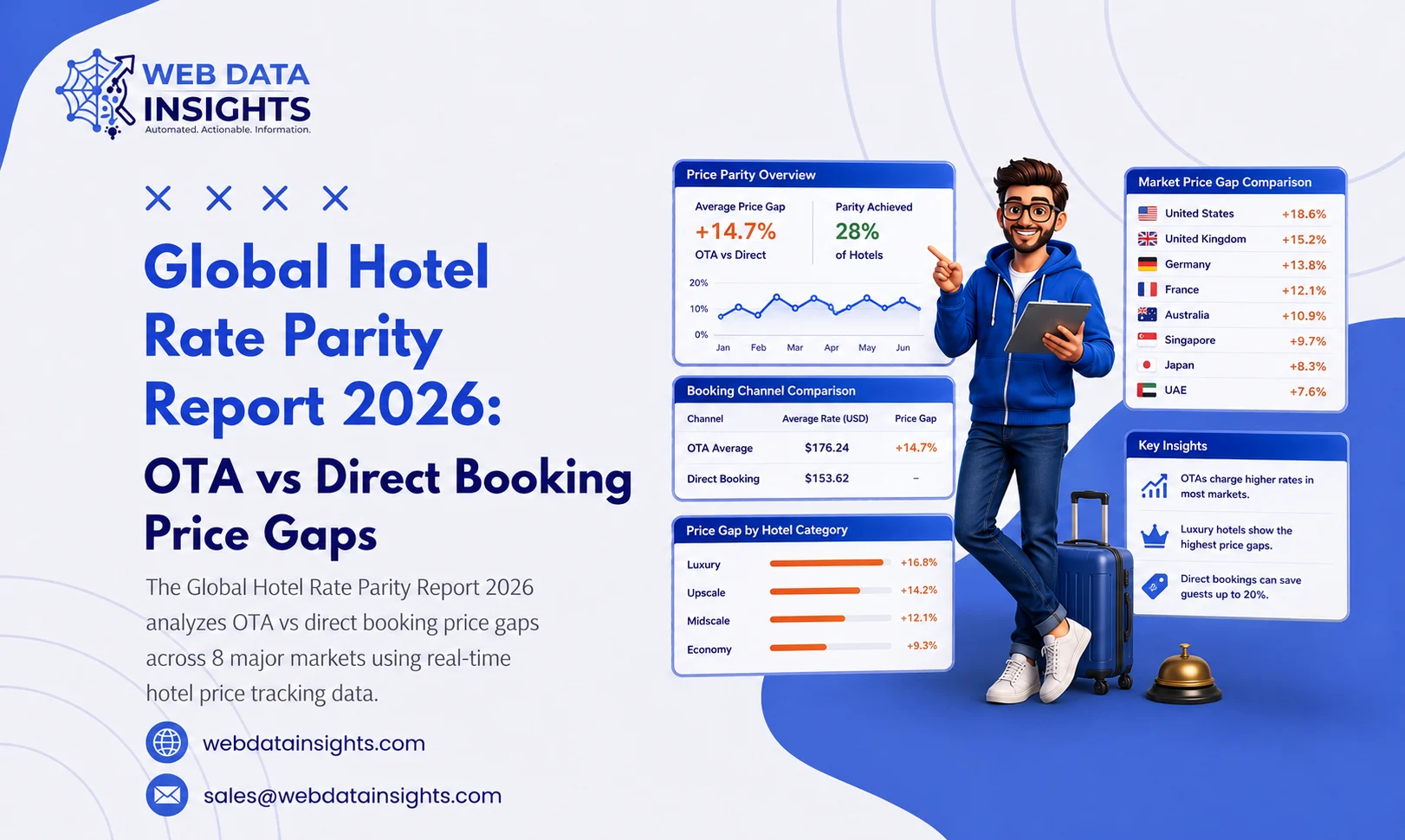
The Global Hotel Rate Parity Report 2026 studies how hotel prices differ between Online Travel Agencies (OTAs) and hotels’ own direct booking channels across eight major global markets — the United States, United Kingdom, Germany, France, UAE, Singapore, India, and Australia.
Rate parity means a hotel room is listed at the same price everywhere it is sold. When that doesn’t happen, it creates a parity gap — a measurable difference between what an OTA charges and what a hotel charges on its own website for the same room, on the same date.
This Global Hotel Rate Parity Report 2026 quantifies where those gaps are widest, why they occur, and what they mean for hotel revenue teams, OTAs, and travel-technology buyers evaluating a Hotel Rate Parity Monitoring Solution for their portfolio.
Key Terms at a Glance
- Hotel Rate Parity Data Scraping — the automated collection of hotel room rates from OTAs, metasearch sites, and direct booking pages so they can be compared side by side.
- Hotel Rate Monitoring API — a data feed that delivers structured, continuously updated hotel pricing data directly into a revenue management or business system.
- Real-Time Hotel Price Tracking — the continuous, near-instant tracking of hotel rates across channels, so price changes are visible within minutes rather than days.
- Global Hotel Pricing Intelligence — the practice of collecting and analyzing hotel pricing data across markets to guide revenue, distribution, and channel strategy.
- Hotel Rate Parity Monitoring Solution — an integrated system — combining scraping, APIs, and alerts — that detects and helps correct rate parity violations.
- Hotel Rate Parity Tracker — a tool used to continuously check, log, and report on rate consistency between OTA and direct channels.
Executive Summary
- Rate parity gaps persist across all 8 markets studied, with average deviations ranging between 4% and 14% depending on region and season.
- Emerging markets (India, UAE) showed higher volatility in parity than mature markets (UK, Germany).
- Mobile-rate and app-exclusive OTA discounts are the leading driver of parity breakage in 2026.
- Hotels without Real-Time Hotel Price Tracking are reacting to parity violations 5–10 days late on average.
- Enterprises using a structured Hotel Rate Parity Monitoring Solution detect and correct pricing discrepancies significantly faster than teams relying on manual audits.
Industry Overview
Hotel distribution today runs through multiple channels — OTAs such as Booking.com and Expedia, metasearch engines, GDS systems, and a hotel’s own website. Rate parity agreements were designed to keep prices consistent across these channels, protecting both OTA commissions and a hotel’s direct booking value.
What Is Hotel Rate Parity and Why Does It Matter?
Hotel rate parity is the principle that a given room, on a given date, should carry the same publicly listed price whether a guest books through an OTA or the hotel’s direct website. It matters because parity breaks quietly erode direct booking revenue, distort a hotel’s pricing credibility, and can trigger contractual disputes with distribution partners.
In practice, parity is difficult to enforce. OTAs apply loyalty discounts, mobile-only rates, and bundled packages that technically bypass traditional parity clauses. This has made Global Hotel Pricing Intelligence — continuous tracking and analysis of rate behavior across channels — a core operational requirement rather than a nice-to-have for revenue and distribution teams.
For hotel groups and travel-tech companies, understanding these gaps at scale requires reliable Travel Data Scraping Services that can capture pricing data accurately and consistently across regions, currencies, and booking windows.
Key Findings
The table below summarizes the average OTA-vs-direct price gap and parity consistency across all 8 markets covered in this research.
| Market | Avg. OTA vs Direct Price Gap | Parity Consistency | Primary Leakage Source |
| United States | 6–9% | Moderate | Loyalty program discounts |
| United Kingdom | 4–7% | High | Mobile-exclusive rates |
| Germany | 3–6% | High | Package bundling |
| France | 5–8% | Moderate | Last-minute OTA promotions |
| UAE | 9–14% | Low | Flash sales & app discounts |
| Singapore | 6–10% | Moderate | Corporate rate leakage |
| India | 10–14% | Low | Aggressive OTA discounting |
| Australia | 5–8% | Moderate | Seasonal promotional pricing |
Key Insight
- Markets with high OTA penetration and price-sensitive travelers (UAE, India) show the widest and most frequent parity breaks.
- Mature markets with stronger direct-channel loyalty (UK, Germany) maintain tighter pricing consistency.
Data Analysis & Insights
Rate parity gaps are not random — they follow predictable patterns tied to booking windows, device type, and promotional cycles.
How Hotel Rate Parity Monitoring Works
A modern Hotel Rate Parity Monitoring Solution typically combines three layers of technology working together:
- Data collection — Hotel Rate Parity Data Scraping gathers live rates from OTAs, metasearch, and direct sites at scheduled intervals across every target market.
- Data delivery — A Hotel Rate Monitoring API feeds this pricing data directly into revenue management systems, dashboards, or internal databases in a structured format.
- Detection and alerting — A Hotel Rate Parity Tracker compares channel prices continuously and flags violations as soon as they appear, enabling near Real-Time Hotel Price Tracking rather than end-of-week reporting.
What the Data Shows
- Price gaps widen 7–14 days before check-in, as OTAs push last-minute discounting to fill inventory.
- Mobile app rates are consistently 3–6% lower than desktop or direct-website rates.
- Weekend and holiday periods show the highest parity volatility across all 8 markets studied.
Organizations building internal pricing models or benchmarking studies can also reference structured Travel Dataset resources to validate trends against historical booking behavior.
Industry Challenges
- Fragmented data sources: Rates live across OTAs, metasearch engines, and direct sites, making manual tracking slow and error-prone.
- Delayed detection: Without a Hotel Rate Parity Tracker in place, most hotels discover violations only after revenue has already been lost.
- Regional pricing complexity: Currency conversion, tax inclusion, and regional promotions distort raw price comparisons across the 8 markets studied.
- Limited internal bandwidth: Revenue teams often lack the tooling to monitor pricing continuously across multiple markets at once.
- OTA contract ambiguity: Loyalty and app-only rates create legal gray areas that complicate parity enforcement.
Opportunities
- Automated parity enforcement: Continuous monitoring reduces revenue leakage and strengthens direct booking channels.
- Dynamic pricing alignment: Pairing parity data with AI Dynamic Pricing allows hotels to respond to OTA rate shifts in near real time.
- Stronger direct-channel positioning: Hotels that consistently monitor and correct parity gaps see improved guest trust and conversion on their own websites.
- Cross-market benchmarking: Enterprises operating in multiple regions can standardize revenue strategy using consolidated Global Hotel Pricing Intelligence.
Strategic Recommendations
- Implement a dedicated Hotel Rate Parity Monitoring Solution rather than relying on periodic manual checks.
- Use a Hotel Rate Monitoring API to integrate live pricing data directly into revenue management systems.
- Combine parity monitoring with broader Price Monitoring to track competitor and market-level rate movement.
- Prioritize markets with historically high leakage — UAE, India, and Singapore — for more frequent monitoring cycles.
- Establish internal SLAs for parity violation response, since detection alone isn’t enough without a correction process.
Best Practices for Ongoing Rate Parity Management
- Run daily or hourly scans using a Hotel Rate Parity Tracker rather than weekly manual spot checks.
- Segment monitoring by device type, since mobile-exclusive rates are the single largest source of leakage.
- Review parity data alongside booking-window trends to anticipate when gaps are most likely to widen.
- Treat Global Hotel Pricing Intelligence as an ongoing discipline, not a one-time audit.
Future Outlook
Rate parity monitoring is moving from periodic audits toward continuous, automated intelligence. As OTAs introduce more personalized and app-based pricing, static parity clauses will matter less than an organization’s ability to track and respond in real time. Hotels and travel-tech providers that invest in Global Hotel Pricing Intelligence infrastructure now — combining Real-Time Hotel Price Tracking with a reliable Hotel Rate Parity Monitoring Solution — will be better positioned to protect margins as distribution pricing grows more dynamic through 2026 and beyond.
Frequently Asked Questions
What is hotel rate parity?
Hotel rate parity means a room is offered at the same price across all distribution channels — OTAs, metasearch, and the hotel’s direct website — for the same dates and conditions.
Why do OTA and direct booking prices differ?
Price gaps typically come from loyalty discounts, mobile-exclusive rates, bundled packages, and last-minute OTA promotions that fall outside standard parity agreements.
Which markets have the widest hotel rate parity gaps in 2026?
Based on this research, UAE and India show the widest average gaps (9–14%), driven by aggressive OTA discounting and flash sales.
How can hotels detect rate parity violations faster?
By using a Hotel Rate Parity Tracker or Hotel Rate Monitoring API for continuous, Real-Time Hotel Price Tracking instead of manual, periodic checks.
What is a Hotel Rate Parity Monitoring Solution?
It is a structured system — combining Hotel Rate Parity Data Scraping, APIs, and analytics — that continuously compares OTA and direct rates to flag inconsistencies as they happen.
What is a Hotel Rate Monitoring API used for?
A Hotel Rate Monitoring API delivers live, structured hotel pricing data into a business’s own systems, removing the need for manual rate checks across markets.
What is Global Hotel Pricing Intelligence?
It is the ongoing collection and analysis of hotel pricing data across markets, used to guide revenue management, channel strategy, and parity enforcement decisions.
Conclusion
Rate parity gaps in 2026 are not a minor operational issue — they directly affect hotel revenue, OTA trust, and direct booking growth. Across all 8 markets studied in this Global Hotel Rate Parity Report 2026, the pattern is consistent: hotels without real-time visibility into pricing behavior lose the ability to protect their rates. Closing this gap starts with reliable, continuous pricing intelligence.
Get a Rate Parity Assessment
Struggling with inconsistent hotel pricing across OTAs and direct channels?
- Get a tailored rate parity assessment for your hotel portfolio or market.
- Set up real-time monitoring and identify leakage sources.
- Build a pricing intelligence framework suited to your markets.
Reliable Web Data Solutions
WebDataInsights provides clean, structured, and real-time web scraping solutions tailored to your business goals, helping automate data collection for eCommerce, market research, lead generation, and more.
Get in TouchReady to Turn Your Data into Revenue Growth?
Partner with WebDataInsights for enterprise-grade B2B data scraping, real-time price monitoring, supplier benchmarking intelligence, and seamless API data delivery.
Request Custom Dataset