





Why Scrape Amazon Fresh ? The Business Case in 2026
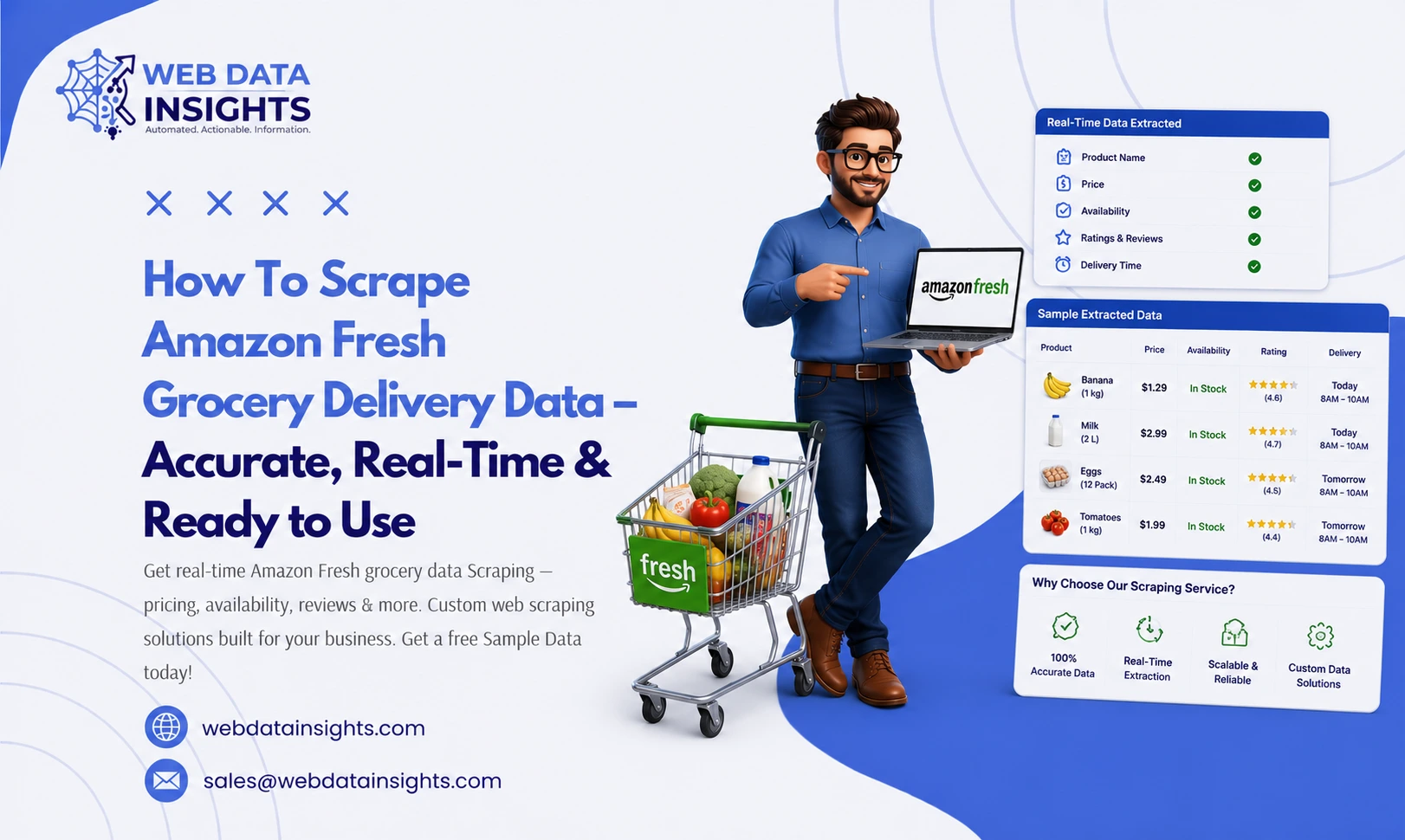
Amazon Fresh is one of the fastest-growing online grocery platforms in the world, processing millions of product listings, customer reviews, and real-time price changes every single day. For businesses operating in e-commerce, retail analytics, supply chain, or competitive intelligence, this data is pure gold. Amazon Fresh Grocery Data Scraping enables companies to systematically extract this valuable information—unlocking insights into pricing trends, product availability, customer sentiment, and competitor strategies, all in real time.
Yet most businesses rely on guesswork instead of data. They make pricing decisions without knowing what competitors charge. They launch products without analyzing consumer demand signals. They manage inventory without understanding real-time availability patterns.
Scraping Amazon Fresh grocery delivery data gives you an unfair competitive advantage — real-time visibility into pricing, product trends, customer sentiment, and market gaps that your competitors are missing.
In this comprehensive guide, we will walk you through everything: the data available on Amazon Fresh, proven web scraping techniques, step-by-step code examples, API integration methods, anti-scraping bypass strategies, and high-ROI use cases for scraped grocery data—along with how Amazon Fresh grocery data scraping services can help businesses automate data collection and gain a competitive edge at scale.
What Data Can You Extract from Amazon Fresh?
Amazon Fresh product listings are data-rich. Each listing contains layers of structured and unstructured data that can be extracted and analyzed. Here is a breakdown of the key data points available for scraping:
1. Product Listing Data
- Product name, brand, SKU, and ASIN (Amazon Standard Identification Number)
- Product category and subcategory hierarchy
- Full product descriptions and ingredient lists (for food items)
- Nutritional information and allergen data
- Product images and image URLs
- Weight, volume, unit count, and pack size
2. Pricing & Promotional Data
- Current selling price and original MRP
- Discount percentage and deal badges (Lightning Deals, Coupons)
- Subscription & Save pricing tiers
- Price per unit / per ounce for comparison
- Price history trends (via repeated scraping)
3. Availability & Delivery Data
- In-stock vs. out-of-stock status
- Delivery slots and estimated delivery windows
- Same-day delivery eligibility by zip code
- Seller information and fulfillment type (Amazon vs. third-party)
- Geographic availability differences
4. Customer Reviews & Ratings
- Overall star rating and total review count
- Individual review text, reviewer name, date, and helpfulness votes
- Verified purchase status
- Positive vs. negative sentiment breakdown
- Top keywords in customer feedback
5. Search & Ranking Data
- Product ranking in category and subcategory
- Search result position for specific keywords
- Sponsored vs. organic product placement
- Amazon Best Seller and Amazon’s Choice badges
Amazon Fresh Scraping Techniques: A Technical Deep-Dive
There is no single best method for scraping Amazon Fresh. The right technique depends on your scale, the type of data needed, and how frequently you need updates. Below are the four primary approaches used by professional data extraction teams.
Technique 1: Static HTML Scraping with BeautifulSoup
BeautifulSoup is Python’s most popular HTML parsing library. For simpler, static Amazon Fresh pages, it provides a fast and lightweight scraping solution.
# Python BeautifulSoup Example for Amazon Fresh

import requests
from bs4 import BeautifulSoup
import time
import random

HEADERS = {
    "User-Agent": "Mozilla/5.0 (Windows NT 10.0; Win64; x64)",
    "Accept-Language": "en-US,en;q=0.9",
}

def scrape_amazon_fresh_product(asin):
    url = f"https://www.amazon.com/dp/{asin}"

    response = requests.get(url, headers=HEADERS)
    soup = BeautifulSoup(response.content, "html.parser")

    # Extract product details
    title = soup.find("span", id="productTitle").get_text(strip=True)
    price = soup.find("span", class_="a-price-whole").get_text(strip=True)
    rating = soup.find("span", class_="a-icon-alt").get_text(strip=True)

    return {
        "asin": asin,
        "title": title,
        "price": price,
        "rating": rating
    }
Technique 2: Dynamic Scraping with Selenium & Playwright
Amazon Fresh uses heavy JavaScript rendering for product carousels, dynamic pricing, and availability checks. Static scrapers miss this data. Headless browsers like Selenium WebDriver and Playwright handle JavaScript-rendered content by simulating a real browser session.
- Playwright is recommended over Selenium for modern scraping — it's faster, more stable, and supports async execution
- Use stealth plugins to avoid Cloudflare and Amazon bot detection
- Rotate user agents and implement random delays between requests (2–8 seconds)
- Capture AJAX network requests to intercept JSON data before it renders to HTML
Technique 3: Scrapy Spider Framework for Large-Scale Crawling
For enterprise-grade scraping at scale — thousands of products, daily refreshes, multi-category crawls — Scrapy is the industry-standard framework. It offers built-in support for:
- Asynchronous request handling (10x faster than synchronous scrapers)
- Middleware pipelines for proxy rotation and user-agent management
- Item pipelines for automatic data cleaning, deduplication, and export
- Scrapy-Splash integration for JavaScript rendering
- Distributed Web crawling via Scrapyd or Scrapy Cloud
Technique 4: Amazon Product Advertising API & Rainforest API
Amazon's official Product Advertising API (PAAPI 5.0) provides structured access to product data for registered affiliates. While limited in scope, it offers reliable, ToS-compliant data access for certain use cases. Third-party wrappers like the Rainforest API provide broader coverage without the affiliate requirement.
Bypassing Amazon's Anti-Scraping Defenses: Expert Strategies
Amazon runs one of the most sophisticated bot detection systems on the internet. Naive scrapers get blocked within minutes. Here is how professional data extraction teams stay undetected at scale:
Proxy Rotation & IP Management
- Use residential proxies (not datacenter IPs) — Amazon blocks datacenter IP ranges aggressively
- Rotate IPs every 5–10 requests to avoid rate limiting
- Use geo-targeted proxies to access region-specific pricing and availability
- Recommended providers: Bright Data, Oxylabs, Smartproxy
Header Spoofing & Browser Fingerprint Emulation
- Always set realistic Accept, Accept-Encoding, Accept-Language, and Referer headers
- Rotate User-Agent strings across Chrome, Firefox, Safari versions
- Emulate browser fingerprints (screen resolution, timezone, WebGL) using Playwright stealth
Request Rate Throttling
- Implement random delays: time.sleep(random.uniform(2.5, 7.5))
- Avoid scraping during peak traffic hours (10am–2pm EST)
- Use exponential backoff on 503 / CAPTCHA responses
CAPTCHA Solving
- Integrate 2Captcha or Anti-Captcha services for automated CAPTCHA resolution
- Use Amazon-specific CAPTCHA bypass techniques with stealth browser sessions
10 High-Value Use Cases for Amazon Fresh Scraped Data
Scraped Amazon Fresh data is not just an analytics exercise — it translates directly into revenue, savings, and competitive edge. Here are ten proven use cases:
1. Real-Time Price Intelligence & Monitoring
Track competitor pricing across thousands of SKUs daily. Automatically adjust your own prices in response to competitor changes. Identify temporary promotions and predict when prices will revert. Amazon Fresh changes prices dynamically — real-time scraping is the only way to stay current.
2. Market Basket Analysis & Consumer Behavior Research
Scrape frequently bought together data and product recommendations to understand consumer purchase patterns. Identify which product combinations drive higher order values, and optimize your own product bundling strategy accordingly.
3. New Product Launch Research
Before launching any new grocery or FMCG product, scrape the competitive landscape: how many SKUs exist, what price bands dominate, which features customers praise or criticize in reviews. This replaces months of manual market research with hours of automated data collection.
4. Inventory & Availability Monitoring
Track stock availability for competitor products in real-time Amazon price monitoring. When a major competitor goes out of stock, there is a window to capture their demand. Automated availability scraping gives you that intelligence instantly rather than days later.
5. Sentiment Analysis from Customer Reviews
Extract thousands of verified customer reviews and run NLP sentiment analysis. Identify recurring complaints, feature requests, and pain points. Use this to build better products, craft superior marketing messages, and address customer concerns before launch.
6. SEO & Search Ranking Intelligence
Track your product's and competitors' search rankings for target grocery keywords over time. Identify which product titles, bullet points, and descriptions rank highest. Reverse-engineer Amazon's A9 algorithm signals by correlating listing attributes with ranking positions.
7. Supply Chain & Demand Forecasting
Historical price and availability data from Amazon Fresh is a reliable leading indicator of supply chain stress. When availability drops and prices spike simultaneously, it signals upstream supply disruption — valuable intelligence for procurement teams.
8. Category Management & Planogram Optimization
Retail category managers can use Amazon Fresh data to understand the full competitive set in each grocery category: how many products exist, which brands dominate shelf space, typical price tier distribution, and emerging brands gaining traction.
9. Private Label & White Label Product Strategy
Identify categories where Amazon's own private labels are capturing market share. Understand at what price point they compete and what product attributes they emphasize. Use this to position your own private label products strategically.
10. Advertising & Sponsored Product Research
Track which brands are consistently appearing in sponsored positions for target keywords. Estimate competitor advertising spend by monitoring sponsored placement frequency. Identify underserved keywords where advertising costs may be lower.
Building a Production-Grade Amazon Fresh Data Pipeline
Scraping data once is useful. Scraping it at scale, reliably, on a schedule, with clean output — that is a competitive moat. Here is the architecture of a production-grade Amazon Fresh data extraction pipeline:
Stage 1: Crawl Planning
- Define target ASINs, categories, or search keyword lists
- Prioritize by update frequency: prices daily, reviews weekly, descriptions monthly
- Build a URL queue with deduplication using Redis or a database task queue
Stage 2: Data Collection Layer
- Deploy Scrapy spiders on Scrapy Cloud or AWS EC2 with auto-scaling
- Route all requests through residential proxy pools
- Implement retry logic with exponential backoff for failed requests
- Capture raw HTML alongside parsed data for re-processing
Stage 3: Data Processing & Enrichment
- Parse extracted fields using regex and CSS selectors
- Standardize price formats, weight units, and category labels
- Deduplicate products by ASIN across scraping runs
- Run NLP pipelines (spaCy, NLTK) on review text for sentiment scoring
Stage 4: Storage & Access Layer
- Store structured product data Intelligence in PostgreSQL or BigQuery
- Store raw HTML and review text in S3 or Google Cloud Storage
- Build REST APIs for internal teams to query scraped data
- Set up real-time alerting for significant price changes or stock-out events
Stage 5: Visualization & Reporting
- Build dashboards in Tableau, Power BI, or Metabase
- Automate daily/weekly reports delivered via email or Slack
- Set KPI alerts: competitor price drop > 15%, category rank change, review volume spike
Legal & Ethical Considerations for Amazon Fresh Scraping
This section is critical. Web scraping exists in a complex legal landscape, and Amazon specifically prohibits automated data collection in its Terms of Service. However, scraping publicly available data has been upheld as legal in landmark court cases including hiQ Labs v. LinkedIn (2022). Here is what you need to know:
Always consult your legal counsel before initiating large-scale scraping operations. The information below is educational and does not constitute legal advice.
Key Principles for Responsible Scraping
- Only scrape publicly accessible data — do not attempt to bypass authentication or access private data
- Respect robots.txt directives — Amazon's robots.txt restricts certain paths
- Never store personally identifiable information (PII) from customer profiles
- Implement rate limiting to avoid impacting Amazon's server performance
- Use scraped data only for analysis, research, or your own competitive intelligence — not for resale or redistribution of Amazon's catalog
Why Choose a Professional Grocery Data Scraping Service?
Building and maintaining an in-house Amazon Fresh scraper is expensive, time-consuming, and technically demanding. Amazon constantly updates its website structure, deploys new bot detection measures, and changes its HTML markup — meaning your scrapers break frequently.
A professional web scraping service offers:
- Ready-to-deploy scraping infrastructure with proxy rotation and anti-bot bypass built in
- Dedicated engineering team that maintains scrapers as Amazon updates its site
- Guaranteed SLAs on data freshness, accuracy, and uptime
- Scalable data delivery via API, CSV, JSON, or direct database integration
- Compliance-first approach ensuring responsible, ethical data collection
- Custom data schemas tailored to your specific business requirements
| Build In-House | Use a Professional Service |
|---|---|
| High setup cost & time | Ready in days, not months |
| Scrapers break on site updates | Maintained & updated continuously |
| No proxy infrastructure | Enterprise proxy pools included |
| Unpredictable data quality | SLA-backed accuracy guarantees |
Conclusion: Turn Amazon Fresh Data into Competitive Advantage
Amazon Fresh is a living, breathing marketplace generating billions of data points every day. Businesses that systematically extract, analyze, and act on this data make smarter pricing decisions, launch better products, and outmaneuver competitors who are still operating on intuition and quarterly reports. WebDataInsights empowers organizations to harness this data at scale through advanced scraping infrastructure, real-time analytics, and enterprise-grade data delivery solutions—turning raw grocery data into actionable competitive intelligence.
Whether you need a one-time dataset for market research, a daily pricing feed for dynamic repricing, or a full-scale competitive intelligence pipeline, professional Amazon Fresh data extraction services can get you from zero to insights in days.
The difference between market leaders and followers is often not strategy—it is data. Scrape Amazon Fresh data, and you will see market opportunities your competitors cannot. To unlock this advantage at scale, contact WebDataInsights and transform real-time grocery data into actionable growth strategies.
Frequently Asked Questions
Is scraping Amazon Fresh legal?
Scraping publicly accessible data is generally legal in many jurisdictions, supported by the hiQ v. LinkedIn ruling. However, it may violate Amazon's Terms of Service. For commercial use, always engage legal counsel and consider using compliant data service providers.
What is the best tool for scraping Amazon Fresh data?
For small scale: BeautifulSoup + Requests. For JavaScript-heavy pages: Playwright or Selenium. For enterprise-scale crawling: Scrapy with middleware pipelines. For managed, no-maintenance data delivery: a professional scraping API service. All tools remain highly relevant in 2026.
How often can I scrape Amazon Fresh prices?
Pricing on Amazon Fresh can change multiple times per day for popular items. For price intelligence use cases, scraping every 4–6 hours gives sufficient granularity. Daily scraping is adequate for trend analysis.
What data format is Amazon Fresh scraped data delivered in?
Typically JSON or CSV for flat data. For complex hierarchical data (reviews with nested metadata), JSON-LD or structured JSON is preferred. Database delivery in PostgreSQL or BigQuery is available through managed services.
Can I scrape Amazon Fresh without getting blocked?
Yes, but it requires residential proxies, realistic browser fingerprinting, randomized request delays, and CAPTCHA-solving infrastructure. Off-the-shelf scrapers without these measures will be blocked quickly.
Reliable Web Data Solutions
WebDataInsights provides clean, structured, and real-time web scraping solutions tailored to your business goals, helping automate data collection for eCommerce, market research, lead generation, and more.
Get in Touch