





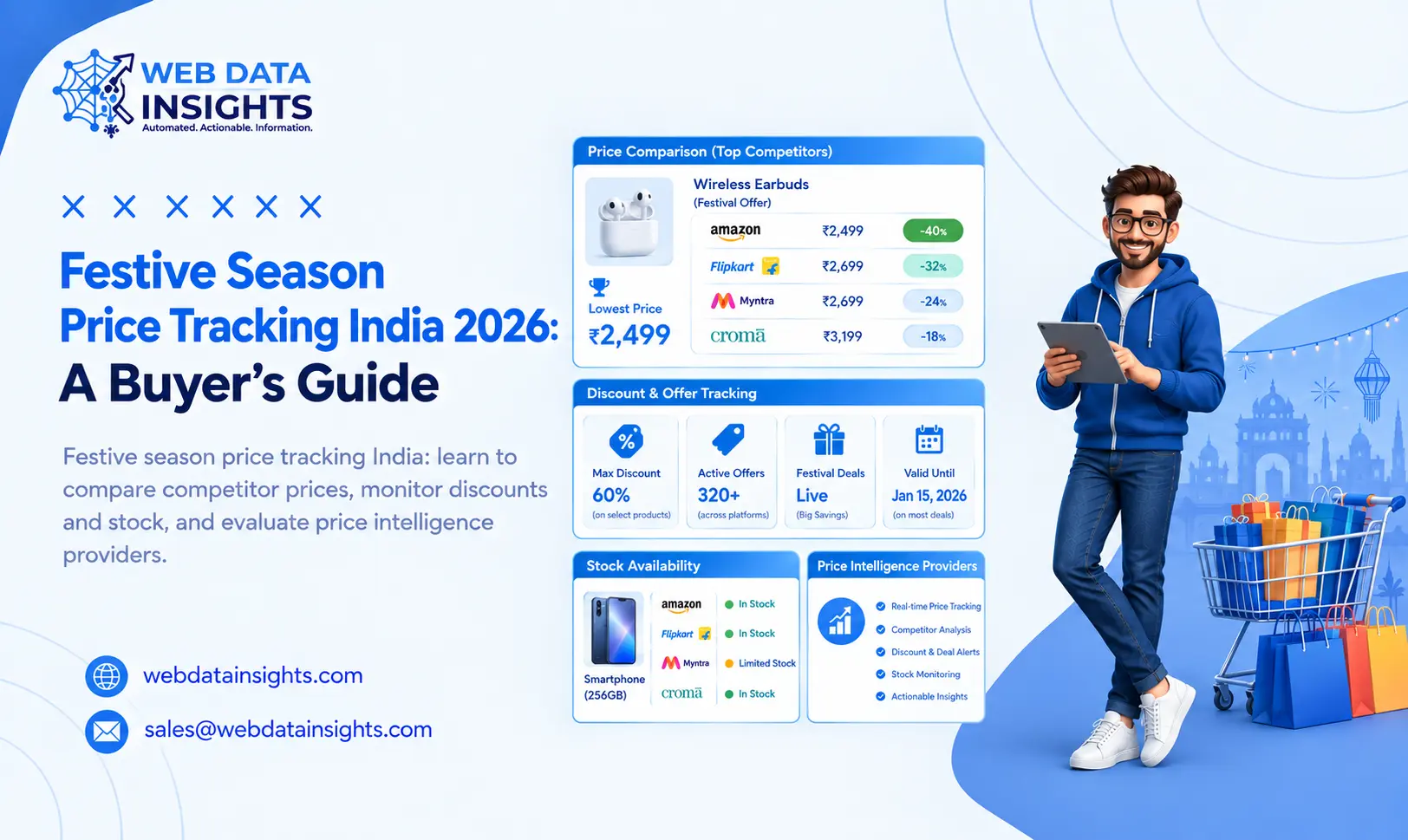
During big Indian retail promotions, prices, discount labels, seller listings and stock status can change several times within a day. A competitive-looking offer may be out of stock by evening, or sit behind a bank-card condition only some shoppers can use. Festive season price tracking India teams rely on is the regular collection of competitor prices, offers, sellers and availability from e-commerce sites, followed by validation and storage so the data can be compared over time.
This kind of e-commerce price intelligence turns scattered page views into a structured, dated record. This guide explains what to monitor, how collection methods compare, how to judge data quality and how to evaluate a provider. It is written for pricing, category and competitive intelligence teams.
Why Festive Season Price Tracking India Matters for Businesses in 2026
Festive sale tracking gives pricing and category teams a dated view of what competitors are doing while promotions are live. It helps answer practical questions: who changed prices and when, whether a discount covered every variant, whether a seller disappeared, and which products went out of stock.
It also helps to keep forecasts in perspective. RedSeer expected festive-season online sales in 2025 to exceed Rs 1.15 lakh crore. Market estimates are useful context, but they cannot show what happened on your own product pages. Direct observation does.
Monitoring supports pricing, promotion and inventory decisions. It does not guarantee better sales or margins, and its value depends on data quality and how your team acts on it.
What Data Should Businesses Monitor for Product Availability Monitoring During Festive Sales?
Effective product availability monitoring needs more than a price and an “in stock” label. Capture identifiers so listings can be matched, the offer details that explain the price, and a timestamp for every observation. The table summarises the core fields.
| Data Field | Business Use | Validation Check |
|---|---|---|
| Product title, URL, brand, model, SKU and other identifiers | Match the same product across sites and over time | Compare model number and variant attributes, not the title alone |
| Listed price | Baseline price comparison | Confirm currency, tax basis and the exact capture time |
| Eligible offer price | Understand the price a buyer can actually pay | Record every condition attached, such as card, coupon or membership |
| Discount label and reference price | Interpret promotional claims | Check how the reference price changes between observations |
| Seller information | Compare sellers and spot seller changes | Verify the seller name is captured per observation |
| Stock status and delivery estimate | Spot availability gaps and fulfilment differences | Keep distinct states such as in stock, low stock, out of stock and unavailable |
| Product variants | Avoid comparing different colours, sizes or storage tiers | Confirm each variant has its own price and stock record |
| Ratings and review counts | Add context to competitive position | Check whether figures belong to the variant or the parent listing |
| Timestamps and historical observations | Review price and stock movement over time | Confirm every record carries a collection time and source URL |
Bank offers, coupons, membership discounts and exchange offers may apply only to some buyers, so store the conditions as separate fields rather than folding them into one headline price.
Teams that need structured product, price, seller and stock fields at scale can look at Ecommerce Data Scraping as one way to collect them.
Manual Tracking vs. Spreadsheets vs. Automated Data Collection
No single method suits every business. The right choice depends on how many products, sites and fields you track, and how often.
- Manual tracking: Low setup effort, but slow, hard to repeat consistently and impractical beyond a small product set.
- Spreadsheets: Good for storing and sorting data, but version control and history become hard as sources and refresh cycles grow.
- Automated data collection: Built for scale, scheduled refreshes and consistent history, but it needs setup and ongoing maintenance because websites change layouts. Costs depend on scope.
A hybrid approach is common: track a few strategic products by hand, analyse in a spreadsheet, and automate as needs grow. When scope outgrows internal capacity, businesses often evaluate managed Web Scraping Services to handle collection, maintenance and delivery.
How Competitor Price Monitoring Helps Businesses Make Better Pricing Decisions
Competitor price monitoring is useful only when the compared items are truly comparable. That starts with product matching: linking listings from different sites to the same product and variant.
Similar titles do not always mean the same item. A phone with 128 GB storage and one with 256 GB can share almost identical titles, and a bundle may include accessories that change the real price. Match on brand, model number, variant attributes and identifiers, and send uncertain matches for review instead of guessing.
Good monitoring also records seller comparisons, price history, offer conditions and stock movements. Mark missing data as missing, because an absent price can mean a delisting, a page error or a collection failure, and each needs a different response. Basic checks include duplicate detection, outlier review and spot checks against live pages.
Teams that want to benchmark specific rivals side by side can explore Competitor Comparison as a structured way to do so.
How to Choose Web Scraping Services in India for Festive-Season Price Intelligence
When shortlisting web scraping services India teams can choose from, compare providers on the same criteria:
- Source coverage: Which marketplaces and brand sites are supported, and how are new ones added?
- Product matching: How are variants handled and uncertain matches flagged?
- Accuracy and completeness: How is field-level accuracy measured and missing data handled?
- Refresh frequency: How often is each source revisited?
- Historical data: Is every observation stored with a timestamp?
- Delivery formats: CSV, JSON, API or database, matched to your tools.
- Scalability, maintenance and support: What happens when a site changes its layout mid-sale?
- Pricing and scope: What is included, and what triggers extra cost?
- Compliance and responsible collection: How does the provider treat site terms, access rules and data protection?
Define refresh frequency precisely. “Real time” is vague unless the provider states what it means operationally: how often each source is checked, how long delivery takes after collection and what happens when a check fails. “Every 30 minutes for selected products, delivered within an hour” is a clear commitment.
Providers should explain how they respect website rules, including the Robots Exclusion Protocol, and how they limit load on source sites. Seek legal advice for your own use case.
If your main need is ongoing rival tracking, ask how a Competitor Price Monitoring workflow would be scoped, refreshed and delivered for your categories.
How E-Commerce Price Intelligence Supports Better Competitive Analysis
Once data is collected and validated, e-commerce price intelligence supports analysis rather than raw reporting. Structured records let teams compare like-for-like products and line up promotions on a timeline.
Uses include reviewing price movements by category, checking whether a discount label reflects a real change in the reference price, and comparing offer prices once card or coupon conditions apply. Patterns worth investigating include repeated stock-outs on a competitor’s best sellers or a price drop that spreads from one site to others.
The data shows what changed and when, not why, so treat patterns as prompts for review rather than conclusions.
India’s Guidelines for Prevention and Regulation of Dark Patterns, 2023 describe drip pricing, where price elements are revealed only later in the buying journey. Record whether a competitor’s displayed price is the full amount payable or a pre-fee figure, so comparisons stay fair.
How to Evaluate a Provider Before Committing
A sample is the most practical way to test a provider. Follow a simple process:
- Define the sample. Choose products, sources and fields that reflect real needs, including multi-variant products and conditional offers.
- Verify against live pages. Check source URLs, identifiers, prices, offer conditions, stock states and sellers against the pages.
- Inspect data hygiene. Look at timestamps, duplicates, missing values and how collection failures are reported.
- Check delivery. Confirm format, field naming and schedule fit your systems.
- Set acceptance criteria. Agree in writing the accuracy, completeness and refresh levels that count as acceptable.
- Clarify costs and compliance. Confirm what the quoted price covers and how responsible collection is handled.
A sample does not prove long-term reliability. It shows quality on a limited set of items at one point in time, while reliability across all sources and peak traffic emerges only with sustained operation.
What Businesses Should Do After the Festive Sales Period
When the sales end, the collected history becomes a planning asset. Review price movements by category, availability trends and the timing of competitor promotions, and compare categories to see where competitors discounted early, late or not at all.
Use the findings to shape next year’s scope. Observed changes do not by themselves prove causation: a competitor’s price cut and your sales dip may or may not be linked, so combine price data with your own sales, traffic and inventory records.
Frequently Asked Questions
How can businesses track competitor prices during festive sales?
Choose the products, sources and fields to monitor, then collect them on a defined schedule using manual checks, spreadsheets or automated collection. Also store timestamps, offer conditions and seller details, and validate samples against live pages.
What data should be monitored during Diwali sales?
At minimum, monitor product identifiers, listed and offer prices, discount labels and reference prices, seller names, stock status, delivery estimates, variants and timestamps. Also record the conditions on bank, coupon, membership and exchange offers.
How frequently should competitor prices be updated?
There is no universal frequency. It depends on how volatile your categories are, how many products you track and what decisions the data supports. Fast-moving categories may justify several checks a day. Ask any provider to state exactly how often each source is checked.
Is automated price monitoring better than manual tracking?
Not always. Automation suits larger product sets, frequent refreshes and historical analysis. Manual tracking can be enough for a small number of products. Choose based on scale, frequency, maintenance effort and budget.
How much does a custom price monitoring solution cost?
Costs vary with the number of sources and products, fields, refresh frequency, historical depth, delivery format and support level. No fixed figure applies without a defined scope, so request a scoped proposal.
Conclusion
Strong festive season price tracking India programmes rest on a few habits: consistent data collection, careful product matching, validation of offer conditions, useful historical records and a disciplined provider evaluation. WebDataInsights helps businesses explore data scraping and competitor price monitoring solutions tailored to their data requirements, supporting more informed pricing comparisons and market analysis.
Reliable Web Data Solutions
WebDataInsights provides clean, structured, and real-time web scraping solutions tailored to your business goals, helping automate data collection for eCommerce, market research, lead generation, and more.
Get in Touch