





Research Summary
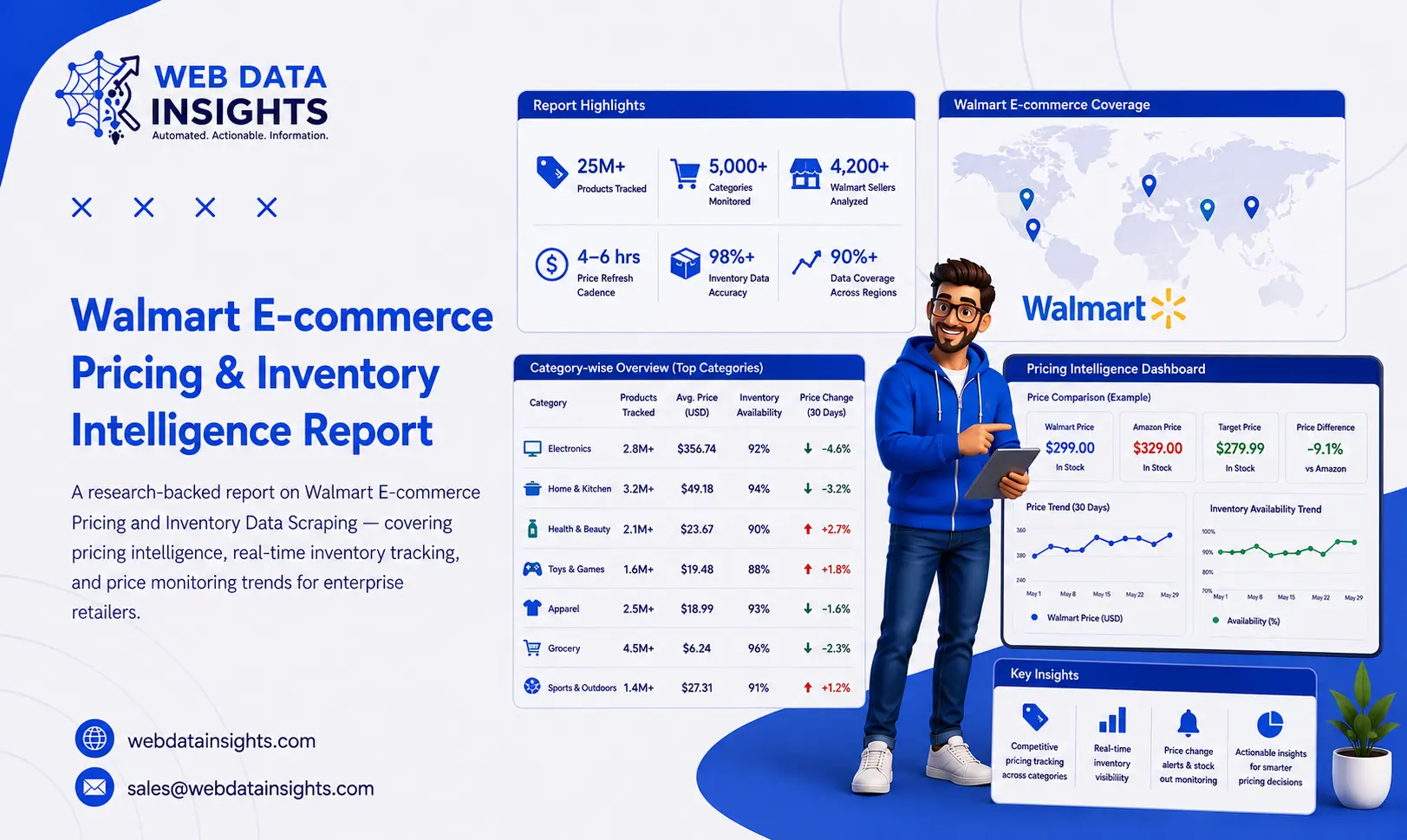
This report examines Walmart E-commerce Pricing and Inventory Intelligence — how product prices and stock levels behave on Walmart’s marketplace, and what that means for sellers and brands tracking competitiveness. Using structured Walmart inventory data extraction alongside pricing data, this research looks at how frequently prices change, how stock availability shifts, and where the two intersect to affect seller performance.
For brands and sellers operating on Walmart, pricing and inventory are rarely static. Understanding both together — not in isolation — gives a far more accurate picture of competitive positioning than tracking price alone.
Executive Summary
- Walmart product pricing shifts most frequently in high-competition categories, often multiple times within a single week.
- Stock-outs and low-inventory signals frequently precede price increases, suggesting sellers adjust pricing as availability tightens.
- Categories with fast inventory turnover show more repricing activity than steady, slow-moving categories.
- Sellers without real-time Walmart inventory tracking often miss the window to adjust their own pricing before competitors do.
- Combining price and inventory signals gives a clearer read on competitor strategy than monitoring price changes alone.
Industry Overview
Walmart’s marketplace has grown into a major channel for third-party sellers and brands, running alongside its retail-owned inventory. Prices and stock levels on the platform shift continuously, driven by competitive repricing, demand fluctuations, and Walmart’s own inventory management systems.
What Is Walmart Pricing Intelligence and Why Does It Matter?
Walmart pricing intelligence is the ongoing tracking and analysis of product prices on Walmart’s marketplace, used to understand competitive positioning and repricing behavior. It matters because a price change without inventory context — or an inventory shift without pricing context — only tells half the story.
Building this kind of visibility depends on reliable Ecommerce Data Scraping that can capture pricing and stock data consistently across large product catalogs.
Key Findings
The table below summarizes price change frequency and stock volatility by category type.
| Category Type | Avg. Price Change Frequency | Stock Volatility | Relationship Observed |
| High-competition (electronics, household) | Several times per week | High | Price increases often follow stock tightening |
| Moderate-competition (apparel, home goods) | Weekly | Moderate | Price and stock move somewhat independently |
| Low-competition (staples, essentials) | Infrequent | Low | Stable pricing regardless of stock levels |
Key Insight
- In high-competition categories, inventory tightening is one of the clearest early signals of an upcoming price increase.
- This makes stock data nearly as valuable as price data itself for competitive tracking.
Data Analysis & Insights
Looking at Walmart pricing and inventory data together reveals patterns that price tracking alone would miss.
What the Data Shows
- Price increases in high-competition categories frequently follow a period of declining stock availability, rather than occurring independently.
- Categories with faster inventory turnover show noticeably more frequent repricing activity than slow-moving categories.
- Out-of-stock signals sometimes precede a listing’s price reappearing higher once restocked, particularly for in-demand SKUs.
This kind of pattern is only visible with real-time Walmart inventory tracking run alongside pricing checks — a single, periodic price check would miss the sequence entirely. Structured, ongoing Walmart product price monitoring turns individual data points into a usable competitive signal.
For teams building internal models or validating these trends further, a structured Walmart Product Dataset can help confirm pricing and stock patterns against historical listing behavior.
Industry Challenges
- Disconnected tracking: Many sellers track price and inventory separately, missing the relationship between the two.
- Update frequency: Fast-moving categories can change price or stock status multiple times a day, making manual checks impractical.
- SKU-level complexity: Large catalogs with thousands of SKUs make consistent tracking difficult without structured tooling.
- Attribution difficulty: Distinguishing a genuine competitive price move from a routine inventory-driven adjustment takes structured pattern analysis.
- Delayed reaction: Without near real-time visibility, sellers often adjust their own pricing after a competitive window has already closed.
Opportunities
- Earlier competitive response: Tracking inventory alongside pricing allows sellers to anticipate price changes before they fully take effect.
- Smarter restocking decisions: Understanding how stock tightening correlates with pricing helps sellers time their own restocking and pricing moves.
- Category-level prioritization: Knowing which categories show the highest price-inventory correlation helps teams focus monitoring where it matters most.
- Stronger repricing strategy: Combining Walmart pricing intelligence with inventory context supports more informed automated repricing rules.
Strategic Recommendations
- Set up real-time Walmart inventory tracking alongside pricing monitoring rather than treating the two as separate processes.
- Prioritize monitoring for high-competition categories, where price and inventory shifts happen most frequently and most closely together.
- Pairing this with a broader Competitor Price Monitoring Services approach helps sellers track pricing behavior across Walmart alongside other marketplaces they compete on.
- Use stock-level signals as an early indicator when setting repricing rules, rather than reacting to price changes alone.
- Review high-turnover categories more frequently than stable, low-volatility categories.
- Maintain ongoing Walmart product price monitoring rather than reverting to periodic manual checks once initial tracking is set up.
Future Outlook
As competition on Walmart’s marketplace continues to intensify, the relationship between pricing and inventory will likely become an even stronger signal for sellers trying to stay competitive.
Sellers who treat price and stock data as connected — rather than separate metrics — will be better positioned to anticipate competitor moves rather than react to them after the fact. Continuous, structured Walmart E-commerce Pricing and Inventory Intelligence is becoming a baseline requirement for serious marketplace sellers heading into 2026 and beyond.
Frequently Asked Questions
What is Walmart E-commerce Pricing & Inventory Intelligence?
It is the practice of tracking Walmart product prices and stock levels together to understand competitive pricing behavior and anticipate future price changes.
How does inventory data relate to Walmart pricing changes?
Based on this research, price increases in high-competition categories often follow a period of tightening stock availability, making inventory a useful early signal.
Why is real-time Walmart inventory tracking important for sellers?
Because stock levels can shift quickly, and sellers without near real-time visibility often miss the window to adjust pricing before competitors react.
Which product categories show the strongest link between price and inventory?
High-competition categories like electronics and household goods show the clearest relationship between stock tightening and price increases.
How can sellers track Walmart pricing and inventory at scale?
By using structured Walmart inventory data extraction combined with ongoing Walmart product price monitoring, rather than relying on manual, periodic checks.
Conclusion
Tracking Walmart prices without inventory context only tells half the story. This report shows that stock availability and pricing move together more often than not, particularly in high-competition categories — making combined tracking far more valuable than price monitoring alone. Sellers and brands that build this kind of continuous intelligence are better equipped to anticipate competitive moves rather than respond to them late. For ongoing Walmart pricing and inventory intelligence, contact WebDataInsights to turn product data into actionable competitive insights.
Reliable Web Data Solutions
WebDataInsights provides clean, structured, and real-time web scraping solutions tailored to your business goals, helping automate data collection for eCommerce, market research, lead generation, and more.
Get in TouchReady to Turn Your Data into Revenue Growth?
Partner with WebDataInsights for enterprise-grade B2B data scraping, real-time price monitoring, supplier benchmarking intelligence, and seamless API data delivery.
Request Custom Dataset