





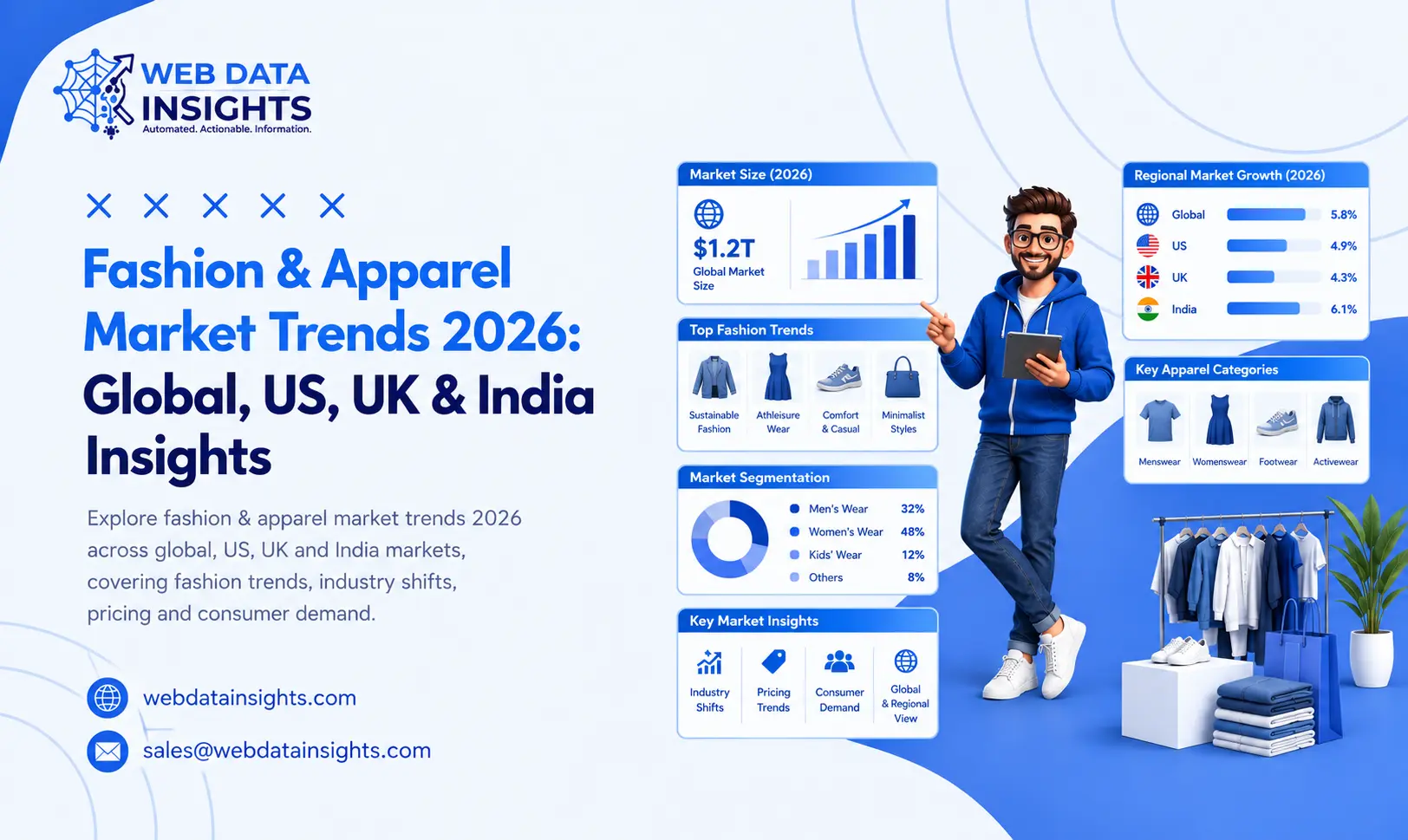
The global fashion and apparel market is valued at roughly USD 1.8 to 1.9 trillion in 2026, growing at a mid-single-digit annual rate. Fashion & apparel market trends 2026 are being shaped less by new consumer tastes and more by structural pressure: tariff-driven cost increases, tighter markdown discipline, and online channels growing far faster than physical retail.
Country-level dynamics diverge sharply. The US is the largest single market and is absorbing the bulk of new tariff costs. The UK has one of the most digitally mature fashion sectors in Europe. India is the fastest-growing large market, powered by a young, mobile-first shopper base and platforms such as Myntra. Across all three, brands are shifting investment toward direct-to-consumer (D2C) channels and leaning more heavily on pricing and assortment data to protect margin.
What Are the Biggest Fashion & Apparel Market Trends 2026?
The defining fashion industry trends 2026 are tariff-driven price inflation, faster growth in online and social commerce than in physical retail, tighter markdown discipline after years of habitual discounting, and rising reliance on data and AI for pricing and personalization decisions.
- Tariffs are reshaping cost structure, not yet consumer prices. US apparel tariffs roughly doubled between early and late 2025, but retail prices moved only modestly through most of that period, meaning brands absorbed the increase into margin rather than passing it on immediately.
- Online and social commerce are outgrowing the category. Global fashion e-commerce is on track to approach USD 950 billion to 1 trillion in 2026, expanding nearly twice as fast as overall apparel sales.
- Discounting is becoming more disciplined. Full-price sell-through has fallen from a historical 70 to 75% norm to roughly 50%, pushing brands toward planned markdown ladders instead of reactive discounting.
- Value and premium segments are both holding share. Off-price and resale formats are gaining attention even as premium positioning holds up in specific markets, producing a more polarized market than a single “trading up” or “trading down” story would suggest.
- Data has become a competitive necessity. As tariff costs vary by sourcing country and fiber type, brands increasingly depend on structured pricing and assortment data rather than intuition.
How Large Is the Global Fashion & Apparel Market in 2026?
The global fashion and apparel market is valued at approximately USD 1.8 to 1.9 trillion in 2026, with most forecasts projecting 4 to 6% annual growth through 2030. Figures vary depending on whether footwear and accessories are included, and whether the estimate reflects retail sales value or manufacturer revenue.
| Source | 2026 Market Value | Forecast Period | CAGR |
|---|---|---|---|
| The Business Research Company | USD 1,788.74 billion, reaching USD 2,212.89 billion by 2030 | 2026-2030 | 5.5% |
| Grand View Research | USD 1.9 trillion, reaching USD 2.5 trillion by 2033 | 2026-2033 | 4.1% |
| MarkWide Research | USD 1.87 trillion, reaching USD 3.11 trillion by 2035 | 2026-2035 | 5.8% |
These figures are not directly interchangeable, since methodology and category scope differ by source. What is consistent is the direction: the market is large, still growing, and expanding faster online than offline. Within the category, women’s apparel is the largest single segment globally, with a projected market volume of roughly USD 1.00 trillion in 2026, and mass-market apparel accounts for the majority of global revenue, underscoring that volume growth remains concentrated in accessible price points rather than luxury.
How Is Consumer Fashion Shopping Changing in 2026?
Fashion shopping in 2026 is shifting toward mobile-first discovery, social commerce, and active price comparison across channels before purchase. Shoppers expect personalization and fast delivery, but remain sensitive to price on discretionary items.
Social commerce has moved from an emerging channel to a mainstream one: the global social commerce market is projected to reach close to USD 1 trillion in 2026, driven largely by short-form video platforms where discovery and purchase intent form in the same session. Returns remain a persistent friction point, with the National Retail Federation estimating that 19.3% of online sales will be returned, apparel among the most exposed categories. This is why virtual try-on and AI sizing tools, which have cut return rates by 40 to 50% at adopting brands, have moved from novelty features to standard retention tools.
How Fast Is D2C Fashion Growing?
Direct-to-consumer fashion is growing faster than the broader apparel market, though its share of total e-commerce is stabilizing rather than continuing to expand rapidly. Fashion and apparel remain the largest single category within the global D2C model, accounting for roughly 34% of total D2C market share.
In the US, D2C e-commerce reached USD 239.75 billion in 2025, about 19.2% of total retail e-commerce. That stabilizing share suggests D2C is no longer taking share from marketplaces at its earlier pace, and is instead growing in line with online retail overall. Brands are not treating D2C as a marketplace replacement so much as a complementary channel that offers margin control and direct customer data, though the trade-off is real: fashion returns run at roughly 25% on DTC sites, notably higher than the broader DTC average of 14.2%, making returns a meaningful cost consideration in channel strategy.
For brands managing pricing and assortment across owned sites, marketplaces and third-party sellers at once, structured monitoring of product listings and pricing has become a practical requirement. Web Scraping Services support brands that need this kind of cross-channel visibility.
How Are Fashion Prices Changing in 2026?
Fashion pricing trends 2026 show apparel moving from years of near-flat inflation toward renewed price growth, driven primarily by tariffs rather than demand-side pressure. US apparel tariffs climbed from roughly 14.7% in early 2025 to over 30% by year-end, yet average retail prices rose only about 0.3% over the same window, as brands absorbed most of the cost into margin.
That gap is now closing. US apparel CPI reached 135.8 in March 2026, up about 14% from 2021 levels, with year-over-year inflation accelerating from 2 to 3% up to roughly 5% as tariff costs work through supply chains. Brand sentiment has shifted accordingly: 71% of fashion executives now plan price increases in 2026, up from 52% previously. In response, markdown strategy is tightening, with brands building planned discount ladders into seasonal buys instead of discounting reactively, since every unplanned markdown now compounds an already thinner margin.
For brands tracking how competitors’ pricing and promotions move in near real time, Competitor Price Monitoring has become central to protecting margin under these conditions.
Which Fashion Categories Are Seeing the Strongest Demand?
Women’s apparel remains the largest category globally by both volume and revenue, while activewear, athleisure and online footwear are growing faster than the category average. Category performance is also diverging by price sensitivity: necessities are absorbing tariff-driven cost increases fastest, while brands are holding prices on discretionary items to protect volume.
Fast fashion remains resilient despite sustainability scrutiny, estimated at approximately USD 180.6 billion in 2026 and forecast to grow at a 10 to 14% CAGR through 2032, roughly double the pace of the broader apparel market. Necessities such as basics and underwear saw the fastest price increases in late 2025 and early 2026, while more discretionary categories like dresses and swimwear saw smaller increases, since brands are more willing to protect volume where purchases can be deferred.
What Do US Fashion Market Trends 2026 Reveal?
US fashion market trends 2026 show the largest apparel market in the world by revenue, alongside the most direct exposure to tariff-driven cost pressure of any market in this report. Revenue in the US apparel market is approximately USD 373 billion in 2026, growing modestly at under 2% annually, reflecting a mature, largely saturated market rather than one gaining new shoppers.
E-commerce is the more dynamic part of the story: US fashion e-commerce is projected to reach roughly USD 241 billion in 2026, the largest fashion e-commerce market in the world, with apparel contributing 45% of that revenue. As detailed above, tariff-driven CPI increases are flowing through more visibly into 2026 pricing than they did through most of 2025, making the US the market most affected by trade policy among the three covered here. Major players shaping the market include Nike, Gap, PVH Corp, Hanesbrands and Levi’s, alongside Amazon and off-price retailers that dominate value-driven volume.
What Do UK Fashion Market Trends 2026 Reveal?
UK fashion market trends 2026 show one of the most digitally mature fashion sectors in Europe, with e-commerce accounting for a larger share of apparel spending than in most comparable markets. The UK apparel market generated approximately £68.7 billion in revenue in 2025, the third-largest apparel and footwear market globally behind the US and China, growing at a steadier pace of roughly 3.4% annually.
E-commerce now represents approximately 60% of all UK apparel transactions once pure-play online retailers and the digital channels of high-street brands are combined, and social commerce accounts for an estimated 23% of online fashion purchases, the highest proportion in Europe. Unlike the US, UK pricing pressure is driven less by tariffs and more by regulatory scrutiny: enforcement under the Digital Markets, Competition and Consumers Act is pushing retailers toward more precise, transparent discount presentation. Major UK-relevant players include Marks & Spencer, ASOS, Next and Primark, alongside international entrants such as Shein that compete heavily on price.
What Do India Fashion Market Trends 2026 Reveal?
India is the fastest-growing large fashion market among the three covered in this report, supported by rising smartphone adoption, a young shopper base and rapid growth in online and app-based fashion retail. Revenue in the Indian apparel market is projected to reach USD 115 billion in 2026, smaller in absolute terms than the US or UK but growing at a materially faster underlying rate.
Online fashion is the primary growth engine: India’s online fashion retail segment is expected to grow at a 21.1% CAGR between 2026 and 2030, well above what mature markets are seeing in their overall apparel categories. Nearly 60% of online fashion shoppers in India are under age 30, and menswear is the fastest-growing online category in tier-2 cities, reflecting how smartphone access is expanding the shopper base beyond major metros. Pricing remains anchored by a large, price-sensitive mass market, led by brands such as Max Fashion and Pantaloons, even as a smaller premium segment grows quickly. Major players include Reliance’s Ajio, Flipkart Fashion, Nykaa Fashion, Tata’s Westside and Zudio, alongside D2C entrants like Bewakoof and Snitch, in addition to Myntra, covered below.
What Role Does Myntra Play in India’s Fashion Market?
Myntra is a fashion e-commerce platform and marketplace, not a manufacturer or owned apparel brand. It functions as a digital storefront connecting hundreds of brands and sellers with consumers, and it holds a particularly strong position in India’s premium online fashion segment, with an estimated 60 to 70% share of that specific segment.
Myntra was the largest e-commerce fashion retailer in India in 2025, with online revenue of approximately USD 12.5 billion. Its relevance extends beyond sales volume: the platform works with more than 400,000 creators every month for content-driven discovery, and it has invested in AI-powered styling tools that suggest personalized outfits from its catalog. For brands and analysts tracking assortment, pricing and promotions at the SKU level on the platform, the Myntra Dataset supports this kind of granular analysis.
How Do Fashion Markets Differ Across the US, UK and India?
The US, UK and India represent three distinct growth patterns rather than three points on the same curve. US growth comes mainly from tariff-driven price increases layered on a flat volume base. UK growth comes from a shift of existing spending into digital channels. India’s growth comes from genuinely new shoppers entering the category, a structurally more durable pattern than the other two.
| Market | 2026 Apparel Market Size | Growth Rate | Defining Trend |
|---|---|---|---|
| United States | ~USD 373 billion | ~1.8% annually | Tariff-driven price inflation reaching consumers |
| United Kingdom | ~£68.7 billion (2025) | ~3.4% annually | Regulatory scrutiny of discount pricing |
| India | ~USD 115 billion | ~3.1% annually (apparel); online ~21% CAGR | Young, mobile-first shopper base scaling fast |
What Are the Biggest Challenges and Opportunities for Fashion Brands in 2026?
The biggest challenge facing fashion brands in 2026 is protecting margin against tariff-driven cost increases while unwinding years of habitual discounting; the biggest opportunity is using pricing and assortment data to plan for both rather than reacting after the fact.
Key challenges
- Tariff uncertainty: unconfirmed rates for major sourcing countries make it difficult to plan sourcing and pricing with confidence.
- Margin compression from discounting habits: markdowns now consume 20 to 50% of net sales in some segments, eating into margin built before costs rose.
- Marketplace dependence: brands relying heavily on third-party platforms have less control over pricing presentation and customer data.
- Elevated return rates: apparel returns remain costlier than most other e-commerce categories, as noted in the D2C section above.
Key opportunities
- Structured markdown planning: optimized markdown management can produce a 400 to 800 basis point gross-margin uplift over reactive discounting.
- AI-assisted personalization: styling tools and virtual try-on, as seen with Myntra in India and adoption in the US and UK, are most valuable where they measurably cut returns.
- Real-time competitive visibility: granular fashion and apparel data scraping lets brands see pricing and assortment shifts as they happen rather than after a reporting cycle closes.
Is the Fashion Industry’s Growth Expected to Continue Beyond 2026?
Yes. Most credible forecasts project continued global growth through 2030 and beyond, though at a more moderate pace than the post-pandemic recovery years, with growth increasingly driven by online and mobile commerce expansion in emerging markets rather than volume growth in mature ones. The global market is projected to reach roughly USD 2.2 trillion by 2030 under widely cited forecasts, a projection rather than an observed outcome, and one that could shift further if tariff policy continues to evolve as it has through 2026.
FAQ
How large is the global fashion and apparel market in 2026?
The global fashion and apparel market is valued at approximately USD 1.8 to 1.9 trillion in 2026, growing at roughly 4 to 6% annually through 2030. Figures vary by source depending on category scope, but all point to continued mid-single-digit growth led by online channels.
Which fashion markets are growing fastest?
India is the fastest-growing large fashion market, with online fashion retail expanding at a 21.1% CAGR through 2030, well ahead of the US and UK. Its growth comes from new shoppers entering the category, driven by rising smartphone adoption and a young, urbanizing population.
How is D2C changing the fashion industry?
D2C now accounts for roughly a third of the total direct-to-consumer market and continues to grow, though its share of total e-commerce is stabilizing. Brands use D2C for margin control and direct customer data, but higher return rates than other online channels remain a real cost trade-off.
Why are fashion prices rising in 2026 after years of staying flat?
Fashion prices are rising primarily because of sharply higher US tariffs on imported apparel, which brands initially absorbed into margin. As that absorption capacity runs out in 2026, tariff costs are increasingly passing through to retail prices.
Is Myntra a fashion brand or a marketplace?
Myntra is a fashion e-commerce platform and marketplace that connects brands and sellers with Indian consumers. It is not a conventional apparel manufacturer, though it holds an estimated 60 to 70% share of India’s premium online fashion segment specifically.
What should fashion brands prioritize in 2026?
Fashion brands should prioritize disciplined, pre-planned markdown strategy and real-time visibility into competitor pricing and assortment, since both directly protect margin against rising input costs. Brand sentiment already reflects this shift, with 71% of executives planning price increases in 2026.
Conclusion
Fashion & apparel market trends 2026 describe an industry that is still growing but doing so unevenly. The global market remains large and resilient, yet growth increasingly reflects channel shift and geographic divergence rather than uniform expansion. The US is absorbing the sharpest tariff shock and is only now passing that cost through to consumers. The UK’s e-commerce maturity offers a signal for where other markets may head next, and India shows that genuine new-shopper growth, not just channel migration, is still available in large emerging markets. Brands that treat pricing, assortment and channel data as an ongoing operational input, rather than a periodic research exercise, are best positioned to navigate a market where tariffs, discounting habits and shopper expectations are all shifting at once. Businesses building that kind of data foundation can find more detail on available services and datasets at WebDataInsights.
Reliable Web Data Solutions
WebDataInsights provides clean, structured, and real-time web scraping solutions tailored to your business goals, helping automate data collection for eCommerce, market research, lead generation, and more.
Get in TouchReady to Turn Your Data into Revenue Growth?
Partner with WebDataInsights for enterprise-grade B2B data scraping, real-time price monitoring, supplier benchmarking intelligence, and seamless API data delivery.
Request Custom Dataset