



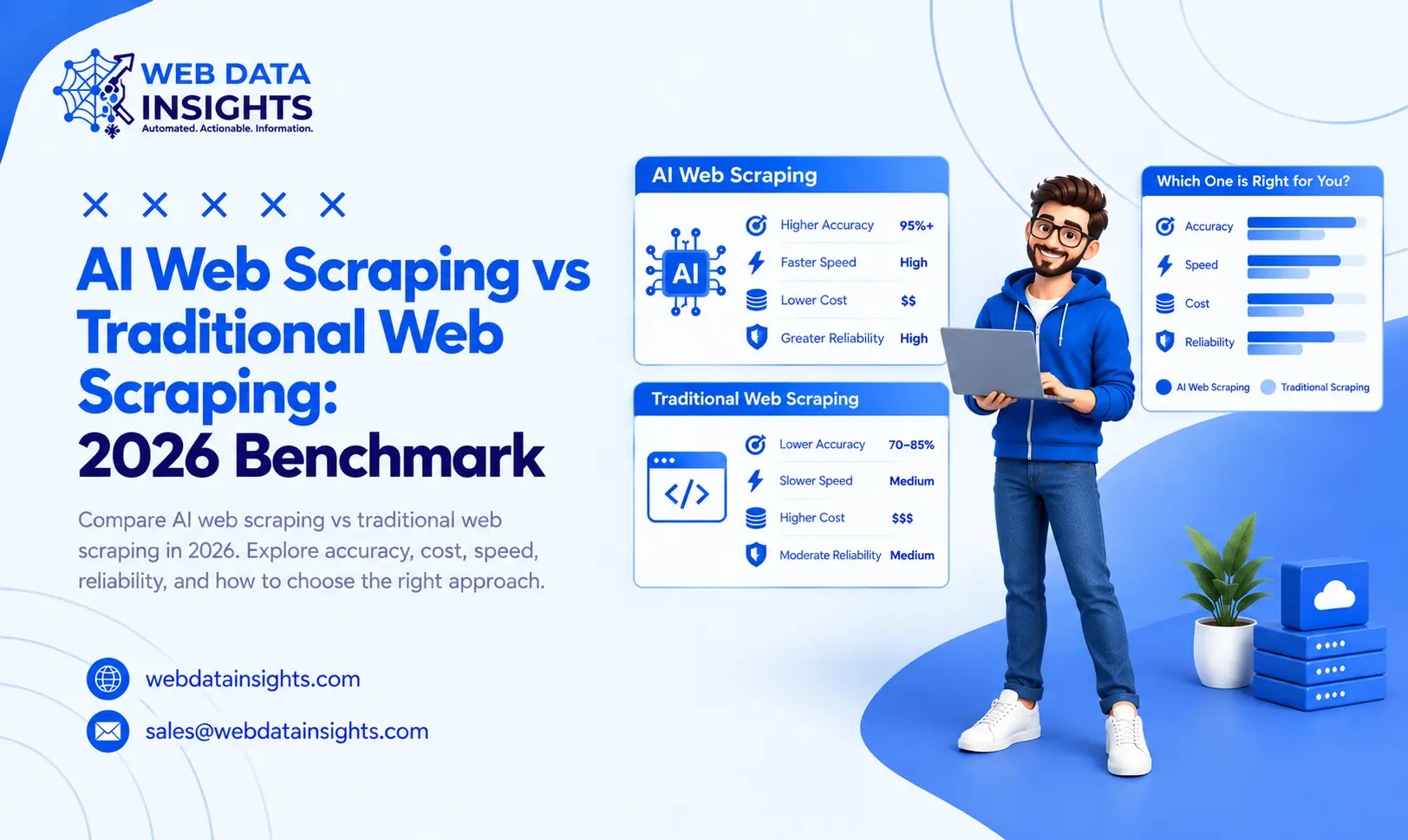
Teams that collect web data face a practical choice. Rule-based scrapers follow fixed instructions to find each field. AI-powered extraction uses a language model to read a page and return structured fields. Hybrid systems combine the two. The debate of AI Web Scraping vs Traditional Web Scraping is often framed as old against new, but the more useful question is which method delivers data that meets your quality threshold at an acceptable cost.
This report compares the approaches on accuracy, cost, speed and reliability. It is a comparative technical analysis with a proposed benchmark framework. It does not report results from completed experiments, and it does not rank specific tools. Where a statement is an established principle, a recommendation or a proposal, the text says so.
AI Scraping vs Traditional Scraping: Understanding the Key Differences
Traditional scraping uses explicit rules. A developer inspects the page, writes selectors, and the scraper applies them to every page of the same type. The same input produces the same output, which makes behavior easy to test.
AI scraping hands part of that job to a model. Instead of naming the exact element for each field, you describe the fields you want, often with a schema, and the model maps page content into that structure.
One distinction matters more than any other. AI-assisted development uses a model once, during setup, to propose selectors or code that then run without further model calls. Runtime AI extraction calls a model for every page, or for the pages where rules fail. These two options have very different cost, speed and risk profiles, so any comparison should state which one is being tested.
| Factor | Rule-based | Runtime AI | Hybrid |
|---|---|---|---|
| Setup effort | Higher per source | Lower per source | Moderate, with design work |
| Layout changes | Rules may break | Some tolerance | Rules plus fallback |
| Exact values such as IDs and prices | Precise when rules are correct | Needs validation | Rules extract, AI checks |
| Interpretive fields | Needs extra logic | Strong fit | AI handles these fields |
| Cost per page | Usually low | Adds inference cost | Low for most pages |
| Reproducibility | High | Varies with model and prompt | High for rule-handled fields |
Traditional Web Scraping: How It Works and Where It Performs Best
A traditional scraper requests a page, parses the HTML into a DOM tree, and uses CSS selectors or XPath expressions to pick out elements. For example, a rule might read the text of a heading with a given class as the product name. Pagination, category discovery and scheduling are also defined as rules.
This approach works best when pages share predictable templates and when exact values matter, such as SKUs, prices, timestamps and identifiers. Each field can be traced back to a selector, which helps debugging and audit trails.
The main cost is maintenance. When a site changes its markup, a selector may return nothing, which is easy to detect, or return the wrong element, which is harder. Teams that prefer to hand over selector upkeep, monitoring and delivery often turn to professional web scraping services for recurring projects.
AI-Powered Data Extraction: Capabilities and Limitations
AI-powered data extraction passes page content, usually cleaned HTML or text, to a model together with instructions and an output schema. The model decides which text satisfies each field. This helps when equivalent information appears under different labels across many sites, and when a field needs interpretation, such as whether a listing offers free cancellation.
The limitations matter as much as the strengths. A schema controls the shape of the output, not whether the values are right. A model can return a valid record with the wrong price, for example by choosing a monthly installment instead of the sale price. Outputs can vary between runs, and page-cleaning choices can change results. Pages may also contain text written to manipulate a model, so extraction should use constrained outputs and avoid unnecessary tool permissions.
AI is often unnecessary when data sits in stable, labelled elements. For sources with many layouts or interpretive fields, AI data scraping services can combine model extraction with validation so that wrong values are caught before delivery.
AI Web Scraping Accuracy: How to Measure Data Quality
Accuracy is not a single number. Measure it per field against a ground-truth set that people have verified from saved page snapshots. Useful measures include:
- Field-level correctness: the share of extracted values that match ground truth.
- Completeness: the share of required fields filled in each record.
- Missing and duplicate records: especially on list and paginated pages.
- Exact match for IDs and prices, with defined tolerance rules for free text.
Two formulas add practical value. Precision penalizes wrong values and recall penalizes misses, so a scraper that skips uncertain fields can look precise while losing data. Report both.
recall = correct extracted values / all values that should be extracted
Include hard cases in the sample: sale prices, missing fields, product variants, alternate templates, pagination boundaries and pages that return consent screens. Averages over easy pages hide the failures that matter. Also separate retrieval failures from extraction failures, because no model can extract data from a page that never loaded correctly.
Web Scraping Cost Comparison: Understanding Total Cost of Ownership
Compare cost per accepted record rather than cost per request. Accepted records are those that pass your quality checks.
Total pipeline cost should include:
- Development and initial configuration for each source.
- Infrastructure, such as browsers, proxies and storage.
- Model usage, including tokens per page and repeated calls.
- Retries for failed or blocked pages.
- Validation and monitoring.
- Maintenance after site changes.
- Human review of flagged records.
Rule-based scraping usually front-loads effort and then reuses it cheaply across many pages of one template. Runtime AI reduces per-source setup but adds inference cost to each page. Which one costs less depends on page volume, the number of distinct sources and the review rate. No universal figure applies, and model pricing changes often, so calculate with your own volumes.
Web Scraping Performance Benchmark: Speed, Reliability, and Scalability
A fair web scraping performance benchmark uses the same pages, the same retrieval layer and the same time window for every method. Otherwise differences in proxies, rendering or blocking get mistaken for differences in extraction. Track these metrics:
- Latency per page, using the median and a high percentile such as the 95th.
- Throughput at a fixed level of concurrency.
- Failure rate and retry rate.
- Silent-failure rate: records that look valid but fail ground-truth checks.
- Recovery time after a layout change.
Rule-based extraction typically adds little time beyond fetching and parsing, while runtime model calls add processing time per page. Treat these as expected tendencies to confirm by testing in your own environment. Reliability also depends on retrieval. A page can return a success status code and still contain a block page or consent screen, so validate page content before extraction.
Scale changes the picture again. When extraction runs continuously and feeds products, dashboards or internal pipelines, an enterprise web scraping API gives applications a stable interface for structured results while queueing, retries and scheduling run behind it.
Hybrid Web Scraping: Combining Rules and AI
Hybrid web scraping assigns each task to the method best suited to it. In a common design, deterministic rules discover URLs, control pagination and extract exact fields. AI handles interpretive fields and unfamiliar layouts. Validation checks everything before delivery. Typical patterns are:
- AI generates, rules execute: a model proposes selectors, people or tests approve them, and the rules run at volume.
- Rules first, AI fallback: only pages where rules fail or return suspect values go to a model.
- Rules plus AI enrichment: selectors copy IDs and prices, while a model classifies descriptions or normalizes categories.
Fallback logic needs clear triggers: empty required fields, values outside expected ranges, schema failures, or record counts that drop against history. Save the pages that trigger fallback. Keep the source text behind each AI-produced value so reviewers can see what the model relied on, and test any AI-proposed repair on saved pages before it replaces a rule. The trade-off is design complexity, since two methods need two sets of monitoring.
Which Web Scraping Approach Should Your Business Choose?
The right choice can differ by site and even by field. In the AI web scraping vs traditional web scraping decision, start from what you know about the pages and the data. These are recommendations from technical reasoning, not test results, so validate them on a sample of your own pages.
| Situation | Suggested start | Reason |
|---|---|---|
| Simple structured pages | Rule-based | Stable templates reward precise, low-cost rules. |
| Frequently changing layouts | Hybrid with AI fallback or AI-assisted repair | Rules stay the default, and AI limits downtime when they break. |
| Complex product pages | Hybrid | Rules for prices and IDs, AI for variants and descriptions. |
| Large-scale extraction | Rule-based core, selective AI | Per-page model cost grows with volume. |
| Recurring enterprise workflows | Hybrid with validation and monitoring | Reliability and auditability matter more than setup speed. |
Research Methodology and Benchmark Limitations
This section describes a proposed methodology, not completed research. No experiments were run for this report, and it contains no measured accuracy, speed or cost figures. WebDataInsights has not published benchmark results here, and none should be inferred from the comparisons above.
A credible benchmark would follow these steps:
- Choose sites across several categories, such as retail, directories, listings and articles, and record the sample size.
- Save page snapshots and build a human-verified ground-truth set for each tested field.
- Fix the retrieval layer so that only the extraction method differs.
- Run each method several times, recording the test date, tool and software versions, model names, prompts and configuration.
- Record accuracy, completeness, latency and cost per accepted record.
- Replay changed layouts to measure recovery and silent failures.
- Publish the limitations alongside the results.
Even a well-run test has limits. Results depend on the chosen sites, model versions and prompts. Model pricing changes. Human-built ground truth can contain errors, and saved snapshots do not capture live blocking behavior. Any future results should state the test date, sample and configuration so others can reproduce or challenge them.
Frequently Asked Questions
What is the difference between AI web scraping and traditional web scraping?
Traditional scraping uses fixed rules, such as CSS selectors or XPath, to locate each field, while AI web scraping uses a model to interpret page content and return structured fields. Rules are predictable and cheap to repeat. AI adapts more easily to varied layouts but adds model cost, latency and output variability.
Is AI web scraping more accurate than traditional web scraping?
Not universally. Rules are usually more precise for exact values on stable templates, while AI can perform better on varied layouts and interpretive fields. Both can fail in different ways: rules often fail visibly, and models can return plausible but wrong values. Measure accuracy against verified ground truth on your own pages.
Is AI-powered web scraping more expensive?
It can be per page, because model usage adds inference and retry costs, but total cost depends on the whole workflow. AI may reduce setup and maintenance across many varied sources, while rules are cheaper for high-volume repeated templates. Compare cost per accepted record, including validation and review.
When should businesses use hybrid web scraping?
Use it when a workload mixes stable fields with variable or interpretive ones, or when you need rules for reliability and AI for exceptions. Typical cases include product pages with exact prices and free-text descriptions, or large source lists where most pages follow templates and a minority do not.
Can AI web scraping handle website layout changes?
Often partly. Runtime AI extraction can tolerate some presentation changes because it reads meaning rather than fixed positions, and AI can propose repaired selectors. It cannot guarantee correct output after major changes to navigation, access controls or meaning, so monitoring and tests on saved pages remain necessary.
Which web scraping approach is best for large-scale data extraction?
For large volumes from known templates, rule-based extraction usually offers the best speed and unit cost, with validation and monitoring. For many different sources, a hybrid approach is often more practical, with AI covering unfamiliar layouts. The right choice depends on volume, source variety, quality targets and budget.
Conclusion
No single answer settles AI web scraping vs traditional web scraping for every project. Rules suit stable, high-volume sources where exact values matter. AI suits varied layouts and interpretive fields. Hybrid designs suit workloads that mix both, provided validation and monitoring are built in. The best fit depends on data structure, quality requirements, update frequency, budget and operational complexity.
If you want to evaluate these approaches for your own sources, send the WebDataInsights team a sample of target pages and the fields you need. A small, well-defined test on real pages will say more than any general comparison.
Reliable Web Data Solutions
WebDataInsights provides clean, structured, and real-time web scraping solutions tailored to your business goals, helping automate data collection for eCommerce, market research, lead generation, and more.
Get in TouchReady to Turn Your Data into Revenue Growth?
Partner with WebDataInsights for enterprise-grade B2B data scraping, real-time price monitoring, supplier benchmarking intelligence, and seamless API data delivery.
Request Custom Dataset