






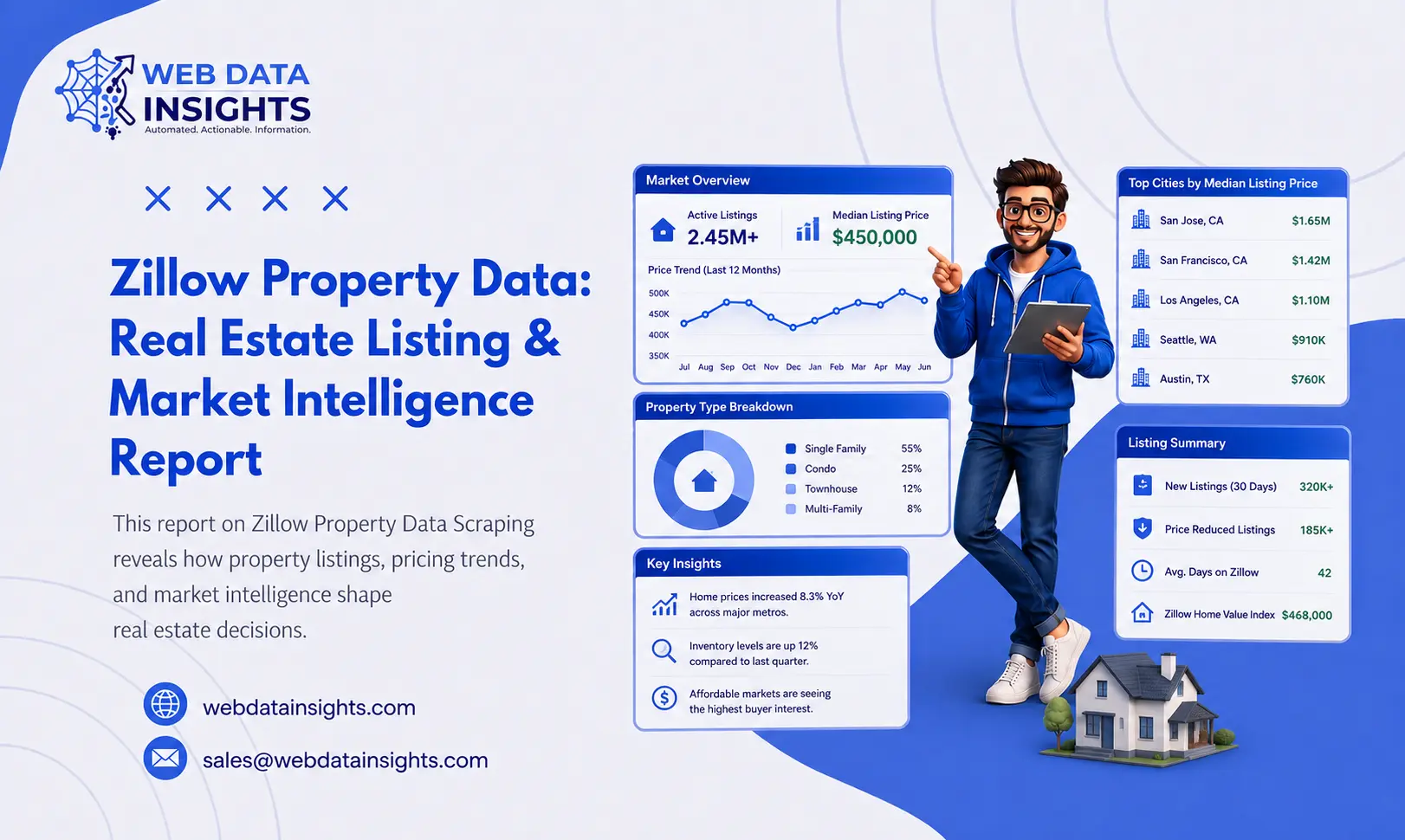
Research Summary
This report examines how Zillow Real Estate Listing Data Scraping supports real estate market analysis — from tracking property listings and price trends to understanding inventory movement across regions. Using structured Zillow property data scraping, this research looks at how listing prices, days-on-market, and inventory levels behave across residential markets, and what that means for investors, lenders, and proptech teams.
Zillow remains one of the most referenced sources of residential listing data in the US housing market. Understanding how to extract and interpret this data responsibly and at scale has become a core capability for real estate intelligence teams.
Executive Summary
- Listing price trends vary significantly by region, with inventory-constrained markets showing steeper price appreciation than markets with growing housing supply.
- Days-on-market is one of the clearest early indicators of shifting demand, often moving before headline price changes appear.
- Property listing volume fluctuates seasonally, with predictable spring and summer increases in most US markets.
- Teams relying on manual, periodic checks of Zillow listings consistently lag behind those using structured, ongoing data collection.
- Combining listing data with historical trends gives a more reliable read on market direction than snapshot price comparisons alone.
Industry Overview
Residential real estate data has become central to decision-making for investors, lenders, developers, and proptech platforms. Zillow, as one of the largest listing platforms in the US, aggregates property details, pricing history, and estimated values across millions of homes — making it a frequently referenced source for market intelligence.
For businesses that depend on accurate, current housing data, Zillow Real Estate Market Analysis has shifted from an occasional research exercise to an ongoing operational need. Static, one-time data pulls quickly become outdated in markets where prices and inventory shift week to week.
Teams building this kind of capability typically start with reliable Web Scraping Real Estate Data methods that can capture listing details, pricing, and property status consistently across target markets.
Key Findings
| Market Indicator | Observed Pattern | Business Relevance |
| Listing Price Trends | Inventory-constrained markets show faster price appreciation | Helps identify high-growth vs. stabilizing markets |
| Days on Market | Shortens ahead of price increases, lengthens ahead of corrections | Early signal for shifting demand |
| Listing Volume | Seasonal increase in spring/summer across most US markets | Supports timing for investment and marketing decisions |
| Price-to-Estimate Gap | Varies by region; wider gaps in fast-moving markets | Indicates how closely asking prices track automated valuations |
Key insight: Days-on-market data tends to shift before listing prices do, making it a useful leading indicator for teams tracking regional housing demand rather than relying on price alone.
Data Analysis & Insights
Looking at listing data over time, rather than as a single snapshot, reveals patterns that are far more useful for decision-making.
What the data shows:
- Markets with tightening inventory consistently show days-on-market shortening several weeks before listing prices begin rising.
- Price-to-estimate gaps widen in markets with high buyer competition, suggesting sellers are pricing ahead of automated valuation models.
- Listing volume patterns are fairly consistent seasonally, but the magnitude of seasonal swings varies meaningfully by region.
Turning raw listings into this kind of insight requires structured Zillow Property Data Intelligence — collecting listing details repeatedly over time rather than relying on a single pull. A one-time snapshot of prices tells you where a market stands; repeated collection tells you where it’s heading.
For teams building models or benchmarking studies on residential real estate trends, a structured Zillow Real Estate Dataset can help validate findings against historical listing and pricing behavior.
Industry Challenges
- Data freshness: Listings change frequently — prices, status, and availability can shift within hours, making stale data a real risk for decision-making.
- Regional inconsistency: Housing market behavior varies widely by metro area, making a single national view insufficient for most business use cases.
- Volume at scale: Tracking listings across multiple markets and thousands of properties is difficult to manage manually.
- Data structure variation: Listing details, pricing history, and estimate fields aren’t always presented uniformly, requiring careful parsing.
- Signal versus noise: Not every listing change reflects a genuine market shift; distinguishing meaningful trends from routine listing updates takes structured analysis.
Opportunities
- Earlier trend detection: Tracking days-on-market and listing volume together helps identify market shifts before they show up in headline price data.
- Sharper regional strategy: A structured Zillow Property Listings Dataset view supports market-by-market decision-making instead of relying on national averages.
- Better investment timing: Understanding seasonal listing patterns helps investors and developers plan acquisitions or launches around predictable market cycles.
- Improved valuation benchmarking: Comparing listing prices against automated estimates over time helps identify markets where pricing behavior is diverging from typical patterns.
Strategic Recommendations
- Build a continuous data collection process rather than relying on periodic, manual checks of listing prices and inventory.
- Track days-on-market alongside price trends, since it often signals shifts in demand earlier than price alone.
- Pairing this listing-level tracking with a broader Competitor Price Monitoring Services approach helps real estate and proptech teams see how pricing behavior compares across related markets and platforms.
- Segment analysis by metro area or region, since national averages can mask meaningful local market differences.
- Maintain a Zillow Real Estate Market Intelligence process that refreshes regularly, particularly in fast-moving or inventory-constrained markets.
- Cross-reference listing data with historical trends before drawing conclusions from short-term price movements.
Future Outlook
As housing markets continue to shift regionally rather than moving in lockstep nationally, the value of granular, continuously updated listing data will keep growing. Investors, lenders, and proptech companies that rely on static or infrequent data pulls will increasingly find themselves reacting to market changes rather than anticipating them. Building durable, structured processes around Zillow listing data — refreshed regularly rather than reviewed occasionally — is becoming a baseline capability for real estate market intelligence in 2026 and beyond.
Frequently Asked Questions
What is Zillow Real Estate Listing Data Scraping used for?
It is used to collect property listing details, pricing, and status information from Zillow at scale, supporting market analysis, valuation research, and investment decision-making.
How does Zillow property data scraping support real estate market analysis?
By tracking listings over time rather than as a one-time snapshot, it reveals trends in pricing, inventory, and days-on-market that inform market timing and strategy.
What is the most reliable early indicator of a shifting housing market?
Based on this research, days-on-market tends to shift before headline listing prices change, making it a useful leading indicator of demand shifts.
Why does listing data need to be collected continuously rather than once?
Because listings change frequently — prices, status, and availability can shift within hours, so a single data pull quickly becomes outdated.
What is a Zillow Property Listings Dataset used for?
It is used to benchmark pricing, inventory, and market trends across regions, supporting model-building and historical trend validation for real estate research.
Conclusion
Understanding real estate markets through Zillow listing data requires more than a single price check — it requires structured, ongoing observation of listings, pricing, and inventory behavior. This report shows that days-on-market and listing volume, tracked over time, often reveal market direction before price data alone would suggest it. Teams that build this kind of continuous intelligence are better positioned to make timely, well-informed real estate decisions.
Reliable Web Data Solutions
WebDataInsights provides clean, structured, and real-time web scraping solutions tailored to your business goals, helping automate data collection for eCommerce, market research, lead generation, and more.
Get in TouchReady to Turn Your Data into Revenue Growth?
Partner with WebDataInsights for enterprise-grade B2B data scraping, real-time price monitoring, supplier benchmarking intelligence, and seamless API data delivery.
Request Custom Dataset