





What Is This Marriott vs Hyatt vs Hilton Data Analytics Report 2026 About?
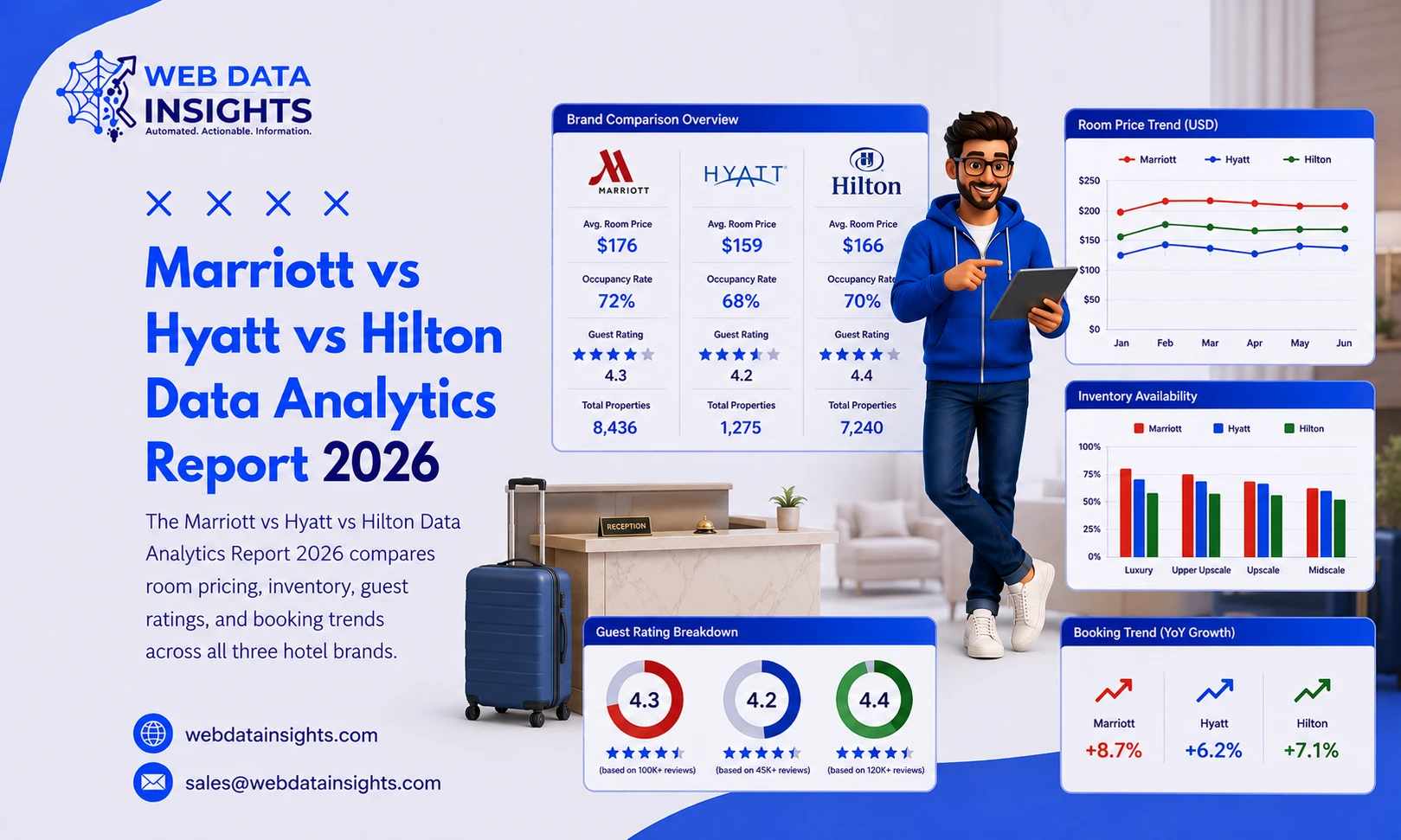
The Marriott vs Hyatt vs Hilton data analytics Report 2026 looks at how three of the world’s largest hotel groups price rooms, manage inventory, and perform on guest sentiment. Instead of comparing headline rates alone, this report pulls together room pricing patterns, availability behavior, review data, and booking trends to build a grounded, side-by-side view of where each brand actually stands.
Hotel pricing has become far more dynamic over the past few years, shifting by demand, day of week, and booking window. For revenue teams, OTAs, and competitive intelligence buyers, understanding how Marriott, Hyatt, and Hilton behave across these dimensions is what separates a useful benchmark from a guess.
What Are the Key Takeaways From This Report?
- Marriott shows the broadest rate variation by market tier, spanning moderate business-hotel pricing to premium luxury positioning.
- Hyatt maintains comparatively tighter rate bands, reflecting a curated, boutique-leaning portfolio.
- Hilton shows the most frequent rate adjustments around weekday-to-weekend transitions, pointing to an aggressive dynamic-pricing model.
- Guest ratings across all three brands cluster near the upper end, but review volume and sentiment themes differ meaningfully by brand.
- Room inventory tightens fastest for Hyatt in leisure-heavy markets, while Marriott and Hilton show steadier availability in business-travel corridors.
Why Does the Hotel Industry Need a Marriott vs Hyatt vs Hilton Hotel Market Analysis?
Marriott International, Hyatt Hotels Corporation, and Hilton Worldwide operate some of the largest hotel portfolios globally, spanning luxury, upscale, and select-service segments. Each group runs its own mix of dynamic pricing, loyalty-driven rate access, and inventory controls to compete for the same broad pool of business and leisure travelers.
A single-point rate check rarely tells the full story, because pricing and availability shift constantly with demand. This is exactly why a proper Marriott vs Hyatt vs Hilton hotel market analysis needs to be built on continuous observation rather than a one-time snapshot — the brand that looks “cheaper” on a Tuesday can flip completely by Friday.
Teams that take this seriously usually start with structured Marriott vs Hyatt vs Hilton hotel pricing scraping, which captures how each brand’s rates move across markets, room types, and booking windows over time rather than relying on a single visit to a booking page. Travel data scraping done this way turns scattered rate checks into a pattern you can actually act on.
What Do the Key Findings Show About Pricing, Inventory, and Reviews?
Room Pricing Comparison
| Brand | Entry-Level Rate Positioning | Rate Volatility (Weekday vs Weekend) | Premium-Tier Presence |
|---|---|---|---|
| Marriott | Moderate to Premium | Moderate | Strong (luxury sub-brands) |
| Hyatt | Moderate | Low-Moderate | Moderate (boutique-luxury focus) |
| Hilton | Moderate | High | Strong (multiple tier brands) |
Room Inventory and Availability
Building reliable Marriott vs Hyatt vs Hilton availability intelligence means watching how fast rooms sell out across markets and seasons, not just what today’s rate shows.
| Brand | Availability Tightening Pattern | Fastest-Selling Markets |
|---|---|---|
| Marriott | Steady, gradual tightening | Major business hubs |
| Hyatt | Sharper tightening in leisure season | Resort and leisure destinations |
| Hilton | Frequent, demand-responsive shifts | Mixed business-leisure markets |
This is also where Marriott, Hyatt & Hilton room inventory intelligence earns its keep — a brand can hold a steady average rate while quietly running out of standard rooms weeks in advance, pushing bookers toward higher-priced categories. Rate data alone won’t show that; inventory tracking will.
Guest Reviews and Ratings
| Brand | Guest Rating Range | Common Review Themes |
|---|---|---|
| Marriott | Consistently high | Service consistency, loyalty program value |
| Hyatt | Consistently high | Property design, personalized service |
| Hilton | High, slightly more variable | Value for price, breakfast and amenities |
Key insight: All three brands score well on guest satisfaction, but the reasons differ. Marriott and Hyatt guests reference service and design more often, while Hilton guests more frequently mention value relative to price paid — a distinction that matters more than the guest rating number itself.
What Does the Data Analysis Reveal About Marriott, Hyatt, and Hilton?
Looking at pricing, inventory, and reviews together — instead of in isolation — surfaces patterns a single metric would miss.
- Hilton’s frequent rate changes track closely with weekday-to-weekend demand shifts, pointing to tighter, more automated dynamic pricing tied to ADR (Average Daily Rate) movement.
- Hyatt’s narrower rate bands suggest a strategy built around consistency rather than aggressive yield management.
- Marriott’s broader rate spread reflects its wider portfolio, spanning select-service to luxury sub-brands under one parent group.
- Review sentiment correlates more strongly with service consistency than with room rate alone — price is not the primary driver of guest satisfaction across any of the three brands.
- When rate and occupancy move together, RevPAR trends give a clearer read on which brand is actually winning demand in a given market, rather than which one simply lists the lowest rate.
A proper scraping Marriott, Hyatt & Hilton data comparison is what makes this kind of multi-dimensional view possible in the first place. Trying to track pricing, inventory, and reviews across three global portfolios by hand simply isn’t realistic at scale — and stale data leads to benchmarks that are wrong the moment they’re published. Teams validating findings against historical booking behavior often lean on a structured travel dataset to cross-check current patterns against past seasons.
What Challenges Do Hospitality Teams Face When Comparing These Brands?
- Rate volatility across brands — Marriott, Hyatt, and Hilton change rates at very different frequencies, which makes a fair, apples-to-apples comparison harder than it looks.
- Inventory visibility gaps — real-time room availability is difficult to track manually across three large portfolios and multiple markets at once.
- Review data fragmentation — guest sentiment is spread across several platforms, making a single, unified view of brand reputation hard to assemble.
- Loyalty-influenced pricing — member-only rates on all three brands complicate any direct, public-rate comparison.
- Market-tier complexity — each brand spans multiple sub-brands and price tiers, so a single “brand-level” number can be misleading without segmentation by market type.
Where Are the Opportunities in the Marriott vs Hyatt vs Hilton Market?
- Sharper competitive benchmarking — comparing pricing, inventory, and reviews together gives a far more accurate read of where each brand truly competes.
- Better rate strategy design — understanding how Hilton’s rate volatility differs from Hyatt’s steadier pricing helps competing brands calibrate their own dynamic pricing.
- Reputation-driven positioning — since guests reward service consistency over price alone, there’s real room to compete on experience rather than rate.
- Inventory planning insight — seeing how availability tightens differently across business and leisure markets supports smarter allocation decisions.
Hospitality and travel-tech teams building this kind of tracking internally often rely on dependable web scraping services to keep pricing, inventory, and review data accurate as hotel websites and listing pages change over time.
Trying to build your own Marriott vs Hyatt vs Hilton benchmark?
We can help you set up ongoing rate, inventory, and review tracking so your team always works from current data, not last quarter’s snapshot. Book a free consultation to scope it out.
What Should Hospitality Teams Do Next?
- Monitor room pricing across Marriott, Hyatt, and Hilton continuously, not through periodic, one-time rate checks.
- Track availability alongside pricing — rate and inventory patterns together tell a far more complete competitive story than either alone.
- Set up ongoing Marriott, Hyatt & Hilton change room prices monitoring so rate shifts are flagged as they happen, not discovered weeks later in a quarterly review.
- Segment analysis by market tier — business hub versus leisure destination — since rate and availability behavior differ meaningfully between the two.
- Combine review sentiment analysis with pricing data to understand whether guests perceive a brand’s pricing as fair relative to the experience delivered.
- Pair this monitoring with a broader price monitoring approach that also covers adjacent hotel competitors beyond these three brands.
- Revisit competitive benchmarks quarterly at minimum, since rate strategies and loyalty structures evolve across all three groups.
What Is the Future Outlook for Marriott, Hyatt, and Hilton Pricing?
Hotel pricing among Marriott, Hyatt, and Hilton is likely to grow more dynamic, not less, as each group refines demand-based pricing and loyalty-tier access through 2026. Guest review data will keep mattering alongside rate comparisons, since satisfaction — not price alone — increasingly shapes brand loyalty and repeat bookings. Hospitality teams that track pricing, inventory, and reputation together, on an ongoing basis, will be better positioned to respond as this landscape shifts.
Frequently Asked Questions
What does the Marriott vs Hyatt vs Hilton data analytics Report 2026 cover?
It compares room pricing, availability and inventory patterns, guest reviews and ratings, and booking behavior across Marriott, Hyatt, and Hilton.
Which hotel brand has the most volatile room pricing — Marriott, Hyatt, or Hilton?
Hilton shows the most frequent rate changes, particularly around weekday-to-weekend demand shifts, compared to Hyatt’s steadier pricing and Marriott’s broader but more gradual rate spread.
Do higher guest ratings mean higher room prices at Marriott, Hyatt, or Hilton?
Not directly. Review sentiment across all three brands correlates more strongly with service consistency than with room rate, meaning price is not the main driver of guest satisfaction.
How can hospitality teams track pricing and inventory across Marriott, Hyatt, and Hilton?
Through structured, ongoing data collection — such as hotel pricing scraping and availability intelligence — that captures rates, inventory, and reviews consistently instead of relying on periodic manual checks.
Which brand has the tightest room inventory in leisure markets?
Hyatt shows the sharpest inventory tightening in leisure and resort destinations compared to Marriott and Hilton, which show steadier patterns in business-travel markets.
What is RevPAR and why does it matter when comparing these three brands?
RevPAR (Revenue per Available Room) combines rate and occupancy into one number, giving a clearer read on which brand is actually converting demand into revenue, rather than which one simply advertises the lowest rate.
Conclusion
Comparing Marriott, Hyatt, and Hilton on price alone misses most of the picture. This report shows that rate volatility, inventory behavior, and guest sentiment together paint a far more useful competitive picture — one where Hilton competes on pricing agility, Hyatt on consistency, and Marriott on portfolio breadth. Hospitality teams that track all three dimensions continuously are better equipped to benchmark and compete effectively.
Reliable Web Data Solutions
WebDataInsights provides clean, structured, and real-time web scraping solutions tailored to your business goals, helping automate data collection for eCommerce, market research, lead generation, and more.
Get in TouchReady to Turn Your Data into Revenue Growth?
Partner with WebDataInsights for enterprise-grade B2B data scraping, real-time price monitoring, supplier benchmarking intelligence, and seamless API data delivery.
Request Custom Dataset