





Research Summary
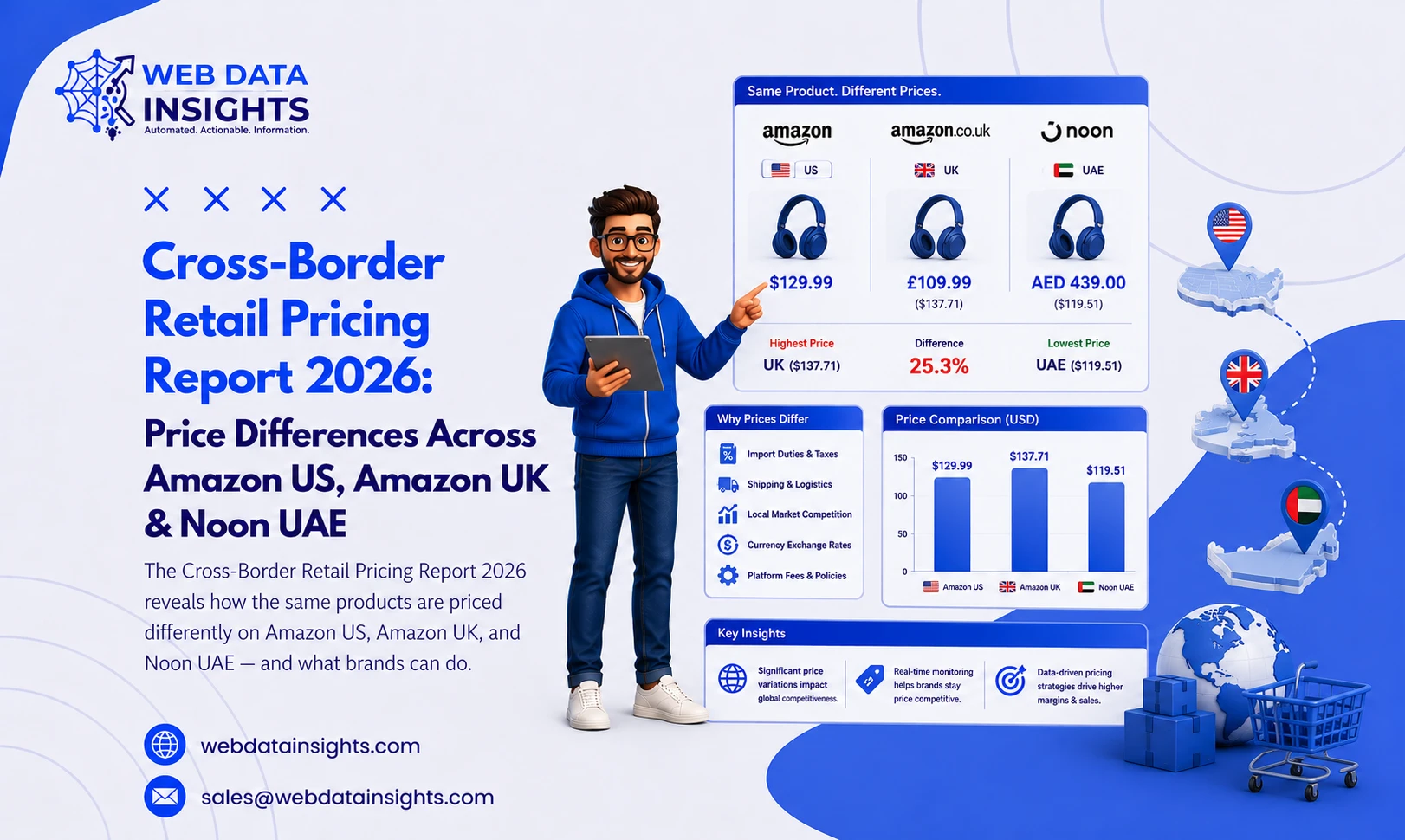
The Cross-Border Retail Pricing Report 2026 examines how identical products are priced across three major marketplaces — Amazon US, Amazon UK, and Noon UAE. Using structured Scrape International retail price comparison Data methods, this research tracks the same SKUs across all three regions to quantify how much prices actually diverge once currency, taxes, and local market positioning are accounted for.
For brands selling internationally, price differences across regions are not always deliberate — many stem from inconsistent monitoring, delayed currency updates, or reseller-driven divergence. This report identifies where those gaps are largest and what brands can do to manage them.
Key Terms at a Glance
Amazon US price Data scraping — the automated collection of live product prices from Amazon’s US marketplace for comparison and analysis.
Scrape Amazon UK price Data — the process of extracting current Amazon UK listing prices to compare against other regions.
Noon UAE price Data Extraction — automated collection of product pricing from Noon, a leading UAE and Gulf-region marketplace.
Global e-commerce pricing Data analytics — the analysis of pricing data collected across multiple countries and marketplaces to identify trends and disparities.
Cross-country product price analysis — comparing the price of the same product across different countries, adjusted for currency and local market conditions.
Executive Summary
- Identical products show meaningful price divergence across Amazon US, Amazon UK, and Noon UAE, even after currency conversion.
- Electronics and branded consumer goods show the widest cross-border price gaps, often linked to import duty and distribution cost differences.
- Noon UAE pricing tends to run higher on globally branded products, reflecting import and logistics costs specific to the Gulf region.
- Brands without continuous cross-border e-commerce Data insights often discover regional price misalignment only after customers or resellers flag it.
- Currency fluctuation alone does not explain most price gaps — local competitive dynamics and distribution costs play a larger role than expected.
Industry Overview
Cross-border e-commerce has made it easy for customers to compare prices across countries, even when brands never intended those prices to be directly comparable. Amazon US, Amazon UK, and Noon UAE each operate under different tax structures, logistics costs, and competitive pressures — all of which influence local pricing independently of brand strategy.
This has made global e-commerce pricing Data analytics essential for brands selling across multiple regions. Without it, pricing decisions in one market can unintentionally undercut or overprice the same product elsewhere, creating friction with distributors, resellers, and customers who shop across borders.
Building this visibility requires reliable Ecommerce Data Scraping that can capture pricing consistently across regions, currencies, and marketplace formats.
Key Findings
| Marketplace | Avg. Price Variance vs. Baseline (US) | Primary Driver of Variance | Most Affected Category |
| Amazon US | Baseline | — | — |
| Amazon UK | +5–12% | VAT, currency conversion timing | Electronics, Beauty |
| Noon UAE | +10–20% | Import duty, logistics cost, limited local competition | Electronics, Branded Appliances |
Key insight
Price gaps are rarely explained by currency alone. Amazon UK’s variance is driven largely by VAT and localized promotions, while Noon UAE’s higher pricing reflects import costs and a less price-competitive local landscape for certain categories.
Data Analysis & Insights
Cross-country product price analysis reveals patterns that are consistent across product categories rather than isolated to individual listings.
What the data shows:
- Electronics and branded appliances show the largest cross-border gaps, often 10–20% above US baseline pricing once adjusted for currency.
- Amazon UK pricing shifts more frequently around VAT-inclusive promotional periods than Amazon US or Noon UAE.
- Noon UAE pricing on globally recognized brands tends to stay elevated due to limited local competition in certain categories, rather than active repricing behavior.
Manually comparing prices across three marketplaces, multiple currencies, and thousands of SKUs is not practical at scale. This is why brands rely on Amazon US price Data scraping, tools to scrape Amazon UK price Data, and Noon UAE price Data Extraction to build a consistent, comparable pricing dataset across all three markets.
For teams building internal pricing models, structured Amazon Product Dataset resources help validate cross-border pricing trends against historical listing data.
Industry Challenges
- Currency and tax complexity: VAT, import duty, and exchange rate timing all distort raw price comparisons between regions.
- Reseller-driven divergence: Third-party sellers can price above or below brand guidance, creating inconsistencies brands don’t control directly.
- Fragmented monitoring: Tracking three marketplaces manually, each with different page structures and currencies, is slow and error-prone.
- MAP enforcement across borders: Minimum Advertised Price policies are harder to enforce when pricing data isn’t compared consistently across regions.
- Delayed detection: Without regular Scrape International retail price comparison Data processes, brands often learn about regional price gaps from customer complaints rather than proactive monitoring.
Opportunities
- Smarter regional pricing strategy: Cross-country product price analysis helps brands set region-appropriate prices instead of relying on simple currency conversion.
- Stronger MAP compliance: Continuous monitoring across Amazon US, Amazon UK, and Noon UAE helps brands catch violations before they spread.
- Better distributor conversations: Clear, data-backed price comparisons give brands stronger footing when discussing pricing with regional distributors or resellers.
- Reduced customer friction: Understanding and explaining legitimate price differences — like VAT or import duty — helps brands manage customer expectations across regions.
Strategic Recommendations
Set up continuous cross-border e-commerce Data insights rather than reviewing regional pricing only when issues are reported.
Track Amazon US, Amazon UK, and Noon UAE together using consistent methodology so price comparisons account for currency, VAT, and duty.
Use a structured Amazon Competitor Price Tracking Dashboard to monitor Amazon US and UK pricing activity in one place.
Combine marketplace-specific tracking with broader Price Monitoring to catch reseller-driven price divergence early.
Review high-variance categories — electronics and branded appliances — more frequently than stable, low-variance categories.
Future Outlook
As more brands expand into cross-border e-commerce, the gap between intended pricing strategy and actual regional pricing will only become harder to manage without structured data. Global e-commerce pricing Data analytics is moving from a periodic audit exercise toward a continuous requirement, particularly for brands operating across currency zones with different tax and duty structures. Brands that invest in this visibility now will be better positioned to manage MAP compliance and regional pricing consistency as cross-border shopping continues to grow through 2026 and beyond.
Frequently Asked Questions
What is cross-border retail pricing analysis?
It is the practice of comparing the price of the same product across different countries or marketplaces, adjusted for currency, tax, and import duty, to understand true pricing differences.
Why are prices different on Amazon US, Amazon UK, and Noon UAE for the same product?
Price differences typically stem from VAT, import duty, currency conversion timing, and local competitive conditions — not currency alone.
Which product categories show the largest cross-border price gaps?
Based on this research, electronics and branded appliances show the widest price variance across Amazon US, Amazon UK, and Noon UAE.
How can brands track pricing across multiple countries?
By using Amazon US price Data scraping, tools to scrape Amazon UK price Data, and Noon UAE price Data Extraction to build a consistent, comparable pricing dataset.
What is global e-commerce pricing Data analytics used for?
It is used to analyze pricing data collected across multiple countries and marketplaces to identify trends, disparities, and MAP compliance risks.
Conclusion
Cross-border price gaps between Amazon US, Amazon UK, and Noon UAE are real, measurable, and only partly explained by currency conversion. In this Cross-Border Retail Pricing Report 2026, WebDataInsights demonstrates that brands without continuous, structured pricing visibility across regions risk both margin loss and MAP compliance issues. Closing this gap starts with consistent, cross-country product price analysis rather than periodic, market-by-market checks.
Reliable Web Data Solutions
WebDataInsights provides clean, structured, and real-time web scraping solutions tailored to your business goals, helping automate data collection for eCommerce, market research, lead generation, and more.
Get in TouchReady to Turn Your Data into Revenue Growth?
Partner with WebDataInsights for enterprise-grade B2B data scraping, real-time price monitoring, supplier benchmarking intelligence, and seamless API data delivery.
Request Custom Dataset