





Practical, engineering-grade methods to remove duplicates, standardize formats, and validate scraped datasets before they reach your dashboards or ML models.
Raw scraped record
id: SKU-8841
title: "Nike Air Max - Blk"
price: "Rs 4,999.00 INR"
seller: "nike_store_in"
Validated record
id: SKU-8841
title: Nike Air Max, Black
price: 4999.00
seller: Nike Official Store
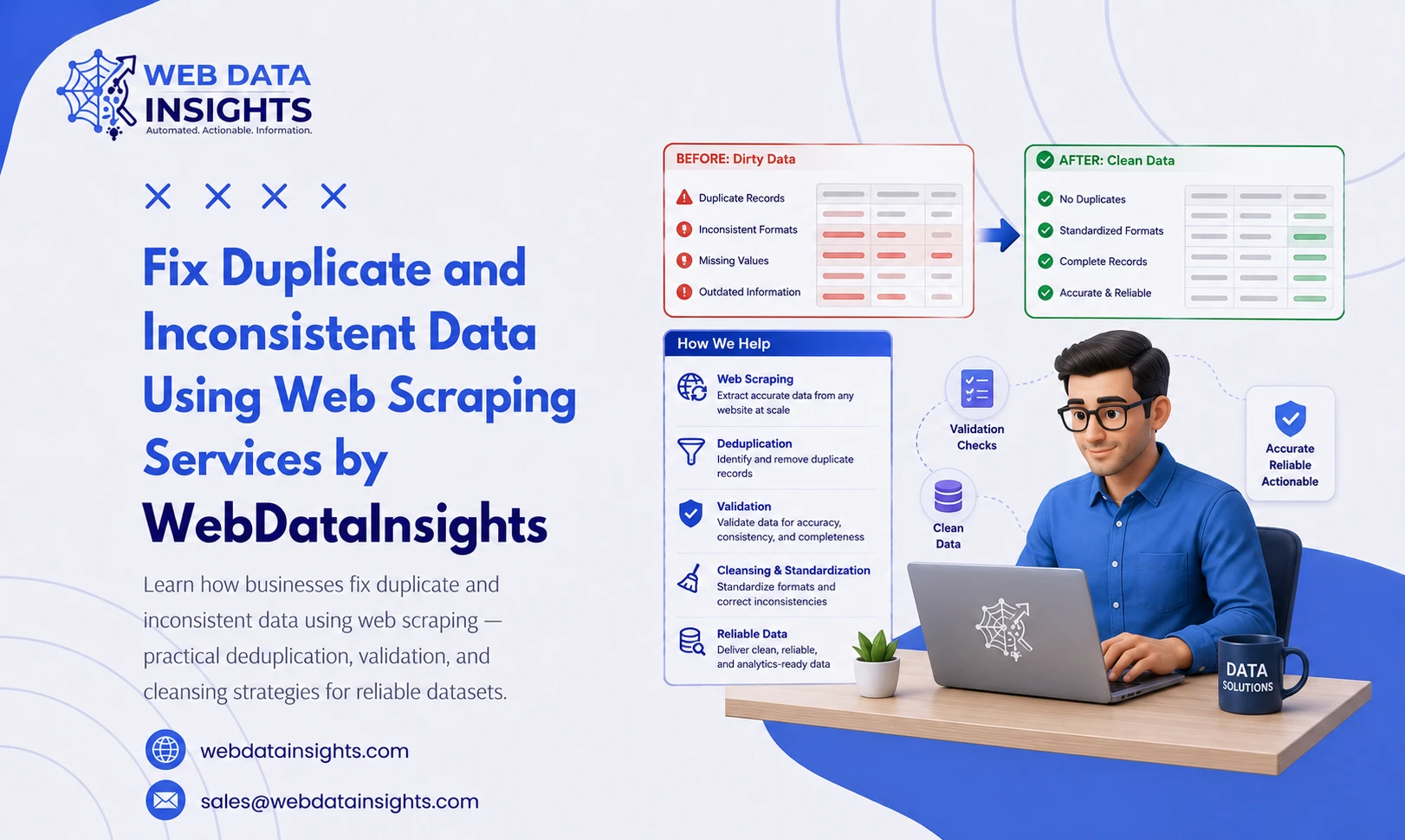
Every web scraping pipeline accumulates the same problem over time: the same record appears twice under slightly different names, price fields carry three different formats, and seller or brand names drift into dozens of near-identical variants. Left unmanaged, this quietly undermines every report and model built on top of the data. This guide walks through how businesses actually fix duplicate and inconsistent data using web scraping, not as a one-time cleanup, but as a built-in part of the extraction pipeline.
QUICK ANSWER
Fixing duplicate and inconsistent data using web scraping means combining extraction-time validation rules with deduplication logic, matching near-identical records, standardizing formats, and rejecting invalid entries before data reaches a warehouse or dashboard, rather than cleaning it manually after the fact.
Why Scraped Data Becomes Duplicate and Inconsistent
Most data quality issues in scraped datasets trace back to a handful of causes: repeated crawl passes over the same pages, pagination overlaps that re-capture the same listing, source websites changing their layout mid-crawl, and different pages representing the same field, price, size, brand, in slightly different formats. None of this is unusual. It is simply what happens when data is pulled from hundreds of independently maintained web pages rather than one controlled system.
This is exactly why Web Scraping Data Quality Solutions exist as a distinct discipline. Extraction gets a business the raw data; a dedicated quality layer is what makes that data usable in a report, a pricing model, or a customer-facing catalog.
Remove Duplicate Data From Web Scraping
Duplicates rarely arrive as perfect copies. Two records might share the same product but differ in title casing, whitespace, or a minor price rounding difference. A reliable deduplication approach usually layers three techniques:
- Exact-key matching - using a stable identifier (SKU, listing ID, canonical URL) where one exists
- Fuzzy matching - comparing title, brand, and price similarity to catch near-identical records without a shared ID
- Record linkage over time - recognising that the same listing recrawled a day later is an update, not a new record
The goal is not to eliminate every duplicate at any cost. Over-aggressive matching can merge genuinely different products. A confidence threshold, reviewed periodically, keeps this balance in check.
Fix Inconsistent Data In Scraped Datasets
Inconsistency shows up in the fields that look fine individually but do not line up across records: currency symbols mixed with plain numbers, dates in three different formats, size labels written as "M", "Med", and "Medium" for the same value. Fixing this requires schema normalization, a single canonical format per field, applied consistently regardless of how the source page originally presented it.
| Field | Common Inconsistency | Normalized Form |
|---|---|---|
| Price | "Rs 4,999.00", "Rs 4999", "4999/-" | 4999.00 (numeric, single currency field) |
| Size | "M", "Med", "Medium" | Medium (canonical value) |
| Date | "12/07/26", "July 12, 2026" | 2026-07-12 (ISO format) |
| Seller name | "nike_store_in", "Nike Store" | Nike Official Store (mapped entity) |
Automated Data Cleansing Solutions
Rule-based cleansing handles predictable problems well: format conversion, whitespace trimming, known value mapping. But some near-duplicates and inconsistencies are too subtle for fixed rules to catch reliably, which is where Automated Data Cleansing Solutions increasingly bring in machine-learning-based matching alongside rules.
Rule-based layer
Handles known patterns: currency formats, date parsing, category value mapping, whitespace and encoding fixes.
ML-assisted layer
Scores similarity between records that do not match on exact rules, flagging likely duplicates or mislabeled fields for automatic or reviewed correction.
Teams building this kind of AI-assisted matching into their pipeline from scratch often turn to Enterprise AI Data Scraping Services rather than maintaining a separate machine-learning system alongside the scraper.
Clean and Validate Dataset Before It Reaches Your Systems
Validation is the checkpoint between extracted and usable. A dataset should pass through defined checks before it is promoted into a warehouse, BI tool, or pricing engine:
- Schema validation - required fields present, correctly typed
- Range and format checks - prices, dates, and ratings within expected bounds
- Referential checks - category, brand, and seller values match known reference lists
- Confidence scoring - every auto-merged or auto-corrected record carries a score, so low-confidence changes get reviewed rather than silently accepted
This is what it means to genuinely clean and validate dataset output, not a single pass of corrections, but a repeatable checkpoint every batch of data goes through.
Data Validation And Deduplication Services: Where Manual Effort Breaks Down
Manual review works at small scale, a few hundred records, checked occasionally. It stops working once a pipeline covers multiple categories, sources, or geographies, refreshed daily. At that point, Data Validation And Deduplication Services stop being a nice-to-have and become the difference between a dataset your team trusts and one that quietly accumulates errors nobody catches until a report looks wrong.
This quality layer is most effective when it is built directly into the broader Web Scraping Services pipeline, rather than bolted on afterward. For businesses that need continuously refreshed data, price trackers, inventory feeds, pairing this with Live Crawler Services keeps validation running in near real time instead of catching issues only during a scheduled batch job.
Industry Use Cases
E-commerce & Retail
Deduplicating product catalogs pulled from multiple marketplaces so pricing and inventory reports reflect real SKU counts, not inflated duplicates.
Real Estate Listings
Merging the same property listed by multiple agents under different descriptions into a single validated record.
Travel & Hospitality
Standardizing price and availability formats across booking sites that display currency and dates differently.
Market & Financial Research
Validating alternative data feeds before they inform pricing models or investment research, where a bad record has outsized downstream impact.
Recruitment & Job Boards
Removing duplicate postings aggregated from multiple job sites and normalizing salary and location fields.
Consumer Electronics
Reconciling spec sheets that describe identical products with inconsistent units, model numbers, or naming conventions.
Expert Insights & Best Practices
Validate at ingestion, not after the warehouse load
Catching a bad record before it enters a production table is far cheaper than correcting a report that already used it. Build validation as a gate, not a post-hoc audit.
Maintain one canonical ID per real-world entity
Every merge decision should resolve to a single, stable master record. Without this, cleaned data quietly re-fragments the next time the pipeline runs.
Log data lineage for every correction
Recording what was changed, when, and by which rule keeps the process auditable, important both for internal trust and for compliance-sensitive industries like finance.
Set explicit match-confidence thresholds
Avoid binary duplicate-or-not logic. A scored threshold, with manual review for borderline cases, prevents both false merges and missed duplicates.
Common Mistakes to Avoid
- Over-aggressive fuzzy matching - merging genuinely different products because titles look similar.
- No monitoring for schema drift - a source site changes its layout and the parser keeps returning malformed fields silently.
- Treating cleanup as a one-time project - data quality decays continuously; it needs an ongoing process, not a single sprint.
- Ignoring encoding and locale issues - especially in multi-region scraping, where currency, date, and character encoding all vary.
- Fixing symptoms instead of the source - repeatedly cleaning the same inconsistency instead of correcting the extraction rule that causes it.
Where Data Quality Is Heading
Machine-learning-based matching is steadily replacing purely rule-based deduplication, since it handles the near-duplicate cases that fixed rules consistently miss. At the same time, businesses running continuously refreshed pipelines are shifting validation from a scheduled batch step to something that happens as data is captured, closer to real time, not after the fact. Compliance pressure in regulated industries is also pushing data lineage and audit trails from a nice-to-have into a standard requirement for any pipeline feeding financial or customer-facing decisions.
Frequently Asked Questions
What does it mean to fix duplicate and inconsistent data using web scraping?
It means applying validation and deduplication rules during and after extraction, matching near-identical records, standardizing formats, and rejecting invalid entries, so the dataset reaching a warehouse or dashboard is already clean, instead of being fixed manually afterward.
Why does scraped data become duplicate or inconsistent in the first place?
Duplicates and inconsistencies usually come from repeated crawl passes, pagination overlaps, source websites using different spellings or formats for the same field, and site structure changes that break parsing rules mid-way through a crawl.
Is exact-match deduplication enough to remove duplicate data from web scraping?
No. Exact-match deduplication only catches identical records. Most real-world duplicates are near-identical, same product with a slightly different title or price format, which requires fuzzy matching and record linkage, not just an exact key comparison.
What is the difference between automated data cleansing and manual data cleanup?
Manual cleanup reviews records after they are already loaded, which does not scale past a few thousand rows. Automated data cleansing solutions apply validation and matching rules continuously, at ingestion, so bad records are caught before they reach downstream systems.
How do you validate a scraped dataset before using it in production?
Validation typically includes schema checks, range and format checks, referential integrity checks against known values, and a confidence score for any auto-merged or auto-corrected record before it is promoted to production.
Can data quality be maintained on an ongoing basis, not just as a one-time cleanup?
Yes, and it should be. Data validation and deduplication services are most effective as a continuous layer built into the scraping pipeline itself, rather than a periodic cleanup project, since source sites and data volume change constantly.
Conclusion
Duplicate and inconsistent data is not a flaw in web scraping itself, it is a natural byproduct of pulling information from hundreds of independently maintained sources. What separates a reliable pipeline from an unreliable one is whether validation and deduplication are built in from the start, or bolted on after a report has already gone wrong. Businesses that treat data quality as a continuous discipline get datasets they can actually build decisions on.
Reliable Web Data Solutions
WebDataInsights provides clean, structured, and real-time web scraping solutions tailored to your business goals, helping automate data collection for eCommerce, market research, lead generation, and more.
Get in Touch