





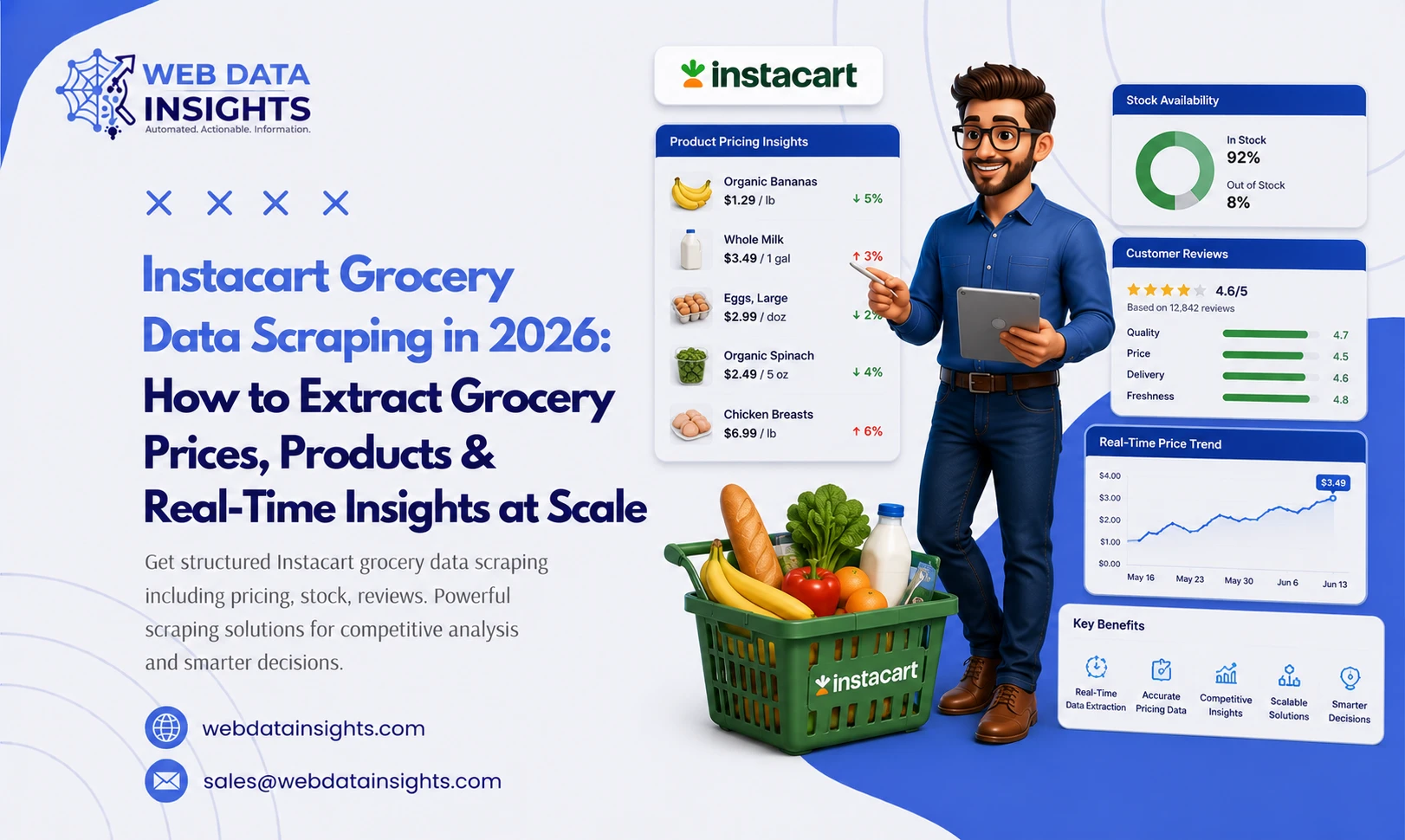
Every CPG brand and grocery startup today is fighting the same battle: making faster, smarter decisions than the competition. The brands pulling ahead aren’t just working harder they’re working with better data. That’s where Instacart Grocery data scraping comes in. By accessing real-time grocery data from product listings and prices to availability and reviews businesses can move quicker, spot opportunities earlier, and stay ahead in an increasingly competitive market.
Instacart is one of the most data-rich grocery platforms in North America. It aggregates product listings, prices, availability, and consumer reviews from thousands of retailers — updated in near real-time. But collecting that data at scale, cleanly and consistently, is a serious technical challenge.
WebDataInsights solves that challenge. We deliver structured, ready-to-use Instacart grocery data customized to your exact needs in as little as 48 hours.
What Is Instacart Grocery Data Scraping?
Instacart grocery data scraping is the automated collection of publicly available product and market data from the Instacart platform. This includes prices, product details, availability, promotional offers, customer reviews, and delivery information gathered at scale across thousands of SKUs and multiple retailers.
Unlike manual research or point-in-time snapshots, a well-built scraping pipeline gives you continuous, structured data — the kind that powers pricing engines, competitive dashboards, and demand forecasting models.
What Instacart Data Can You Extract?
Here is a breakdown of the key data fields WebDataInsights extracts from Instacart:
Product Data
- Product name, brand, SKU, UPC/barcode
- Category, subcategory, product description
- Package size, unit of measure, nutritional labels
- Dietary tags: organic, gluten-free, vegan, etc.
Pricing & Promotions
- Current price, sale price, discount percentage
- Unit pricing (per oz / per lb) for comparison
- Price variations across retailers on Instacart
- Instacart+ member pricing and exclusive deals
Availability & Inventory
- In-stock / out-of-stock status by store and ZIP code
- Estimated delivery time and express delivery availability
- Pickup vs. delivery options per location
Reviews & Ratings
- Average star rating and total review count
- Individual review text and date
- Sentiment trends over time
Retailer & Store Data
- Retailer name, store ID, delivery zone
- Retailer-specific promotions and service hours
- Store coverage by city or ZIP code
Why CPG Brands and Startups Use Instacart Data in 2026
The grocery market is faster than ever. Here is how our clients are putting Instacart data to work right now:
Real-Time Competitive Price Monitoring
CPG brands track how their own SKUs are priced across multiple Instacart retailers simultaneously. When a competitor goes on promotion, you see it within hours — not weeks — giving your Dynamic Pricing Software team time to respond.
New Product Launch Intelligence
Startups entering a new grocery category use Instacart data to map existing players: their Price Monitoring points, packaging sizes, ratings, and review sentiment. This turns a months-long research process into a 48-hour data project.
Distribution Gap Analysis
Brands compare their product availability across ZIP codes on Instacart to find whitespaces — cities or regions where they have no presence but competitors do. This directly informs sales and distribution strategy.
Demand Signals for Forecasting
In-stock and out-of-stock patterns across thousands of stores are a powerful proxy for demand. Brands and distributors use this to anticipate surges, prevent stockouts, and time promotional pushes.
Why WebDataInsights ? Fastest Delivery in the Industry
Most Instacart data providers operate on 7–15 day project timelines. At WebDataInsights, we have built our infrastructure specifically for speed without sacrificing accuracy.
| What You Need | Typical Providers | WebDataInsights |
|---|---|---|
| First data delivery | 7–15 business days | 48–72 hours |
| Custom fields | Limited options | Fully customizable |
| Multi-retailer support | Manual setup required | Built-in |
| Data cleaning included | Raw data only | Structured & validated |
| API delivery | Often unavailable | REST API available |
| Ongoing maintenance | Self-managed | Fully managed |
| CPG-specific expertise | Generic scraping | Grocery-native team |
How It Works: From Request to Data in 48 Hours
Step 1 — Share your requirements: Tell us which product categories, retailers, ZIP codes, and data fields you need. A 15-minute discovery call or a simple brief works fine.
Step 2 — We build your custom pipeline: Our engineers configure scrapers specifically for your data structure — handling JavaScript rendering, location-based content, and dynamic pricing.
Step 3 — Data cleaning and structuring: Every dataset goes through normalization — standardized product names, cleaned prices, deduplication, and quality validation.
Step 4 — Delivery in your format: CSV, JSON, XLSX, or REST API. We can push directly to AWS S3, Google Cloud Storage, or your data warehouse.
Step 5 — Ongoing updates: We monitor and maintain your pipeline. If Instacart changes its structure, we fix it — you never lose your data feed.
Is Instacart Data Scraping Legal?
Publicly available data on Instacart — product listings, prices, and information visible to any website visitor — is generally legal to collect for business Real-Time pricing intelligence purposes. Court precedent in the US, including decisions related to the Computer Fraud and Abuse Act, has consistently supported the legality of scraping publicly accessible data.
WebDataInsights follows strict ethical guidelines: we only collect public data, respect crawl rate limits, never bypass authentication, and never collect personally identifiable information. We recommend clients seek their own legal counsel for jurisdiction-specific advice.
Frequently Asked Questions
How quickly can I receive Instacart data after placing an order?
Standard projects receive their first dataset within 48 to 72 hours. For urgent requirements, we offer expedited delivery. Most ongoing subscription clients receive daily or real-time data feeds after the initial setup.
What types of businesses benefit most from Instacart data scraping?
CPG brands use it for competitive pricing and distribution analysis. Grocery startups use it for market entry research and product benchmarking. Retail analysts and research firms use it for category trend reports and consumer demand studies.
Can I get Instacart data for a specific city or ZIP code?
Yes. Instacart shows different pricing and availability by delivery zone. We configure scrapers for any specific geography you need — city, region, or ZIP code.
What formats is the data delivered in?
We deliver in CSV, JSON, XLSX, or via REST API. We also support direct integration with cloud storage and data warehouses like BigQuery, Snowflake, and AWS S3.
How is WebDataInsights different from other Instacart scraping services?
Our key difference is delivery speed — 48 to 72 hours versus the industry standard of 7 to 15 days. We also specialize in grocery and CPG data specifically, which means cleaner taxonomy, better field normalization, and more relevant data structures for your use case.
Do you offer a free sample dataset before committing?
Yes. We provide a free sample dataset based on your specific requirements so you can evaluate data quality and structure before any commitment.
Ready to Get Your Instacart Data?
Whether you need a one-time competitive analysis or a live data feed updated daily, Contact Webdatainsights delivers clean, structured Instacart data tailored to your business. Most clients receive their first dataset within 48 hours of sharing their requirements.
Request a Free Sample Dataset Today
webdatainsights.com/contact-us/
Reliable Web Data Solutions
WebDataInsights provides clean, structured, and real-time web scraping solutions tailored to your business goals, helping automate data collection for eCommerce, market research, lead generation, and more.
Get in Touch