





Introduction
In today’s hyper-competitive travel market, the difference between a booking and a bounce often comes down to one thing price. At WebDataInsights, we work with travel platforms facing this exact challenge, where travelers compare rates across dozens of sites in seconds and even a small pricing gap leads to lost bookings.
This is the challenge one of our clients a fast-growing online travel aggregator brought to us. Their platform listed hotel deals across 30+ destinations, but their internal pricing data was lagging behind the market. By the time their team updated rates, competitors had already undercut them. They were losing bookings they should have won.
What they needed wasn’t just a scraping tool. They needed a full-stack travel pricing intelligence system one that could extract hotel deal data in real time, normalize it across sources, and feed it directly into their pricing engine. Our travel pricing intelligence system uses real-time hotel deals data extraction to enable accurate hotel rate monitoring across OTAs.
That’s exactly what we built. And the results speak for themselves.
About the Client
Our client is a mid-sized online travel aggregator operating across South Asia, Southeast Asia, and the Middle East. They work with over 200 hotel partners and handle thousands of search queries daily across their web and mobile platforms.
Despite their impressive growth trajectory, they were running on outdated dynamic pricing logic. Their team was manually pulling competitor rates every few hours a process that was error-prone, time-intensive, and simply couldn’t scale. As their destination footprint expanded, the cracks in their data pipeline became impossible to ignore.
They came to us with a clear mandate: automate the extraction of live hotel deal data and build a Real-Time pricing intelligence layer that would let their revenue team respond to market shifts in near-real time.
| Industry | Online Travel & Hospitality |
| Headquarters | Dubai, UAE (Operations across 30+ destinations) |
| Team Size | 150–200 employees |
| Project Duration | 14 weeks (Ongoing) |
| Service Delivered | Hotel Data Extraction, Travel Pricing Intelligence, Competitive Rate Monitoring |
Challenges & Objectives
The Problem – Pricing Blindness in a Real-Time Market
When the client first approached us, they described a situation familiar to anyone running a travel platform at scale: they knew their prices were off, but they had no reliable way to know by how much, for which properties, or at what times.
Here’s what was happening on the ground:
- Their pricing team was manually checking 6–8 OTAs every few hours and updating rates through an internal spreadsheet. On peak travel days, this process alone consumed 3–4 hours of productive time.
- Because rate updates happened in batches rather than continuously, their platform competitors regularly displayed prices that were 8–15% higher than direct OTA competitors on the same properties.
- Different team members were pulling data from different sources at different times, leading to conflicting numbers inside the same dashboard a trust issue that slowed down decision-making.
- Seasonal deals, flash sales, and last-minute inventory drops were completely invisible to them unless someone manually noticed it on a competitor site.
Objectives Going Into the Project
- Build a fully automated hotel deals data extraction pipeline covering 15+ major OTAs and booking platforms.
- Deliver rate data with a refresh cycle of 30 minutes or less across all target destinations.
- Create a centralized travel pricing intelligence dashboard that unifies data from all sources with no manual reconciliation required.
- Enable the revenue team to set automated alerts when competitor prices drop below defined thresholds.
- Ensure the system could scale to 50+ destinations without infrastructure changes.
Our Strategic Approach
Before writing a single line of code, we spent two weeks in discovery. We audited their existing pricing workflow, mapped every data source they cared about, and interviewed their revenue and tech teams. What we learned shaped every decision that followed.
The core insight was this: the client didn’t just need data — they needed data they could trust, at a speed that matched how the market actually moved. That framing shifted the entire architecture of our solution.
Phase 1 – Source Mapping & Priority Tiering
We catalogued 22 travel booking platforms and OTAs, then tiered them by data freshness, traffic influence, and market relevance for their destination mix. This prevented us from building a system that collected everything equally — instead, we prioritized sources that drove actual booking decisions.
Phase 2 – Extraction Architecture Design
Rather than a monolithic scraper, we designed a distributed extraction framework with dedicated handlers for each source tier. High-priority sources ran on 15-minute cycles; secondary sources on 45-minute cycles. This balanced data freshness with infrastructure cost.
Phase 3 – Data Normalization Layer
Hotel naming conventions, room type labels, tax inclusion rules, and currency formats varied wildly across sources. We built a normalization engine that mapped these inconsistencies to a single schema — so “Deluxe King Room” from Site A and “King Deluxe” from Site B resolved to the same entity in the client’s dashboard.
Phase 4 – Intelligence Layer & Alerting
On top of clean, normalized data, we built the travel pricing intelligence layer — a rules engine that compared the client’s live rates against competitor benchmarks, flagged outliers, and triggered Slack and email alerts when pre-defined thresholds were breached.
Technical Roadblocks
No data extraction project at this scale runs without friction. Here are the real challenges we hit — and why they mattered:
Anti-Scraping Defenses on Tier-1 OTAs
Several of the highest-priority booking platforms had sophisticated bot detection in place Dynamic Pricing Software JavaScript rendering, CAPTCHA walls, rate limiting, and behavioral fingerprinting. A naive scraper would have been blocked within hours.
This wasn’t a minor inconvenience. These platforms accounted for nearly 40% of the market rate signals the client needed most.
Dynamic JavaScript Rendering
Roughly 60% of target sources loaded pricing data client-side via JavaScript — meaning traditional HTTP-based scraping returned empty pricing containers. We needed a headless browser approach for these sources, which introduced latency and compute overhead.
Rate Data Inconsistencies Across Sources
The same hotel room would appear with taxes included on one platform, excluded on another, and partially included on a third. Without resolving this at the normalization layer, every price comparison would be meaningless. Mapping these inconsistencies took significantly more time than anticipated — and required manual verification against known benchmarks for dozens of properties.
Session Management & IP Rotation
Maintaining persistent sessions on booking platforms without triggering security flags required careful orchestration of IP rotation, request timing, and session token management. Getting this wrong didn’t just break extraction — it risked IP blocks that could take days to recover from.
Our Solutions
The platform functions as a complete OTA price comparison system, enabling competitor hotel pricing comparison in real time.
Multi-Layer Extraction Engine
We deployed a three-tier extraction stack:
- Tier 1 (REST API integrations): For sources that offered structured data access, we used direct API calls — fast, reliable, and resistant to layout changes.
- Tier 2 (Headless browser rendering): For JavaScript-heavy platforms, we used a managed headless browser pool with intelligent scheduling to minimize detection risk.
- Tier 3 (Structured HTML parsing): For sources with stable HTML layouts, we used lightweight parsers with layout-change detection to flag when a site structure update required a selector update.
Intelligent Anti-Detection Framework
To handle bot-mitigation systems on tier-1 OTAs, we built a behavioral simulation layer that randomized request timing, rotated browser fingerprints, managed cookie sessions, and distributed extraction load across a rotating IP pool. This brought our success rate on previously blocked sources to above 96%.
Proprietary Tax Normalization Engine
We built a rule database covering tax inclusion logic for 300+ hotel properties across the client’s destination set — cross-referenced against publicly available tax rate data and manually verified for each market. Every price in the final dataset was normalized to a tax-inclusive, base-currency figure before being written to the client’s database.
Real-Time Travel Pricing Intelligence Dashboard
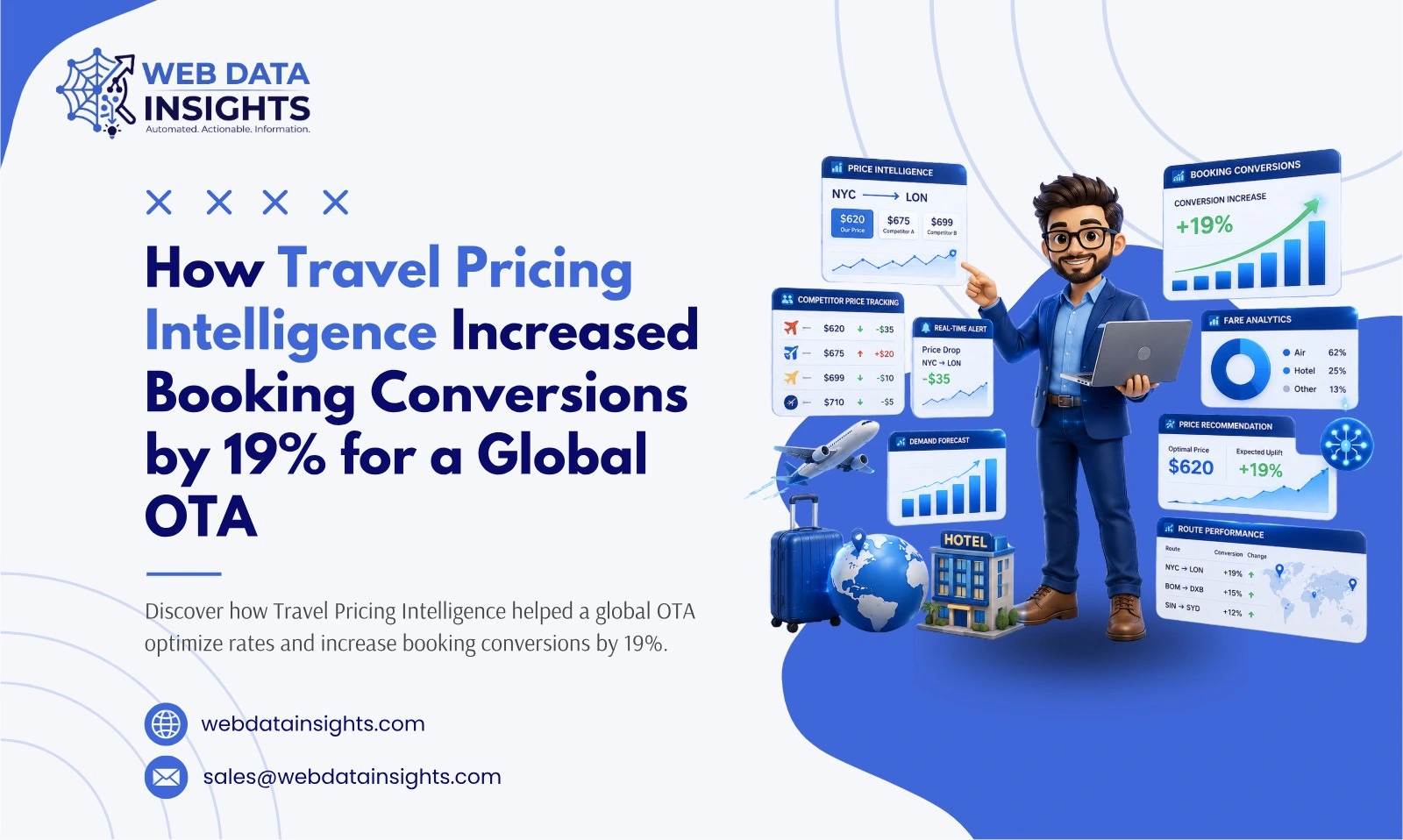
The final deliverable was a centralized dashboard that gave the revenue team a single source of truth for hotel pricing across all monitored sources. The dashboard includes automated hotel pricing alerts and a real-time travel pricing dashboard for instant decision-making.
Key features included:
- Live rate comparison tables — client rate vs. top 5 OTA competitors per property
- Price gap heat maps highlighting which destinations and property tiers were most misaligned
- Configurable alert thresholds with Slack and email notifications
- 7-day and 30-day rate trend charts per property
- Export-ready data feeds for direct ingestion into the client’s pricing engine
“We essentially built a competitive radar for their revenue team — the kind of real-time market visibility that was previously only available to enterprise-level OTAs with in-house data engineering teams.”
— Lead Data Architect, WebDataInsights
Results & Key Metrics
We track outcomes, not outputs. Here’s what the client actually saw after 90 days of the system being live:
| Metric | Result |
|---|---|
| Data extraction success rate | 97.3% across all monitored sources |
| Price refresh cycle | Down from 4–6 hours to 22 minutes average |
| Pricing gap vs. competitors | Reduced from 8–15% to under 2% within 60 days |
| Manual pricing hours saved per week | 28+ hours |
| Booking conversion rate improvement | +19% on monitored hotel categories |
| Properties tracked simultaneously | 2,400+ live hotel listings |
| Sources monitored | 18 OTAs and booking platforms |
| Alert accuracy | 94.6% precision on threshold breach notifications |
Beyond the numbers, the qualitative shift was equally significant. The revenue team described a fundamental change in how they worked: instead of reacting to pricing problems after customers had already left, they were now identifying and correcting gaps before they affected conversion.
Within the first two months, the client used the travel pricing intelligence system to identify three competitor flash-sale windows they previously would have missed entirely — and matched those rates within the same business hour.
Client Feedback
“Before this system, our pricing team spent half their day chasing data that was already outdated. Now they spend their time actually making decisions. The difference is night and day. We’ve recovered margin we didn’t even know we were losing.”
— Head of Revenue, Online Travel Aggregator (Dubai)
The client specifically highlighted three aspects of the engagement that stood out:
- Speed of delivery: The first working extraction pipeline was operational within 3 weeks of project kickoff — well ahead of their internal estimate.
- Data reliability: After initial calibration, the system consistently delivered clean, normalized data with minimal intervention required from their team.
- Partnership quality: Throughout the project, communication was proactive and solutions-oriented — particularly when we hit the anti-scraping challenges on tier-1 platforms.
Why Partner with WebDataInsights
There are dozens of vendors who will sell you a web scraper. What most of them won’t tell you is that scraping is the easy part. The hard part the part that determines whether you actually get value from the data is everything that comes after the raw extraction.
Here’s what makes our approach to travel pricing intelligence different:
| What We Bring | Why It Matters |
|---|---|
| Travel domain expertise | We understand OTA structures, rate parity rules, and market dynamics — not just HTML parsers. |
| Anti-detection resilience | Our systems are built to maintain high uptime on platforms that actively fight extraction. |
| Full-stack delivery | Extraction → normalization → intelligence dashboard — all from one partner, no integration headache. |
| Scalable infrastructure | Built to grow with your destination portfolio — adding new markets doesn’t mean rebuilding the pipeline. |
| Transparent partnership | We flag problems early, communicate proactively, and don’t overpromise on timelines. |
Conclusion
Pricing inconsistency isn’t a data problem — it’s a revenue problem. For this client, the gap between what they were charging and what the market was doing wasn’t just costing them bookings. It was eroding confidence in their platform, slowing down their team, and making it harder to plan for growth.
The travel pricing intelligence system we built didn’t just fix the data pipeline. It changed how the revenue team operates — moving them from reactive firefighting to proactive market positioning. With live hotel deals data extraction running across 18 platforms, a 22-minute refresh cycle, and full price normalization in place, they now have the kind of competitive visibility that used to require a dedicated in-house data engineering team.
If your travel brand is dealing with pricing inconsistencies, outdated rate data, or a manual Price Monitoring process that’s becoming impossible to scale – this is the kind of problem we solve every day. This improved visibility eliminated pricing blind spots and strengthened hotel rate monitoring across OTAs. Contact Webdatainsights is your trusted partner for ride-hailing fare data.
Reliable Web Data Solutions
WebDataInsights provides clean, structured, and real-time web scraping solutions tailored to your business goals, helping automate data collection for eCommerce, market research, lead generation, and more.
Get in TouchReady to Turn Your Data into Revenue Growth?
Partner with WebDataInsights for enterprise-grade B2B data scraping, real-time price monitoring, supplier benchmarking intelligence, and seamless API data delivery.
Solve My Problem