



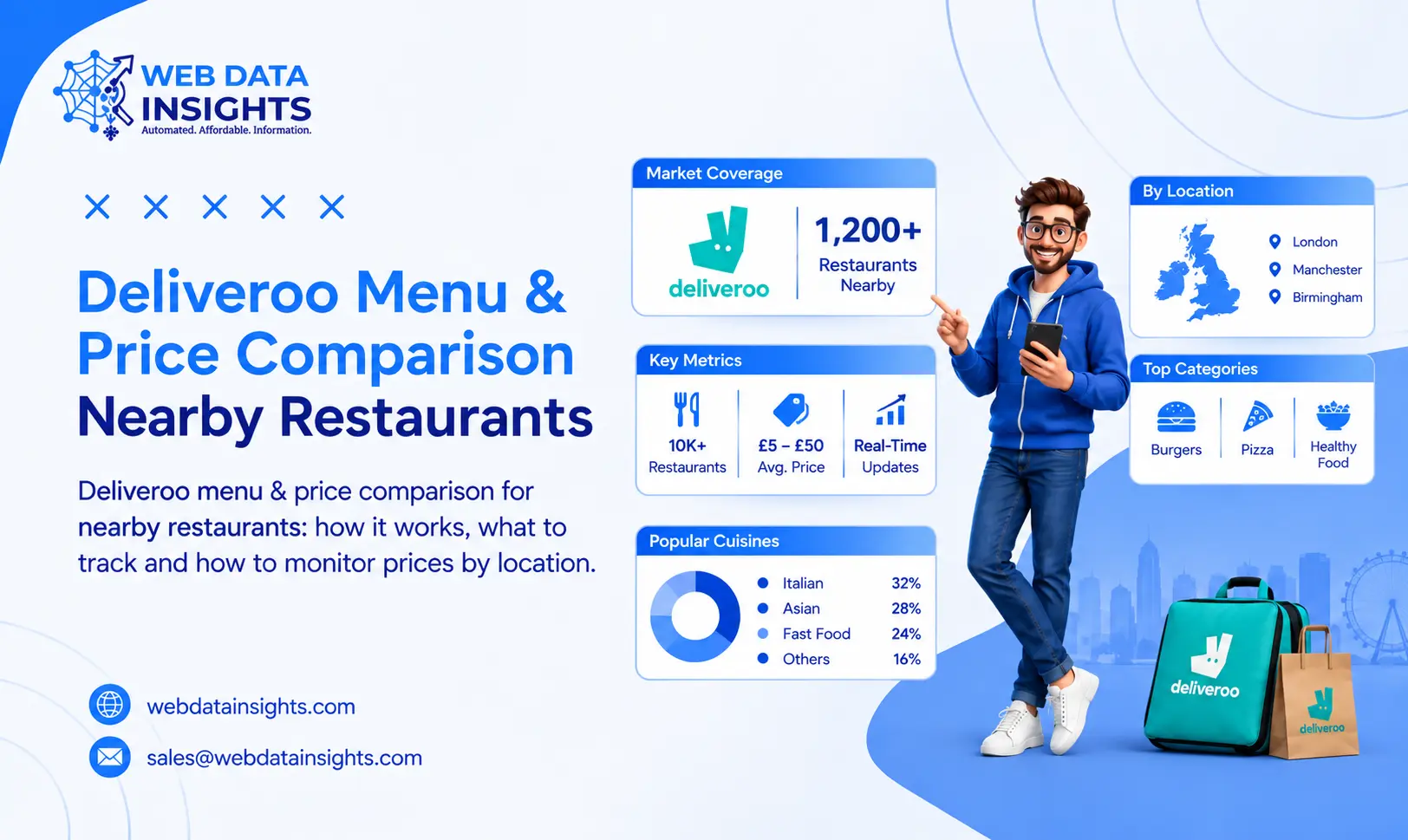
Customers compare nearby restaurants on Deliveroo in a few taps. A Deliveroo menu & price comparison shows you what the restaurants around you charge, dish by dish, so you can price with evidence instead of guesswork.
What Is a Deliveroo Menu & Price Comparison?
Short answer:
it is a side-by-side view of menus, dish prices, fees and offers for restaurants that serve the same delivery area, collected from what customers can see on public menu pages.
Deliveroo is large enough that most restaurant owners now think of it as a second high street. It reported about 7 million monthly active consumers and roughly 176,000 partners in 2024, handled 296 million orders that year, and passed 2 billion orders globally in April 2026.
On a screen that busy, your menu sits right next to your neighbours’. If your burger is 80p dearer than the one two streets away, customers see it before they ever taste it. This page explains how a Deliveroo menu & price comparison works, what to track and how to keep it running.
How Does Deliveroo Nearby Restaurant Price Comparison Work?
A Deliveroo nearby restaurant price comparison starts with a delivery address. From that address, you list every restaurant a customer could order from, then capture their menus and compare like with like.
- Pick the address. Use your restaurant, or the postcode where most of your customers live.
- List the competitors. Include every restaurant that appears for that address, not just the ones you think of as rivals.
- Capture the menus. Record dish names, prices, sizes, offers and delivery fees.
- Match the dishes. Group similar items, such as “cheeseburger” or “margherita pizza”, so the comparison is fair.
- Compare. See where you sit against the local average and the cheapest and dearest options.
A worked example (illustrative)
Say a neighbourhood has 15 competing restaurants, and each lists about 60 items. That is 900 prices to compare. If you run 50 sites, that is 45,000 prices a day, or about 1.35 million a month. This is why doing it by hand stops working very quickly.
Why Does Deliveroo Location-Based Price Monitoring Matter?
Definition:
Deliveroo location-based price monitoring means checking menus and prices as they appear for a specific delivery address, because what customers see can change from one area to the next.
Menus, fees, minimum orders and promotions can differ by address. A check from your head office may show something quite different from what a customer sees in a neighbouring town.
Location-based checks fix that. You choose the addresses that matter, such as each of your sites or your top delivery areas, and look at the market through the customer’s eyes.
- See which areas you are pricing above or below the local market.
- Spot competitors who only run offers in certain postcodes.
- Set regional prices instead of one price for every site.
How Do You Run Deliveroo Price Monitoring for Nearby Restaurants Over Time?
A single comparison is a snapshot. Deliveroo price monitoring for nearby restaurants turns it into a moving picture, so you can see when prices rise, when offers start and when a new rival opens.
Most teams check core items daily and the full menu weekly. Alerts then flag changes that matter, for example a competitor raising a best-seller by more than 5%, or a new meal deal appearing in your area.
For ongoing tracking across channels, our Price Monitoring service keeps the data flowing and the alerts relevant.
What Does a Deliveroo Menu Price Scraper Collect?
A Deliveroo menu price scraper is a tool that reads the public menu pages and turns them into clean, structured data. It should collect only what any customer can see, and store it with a date.
| Data point | Why it matters |
|---|---|
| Restaurant name and cuisine | Shows who you really compete with. |
| Dish name and category | Lets you match similar items. |
| Item price and size | The base of every price comparison. |
| Offers and bundles | Reveals promotions that change real value. |
| Delivery fee and minimum order | Affects what customers actually pay. |
| Date and delivery address | Makes trends and location checks possible. |
Pages change layout often, so a scraper needs upkeep as well as a first build. Our Web Scraping Services and Food Delivery Data Scraping teams handle that part, so your analysts get clean data and not broken scripts.
What Is Deliveroo Menu Item Price Tracking and When Do You Need It?
Deliveroo menu item price tracking follows the price of individual dishes over time, not just the average menu price. It is useful when a few items drive most of your sales.
- Track your top 20 best-sellers against their closest equivalents nearby.
- Catch small price creeps that average figures hide.
- Measure how a price change on your side affects orders.
If you want wider market context, a ready-made Food Delivery Dataset can sit alongside your own location-level tracking.
What Should Deliveroo Competitor Menu Tracking in 2026 Cover?
Deliveroo competitor menu tracking in 2026 should go beyond prices. Menus change faster than they used to, so track the whole offer.
- New items and removed items. They show where rivals are heading.
- Bundles and meal deals. They change the value customers see.
- New openings nearby. A new rival changes your local market overnight.
- Fee changes. A cheaper dish with a higher delivery fee may not be cheaper at all.
Which Businesses Use Nearby Restaurant Price Comparison?
Restaurant Chains
Set menu prices by region instead of one price for every site.
Independent Restaurants
Check whether your prices sit within the local range before you change them.
Cloud & Dark Kitchens
Choose cuisines and price points that suit each area.
Franchise Operators
Give franchisees local price guidance backed by data.
Food Brands & Suppliers
See which dishes and ingredients are trending nearby.
Investors & Analysts
Judge competition and pricing pressure in a market.
What Are the Best Practices for Tracking Deliveroo Menus and Prices?
- Start with a small set of addresses and your 20 best-selling dishes.
- Match dishes by size and type before you compare prices.
- Keep a dated history, so you can see trends and not just snapshots.
- Set alerts for core items only, so the team keeps reading them.
- Read the platform’s terms and take legal advice before you start collecting data.
Frequently Asked Questions
How do I compare menu prices of nearby restaurants on Deliveroo?
Set a delivery address, list the restaurants that appear for it, then compare matching dishes by price, size and offers. For more than a handful of restaurants, an automated tracker saves a lot of time.
Do Deliveroo prices change by location?
They can. Menus, fees and offers may differ by delivery address, which is why location-based checks are more reliable than a single lookup.
How often should I check competitor prices?
Daily for core items works well. Weekly is enough if you only want trends and promotions.
Is it legal to track competitor menu prices on Deliveroo?
Prices shown publicly are generally fair to view, but a platform’s terms may limit automated access. Read the terms and speak to a lawyer before you start.
Can I use a ready-made Apify tool for Deliveroo menu item price tracking?
A ready-made tool can work for a small test or a one-off pull. For daily tracking across hundreds of restaurants, you also need dish matching, quality checks and someone to fix it when pages change.
How many restaurants does Deliveroo have?
Deliveroo disclosed about 176,000 partners, including restaurants, grocers and retailers, with roughly 7 million monthly active consumers in 2024.
What do I need to get started?
A list of your sites or delivery areas, and the dishes you most want to compare. That is enough for a first sample.
Reliable Web Data Solutions
WebDataInsights provides clean, structured, and real-time web scraping solutions tailored to your business goals, helping automate data collection for eCommerce, market research, lead generation, and more.
Get in TouchReady to Turn Your Data into Revenue Growth?
Partner with WebDataInsights for enterprise-grade B2B data scraping, real-time price monitoring, supplier benchmarking intelligence, and seamless API data delivery.
Solve My Problem