





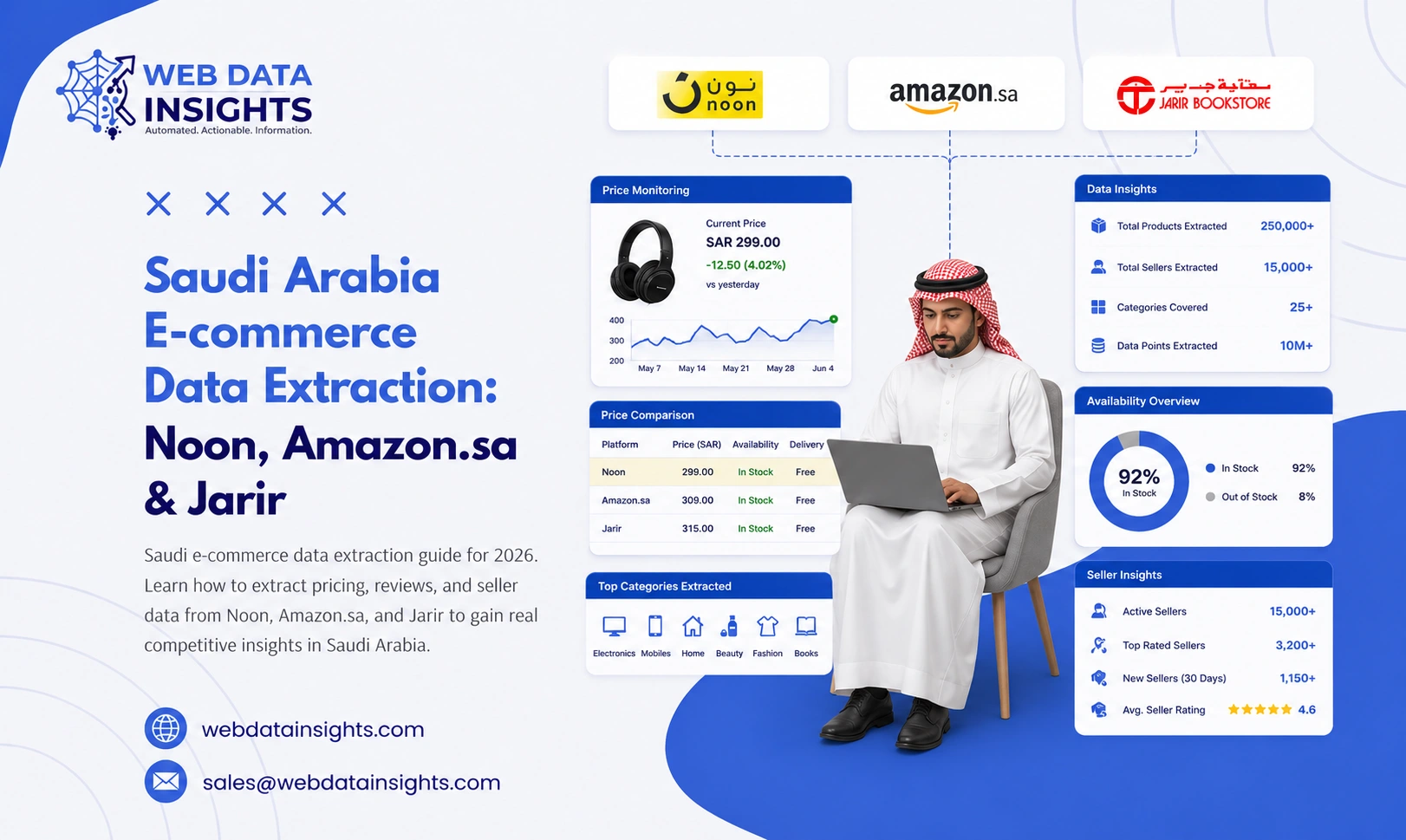
Saudi e-commerce data extraction is no longer optional for brands that want to compete inside the Kingdom. The market crossed $16 billion in gross merchandise value in 2025, growing faster than any other economy in the Middle East. Yet most brands entering Saudi Arabia are flying blind relying on distributor gut-feel and quarterly reports that are already six months stale by the time they land on someone’s desk.
This guide is a practical breakdown of how data extraction actually works across the three platforms that dominate Saudi e-commerce Noon Saudi Arabia, Amazon.sa, and Jarir. Drawing on real-world implementation experience from WebDataInsights, it covers what data you can realistically extract, the technical challenges in 2026, and how serious operators turn that data into decisions that actually move the needle.
If you have been asking yourself any of the following questions, you are in the right place.
Why Is Saudi Arabia the Hardest E-commerce Market to Get Data From?
The UAE has had competitive Real-Time price intelligence infrastructure for years. Saudi Arabia does not. The market is bigger, growing faster, and has more strategic money behind it — but the data ecosystem is still catching up. That gap is both the problem and the opportunity.
Three things make Saudi e-commerce data uniquely difficult compared to any other market in the region:
- Arabic-first content. Saudi consumers are the most Arabic-dominant online shoppers in the entire GCC. Reviews, product descriptions, and search behavior happen overwhelmingly in Arabic — specifically Gulf Arabic with Saudi dialect. Standard Arabic NLP tools built for MSA (Modern Standard Arabic) miss a significant percentage of the signal.
- Saudi-specific IP requirements. Noon Saudi Arabia and Amazon.sa serve different content to international IPs versus Saudi residential connections. You cannot get authentic Saudi pricing, availability, and delivery window data without Saudi-origin infrastructure. This is a real technical wall, not a guideline.
- Three distinct metro markets. Riyadh, Jeddah, and Dammam do not behave the same way. Consumer preferences differ, delivery windows differ, and in some categories dynamic pricing software differs. A single national-level scrape misses this entirely.
None of this is insurmountable. But it does mean that generic scraping tools built for US or European markets will not give you what you need in Saudi Arabia.
What Data Can You Actually Extract From Noon Saudi Arabia in 2026?
Noon is the regional champion. Backed by over a billion dollars in capital and deeply embedded in the Saudi market, it is where most international brands land first and where local competitors benchmark themselves hardest. Here is what is genuinely extractable from noon.com/saudi-en:
Product and Pricing Data
Full product listings come with Arabic and English titles and descriptions, pricing in SAR with Noon Express delivery eligibility clearly marked, and promotional data that covers White Friday, Ramadan deals, and daily flash offers. The seller marketplace layer tells you whether you are looking at Noon direct inventory or a third-party seller — a critical distinction for brand protection work. Instalment plan dynamic pricing is also visible, which matters enormously in electronics and appliances categories where buy-now-pay-later is a dominant purchasing pattern.
Review and Sentiment Data
Review text on Noon Saudi Arabia is predominantly Arabic, often with Gulf dialect patterns and Arabic-English code-switching. If you are only reading the star rating without parsing the text, you are getting maybe 30% of the story. Verified purchase flags, reviewer city data where visible (Riyadh versus Jeddah versus Dammam patterns), and review media — photos and videos — all carry intelligence that star distributions cannot tell you.
Brand-Level and Category Signals
Brand storefronts on Noon provide SKU count, pricing position relative to category average, and promotional participation frequency. Category bestseller rankings and Noon Plus pricing where visible round out the brand-level picture. These signals, tracked over time, become a reliable proxy for market share movement.
How Is Amazon.sa Different From Amazon.com or Amazon.ae for Data Purposes?
Amazon.sa is not a reskinned version of its global counterpart. The Saudi localisation has real structural differences that affect both what data is available and how you access it.
The Buy Box mechanics work similarly to other Amazon marketplaces, and ASIN-level pricing and offer stacks are extractable. Prime eligibility, Subscribe and Save availability, and Amazon’s Choice badges all pull cleanly. What makes Amazon.sa distinct is the combination of Saudi-specific content — Arabic product descriptions and Saudi consumer reviews — with Amazon’s global catalog infrastructure.
Bestseller rank on Amazon.sa reflects Saudi purchasing patterns, not global ones. A product that ranks in the top ten on Amazon.com may rank 40th in Saudi Arabia in the same category, and vice versa. This category-level ranking data is one of the cleanest demand signals available in the Saudi market.
Brand Registry data, A+ Content, and Enhanced Brand Content all surface through Amazon.sa extraction and can tell you a lot about how seriously a brand is investing in the Saudi market. Brands that have built full A+ pages are signaling long-term commitment. Brands operating with placeholder content are signaling the opposite.
One technical note: Amazon.sa deploys anti-bot infrastructure that is tied to Saudi IP verification. International proxy routes will hit walls or return inconsistent data. Saudi residential IP infrastructure is the only reliable path to consistent extraction.
Why Does Jarir Data Require a Completely Different Approach?
Jarir Bookstore is one of the most trusted retail brands in Saudi Arabia. It built that trust over decades of physical retail in electronics, stationery, and general merchandise. Its e-commerce platform (jarir.com) is now a serious competitive force — particularly in computing, gaming, office supplies, and books.
The technical architecture of Jarir’s platform is fundamentally different from Noon or Amazon. Category-specific scraping is required, especially in electronics where product specifications are deeply nested within the page structure. What looks like a single product listing to a human browser is multiple data layers that need to be pulled separately and assembled.
Jarir-specific data points that carry high intelligence value:
- In-store versus online pricing differentials, which Jarir does not always keep consistent
- Jarir-exclusive products and bundles, which do not appear on Noon or Amazon.sa
- Jarir’s own promotional cadence, which runs independently of White Friday and Ramadan standard timings
- Gift card and corporate sales indicators, relevant for B2B purchasing intelligence
- Customer review data that, while lower in volume than Noon or Amazon, carries high trust signals given Jarir’s brand credibility
Brands competing in consumer electronics in Saudi Arabia cannot benchmark themselves accurately without Jarir data. The platform exists in a separate competitive universe from the marketplaces, and treating all three as interchangeable gives you an incomplete picture.
What Are the Real-World Use Cases Driving ROI From Saudi E-commerce Data?
The use cases that generate the strongest return on investment from Saudi e-commerce data extraction tend to fall into a handful of recurring categories.
International Brand Market Entry
A brand entering Saudi Arabia without competitive data is entering a conversation they cannot hear. Six months of historical pricing and review data before launch tells you the real price ceiling consumers will accept, what competitors are actually being criticized for, and where genuine product category gaps exist that your positioning can own. This is not market research in the traditional sense — this is live market intelligence that changes the shape of a launch plan.
Unauthorized Seller Detection
Saudi Arabia’s grey market problem is significant. Distributors managing forty or more international brands regularly find unauthorized sellers undercutting official pricing on Noon and Amazon.sa marketplace listings. Daily extraction that tracks seller IDs, pricing deviations, and fulfillment type is the only scalable way to catch this before it erodes distributor margins and brand positioning.
Ramadan and White Friday Strategy
Ramadan is Saudi Arabia’s largest commercial event. E-commerce revenue during Ramadan can represent 25 to 30 percent of a brand’s annual volume. The brands that win Ramadan are the ones that went into it with historical data — knowing exactly what competitors promoted, at what depth of discount, in which categories, and how consumer response shifted across the month. White Friday follows a similar pattern. These are not events you can prepare for without data.
Vision 2030 Investment and Consulting Intelligence
Consulting firms advising Saudi government entities on retail sector development, and PE and VC firms building investment theses around Vision 2030 retail, all need comprehensive e-commerce data. The difference between a deal sourced from marketplace intelligence and one sourced from a broker’s pitch deck is significant in terms of the quality of underlying conviction. Saudi-focused investors are increasingly building this capability in-house or through dedicated data partners.
How Does Saudi E-commerce Seasonality Change Your Data Strategy?
Most Western e-commerce markets have one or two major seasonal peaks — Christmas and maybe a summer sale period. Saudi Arabia has four to five distinct commercial events that each require their own data-driven preparation:
- Ramadan: The biggest. Gifting, family consumption, and home spending all spike simultaneously. Begins with a 3-to-4-week promotional build-up.
- Hajj season: Religious tourism creates a distinct commercial event, particularly in hospitality, apparel, and personal care categories.
- Saudi National Day (September 23): Consumer electronics, appliances, and Saudi-branded products see significant promotional activity.
- White Friday: Saudi Arabia’s version of Black Friday, timed to the Friday after the US Thanksgiving — now one of the biggest single shopping days on both Noon and Amazon.sa.
- Back to School / Academic year start: Jarir in particular sees outsized volume in electronics, stationery, and computing categories.
Each of these events requires burst-capacity data extraction — higher frequency, broader coverage, and faster processing. An infrastructure built only for steady-state price monitoring will miss the most commercially valuable windows of the year.
Saudi Arabia’s work week (Sunday through Thursday) and daily rhythm shaped by prayer times also create different online shopping patterns than Western or even UAE markets. Peak platform traffic times in the Kingdom are distinct, and extraction schedules that do not account for this will over-index on low-traffic windows and under-index on the periods that carry the most price and inventory change.
Is SASO Compliance Data Extractable From Saudi E-commerce Platforms?
SASO — the Saudi Standards, Metrology and Quality Organization — requires certification for a wide range of product categories sold in Saudi Arabia. Electronics, appliances, food products, and many consumer goods categories all have SASO certification requirements that are distinct from what brands need to comply with in the UAE or other GCC markets.
Product listings on Noon and Amazon.sa sometimes carry visible certification badges or imported product declarations. Extracting these signals systematically — and mapping them against competitor listings — gives brands two things: a compliance benchmark for their own listings, and intelligence on whether competitors are actually meeting certification requirements or quietly flouting them.
The full SASO certification database lives on government portals separate from the e-commerce platforms. Building an extraction pipeline that connects platform listing data to the SASO registry adds a layer of compliance intelligence that most brands currently do not have access to in any structured form.
What Does a Complete Saudi E-commerce Data Operation Look Like?
Companies that are genuinely winning with Saudi e-commerce data in 2026 are not running one-off scrapes. They have built or bought into continuous data pipelines with these characteristics:
- Multi-platform coverage across Noon SA, Amazon.sa, Jarir, Extra, and Namshi at minimum — plus Saudi SME platforms built on Salla and Zid where relevant to their category.
- Daily refresh cadence for pricing and availability, with higher-frequency monitoring in the 72 hours before and after major commercial events.
- Arabic NLP with Gulf dialect handling — not generic Arabic NLP — for review sentiment, product description analysis, and keyword intelligence.
- Geo-specific data for Riyadh, Jeddah, and Dammam separately, with secondary city coverage for brands in distribution-heavy categories.
- Historical archive access going back 18 to 24 months minimum, to enable seasonal benchmarking across full annual cycles.
- Cross-GCC comparison capability for brands operating across Saudi Arabia, UAE, Kuwait, Bahrain, Oman, and Qatar.
- Delivery format flexibility — REST API, S3 data drops, warehouse loads, or dashboard access — based on how the data will be operationalized.
The companies building this seriously are tracking two million or more active Saudi product listings on a daily basis. That scale is what allows category-level benchmarking to be statistically meaningful rather than directionally suggestive.
Frequently Asked Questions About Saudi E-commerce Data Extraction
Is it legal to scrape Noon, Amazon.sa, and Jarir?
Publicly visible product catalog data — pricing, descriptions, ratings — sits in a different category from personal data. Saudi Arabia’s Personal Data Protection Law (PDPL) is focused on personal data. Product listing data is not personal data. That said, terms of service vary by platform, and any extraction operation at commercial scale should have qualified Saudi legal counsel review the specific use case before going live.
How important is Arabic NLP for Saudi review analysis?
Critical. Saudi Arabia is the most Arabic-dominant e-commerce market in the GCC. If your review analysis cannot handle Saudi dialect Arabic, code-switching (Arabic-English mixing within the same sentence), and Gulf Arabic idioms, you are misreading a substantial portion of your consumer sentiment data. This is one of the areas where Saudi e-commerce intelligence diverges most sharply from UAE or Egyptian market tools.
Can you get pricing data that differs by Saudi city?
Yes, though it requires geo-specific extraction infrastructure. Riyadh, Jeddah, and Dammam sometimes show different delivery windows and availability statuses, and in some categories pricing can vary. Extracting this accurately requires Saudi residential IP infrastructure that can be pointed at specific metro areas — not national-level Saudi IPs.
How does Ramadan affect data extraction operations?
Ramadan requires burst-capacity infrastructure. Price change frequency increases significantly during the promotional run-up, and platform traffic patterns shift dramatically with evening shopping spikes after Iftar. An extraction pipeline built for normal-cadence operation will produce incomplete data during the Saudi commercial events that matter most. Scaling for 5x normal capacity during Ramadan and White Friday periods is a baseline operational requirement, not a nice-to-have.
The Bottom Line
Saudi Arabia is the fastest-growing e-commerce market in the Middle East, and the data gap between what is available and what most brands are actually using is wider than in any comparable market globally. The brands and investors that close that gap first will have a structural advantage that compounds over time.
Saudi e-commerce data extraction across Noon, Amazon.sa, and Jarir is technically achievable with the right infrastructure — Saudi-origin IPs, Arabic NLP that handles Gulf dialect, geo-specific coverage, and burst capacity for the Kingdom’s commercial calendar. The technical challenges are real, but they are not novel. What is novel is the market opportunity on the other side of solving them.
Whether you are a brand entering Saudi Arabia, a distributor protecting your portfolio, or an investor building conviction around Vision 2030 retail — the intelligence you need exists inside these platforms today. The question is only whether you have a reliable way to get it.
Ready to Get Your Saudi E-commerce Data Noon SA, Amazon.sa, and Jarir ?
Whether you need a one-time competitive analysis or a live data feed updated daily, Contact Webdatainsights delivers clean, structured Noon SA, Amazon.sa, and Jarir Data tailored to your business. Most clients receive their first dataset within 48 hours of sharing their requirements.
Request a Free Sample Dataset Today
webdatainsights.com/contact-us/
Reliable Web Data Solutions
WebDataInsights provides clean, structured, and real-time web scraping solutions tailored to your business goals, helping automate data collection for eCommerce, market research, lead generation, and more.
Get in Touch