





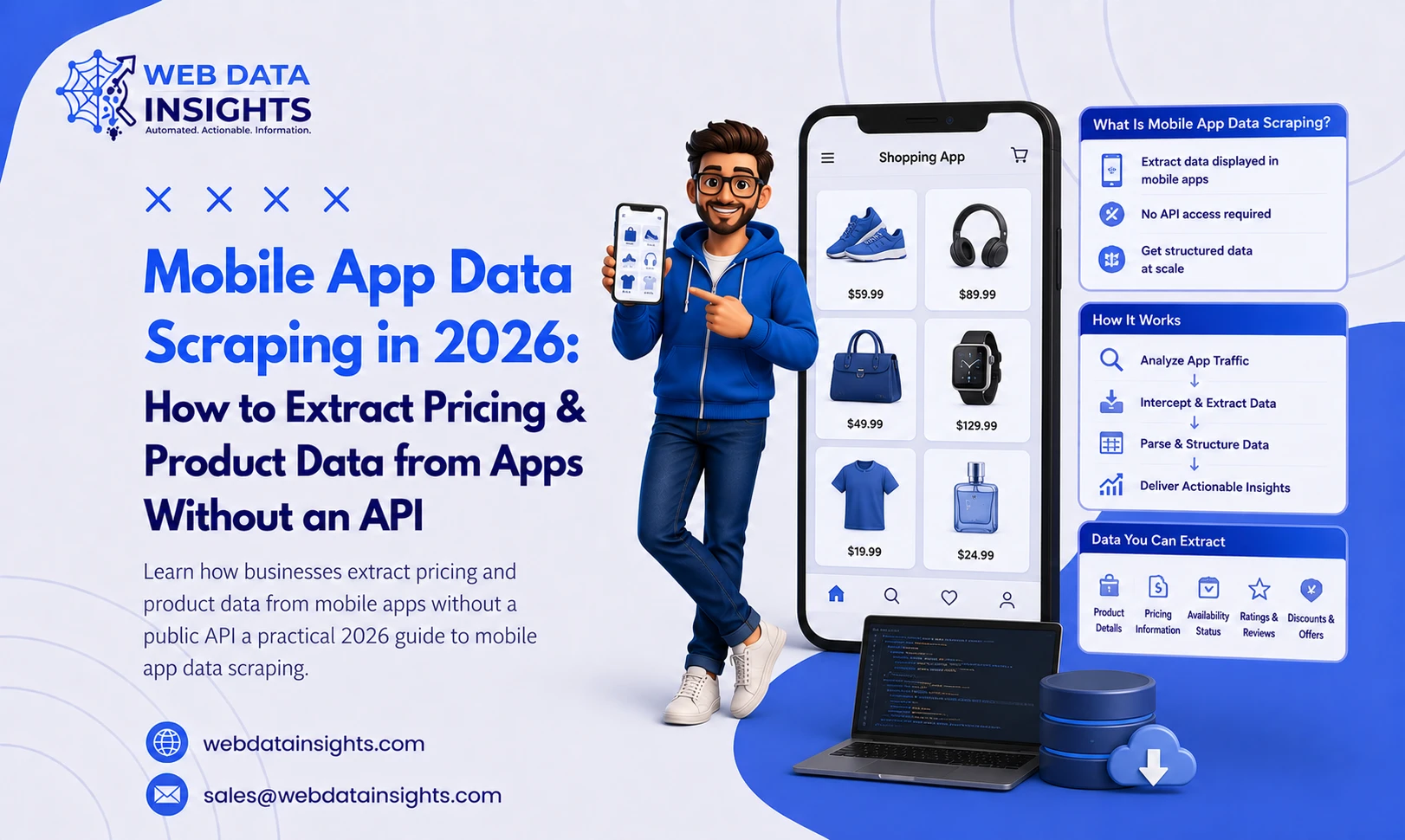
A growing number of pricing and product-heavy businesses — quick-commerce, ride-hailing, app-exclusive fashion drops — now operate mostly or entirely through a mobile app, with no equivalent public website to scrape and no public API for outside teams to query. Mobile app data scraping in 2026 has become the practical answer for businesses that need pricing, catalog, or availability data from these apps, using techniques that look quite different from traditional web scraping.
QUICK ANSWER
Mobile app data scraping in 2026 refers to extracting structured data — pricing, product listings, availability — directly from mobile applications rather than websites, typically through traffic-based capture or UI-based automation, since most mobile-first apps don’t expose a public API or a scrapable web page.
Why Mobile Apps Are Harder to Scrape Than Websites
Websites render content as HTML that a scraper can parse directly. Mobile apps render the same information through native UI components, which means there’s no static page structure to read from outside the app itself. On top of that, many app-only businesses never publish a full web catalog at all, app updates roll out more frequently than most website redesigns, and pricing is often personalized by device, location, or session — three complications a typical web scraping approach was never built to handle.
Mobile App Data Extraction: How It Works
Mobile app data extraction generally relies on one of two approaches, often combined for reliability. The first is structured capture of the app’s own network traffic — reading the same data the app requests from its backend as it loads a screen. The second is UI-based automation, where a controlled process interacts with the app interface and reads data directly as it’s rendered, which becomes the fallback when traffic alone doesn’t expose everything needed.
Neither approach involves bypassing app security controls or accessing anything beyond what a normal user session would see — the goal is capturing publicly viewable data at scale, not circumventing protections.
Example: Network Response Captured From a Mobile App
{
  "store_id": "NYC_102",
  "product": {
    "id": "SKU-87451",
    "name": "Wireless Earbuds Pro",
    "category": "Electronics"
  },
  "pricing": {
    "list_price": 99.99,
    "selling_price": 84.99,
    "currency": "USD",
    "discount": "15%"
  },
  "inventory": {
    "stock_status": "In Stock",
    "quantity_available": 42
  },
  "delivery": {
    "estimated_time": "25 mins",
    "city": "New York"
  },
  "last_updated": "2026-07-15T14:18:27Z"
}
Extract Pricing and Product Data from Mobile Apps
Teams that need to extract pricing and product data from mobile apps are usually watching for the same core signals that matter on the web, plus a few that are specific to mobile: base price versus personalized or location-adjusted price, real-time stock status, and how often a price changes within a single session versus across sessions.
| Signal | Why It's Different on Mobile |
|---|---|
| Location-based pricing | Quick-commerce and ride-hailing apps often price by delivery zone or city |
| Session-based variance | The same account can see different prices across app sessions |
| Surge or demand pricing | Prices can shift within minutes during peak demand windows |
| App-exclusive listings | Some products or offers exist only inside the app, never on the web |
Product Data Extraction from Apps: What to Capture
Product data extraction from apps covers much of the same ground as web catalog scraping — title, category, images, specifications, variants — with one added wrinkle: app-exclusive listings. Many retail and marketplace apps run drops, bundles, or promotions that never appear on the brand's website, which means a web-only monitoring approach will simply miss them.
Real-Time App Data Extraction for Time-Sensitive Categories
Real-time app data extraction matters most in categories where price and availability shift by the hour rather than by the day. Quick-commerce delivery windows, ride-hailing surge pricing, and flash-sale inventory all fall into this bucket — a daily refresh cycle is simply too slow to catch what's actually happening, and stale data here can be actively misleading rather than just outdated.
How to Scrape Mobile App Data Without an API
Most consumer apps never publish a public API, which is exactly the gap mobile app scraping fills. The practical approach to scrape mobile app data without an API is to treat the app's own internal data channels and rendered UI as the source of truth, capturing what's already being shown to a normal user rather than trying to access anything hidden or restricted. This keeps the process aligned with publicly accessible information, similar in spirit to how Web Scraping API Services provide structured access to web data where a native API doesn't exist.
Example: Extracting Product Data From a Mobile App Response
import requests

headers = {
    "User-Agent": "Mozilla/5.0",
    "Accept": "application/json"
}

response = requests.get(
    "https://example-app.com/api/v1/products",
    headers=headers,
    timeout=20
)

data = response.json()

for item in data["products"]:
    print({
        "name": item["title"],
        "price": item["price"]["current"],
        "availability": item["stock_status"]
    })
Note: example-app.com intentionally uses a placeholder domain for illustration only.
Mobile App Web Scraping Solutions: Build vs. Partner
Building this in-house means maintaining separate handling for iOS and Android, tracking app version updates that can break a pipeline overnight, and running device or emulator infrastructure that most data teams aren't set up to manage long-term. This is why Mobile App Web Scraping Solutions from a dedicated partner are often the more practical route — the underlying Mobile App Scraping infrastructure and monitoring already exist, rather than being rebuilt from scratch for every new app tracked. This sits alongside broader Web Scraping Services for businesses that need both web and app coverage in one pipeline.
Examples: Who Actually Uses This Data
Quick-commerce and grocery delivery brands track competitor pricing and delivery-fee structures across cities where pricing is set locally. Ride-hailing and mobility companies monitor surge-pricing patterns and driver availability trends across metro areas. Food delivery and restaurant aggregators watch app-exclusive promotions that never appear on a competing brand's website. Fashion and marketplace apps running limited drops need visibility into inventory and pricing the moment a release goes live. Fintech and travel apps with app-only fare or rate structures need this data to benchmark pricing that a website simply doesn't show.
Expert Insights & Best Practices
Treat app updates as routine, not exceptional
App interfaces and data structures change more often than most websites. A pipeline that isn't built to expect this will break repeatedly and unpredictably.
Match refresh frequency to category volatility
Surge-priced and flash-sale categories need near-continuous monitoring. This pairs naturally with a broader Price Monitoring strategy that spans both web and app channels.
Account for personalized and location-based pricing separately
A single "current price" often doesn't exist on mobile the way it does on a simpler website. Track price by location or session context rather than assuming one number applies everywhere.
Stay within compliant, publicly visible boundaries
Extract only what a normal app session would show, and avoid any approach that circumvents security or access controls — this is both a legal safeguard and good engineering practice.
Common Mistakes to Avoid
- Assuming web scraping techniques transfer directly — mobile apps need a fundamentally different extraction approach, not a modified web scraper.
- Ignoring iOS/Android fragmentation — a pipeline built for one platform often needs entirely separate handling for the other.
- Missing personalized pricing variance — treating one captured price as the "real" price when it may only reflect one session or location.
- Underestimating update frequency — app releases can break a data pipeline far more often than a website redesign would.
- Skipping compliance review upfront — mobile data collection deserves the same legal and terms-of-service diligence as any other extraction project.
Where This Is Heading
More pricing-sensitive businesses are becoming app-first or app-exclusive, with no web equivalent to fall back on for monitoring. At the same time, scrutiny around how mobile data is collected is increasing, pushing the industry toward more structured, compliance-aware extraction methods rather than ad hoc scripts. Expect growing demand for dedicated mobile data pipelines that behave more like managed services than one-off scraping projects, as more of the pricing and product data businesses need simply lives inside an app.
Frequently Asked Questions
What is mobile app data scraping?
Mobile app data scraping is the process of extracting structured data, such as pricing, product listings, and availability, directly from mobile applications rather than websites, typically through traffic-based capture or UI-based automation, since most mobile-first apps do not expose a public API or a scrapable web page.
Why is scraping a mobile app harder than scraping a website?
Mobile apps render data through native UI components instead of static HTML, update more frequently than most websites, and often serve personalized or location-based pricing per session, all of which make traditional web scraping techniques ineffective without adaptation.
Can you scrape mobile app data without an API?
Yes. When an app has no public API, data is typically captured through structured traffic analysis of the same data channels the app itself uses, or through automated UI interaction that reads data as it is rendered on screen, always within publicly accessible, compliant boundaries.
What kind of businesses need real-time app data extraction?
Quick-commerce, ride-hailing, and flash-sale retail apps are the clearest cases, since prices and inventory in these categories can change multiple times within a single hour, making a daily or weekly data refresh far too slow to be useful.
Does mobile app data scraping work the same way for iOS and Android?
No. iOS and Android apps differ in how they render UI and structure network traffic, and both platforms release frequent version updates, so a pipeline built for one OS typically needs separate handling and maintenance for the other.
Is it better to build in-house mobile app scraping or use a dedicated service?
Most businesses find dedicated mobile app scraping solutions more practical than an in-house build, since app UI and traffic structures change often enough that maintaining a reliable pipeline requires continuous engineering attention beyond the initial setup.
Conclusion
As more pricing and product-heavy businesses move to app-only or app-first models, the ability to extract reliable data from mobile apps has stopped being a niche technical challenge and become a core competitive intelligence need. Teams that treat mobile app data extraction as a dedicated discipline—with its own refresh cadence, monitoring, and compliance approach — get a clearer, more current view of the market than those still relying on web-only tracking. At WebDataInsights, we help businesses build scalable mobile app data extraction pipelines that deliver reliable pricing, product, and availability data across both iOS and Android platforms.
Reliable Web Data Solutions
WebDataInsights provides clean, structured, and real-time web scraping solutions tailored to your business goals, helping automate data collection for eCommerce, market research, lead generation, and more.
Get in Touch