





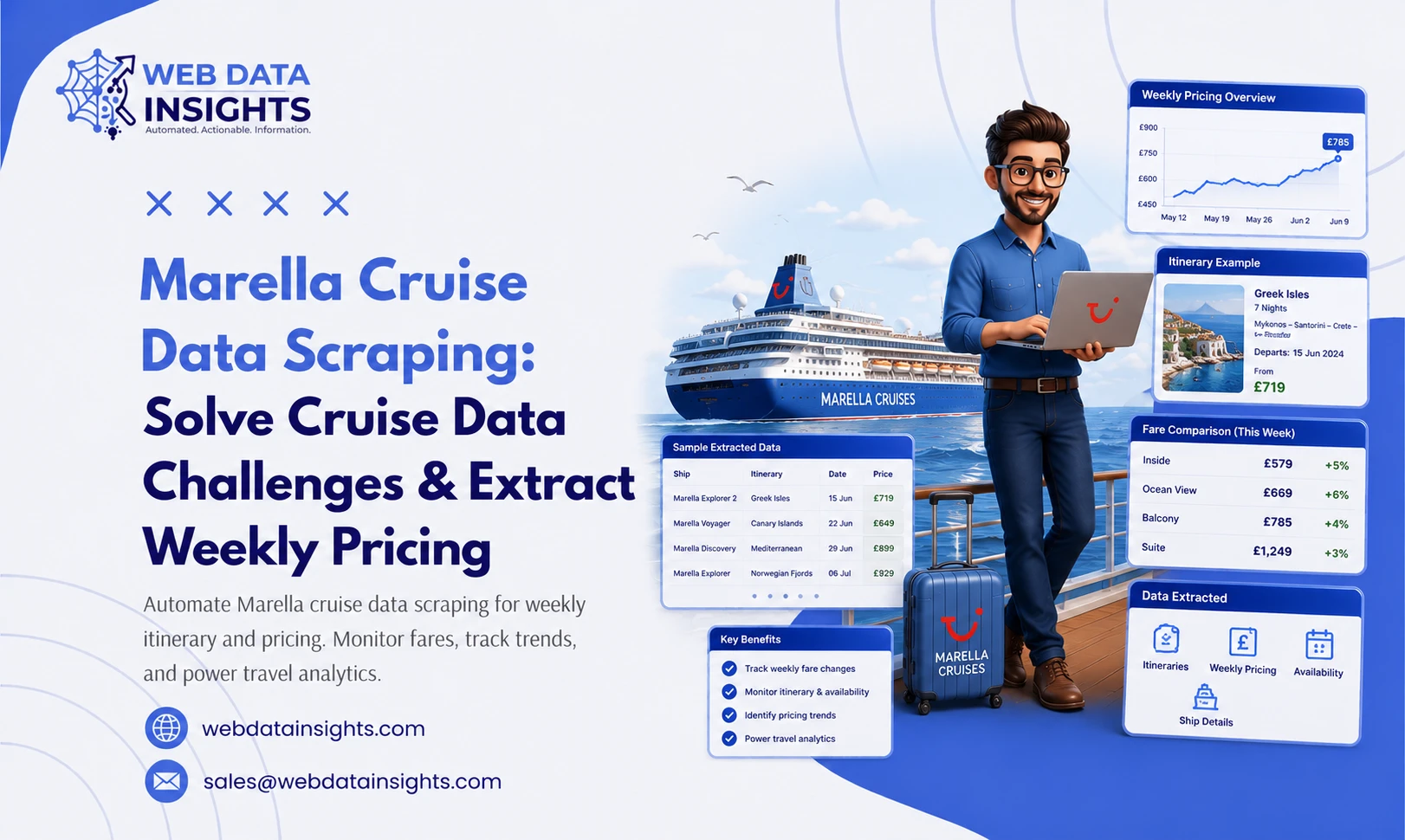
If you’ve ever tried Marella Cruise Data Scraping to track Marella Cruises’ weekly pricing and itinerary changes, you already know the pain. Fares shift multiple times a day. New sailings get added quietly. Cabins sell out, prices spike, and by the time your analyst refreshes the spreadsheet, the window is gone—along with the opportunity.
This isn’t a problem limited to a single team it’s one of the biggest structural frustrations in cruise price optimization and travel data intelligence today. And it only intensifies at scale, when you’re managing dozens of routes, tracking competitor positioning, or feeding an AI Pricing for Cruise Industry engine that demands fresh, accurate data every Monday morning.
That’s exactly where WebDataInsights comes in helping businesses streamline large-scale data extraction and power smarter, real-time pricing decisions with reliable, automated intelligence.
In this guide, we’ll walk through the real data challenges travel businesses face when dealing with cruise itinerary Real-Time pricing intelligence and then show you exactly how structured, automated Marella Cruise data extraction solves them, week after week.
Why Marella Cruise Data Is Harder to Track Than You Think
Marella Cruises, operated by TUI UK, is one of the largest cruise brands catering to British holidaymakers. Their fleet covers Mediterranean circuits, Caribbean routes, transatlantic crossings, and more — with itineraries and pricing refreshed on a rolling weekly basis.
That rolling refresh is exactly what makes scraping Marella cruise itinerary data genuinely difficult. It’s not like scraping a static product catalog. You’re dealing with:
- Dynamic pricing that changes based on departure date, cabin type, occupancy, and demand signals
- Short booking windows where early-week pricing can differ drastically from Thursday pricing for the same sailing
- JavaScript-heavy pages that don’t expose clean data in the HTML source
- Anti-bot protections and rate limiting that block naive scraping attempts
- Session-based availability data that only renders after user interaction
And if you need weekly Marella cruise data extraction meaning fresh data every 7 days to feed your pricing model, commercial dashboard, or partner system the complexity compounds. Missing one week means working from stale data. And in a market this volatile, stale data means bad decisions.
The Real Cost of Poor Cruise Data Infrastructure
Let’s be specific about what poor data infrastructure actually costs — because this is where it stops being a technical conversation and becomes a business one.
Lost Revenue Windows
Cruise pricing is cyclical. There are predictable demand peaks — school holidays, early booking surges in January, last-minute drops in shoulder season. Without structured price monitoring tied to real-time Marella fare data, you’re essentially guessing when those windows open and close.
Misaligned Partner Packages
Travel agents and OTAs that package Marella sailings with flights, hotels, or transfers need accurate lead times and pricing to build competitive bundles. If your fare data is 3 days old, your bundle pricing is wrong — and customers notice when the live site shows something different.
Competitive Blindspots
Your competitors are using travel data intelligence tools. If you’re not monitoring the same Marella itineraries they are — departure dates, pricing tiers, available cabins you’re flying blind in a market where information asymmetry directly translates into margin difference.
Operational Waste
Manual data collection analysts visiting the Marella site, copy-pasting fares into spreadsheets, building reports by hand is expensive, error-prone, and unjustifiably slow. It also doesn’t scale. Adding five new routes to monitor means hiring more people, not building better systems.
The fundamental issue isn’t that the data doesn’t exist. It does. The issue is that without the right extraction infrastructure, you can’t access it reliably, at the frequency and structure your business needs.
Key Data Points You Actually Need from Marella
Before we talk about extraction methods, it’s worth being precise about what data matters. Not everything on the Marella site is equally useful, and a good data strategy focuses on the fields that drive decisions.
Here’s what structured Marella Cruise data collection should capture:
| Itinerary Name | Full cruise name and route label (e.g., ‘Greek Isles from Palma’) |
| Departure Date | Weekly departure schedules with ship assignment |
| Duration | Number of nights and day-by-day port schedule |
| Ship Name | Marella Explorer, Marella Discovery, etc. |
| Cabin Types | Inside, Oceanview, Balcony, Suite — with bed configuration |
| Price Per Person | Lead-in price and full cabin price, including/excluding flights |
| Availability Status | Sold out, limited, or open availability per cabin class |
| Included Extras | AI, drinks packages, excursion credits — affects perceived value |
| Departure Port | Key differentiator for regional pricing and packaging |
| Promotion Flags | Sale labels, early booking discounts, last-minute deals |
This level of Marella Cruise Schedule & Fare Intelligence — structured, timestamped, and updated weekly — is what separates reactive pricing teams from proactive ones.
How Weekly Marella Cruise Data Extraction Actually Works
Let’s get practical. Cruise data automation for a site like Marella isn’t as simple as pointing a basic scraper at a URL and calling it done. Modern travel websites are built to serve humans through browsers — not machines through HTTP requests. Here’s what a production-grade extraction pipeline actually looks like.
Step 1: Headless Browser Rendering
Marella’s fare pages load data through JavaScript after the initial page request. That means simple HTTP scrapers that just fetch HTML will miss almost everything important. A robust scraper uses headless browser automation tools like Playwright or Puppeteer to render pages exactly as a browser would, including all the Dynamic Pricing Software content.
Step 2: Session and Cookie Management
Availability data on Marella’s platform is often session-dependent. The scraper needs to maintain valid sessions, handle cookie consent flows, and navigate the booking funnel to reach cabin-level pricing data — all without triggering bot detection.
Step 3: Anti-Bot Navigation
This is where most in-house web scraping services for travel industry fall over. Enterprise sites use browser fingerprinting, request rate analysis, and CAPTCHA challenges to detect automated traffic. Production scrapers need rotating residential proxies, human-mimicry behavior, and adaptive request pacing to stay under the radar consistently.
Step 4: Structured Data Extraction and Normalization
Once the page content is accessible, the scraper extracts the relevant fields using CSS selectors or XPath, then normalizes the output converting prices to a standard format, parsing date strings, cleaning cabin type labels so the data is immediately usable downstream without manual cleaning.
Step 5: Scheduled Weekly Delivery
True cruise data automation means the pipeline runs itself. A scheduler triggers extraction on your preferred cadence — Monday mornings before your commercial team starts their week, for example — and delivers clean, structured data to your destination of choice: S3, a database, a REST endpoint, or directly to your BI tool.
The goal isn’t just to scrape data once. It’s to build a reliable, automated intelligence feed that your teams and systems can depend on every week without thinking about it.
Build vs. Buy: Why Most Teams Choose a Cruise Data Provider
At this point, some teams are tempted to build the extraction pipeline in-house. And it’s a reasonable instinct — you control the code, you control the schedule, you understand your own data needs. But in practice, building and maintaining a production-grade scraper for a dynamic site like Marella is a significant ongoing commitment.
Consider what ‘maintaining’ actually means:
- Every time Marella redesigns their booking flow or changes their site structure, your scraper breaks — often silently, returning partial or incorrect data
- Anti-bot measures evolve continuously; what worked last quarter may not work next month
- Proxy infrastructure needs active management and spend
- Monitoring, alerting, and data quality checks are engineering work that doesn’t end
- When something breaks on a Monday morning before your team’s weekly planning meeting, someone needs to fix it — now
For most travel businesses, the honest calculation is that building this in-house costs more in engineering time and ongoing maintenance than simply working with a specialist cruise data provider who maintains the extraction infrastructure and delivers clean data as a managed service.
WebDataInsights operates exactly this way. We maintain production-grade web scraping services for travel industry including Marella Cruise data extraction and deliver structured, normalized data on your schedule. No engineering overhead. No broken scrapers on Monday mornings. Just reliable data, week after week.
API for Cruise Data: Getting the Data Where You Need It
Once extraction is handled, the next question is delivery. A structured Travel Data API — or API for cruise data — makes it straightforward to pipe Marella itinerary and pricing data directly into the tools your team already uses.
Here’s what that looks like in practice:
- Your revenue management system pulls weekly fare data automatically and updates its pricing model
- Your commercial dashboard refreshes every Monday with the latest Marella sailings, prices, and availability by route
- Your partner portal serves accurate Marella pricing to travel agents without manual updates
- Your AI pricing engine ingests structured fare history to identify demand patterns and predict optimal package prices
This is what AI pricing for the cruise industry actually requires as its foundation — not just the algorithm, but the clean, consistent, structured data feed that the algorithm can trust. Garbage in, garbage out applies to ML models just as much as to spreadsheets.
WebDataInsights provides a Travel Data API that gives you programmatic access to normalized Marella Cruise data — including historical snapshots, weekly diffs, and real-time fare alerts when prices cross thresholds you define.
Use Cases: Who Actually Benefits from Marella Cruise Data Scraping
Let’s make this concrete. Here are the teams and businesses that consistently get the most value from structured Marella data:
Revenue Management Teams
If you’re responsible for cruise price optimization either at a cruise line, an OTA, or a travel group — you need fare benchmarks and competitive reference points. Weekly Marella data gives you a consistent external signal against which to calibrate your own pricing decisions.
Travel Agents and Independent Tour Operators
Packaging Marella sailings with flights and hotels requires accurate, up-to-date pricing. Agents who work from stale data build packages with the wrong margins or mislead clients — neither of which is good for business. Automated data feeds solve this.
Price Comparison and Metasearch Platforms
Any platform aggregating cruise fares across multiple operators needs Marella Cruise data scraping as a reliable input. Without it, your comparison is incomplete and users will notice the gaps.
Market Research and Analyst Teams
Tracking Marella’s pricing strategy over time how fares evolve across booking windows, which routes see the most volatility, how seasonal promotions are structured requires long-term historical data. That only comes from consistent, ongoing weekly Marella cruise data extraction.
Technology Vendors
If you’re building products for the cruise or travel industry a yield management platform, a booking engine, a BI solution structured cruise data automation gives you the training data, benchmarking capability, and demo content you need to build and sell effectively.
What Good Marella Cruise Data Looks Like
Quality matters as much as availability. Here’s what distinguishes reliable cruise data from noise:
- Timestamped entries — knowing exactly when a price was captured matters for trend analysis and dispute resolution
- Cabin-level granularity — not just lead-in prices, but pricing across all available cabin categories
- Availability flags — whether a sailing is open, limited, or sold out, captured at the point of extraction
- Flight-inclusive vs. cruise-only pricing — clearly separated so packaging comparisons are accurate
- Promotion detection — identifying when a price includes a discount versus reflects the base rate
- Schema consistency — the same fields, in the same format, every week, so downstream systems don’t break when Marella changes their site
WebDataInsights structures all Marella Cruise Schedule & Fare Intelligence output to these standards — with data validation built into the pipeline so you get alerts when something looks anomalous before it reaches your systems.
Common Objections — Answered Honestly
‘Can’t we just use Marella’s own feeds or partner APIs?’
Marella’s official partner data tends to be limited in scope, subject to access agreements, and not designed for the kind of granular, high-frequency price monitoring that modern travel intelligence requires. It’s a starting point, not a complete solution.
‘Is web scraping legal?’
Scraping publicly accessible pricing data the fares anyone can see on the Marella website without logging in sits in well-established legal territory across most jurisdictions. What matters is how the data is collected (no unauthorized access, no terms violations) and how it’s used (commercial intelligence, not redistribution of copyrighted content). We operate within these boundaries and are happy to discuss compliance specifics.
‘What if Marella changes their site?’
They will. Every major site does. This is exactly why maintaining an in-house scraper is expensive and why working with a specialist provider who actively monitors and adapts extraction logic is more reliable. Our engineering team handles site changes as part of the service, not as an extra.
‘We already have some data — how do we know yours is better?’
Run a comparison. We’re happy to provide a sample data set from your key Marella routes and departure dates so you can validate coverage, accuracy, and schema quality against what you’re currently working with. Let the data speak for itself.
Closing Thoughts: Data Infrastructure Is a Competitive Advantage
The cruise market is pricing-sensitive, booking-window-dependent, and increasingly data-driven. Operators, OTAs, and travel businesses that invest in reliable data infrastructure — structured, automated, weekly — are building a durable edge over those that don’t.
Marella Cruise data scraping isn’t a one-time project. It’s an ongoing capability. And like any capability, it compounds over time — better historical datasets enable better trend modeling, which enables better pricing decisions, which drives better commercial outcomes.
If you’re ready to stop working from stale spreadsheets and start building real Marella Cruise Schedule & Fare Intelligence into your operations, WebDataInsights is built for exactly that.
Ready to access structured Marella Cruise data every week? Talk to the WebDataInsights team → contact webdatainsights.
Quick FAQ For Marella Cruise Data Scraping
What is Marella Cruise data scraping?
Marella Cruise data scraping refers to the automated extraction of publicly available itinerary, pricing, cabin availability, and schedule data from the Marella Cruises website. It is used by travel businesses for cruise price optimization, competitive intelligence, and feed aggregation.
How often should Marella cruise data be extracted?
For most commercial use cases, weekly Marella cruise data extraction is the minimum effective cadence. Pricing changes most significantly around weekly booking cycles. High-frequency monitoring (daily or real-time) is valuable for last-minute pricing intelligence.
What data fields does Marella cruise data include?
A complete Marella data extract includes itinerary names, departure dates, ports of call, ship names, cabin types, per-person pricing (cruise-only and flight-inclusive), availability flags, promotion labels, duration, and departure ports.
Is there an API for Marella cruise data?
Yes. WebDataInsights provides a structured Travel Data API that delivers Marella Cruise itinerary and fare data in normalized JSON format on a scheduled or on-demand basis.
Who provides cruise data extraction services for the travel industry?
WebDataInsights is a specialist cruise data provider offering web scraping services for the travel industry, including Marella Cruise data extraction, schedule monitoring, fare intelligence, and API delivery.
Reliable Web Data Solutions
WebDataInsights provides clean, structured, and real-time web scraping solutions tailored to your business goals, helping automate data collection for eCommerce, market research, lead generation, and more.
Get in Touch