





Why Pizza Chain Data Scraping USA 2026 Is the New Competitive Baseline
Structured web data extraction from the top 10 pizza chains has become a foundational capability for competitive intelligence teams, market researchers, and QSR operators seeking a real edge in 2026.
The U.S. quick-service restaurant (QSR) pizza segment has entered a period of data-intensive competition. Between 2020 and 2026, the market was reshaped by digital ordering growth, third-party delivery platform dependency, and relentless menu innovation. Brands that invested early in systematic pizza chain data scraping USA 2026 capabilities now operate with a pricing and positioning advantage that is difficult to replicate.
This report by WebDataInsights synthesizes structured datasets collected across the 10 dominant pizza chains in the United States — covering menu pricing, store location intelligence, franchise expansion patterns, and delivery footprint analysis. Each section is designed to answer the questions that matter most to analysts, strategists, and data buyers in the QSR space.
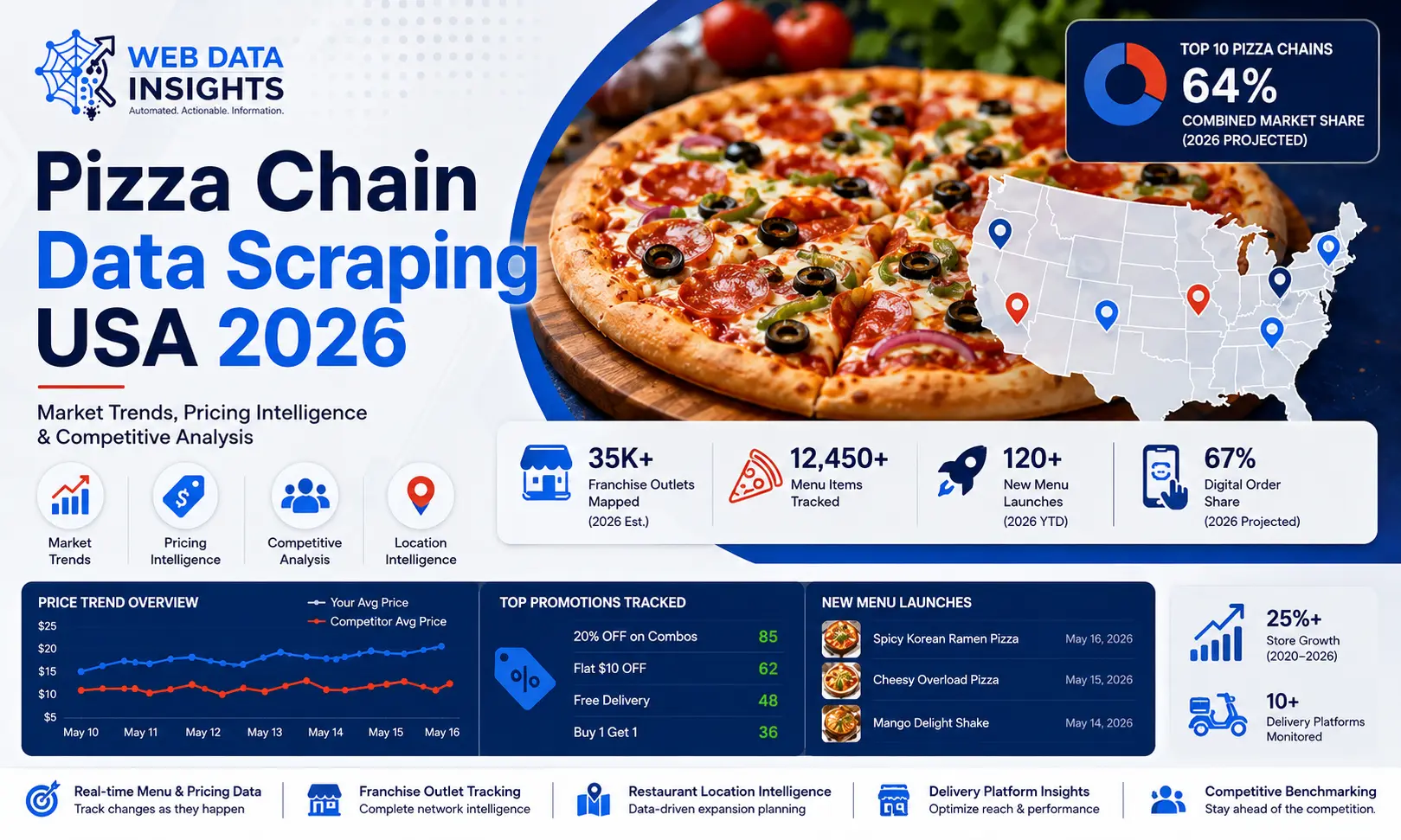
The actionable value of pizza chain market analysis lies in its specificity. Unlike industry-level trend surveys, web-extracted data provides SKU-level pricing, real-time location counts, and promotional cadence — inputs that drive decisions on competitive benchmarking, market entry, and operational planning.10 Chains Tracked 64% Market Share (2026 Projected) 35K+ Franchise Outlets Mapped 40% Menu Diversification Growth
Understanding Market Leaders Through QSR Data Extraction
Systematic QSR data extraction across the top 10 pizza chains reveals the pricing benchmarks, menu architectures, and promotional patterns that define market leadership in the U.S. pizza segment.
The top 10 pizza chains have maintained a combined market share above 60% since 2020, and that dominance continues to consolidate. Web-extracted data provides a granular view of how each brand positions itself — from value-tier pricing to premium specialty offerings — and how that positioning shifts in response to commodity costs, competitive pressure, and consumer sentiment.
Key signals extracted through pizza chain data scraping USA 2026 methodologies include real-time menu pricing across delivery platforms, in-store versus online price differentials, limited-time offer cadence, and bundle deal frequency. These signals, when aggregated across all 10 chains, form a reliable market-level pricing intelligence layer.
Data Insight: Chains deploying dynamic online pricing show an average of 8–12% higher delivery order values than those with static menu structures — a pattern consistently visible through systematic pizza chain pricing intelligence extraction.
Revenue growth projections for the segment reach +12% in 2026, driven primarily by digital channel expansion and loyalty program integration. Brands with strong data infrastructure are capitalizing on this shift faster than those relying on lagged market reports.
| Year | Combined Market Share (Top 10) | YoY Revenue Growth | Digital Order Share |
|---|---|---|---|
| 2020 | 58% | +8% | 34% |
| 2022 | 60% | +9% | 48% |
| 2024 | 62% | +11% | 59% |
| 2026 (Projected) | 64% | +12% | 67% |
Mapping Expansion Through Restaurant Location Data USA
Restaurant location data USA extraction provides the clearest picture of where QSR pizza brands are growing, where they are saturated, and where white-space opportunities remain untapped.
Between 2020 and 2026, major pizza chains collectively expanded their U.S. store presence by more than 25%. That headline figure, however, masks significant regional variation. Suburban corridors in the Sun Belt and Mountain West have seen the most aggressive new-unit development, while coastal urban cores show a different pattern: fewer new openings but higher delivery radius optimization and dark kitchen experimentation.
At a national level, pizza chain data scraping USA 2026 location extraction captures store addresses, operating hours, delivery zones, and dine-in capacity — data points that are updated continuously as chains adjust their footprints. This enables market analysts to track expansion velocity at the metro, county, and ZIP-code level.
| Region | New Store Growth (2020–2026) | Dominant Model | Competitive Intensity |
|---|---|---|---|
| Northeast | +15% | Delivery-first | High |
| Midwest | +18% | Dine-in + carry-out | Moderate |
| South | +25% | Suburban expansion | Growing |
| West | +22% | Hybrid + ghost kitchen | Very High |
Location Data as a Strategic Asset
When restaurant location data USA is combined with demographic overlays and delivery platform coverage maps, it becomes a predictive tool — not just a descriptive one. Chains and investors use this combined intelligence to score new market opportunities before committing capital to site acquisition.
Franchise Outlet Data Scraping: Measuring Scale and Growth Velocity
Franchise outlet data scraping across the top 10 U.S. pizza chains provides a real-time lens on network scale, operator density, and expansion momentum — data that is not reliably available from any single public source.
The U.S. pizza franchise network has grown from approximately 25,000 outlets in 2020 to a projected 35,000+ by end of 2026 — a 40% expansion driven by both domestic scale-up and the conversion of independent operators to franchise agreements. Structured extraction of franchise listing pages, FDD filings, and chain locator tools makes this growth trackable at the individual-unit level.
Key franchise data dimensions include: total unit count by chain, new unit openings per quarter, closures and net growth, territory saturation by state, and multi-unit operator concentration. Each of these dimensions informs different stakeholders — investors evaluate network health, franchisors assess territory availability, and competitors benchmark expansion pace.
| Year | Total Franchise Outlets | Net Growth Rate |
|---|---|---|
| 2020 | 25,000 | +10% |
| 2022 | 28,500 | +14% |
| 2024 | 32,000 | +18% |
| 2026 (Est.) | 35,000+ | +20% |
Franchise Data Signal: Chains with the highest multi-unit operator concentration (top 20% of franchisees controlling 50%+ of units) consistently show faster menu adoption and higher promotional compliance — a pattern visible only through longitudinal franchise outlet data scraping.
Unlocking Competitive Advantage with POI Data Pizza Chains
Point-of-interest (POI) data extraction for pizza chains delivers a three-dimensional view of the competitive landscape — combining store presence, foot traffic signals, and competitor Dynamic Pricing proximity into a single analytical layer.
POI data pizza chains extraction goes beyond simple store counts. Structured datasets include geospatial coordinates, competitor co-location patterns (which chains cluster near each other and why), customer-facing attributes like parking availability and drive-through access, and proximity to high-traffic anchors such as retail centers, sporting venues, and transit hubs.
Since 2020, the use of POI data in QSR competitive analysis has grown by over 50% among data-mature organizations — reflecting the shift from reactive market research to proactive location intelligence. Pizza chain data scraping USA 2026 POI extraction enables this shift at scale, across all 10 major chains simultaneously.
| POI Data Dimension | Strategic Insight Delivered | Decision Impact |
|---|---|---|
| Store Density by Market | Identifies oversaturated vs. underserved zones | High |
| Competitor Proximity | Maps head-to-head competitive pressure points | Very High |
| Anchor Proximity (malls, stadiums) | Predicts foot traffic opportunity for new units | High |
| Operating Hours Patterns | Reveals late-night and weekend demand gaps | Moderate |
| Delivery Radius Coverage | Benchmarks digital reach vs. physical footprint | Very High |
Extracting Competitive Edge from QSR Pizza Chain Data in USA
Menu structure, pricing architecture, and promotional mechanics are the operational fingerprint of any QSR brand. Systematic extraction of QSR pizza chain data in USA makes that fingerprint readable — and comparable — at scale.
From 2020 to 2026, menu diversification across the top 10 pizza chains grew by 40%. This reflects a strategic shift from core pizza SKUs toward meal bundles, plant-based alternatives, sides and dessert extensions, and region-specific limited-time offers (LTOs). Web-extracted menu data captures each of these dimensions across delivery platforms, brand websites, and third-party aggregators — often before formal press releases are issued.
The pricing intelligence layer is equally important. price monitoring variations between in-store, brand-app, and third-party delivery channels regularly reach 15–25% for the same item. Pizza chain pricing intelligence extraction across all channels allows brands to identify where competitors are discounting, where they are protecting margins, and where promotions are concentrated.
- Real-time menu pricing across delivery apps and brand channels
- Limited-time offer launch timing and promotional frequency
- Bundle deal construction and value-anchor positioning
- Plant-based and dietary variant introduction tracking
- Cross-channel price differential monitoring
- Loyalty reward structure and redemption mechanics
- Upsell and add-on SKU performance signals
- Regional menu variation mapping by DMA
| Data Category | Business Question Answered | Update Frequency | Strategic Value |
|---|---|---|---|
| Menu SKUs | What are competitors offering and when do they innovate? | Weekly | High |
| Pricing by Channel | Where are margin gaps and discount patterns? | Daily | Very High |
| LTO Cadence | How often and when do chains drive urgency? | Real-time | Very High |
| Customer Review Signals | Which menu items are resonating or failing? | Daily | High |
Tracking Growth Patterns via Pizza Chain Store Count Extraction
Pizza chain store count extraction across all U.S. markets provides the clearest available picture of network health, regional prioritization, and competitive white space — updated continuously rather than annually.
Store count growth averaged 20% across the top 10 chains from 2020 to 2026, but the distribution of that growth tells a more nuanced story. Southern markets — particularly Texas, Florida, and the Carolinas — account for the highest share of net new unit openings, reflecting population migration patterns and lower real estate costs relative to coastal metros.
The Midwest market, while showing lower absolute growth, demonstrates superior unit economics — higher average weekly sales per location and lower competitive intensity — making it an undervalued expansion target for brands that rely on pizza chain store count data to guide capital allocation.
| Region | Store Growth | Market Maturity |
|---|---|---|
| Northeast | +15% | Mature / Stable |
| Midwest | +18% | Stable / Undervalued |
| South | +25% | High Growth |
| West | +22% | Competitive / Evolving |
Distribution Signal: Chains entering new Southern markets through franchise agreements — rather than company-owned units — show 30% faster time-to-open and significantly lower closure rates within the first 24 months. This pattern emerges clearly through longitudinal store count extraction paired with franchise ownership data.
Our Food Delivery Data Scraping USA Infrastructure
Delivering reliable pizza chain intelligence requires an extraction infrastructure built for the specific technical and structural challenges of QSR data — including Dynamic pricing software JavaScript rendering, geo-restricted content, and platform-level anti-scraping measures.
Our food delivery data scraping USA capabilities cover the full digital footprint of major pizza chains: brand-owned ordering platforms, third-party delivery aggregators (DoorDash, Uber Eats, Grubhub), franchise locator tools, review platforms (Google Maps, Yelp), and social commerce channels. All data passes through a structured cleaning and normalization pipeline before delivery.
Extraction is conducted at configurable frequencies — from real-time pricing alerts to weekly menu snapshots — with delivery in JSON, CSV, or API format. Our pipeline includes automatic anomaly detection to flag pricing errors, sudden menu removals, and location status changes before they affect downstream analysis.
- AI-powered structured extraction from dynamic web environments
- Geo-targeted scraping across all U.S. DMAs and ZIP codes
- Cross-platform normalization: delivery apps + brand sites
- Real-time alerting on pricing changes and LTO launches
- Franchise locator scraping with ownership attribution
- Review and rating extraction for sentiment benchmarking
- Delivery in JSON, CSV, API, or Webhook format
- 99%+ data accuracy with human-in-the-loop QA layer
Pizza Chain Data Scraping USA 2026 Is a Strategic Imperative
The top 10 U.S. pizza chains generate billions of publicly accessible data signals every week — across their menus, pricing structures, franchise networks, location footprints, and delivery channels. Organizations that extract, structure, and analyze this data systematically hold a measurable advantage over those relying on industry reports or manual research.
Pizza chain data scraping USA 2026 is no longer a niche capability for large enterprise intelligence teams. It is the baseline for any organization — brand, investor, operator, or researcher — that needs to understand the U.S. QSR pizza market with accuracy and speed. From restaurant location data USA extraction to franchise outlet data scraping and pizza chain pricing intelligence, the full data stack is available, structured, and actionable.
As the market continues to grow toward a projected 64% top-10 concentration by end of 2026, the window for establishing data-driven competitive positioning continues to narrow. The organizations investing in food delivery data scraping USA infrastructure today will shape the benchmarks that others measure themselves against tomorrow.
For custom Pizza Chain Data Scraping USA 2026 datasets, real-time QSR pricing intelligence, franchise outlet tracking, and restaurant location data solutions, Contact WebDataInsights.
WebDataInsights helps brands, analysts, investors, and data buyers access structured food delivery and restaurant intelligence datasets built for competitive analysis, market research, and business growth.
Reliable Web Data Solutions
WebDataInsights provides clean, structured, and real-time web scraping solutions tailored to your business goals, helping automate data collection for eCommerce, market research, lead generation, and more.
Get in TouchReady to Turn Your Data into Revenue Growth?
Partner with WebDataInsights for enterprise-grade B2B data scraping, real-time price monitoring, supplier benchmarking intelligence, and seamless API data delivery.
Request Custom Dataset