




Enterprise AI Data Scraping Services for LLMs, ML Models and Generative AI
Building an AI model, fine-tuning an LLM, or training a machine learning pipeline starts with one thing: high-quality, domain-specific data. Generic datasets are not enough. Our AI Data Scraping Services collect, clean, and structure custom training data from any web source, application, or API at scale, giving US AI teams the precise datasets their models actually need to perform. No noise, no unstructured dumps, no labeling overhead.
- 25M+
- Data Points Delivered
- 12+
- AI Data Categories
- 99.1%
- Data Accuracy Rate
- 200+
- Sources Crawled
What Are AI Data Scraping Services?
AI Data Scraping Services are purpose-built data collection pipelines that extract, clean, and structure large volumes of domain-specific content from websites, mobile applications, and public APIs, formatted specifically for AI model training, fine-tuning, and inference workflows.
Unlike general-purpose web scraping, AI data scraping is designed around the needs of machine learning engineers and AI teams. Data must be deduplicated, normalized, annotated where required, and delivered in formats that training pipelines can consume directly, including JSONL, Parquet, CSV, and plain text corpora. At WebDataInsights, our AI Data Scraping Services handle the full pipeline from raw extraction to model-ready structured datasets, so your team can focus on building and not on data wrangling.
Whether you are building a large language model from scratch, fine-tuning an existing foundation model on vertical-specific data, or feeding a retrieval-augmented generation pipeline with fresh real-world content, the quality of your training data determines the quality of your model. Our services exist to make that data better.
- Domain-specific AI training data extracted to your exact specification
- Cleaned, deduplicated, and normalized before delivery
- Delivered in JSONL, Parquet, CSV, TXT, or custom schema formats
- Continuous feed support for RAG pipelines and real-time AI inference
- Multi-language and multi-domain dataset support
AI Training Data Types We Extract and Structure
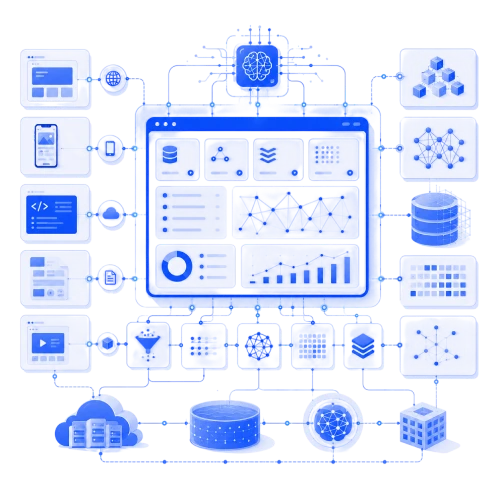
Our AI Data Scraping Services cover every major data category that modern AI and ML teams require, with defined extractable fields for each type.

Text and NLP Datasets
Structured text corpora for training large language models, NLP classifiers, sentiment engines, and conversational AI systems. Sourced from news, forums, reviews, and editorial content.

Product Review and Sentiment Data
High-volume review datasets from e-commerce and marketplace platforms for training sentiment analysis models, opinion mining systems, and recommendation engines.

E-Commerce and Pricing Data
Structured product and pricing datasets from major retail platforms for training AI pricing engines, recommendation models, and AI Based Pricing Software. Ideal for retail AI applications and Competitor price tracking systems.
News and Web Content Datasets
Large-scale web content extraction from news portals, blogs, and editorial sources for pre-training LLMs, building RAG pipelines, and creating domain-specific knowledge bases for generative AI applications.

Job Listings and Professional Data
Structured job market data for training HR AI models, skills extraction engines, labor market intelligence tools, and workforce analytics platforms across US industries.

Healthcare and Pharma Data
Public health and pharmaceutical data for training clinical NLP models, medical entity recognition systems, drug information extraction engines, and healthcare AI applications requiring domain-specific training corpora.

Real Estate and Location Data
Property listing and transaction data for training real estate AI valuation models, predictive pricing tools, location intelligence systems, and market trend forecasting engines.

Travel and Hospitality Data
Hotel, flight, and booking platform data for training travel recommendation models, dynamic rate prediction engines, and customer intent classification systems used by travel AI applications.

Financial and Market Data
Public financial content including earnings summaries, analyst commentary, pricing feeds, and market news for training financial NLP models, real-time pricing intelligence engines, and investment research AI tools.
Why AI and ML Teams Need Specialized Data Scraping
Public datasets are outdated, generic, and not built for your specific model requirements. Custom AI data scraping is how the highest-performing AI teams get a measurable edge over those relying on shared benchmarks.
Public Datasets Are Not Enough for Production AI
Hugging Face datasets and Common Crawl snapshots are a starting point, not a solution. Domain-specific AI models require domain-specific training data that only custom extraction can deliver at the quality and scale production deployment demands.
Fresh Data Produces Better Model Performance
AI models trained on stale data reflect an outdated world. Our AI Data Scraping Services continuously collect and refresh training corpora so your models stay current with real-world language, pricing, and behavior patterns.
Data Quality Directly Determines Model Output Quality
Dirty, duplicated, or inconsistently structured training data produces unreliable model outputs. Every dataset we deliver goes through deduplication, normalization, and quality scoring before it reaches your training pipeline.
RAG Pipelines Require Continuously Updated Data Feeds
Retrieval-augmented generation systems depend on fresh, indexed content to answer questions accurately. Our real-time data feeds keep your RAG knowledge base current without manual intervention or scheduled batch jobs.
Building In-House Data Pipelines Is Expensive and Slow
Engineering a compliant, scalable, multi-source data collection system takes months and significant infrastructure investment. Outsourcing to a managed AI data scraping provider compresses that timeline to days and eliminates ongoing maintenance costs.
Fine-Tuning Requires Vertical-Specific, High-Density Corpora
General pre-training data cannot teach a model the nuances of retail pricing logic, medical terminology, or legal clause structure. Vertical-specific datasets extracted from authoritative sources in your domain are what make fine-tuning actually work.
How US AI Teams Use Our AI Data Scraping Services
From LLM pre-training to real-time inference feeds, our AI data extraction services support every stage of the AI development lifecycle across US industries.
Pre-Training and Fine-Tuning Data for Large Language Models
AI labs and enterprise AI teams use our AI Data Scraping Services to build large, domain-specific text corpora for pre-training and fine-tuning language models. We extract and structure high-quality text data from web sources, forums, product content, and editorial domains, cleaned and formatted for direct ingestion into training frameworks like PyTorch and JAX. Supports both English-only and multilingual LLM projects.
AI Pricing Models and Dynamic Repricing Engines
Retail AI teams building AI Dynamic Pricing systems require large volumes of competitor pricing history, promotional patterns, and market movement data. Our scraping pipeline collects structured pricing data from hundreds of retail sources and delivers it in formats optimized for training regression models, reinforcement learning agents, and rule-based pricing engines that drive automated price monitoring workflows.
Product Recommendation and Search Ranking Models
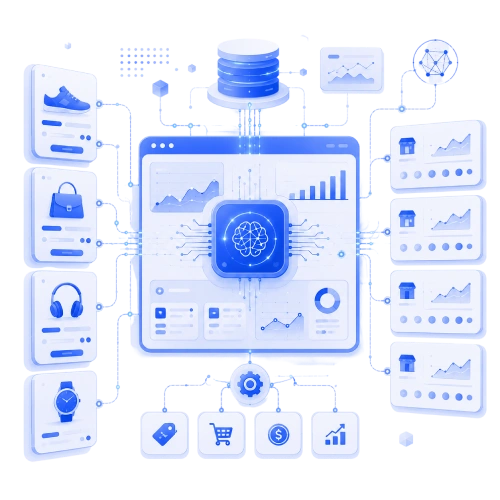
Training recommendation systems and semantic search ranking models requires rich product data at scale, including titles, descriptions, attributes, category paths, user reviews, and engagement signals. Our AI Data Scraping Services extract this data from major US retail platforms and structure it into structured datasets ready for matrix factorization, transformer-based ranking, and collaborative filtering pipelines.
Promotion Compliance and Competitor Monitoring
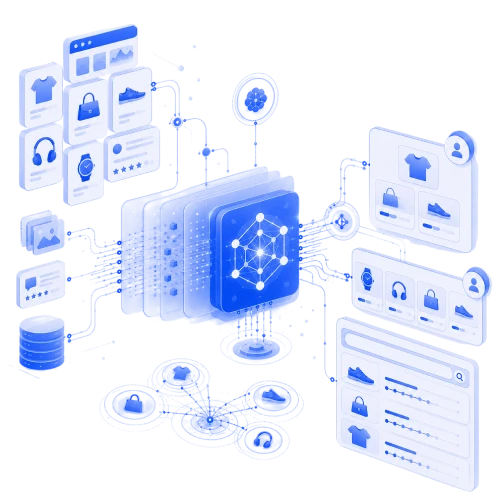
AI-powered competitive intelligence platforms use our data feeds for Promotion Compliance Tracking across retail and e-commerce channels. We extract promotional data, MAP policy deviations, discount structures, and marketing messaging from competitor and partner sites, structuring it as labeled datasets for classification and anomaly detection models that flag compliance violations automatically.
Chatbot and Virtual Assistant Training Data
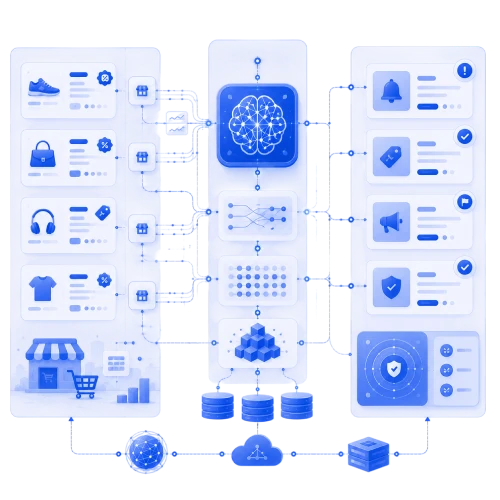
Building a domain-specific chatbot or virtual assistant requires real-world conversational data, product Q&A pairs, support thread text, and intent-labeled examples that generic datasets do not contain. We extract and structure this content from forums, review platforms, support pages, and community sites, delivering labeled training pairs ready for fine-tuning dialogue models and intent classifiers.
Knowledge Base Data for Retrieval-Augmented Generation
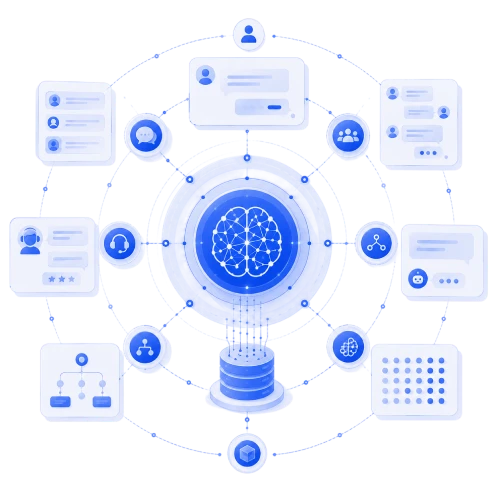
RAG systems require continuously updated, accurately indexed knowledge bases to ground AI responses in real-world fact. Our real-time data feeds collect fresh content from authoritative web sources across your target domains and deliver chunked, embedded-ready text data to your vector database or search index. Supports Pinecone, Weaviate, Chroma, and custom vector store integrations.
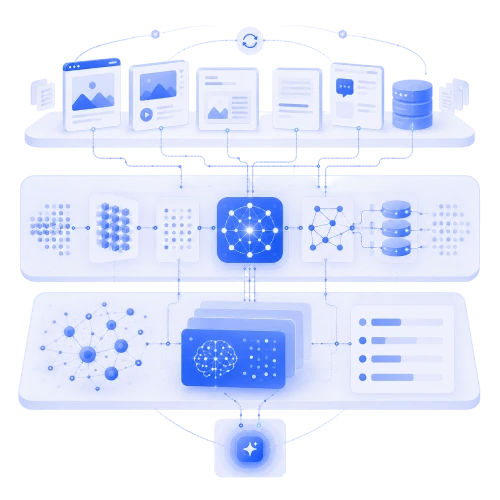
How Our AI Data Scraping Services Work
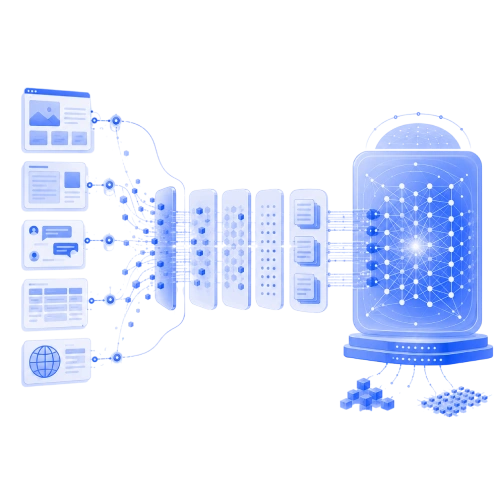
From requirements to model-ready data delivery in days, not months. A structured six-step pipeline designed specifically for AI and ML data workflows.
Define Data Requirements
Share your model type, target domain, language requirements, volume needs, and desired output schema. We review your AI use case and confirm source availability and field coverage before extraction begins.
Source Identification and Mapping
Our team identifies the highest-quality web sources, platforms, and data endpoints relevant to your domain. We map extractable fields to your schema and document expected data density per source.
Large-Scale Data Extraction
Our extraction infrastructure crawls and collects data at scale across all mapped sources, handling JavaScript rendering, pagination, rate-limit management, and multi-platform extraction simultaneously.
Cleaning, Deduplication and Normalization
Raw collected data passes through deduplication, HTML stripping, encoding normalization, quality scoring, and schema alignment. Records below your defined quality threshold are filtered out before packaging.
Labeling and Annotation
Where required, we apply rule-based or model-assisted labeling for sentiment, intent, entity tags, category classification, or any custom label schema your training pipeline requires. Reviewed for consistency before delivery.
Dataset Delivery and Ongoing Refresh
Final datasets are delivered in your chosen format including JSONL, Parquet, CSV, or TXT, to your cloud storage, API endpoint, or vector database. Ongoing refresh cycles keep your training data and RAG pipelines current.
Why Choose Our AI Data Scraping Services?

Training-Format Output
Data delivered in JSONL, Parquet, and HuggingFace-compatible formats. No preprocessing step needed before training begins.

Continuous Data Refresh
Automated refresh cycles keep your RAG index and fine-tuning corpora updated without manual pipeline intervention.

Quality-Scored Records
Every record carries a quality score. Below-threshold data is filtered before delivery so your model trains on clean data only.

Annotation Support
Optional labeling for sentiment, intent, entities, and custom tags applied before delivery to your supervised learning pipeline.
Most data providers offer generic web scraping. Our AI Data Scraping Services are engineered specifically for the requirements of AI and ML teams: domain precision, data quality scoring, training-format output, annotation support, and continuous refresh capabilities that generic scrapers simply cannot provide.
We work with AI teams building everything from specialized retail pricing models using Web Scraping Services as a foundation, to enterprise LLMs requiring billions of tokens of domain-specific text. Every engagement starts with your model requirements and ends with data your training pipeline can consume on day one without additional engineering overhead.
- AI-specific output formats: JSONL, Parquet, CSV, TXT, HuggingFace compatible
- Quality scoring on every record before dataset delivery
- Optional annotation and labeling pipeline included
- Ongoing data refresh for RAG pipelines and real-time AI inference
- Multi-source, multi-language, multi-domain extraction support
- Compliance-first collection of publicly accessible data only
- First dataset delivery within 5 to 7 business days of scoping
What AI Teams Say About Our AI Data Scraping Services
From LLM fine-tuning teams to retail AI labs, here is how US-based clients describe working with our AI data extraction pipeline.
"We were spending three to four weeks per project just sourcing and cleaning data before any actual model training could begin. Switching to this team cut that down to a few days. The quality score filtering alone made a noticeable difference in our validation loss. For any team serious about building production-grade NLP models, this is the right data partner."

Daniel Rourke
"Our retail AI team needed product and pricing data at a scale and freshness level that public datasets simply cannot provide. The structured e-commerce datasets we receive are formatted directly for our training pipeline and updated on a schedule we control. It has meaningfully improved our dynamic pricing model accuracy and reduced time to deployment on new verticals."

Samantha Cruz
"We use the RAG data feed for our enterprise knowledge assistant. The content arrives pre-chunked, consistently structured, and refreshed on a 48-hour cycle which keeps our retrieval layer accurate without any manual pipeline work from our engineering team. Onboarding was straightforward and the team clearly understands how AI data pipelines actually work in practice."

Brian Weston
Frequently Asked Questions About AI Data Scraping Services
Answers to the questions US AI and ML teams ask most before engaging our AI data extraction pipeline.
Regular web scraping extracts raw data from websites for business intelligence or monitoring purposes. AI Data Scraping Services are purpose-built for a different consumer: machine learning models and AI pipelines. This means the extraction is designed around training formats, annotation requirements, deduplication standards, and quality scoring that general scraping does not address. Output formats are model-ready including JSONL, Parquet, and HuggingFace dataset structures. Data passes through cleaning and normalization steps that remove noise, fix encoding issues, and align fields to your schema before any delivery. The entire pipeline is optimized for training quality, not just data availability.
Custom AI data scraping delivers the highest value for any model that requires domain-specific knowledge rather than general-purpose language understanding. This includes large language models being fine-tuned on vertical content such as legal, medical, retail, or financial text; NLP classifiers for sentiment, intent, and named entity recognition; recommendation and ranking systems for e-commerce and content platforms; computer vision models needing structured image metadata; RAG systems requiring fresh, accurately indexed knowledge bases; and AI pricing and competitive intelligence tools that depend on real-time structured market data. Any AI model that underperforms on public benchmark datasets because its target domain is not well represented is a strong candidate for custom data collection.
We deliver AI training data in the formats most commonly used by modern machine learning frameworks. JSONL is the default for most text and NLP datasets. Parquet is available for large-scale tabular datasets and is compatible with frameworks like Apache Spark, Pandas, and cloud data warehouses including BigQuery and Snowflake. Plain text corpora formatted for tokenizer ingestion are available for LLM pre-training projects. CSV delivery is supported for structured datasets used in classification and regression tasks. HuggingFace Datasets compatible formats are available on request. For RAG pipelines, we can also deliver pre-chunked text with optional embedding metadata. Output format is confirmed during the scoping session before extraction begins.
Data quality is the most critical variable in AI model performance, and we treat it accordingly. Every record collected through our AI Data Scraping Services passes through a multi-stage quality pipeline before delivery. This includes deduplication at both exact-match and near-duplicate levels, HTML and encoding artifact removal, language identification and filtering, field completeness checks against your schema, and a quality score assigned to each record based on text coherence, length, and source authority. Records that fall below your defined quality threshold are filtered out and re-collected or excluded from the final dataset. Annotation consistency is reviewed by a secondary validation pass where labeling is applied. The result is a dataset where every record is intentional and usable, not just collected.
Yes. Continuous data refresh is one of the core capabilities of our AI Data Scraping Services and is specifically designed for retrieval-augmented generation systems. RAG pipelines degrade in accuracy when the knowledge base they retrieve from becomes stale, which happens quickly in dynamic domains such as news, e-commerce, financial data, and policy content. We configure automated refresh cycles at intervals ranging from daily to weekly depending on your domain's rate of change and your retrieval system's freshness requirements. Refreshed content is delivered pre-chunked and formatted for direct ingestion into your vector database or search index. We support Pinecone, Weaviate, Qdrant, Chroma, and Elasticsearch as delivery targets.
Our AI Data Scraping Services collect only publicly accessible data, meaning content that any user can view in a standard browser without authentication, bypassing access controls, or violating platform terms that prohibit automated access to non-public data. We respect crawl rate guidelines, do not access private accounts, and do not collect personally identifiable information as part of our standard data collection pipeline. For US-based AI teams, we also advise clients to consider applicable frameworks including the CCPA, relevant fair use considerations for training data, and any emerging AI-specific data legislation in their operating jurisdictions. We can discuss the specific compliance considerations for your use case and data domain during the initial scoping session.
Timelines depend on dataset size, domain complexity, and whether annotation is required. For standard text or product datasets without annotation, first delivery typically happens within 5 to 7 business days of completing the scoping session. Larger corpora over 10 million records or datasets requiring multi-source extraction across more than 20 domains may take 10 to 15 business days for first delivery. Annotated datasets with custom labeling schemas add 3 to 5 business days for annotation and validation. We provide a confirmed delivery timeline at the end of the scoping session based on your specific requirements. Ongoing refresh cycles begin automatically after initial dataset delivery.
Yes. Multilingual dataset collection is fully supported. We extract and structure data in over 40 languages, with language identification, filtering, and locale tagging applied at the record level. This is particularly relevant for teams fine-tuning multilingual LLMs, building localized conversational AI applications, or training cross-lingual NLP models. Each language in a multilingual dataset is extracted from geographically and linguistically appropriate sources to ensure idiomatic, high-quality text rather than machine-translated or low-quality content. Language mix ratios in the final dataset can be specified during scoping to match your model's target language distribution.