





Introduction: Why Alcohol Price Compliance Matters in the UK
In the United Kingdom, alcohol brands invest enormous resources in shaping how their products are priced and presented at retail. Recommended retail prices, trade investment, promotional commitments, and category positioning agreements all rest on the assumption that retailers will implement pricing in line with what was agreed. Yet the reality of multi-chain, multi-format UK retail is that pricing drifts. Promotions extend beyond agreed windows, prices fall below intended floors, premium positioning erodes, and distributor agreements quietly break down — often without anyone noticing for weeks.
For brand owners, importers, and distributors, the cost of undetected price compliance issues is significant. Margins shrink, brand equity erodes, and competitor brands gain ground while teams remain unaware. Manual audits cannot keep up with the velocity and breadth of UK retail. The only scalable answer is automated monitoring through web scraping.
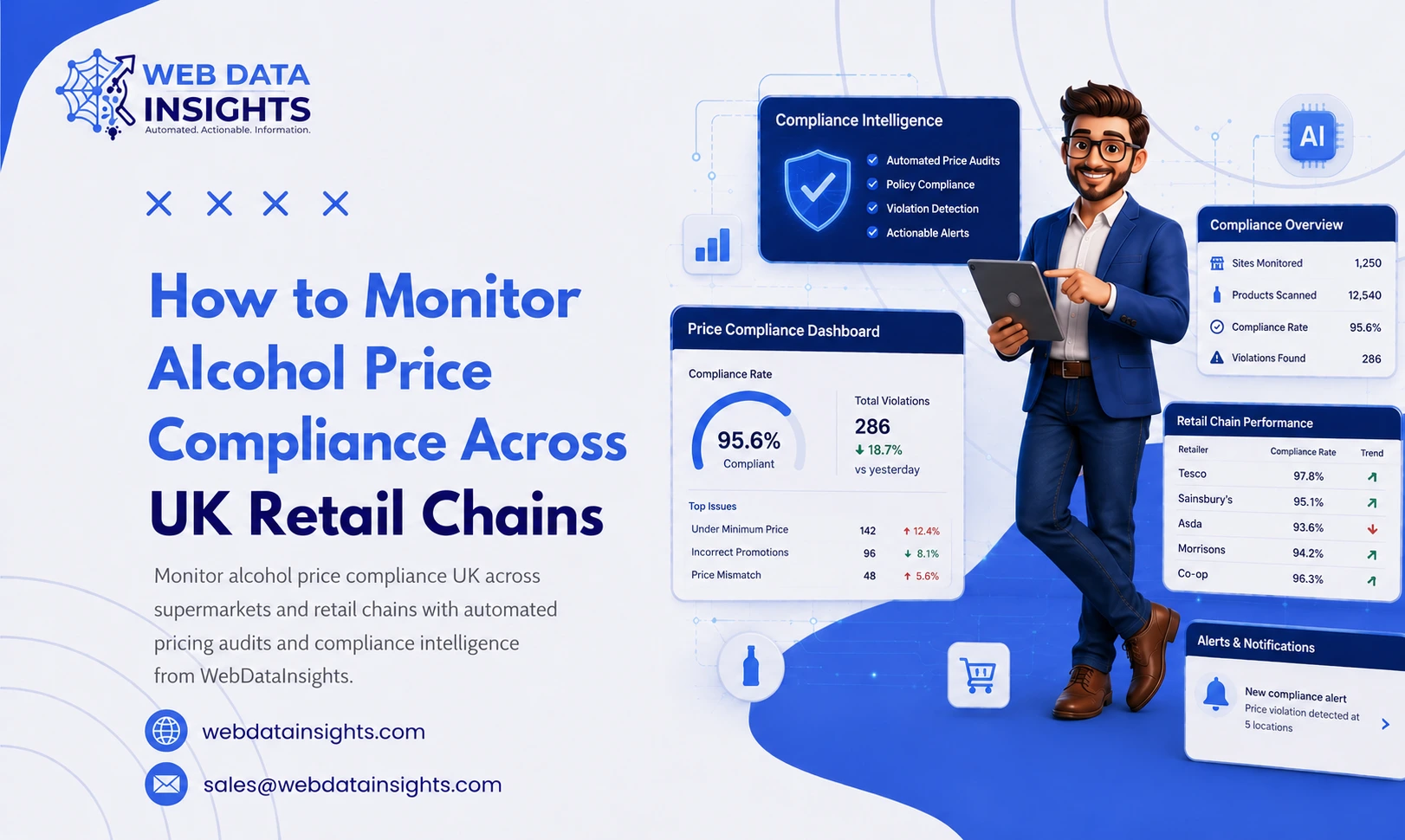
That is exactly where Webdatainsights delivers. Our alcohol price compliance UK infrastructure scrapes pricing data daily across every major UK retail chain, normalizes it into a single comparable schema, and surfaces compliance signals brands can act on in days rather than months. This blog explains why compliance monitoring matters, what to monitor, the methodology behind reliable scraping, and how to operationalize the resulting intelligence into a working compliance programme that delivers business outcomes.
What Price Compliance Means in UK Alcohol Retail
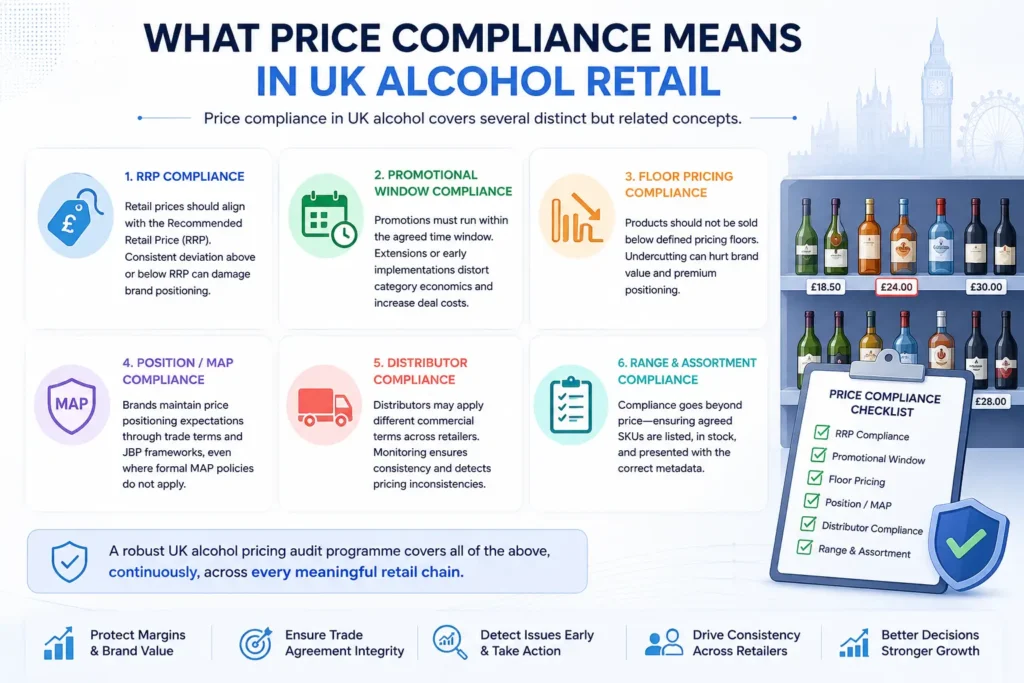
Price compliance in UK alcohol covers several distinct but related concepts.
Recommended retail price (RRP) compliance. Brands set RRPs for their products and expect retailers to display prices reasonably aligned with those benchmarks. Persistent listing significantly above or below RRP can damage brand positioning.
Promotional window compliance. Trade investment agreements typically specify that a promotional price applies for a defined window. Extension of the promotion beyond the window — or implementation outside it — distorts category economics and inflates the cost of the deal.
Floor pricing compliance. Some categories operate with informal pricing floors below which a brand does not want to be sold (because consumer perception of value or premium positioning would suffer). Detecting drift below floors is essential.
Position/MAP compliance. While true MAP (minimum advertised price) policies are less common in the UK alcohol environment than in some US markets, brands maintain similar expectations through trade terms and JBP (Joint Business Plan) frameworks.
Distributor compliance. Distributors operating across multiple retailers may apply different commercial terms, leading to pricing inconsistencies that brands need to detect and address.
Range and assortment compliance. Compliance is not only about price — it also covers whether agreed SKUs are listed, whether they are in stock, and whether they are presented with the agreed metadata.
A robust UK alcohol pricing audit programme covers all of the above, continuously, across every meaningful retail chain.
The UK Retail Chains That Matter
To monitor alcohol price compliance comprehensively, scraping must cover the chains that drive the bulk of UK alcohol volume.
Big Four supermarkets. Tesco, Sainsbury’s, ASDA, and Morrisons collectively account for the majority of UK packaged alcohol retail. These four are the foundation of any compliance programme.
Discounters. Aldi and Lidl have grown to meaningful share, particularly in wine, beer, and own-label spirits, with very different pricing logic from the Big Four. Discounter compliance often surfaces particular dynamics around exclusive labels and parallel imports.
Co-op and convenience. Co-op (and other convenience chains) plays a larger role in immediate-consumption occasions and often prices differently from larger-format competitors. Compliance issues in convenience are easy to miss because the volume per store is small but cumulative impact across hundreds of stores is significant.
Marks & Spencer Food. A specialty grocer with a premium positioning, particularly relevant for wine, champagne, and ready-to-drink ranges. M&S compliance dynamics are particularly important for premium and own-label-heavy categories.
Waitrose. A premium retailer with a sophisticated wine and spirits programme, where compliance dynamics are particularly important for premium brands. Waitrose’s customer demographics make pricing positioning especially important for brands targeting affluent shoppers.
Specialist off-licences and online wine merchants. Majestic, Laithwaites, The Whisky Exchange, Master of Malt, and other specialists matter for premium and craft segments. These channels are often where premium positioning is most clearly tested.
Quick-commerce and delivery platforms. As covered separately, Gopuff, Deliveroo, Just Eat, and Uber Eats add an on-demand layer that compliance programmes increasingly need to include — particularly for brands with heavy on-trade-adjacent positioning.
A comprehensive compliance programme captures all of these chains, harmonizes the data, and surfaces deviations from expected pricing in a single dashboard.
How Web Data Insights Powers Compliance Monitoring
Webdatainsights operates a purpose-built infrastructure for UK retail chain price monitoring that ingests pricing data from every major UK chain daily and harmonizes it for compliance analysis.
Daily catalogue capture. We Scrape UK Retail Prices across each chain’s full alcohol catalog every day, capturing standard price, promotional price, multi-buy mechanics, member pricing, and stock availability.
Postcode anchoring. Where chains personalize availability or pricing by postcode, our crawlers anchor across multiple postcodes nationally to build a representative view.
Promotional flag detection. Rollbacks, “Was/Now” pricing, multi-buy offers, member-only deals, and time-limited promotions are extracted as structured fields rather than buried in raw text.
Compliance rule engine. Clients define the rules that matter to them — RRP bands, promotional windows, pricing floors, expected listing presence — and our system surfaces deviations in dashboards and alerts.
Historical archive. Every captured price is timestamped and retained, creating a complete time-series archive that supports retrospective audits as well as real-time monitoring.
Severity tiering. Detected deviations are classified by depth (how far the observed price is from expected), duration (how long the deviation has persisted), and brand impact (is this a flagship SKU or a tail SKU). Higher-severity deviations trigger immediate alerts; lower-severity items aggregate into weekly summaries.
Quality assurance. Every record passes schema validation, brand-name disambiguation, ABV and volume sanity checks, GBP currency normalization, and outlier detection before reaching client systems.
Clients access data through a documented retail price compliance API, scheduled CSV/JSON exports, direct integration into Snowflake or BigQuery, and custom compliance dashboards configured to their rule sets.
Sample Compliance Data
Here are representative records from the UK Compliance Dataset delivered by Webdatainsights. All prices in GBP.
Retail Price Compliance Monitoring Example
Below is a real-world example of how brands monitor retailer pricing compliance across major UK supermarkets to detect MAP violations, unauthorized discounting, and promotional leakage.
| Brand | Product | Retailer | RRP | Observed | Deviation | Status | Date |
|---|---|---|---|---|---|---|---|
| Brand A | Premium Gin 70cl | Tesco | £30.00 | £24.00 | -20% | Below floor | 2026-04-30 |
| Brand A | Premium Gin 70cl | Sainsbury’s | £30.00 | £29.00 | -3% | Compliant | 2026-04-30 |
| Brand A | Premium Gin 70cl | ASDA | £30.00 | £25.50 | -15% | Below floor | 2026-04-30 |
| Brand A | Premium Gin 70cl | Morrisons | £30.00 | £29.50 | -2% | Compliant | 2026-04-30 |
| Brand A | Premium Gin 70cl | Waitrose | £30.00 | £32.00 | +7% | Compliant | 2026-04-30 |
Insights :
- Tesco showing 20% deviation below RRP
- ASDA discounting beyond approved threshold
- Waitrose maintaining premium positioning
- Automated alerts help brands enforce regional pricing policies
Promotional Window Compliance Example
This example shows how brands track retailer promotional periods to ensure temporary discounts do not continue beyond agreed campaign windows.
| Brand | Product | Retailer | Promo Price | Agreed Window | Observed Window | Status |
|---|---|---|---|---|---|---|
| Brand B | Premium Whisky 70cl | Tesco | £35.00 | 14 days | 21 days | Window extended by 7 days |
| Brand B | Premium Whisky 70cl | ASDA | £34.50 | 14 days | 14 days | Compliant |
| Brand B | Premium Whisky 70cl | Sainsbury’s | £35.00 | 14 days | 18 days | Window extended by 4 days |
Then explain:
- Tesco extended promo by 7 extra days
- Unauthorized extension impacts margin consistency
- Compliance tracking reduces channel conflict
Retail Listing Presence Audit Example
Monitor SKU availability and retailer assortment consistency across major supermarket chains with automated listing presence audits. This example shows how brands identify missing product listings, distribution gaps, and retailer-level assortment inconsistencies that directly impact sales visibility and market share.
| Brand | Required SKUs | Listed at Tesco | Listed at Sainsbury’s | Listed at ASDA | Gap Total |
|---|---|---|---|---|---|
| Brand C | 12 | 11 | 12 | 9 | 4 missing |
| Brand D | 8 | 8 | 7 | 8 | 1 missing |
| Brand E | 15 | 13 | 14 | 12 | 6 missing |
Brands use listing presence audits to detect unavailable SKUs, monitor retailer compliance, and improve product visibility across online and offline retail channels. Real-Time price intelligence assortment tracking helps sales and category teams quickly identify gaps, reduce lost revenue opportunities, and maintain consistent shelf presence across all retail partners.
Stock Availability Audit Example
Track real-time product availability across multiple retailers and geographic locations with automated stock availability audits. This example highlights how brands monitor in-stock performance, identify regional supply gaps, and detect out-of-stock issues that can directly impact revenue, customer experience, and market share.
| Product | Retailer | Postcodes Checked | In Stock | Out of Stock | OOS Rate |
|---|---|---|---|---|---|
| Brand F Vodka 70cl | Tesco | 25 | 23 | 2 | 8% |
| Brand F Vodka 70cl | Sainsbury’s | 25 | 18 | 7 | 28% |
| Brand F Vodka 70cl | ASDA | 25 | 24 | 1 | 4% |
| Brand F Vodka 70cl | Morrisons | 25 | 19 | 6 | 24% |
Stock availability monitoring helps brands detect fulfillment issues, improve inventory planning, and maintain consistent shelf availability across online grocery and retail platforms. Automated out-of-stock tracking enables supply chain and category teams to respond quickly to retailer inventory gaps and reduce lost sales opportunities.
Severity-Tiered Pricing Deviation Summary (Weekly)
Identify and prioritize retailer pricing violations with severity-based compliance monitoring. This weekly deviation summary helps brands classify pricing issues by impact level, measure average discount deviation, track issue duration, and trigger the appropriate escalation workflow for faster enforcement and resolution.
| Severity | Count of Issues | Avg Deviation | Avg Duration | Action Required |
|---|---|---|---|---|
| Tier 1 (Critical) | 3 | -22% | 9 days | Immediate escalation |
| Tier 2 (High) | 8 | -14% | 5 days | Account-team follow-up |
| Tier 3 (Medium) | 21 | -7% | 3 days | Weekly summary review |
| Tier 4 (Low) | 47 | -3% | 2 days | Monthly aggregate review |
Severity-tiered monitoring enables pricing, sales, and compliance teams to focus on the most damaging retailer violations first. Automated deviation scoring helps brands reduce margin leakage, improve MAP policy enforcement, and streamline retailer escalation workflows across multiple markets.
Distributor-Level Compliance Scorecard Example
Evaluate distributor performance and retailer compliance efficiency with automated distributor-level scorecards. This example shows how brands measure compliance rates, monitor resolution speed, and compare distributor effectiveness across major retail networks.
| Distributor | Retailers Covered | Compliance Rate | Avg Resolution Days |
|---|---|---|---|
| Distributor X | All Big Four | 92% | 6 |
| Distributor Y | Tesco + Sainsbury’s | 88% | 9 |
| Distributor Z | ASDA + Morrisons | 81% | 14 |
Distributor compliance scorecards help brands identify underperforming partners, improve retailer coordination, and accelerate issue resolution across the supply chain. Real-time compliance analytics provide better visibility into distributor accountability, pricing governance, and operational performance.
These tables represent only a small slice of the millions of compliance records Webdatainsights captures monthly across UK retail chains.
Building a Compliance Programme: Best Practices
Across our work with UK alcohol brands and distributors, several best practices for compliance monitoring have emerged.
Define rules clearly upfront. A compliance programme is only as good as its rules. Specify RRP bands, promotional windows, listing requirements, and floor prices in writing, with the precision needed to translate them into automated checks.
Capture continuously, not periodically. Spot-checks miss most deviations. Daily capture across all chains is the only way to detect window extensions, rapid promotional changes, and SKU delistings within useful timeframes.
Pair scraping with trade-investment data. A pricing deviation is most actionable when overlaid with the agreed promotional window or trade-deal terms. Joining scraped retail data with internal trade-investment records creates a true audit picture.
Tier deviations by severity. Not every deviation merits immediate escalation. Tier deviations by depth, duration, and brand impact, and route only the most significant ones to senior commercial teams.
Make insights operationally consumable. Compliance data is most valuable when delivered to commercial teams in the format they already use — JBP scorecards, account dashboards, weekly business reviews — rather than as standalone reports.
Loop back into trade negotiations. Use observed compliance data in JBP and term-renewal conversations with retailers. A documented record of pricing behaviour shifts the negotiation Dynamic pricing software meaningfully.
Combine with consumer-facing data. Pair retail compliance scraping with on-demand and quick-commerce scraping to capture the full UK alcohol e-commerce picture, not just the supermarket slice.
Roles and Responsibilities in a Working Compliance Programme
A functional compliance programme is not just a data feed — it is a living operational system that engages multiple roles inside the brand or distributor organization.
Compliance lead or analyst. Owns the day-to-day operation of the programme, monitors dashboards, manages alert thresholds, and routes issues to the appropriate commercial team.
Account managers. Own the relationship with each retailer. When a Tier 1 or Tier 2 issue is identified at their account, they take it forward to the buyer. The compliance feed becomes part of their weekly cadence with the retailer.
Trade-marketing team. Plans and tracks promotional investment. Works with the compliance lead to overlay observed promotional data with planned investment, quantifying actual ROI versus promised ROI.
Commercial leadership. Reviews aggregated compliance posture monthly or quarterly, uses observed data in retailer negotiations, and decides on systemic interventions when patterns suggest broader compliance erosion.
Finance. Quantifies the financial impact of compliance issues, including margin loss from over-promotion and revenue loss from out-of-stock or delisted SKUs.
Distributor partners. When third-party distributors are involved, compliance data should be shared transparently with them — they are partners in resolving issues, not adversaries.
Defining who does what when an alert fires is what separates compliance programmes that drive results from compliance programmes that fill dashboards no one looks at.
Common Compliance Pitfalls to Avoid
Several pitfalls trip up compliance programmes in their first year.
Capturing too much, acting on too little. It is easy to capture millions of data points and fail to translate them into action. Severity tiering and clear action loops are essential.
Setting RRP bands too tight. RRP bands that flag every minor variation create alert fatigue. Bands should reflect the realistic operating variation in UK retail while still surfacing meaningful deviations.
Ignoring stock-out as a compliance signal. Out-of-stock products are a compliance issue too — they cost sales just as much as overaggressive promotion. Stock should be tracked alongside price.
Treating promotional windows as fixed. Some retailers will negotiate window extensions for genuine commercial reasons. Compliance programmes should accommodate documented exceptions rather than treating every extension as a violation.
Failing to update rules. RRPs change. Promotional plans change. Distributor terms change. Compliance rules must be updated regularly to reflect the current commercial reality.
Working in isolation from the rest of the commercial team. Compliance lives or dies based on whether commercial teams act on the data. Building cross-functional buy-in is as important as building the data feed itself.
Use Cases Beyond Pure Compliance
While compliance is the primary application, the same data infrastructure supports a wider set of pricing intelligence UK alcohol use cases.
Competitor monitoring. The same scraping infrastructure that monitors your brand’s pricing simultaneously captures competitor Dynamic Pricing, surfacing market dynamics in real time.
Promotional ROI measurement. Combining compliance data with sales data quantifies the true cost and impact of every promotion, sharpening trade-investment decisions.
Retailer scorecards. Track each retailer’s compliance posture over time to inform trade negotiations and prioritization decisions.
M&A due diligence. When evaluating UK alcohol brands or distributors, compliance scraping provides hard market evidence to validate revenue and pricing assumptions.
Crisis response. When a pricing crisis emerges (a viral media story, a competitor’s aggressive move), compliance scraping delivers a real-time picture of how the market is responding within days.
Distributor scorecarding. Where multiple distributors operate across different retailers, compliance data quantifies relative performance and informs distributor selection and renewal decisions.
Coverage and Schema
Our UK supermarket compliance data spans the full alcohol catalogs of Tesco, Sainsbury’s, ASDA, Morrisons, Aldi, Lidl, Co-op, M&S Food, Waitrose, and the major specialist online merchants — plus optional integration with quick-commerce platforms.
A typical compliance record includes product name, brand, parent company, and category; ABV, pack size, container type, and country of origin; retailer, postcode anchor, and store-level identifier where applicable; standard price, promotional price, multi-buy price, and member price; promotional flags (rollback, “Was/Now”, bundle, member offer); compliance status fields (RRP deviation, window status, listing status, severity tier); stock availability and out-of-stock duration; image URLs and product page URLs; and capture timestamp for time-series analysis.
Frequently Asked Questions
How quickly can a compliance programme be set up?
Onboarding typically takes two to four weeks. The first phase captures baseline data; the second phase configures rules and dashboards; ongoing monitoring then runs continuously.
How do you handle retailers with permission-based pricing?
Where pricing is permission-gated (e.g., requires login), our capture is limited to what is publicly visible. This generally covers the headline pricing layer; member-only personalized prices behind authentication are outside scope.
Can the system integrate with internal trade-investment data?
Yes. Most clients overlay scraped retail data with their internal trade-investment records to produce a true audit picture. This integration is configured as part of onboarding.
What about Scotland’s minimum unit pricing?
Minimum unit pricing in Scotland (and now Wales) creates effective price floors on certain categories. Our system captures regional pricing differences explicitly and supports rules tailored to MUP-affected categories.
How does Webdatainsights handle deviations that turn out to be approved?
Approved exceptions can be flagged in the compliance rule engine to suppress alerts on those specific SKU-retailer-date combinations, eliminating false positives.
Is the system suitable for brands without a dedicated compliance team?
Yes. Many smaller brands work with Webdatainsights on a managed-service basis, where our analyst team monitors the dashboards and escalates issues directly to the brand’s commercial leads.
Why Choose WebDataInsight
Building reliable in-house compliance scraping across the UK retail estate is a major engineering undertaking. Each retailer uses different page structures, taxonomies, and promotional logic. Postcode personalization and frequent UI changes add ongoing maintenance burden. Translating raw scraped data into compliance insights requires careful rule design, severity tiering, and operational integration. Most internal teams discover that the cost of doing this in-house far exceeds the cost of working with a specialist provider.
Webdatainsights provides managed infrastructure, ethical and compliant data collection practices, and deep domain expertise in UK retail. Our advantages include compliance-first architecture, scalable extraction across millions of pages daily, fully customizable harmonized schemas, near-real-time refresh on priority SKUs, dedicated analyst support familiar with the UK alcohol market, configurable compliance rule engines, severity-tiered alerting, and out-of-the-box dashboards highlighting deviations.
Conclusion: From Reactive to Proactive Compliance
UK alcohol price compliance has historically been a reactive discipline — issues are detected weeks or months after they occur, often by accident, and remediation lags badly behind the damage. Web scraping flips this dynamic. With daily, multi-chain, postcode-aware capture and a clear rule engine, brands and distributors can detect deviations within hours, escalate within days, and remediate while the impact is still manageable.
Webdatainsights exists to deliver this capability in clean, decision-ready form. Across every major UK retail chain and millions of weekly data points, we transform the public web of UK alcohol retail into structured compliance intelligence. Whether you need a one-time pricing audit, a recurring compliance dashboard, or an always-on API feeding your BI stack, we configure a delivery model that fits your workflow and operational rhythm.
If you are ready to move from reactive to proactive on UK alcohol pricing compliance, get in touch with Webdatainsights today.
Looking for a custom UK Compliance Dataset, a one-time pricing audit, or an always-on retail price compliance API? Contact Webdatainsights to scope a solution tailored to your goals.
Reliable Web Data Solutions
WebDataInsights provides clean, structured, and real-time web scraping solutions tailored to your business goals, helping automate data collection for eCommerce, market research, lead generation, and more.
Get in Touch