





Introduction
In Amazon’s online store, prices can change every ten minutes. One of your competitors may drop their price by eight percent and instantly take control of the Buy Box, while your sales start declining as you rely on outdated spreadsheets from earlier in the day. That’s not a hypothetical situation — it happened to me on a Tuesday, and it was bad.
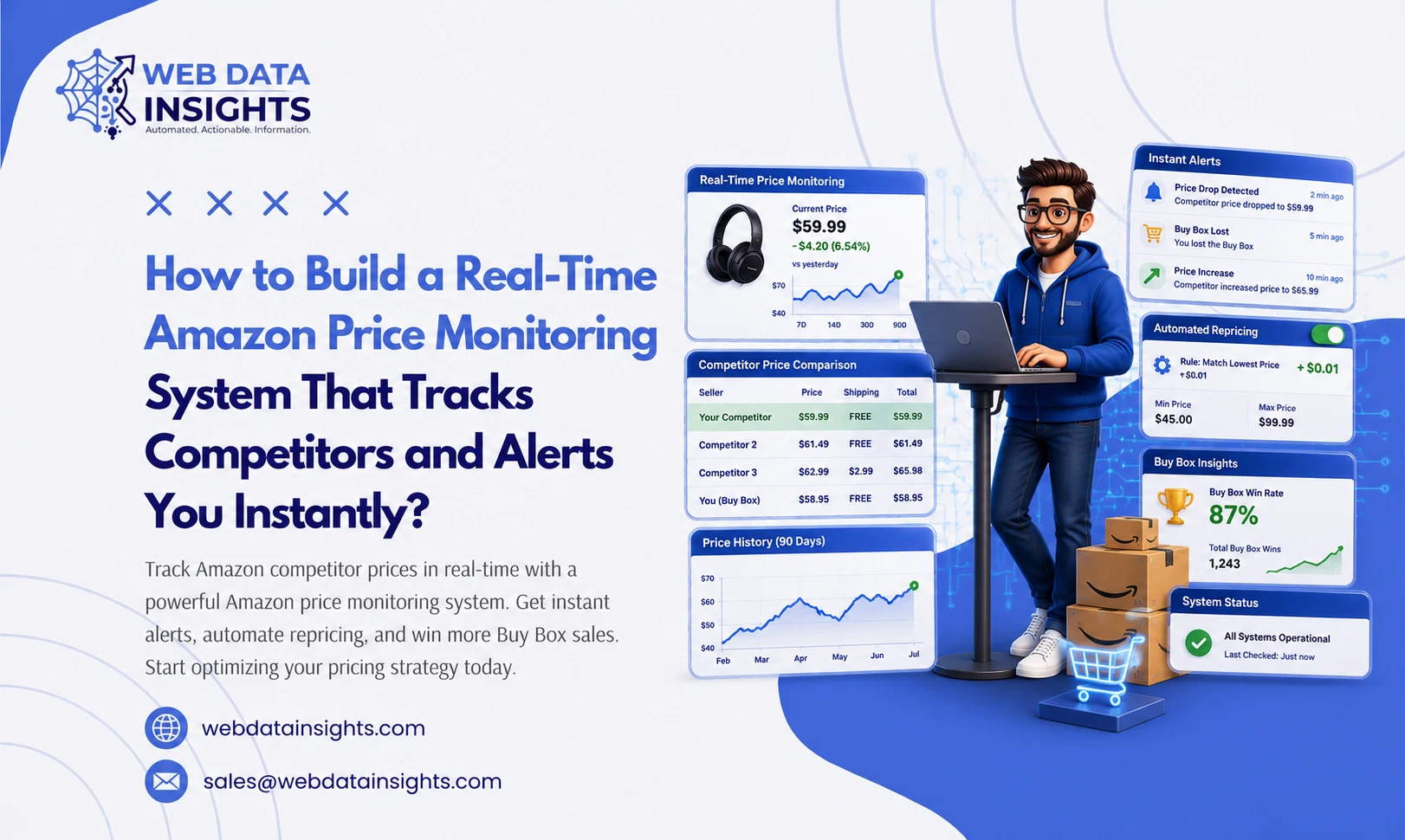
This is exactly why relying on manual methods or a basic amazon price tracker is no longer enough. To stay competitive, sellers need an advanced amazon price monitoring system that can continuously track Amazon prices, analyze competitor movements in real-time, and integrate with an amazon repricing tool to respond instantly.
To compete against someone else on Amazon, you need a way to monitor competitor prices in real-time using an Amazon price monitoring system powered by AI-powered web scraping and price monitoring. This system tracks competitors 24/7, analyzes historical price data, and sends you instant price drop alerts so you don’t have to manually check. This guide outlines exactly how to build your own system, what data points to track, and how to use competitive intelligence to make smarter automated repricing decisions.
There are several tools such as webdatainsights, built exclusively for this purpose, that allow you to monitor your competitors with an organized, systematic approach and take immediate action on Dynamic Pricing intelligence. No matter if you manage 50 or 50,000 ASIN’s, the way to gain a competitive edge is by using tools such as webdatainsights to automatically manage your competitive intelligence and monitor the market in real-time rather than having to react or respond to the previous day’s market changes.
Why Manual Amazon Price Tracking Is Quietly Killing Your Business
Each year, over $500 billion of business is run through Amazon’s marketplace via 2.5+ million active sellers competing against each other for limited Buy Box opportunities. When a seller owns the Buy Box for a particular item, they typically get 82% of the item’s total sales
Amazon prices change every ten minutes, and algorithmically-driven sellers with serious operations are adjusting their prices against 1000s of ASINs in real-time, 24/7 and capitalizing on every profitable opportunity. A seller manually checking 20-30 of their competitors’ pricing each morning is operating from data that is generally stale by 8 to 12 hours.
Cost can compound quickly in missed pricing-matching windows, lost Buy Box positioning, delayed responses to ahead-of-schedule competitor stock-outs and so on. Within webdatapoints’s seller data, it’s abundantly clear that sellers that rely only on manual price tracking lose substantial revenue every week, not because they aren’t doing a good job of staying on top of prices -but because they lack the proper visibility to do so.
The key isn’t to work harder – it’s to automate Amazon price tracking with a solution that never sleeps.
The Core Architecture of a Real-Time Amazon Price Monitoring System
A successful Amazon competitive intelligence system consists of four types of processes working together to produce an Amazon competitive intelligence system:
- Data Extraction Process: Continuously extracts pricing data, Buy Box ownership information, number of sellers, inventory levels, and product ranking from Amazon product pages and search results.
- Storage and History Process: Allows you to maintain a history of prices for each ASIN, allowing you to identify price fluctuations and patterns and identify gradual price erosion before it becomes rampant.
- Alert Engine Process: Measures current prices against your pricing thresholds and sends you a real-time alert if another sell has dropped their price via email, Slack, or API webhook.
- Repricing Integration Process: Connects your data/history to your repricing tool, enabling the tool to respond automatically to incoming price drops instead of simply alerting you.
It is these four layers interconnected to create a true competitive intelligence system vs just a functional price tracking system.
Critical Data Points Your Amazon Price Monitor Should Track
In order to effectively monitor your competition using only price, you also need to look at all of the other factors that can impact your market share on Amazon:
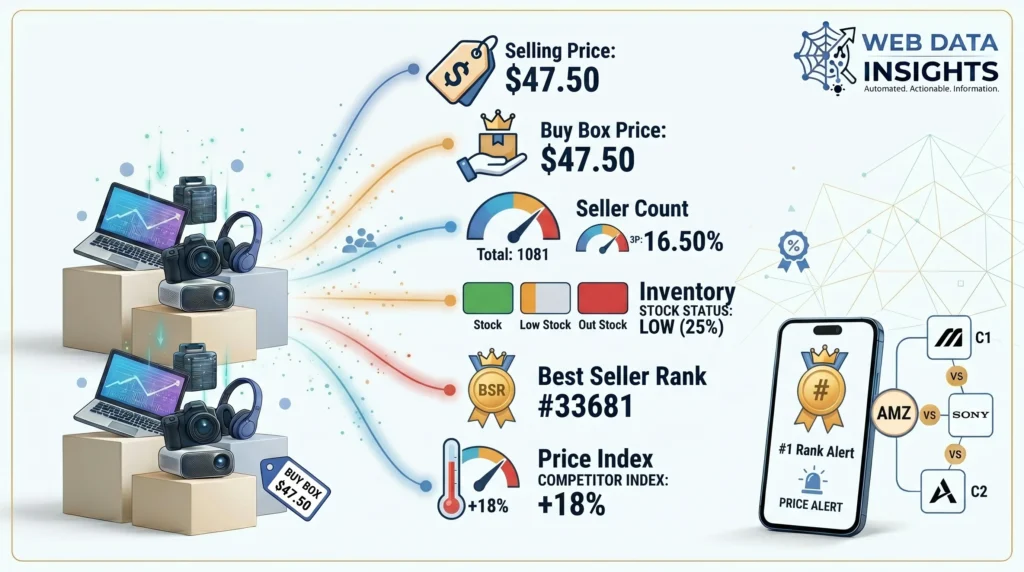
Your Selling Price – This refers to the price you’re actually selling your product at, considering any discounts or coupons applied at check-out. The price that’s at the top of your listing (i.e., your “Headline Price”) may not reflect what you actually are being sold for and also doesn’t account for the price that is creating price pressure on your competitors.
Buy Box Owner and Buy Box Price – This will show you who has won the buy box for your product and how much was paid for that buy box. Your Buy Box Percentage is possibly the most important statistic for your revenue projection
Number of Sellers and Number of Third Party Sellers – Tells you how many different sellers are on the same ASIN that you have listed. If the number of sellers is increasing, it is usually a sign that your price is going to come under pressure.
Inventory and Stock Status – As an example, if another seller runs out of inventory on your ASIN, that is usually a sign that you can increase your price to take advantage of the margin before that seller restocks.
Best Seller Rank (BSR) – BSR is an indicator of how fast a seller’s product is selling so an increase in BSR will usually precede a price increase. Price volatility index — A calculated measure of how much a product’s price fluctuates over time. High volatility means an aggressive competitive environment. Low volatility suggests a stable category where you can hold margins.
Price Index Relative To Competitors – Price divided by the average competitor price expressed as an index. Staying within 95-105 on most categories makes you competitive without sacrificing margins unnecessarily.
Webdatainsights has a comprehensive approach to tracking these signals altogether, giving sellers 360-degree market intelligence as opposed to just a snapshot of what prices look like today.
How to Set Up Automated Amazon Price Tracking: Step by Step
Step 1: Define Your Monitoring Scope
This report investigates a changing marketplace—a changing marketplace for Generation Z (Gen Z), a growing economic influence in the marketplace and a strong environmental value set—resulting in them being likely to lead changes in how retail will be conducted. This includes synthesizing prior studies relating to shopping behaviors and consumer preferences of Gen Z for sustainable products (i.e. clothing) as well as studying the motivations behind their desire to purchase sustainable goods, such as demands for “brand transparency,” “authenticity,” and “social responsibility.
”Additionally, this report will address behaviors that contrast with their desire for sustainability, including a phenomenon called the “Value/Action Gap”-the difference between how consumers (specifically members of Generation Z) feel about sustainability and how they actually purchase goods that are sustainable in nature-as well as the constraints of financial resources and current trends in fast fashion purchases.
Step 2: Choose Your Monitoring Frequency
This report analyzes the evolving marketplace according to Generation Z (Gen Z). Gen Z is fast becoming a major economic force in the marketplace with a strong set of environmental values and thus may be the ones who drive changes in how retail will be done. Additionally this report synthesizes previous research that explored shopping habits and Gen Z’s consumer preferences for sustainable products (i.e. clothing) as well as the reasons why Gen Z wants to purchase sustainable goods (i.e., the demand for “brand transparency,” “authenticity,” and “social responsibility”).
This report also discusses the ways that their values are at odds with their purchasing behaviors, including a phenomenon called the “Value/Action Gap” – the disparity between consumers’ (primarily Gen Z’s) feelings about sustainability versus how they purchase sustainable products; as well as, the constraints of financial resources and trends in fast fashion purchases.
Step 3: Configure Price Drop Alert Thresholds
This is where your monitorinq System bec02mes active and where you need to define trigger events that affect your business.
- A competitor drops price more than X% below yours.
- A competitor’s price falls below your cost.
- You no longer qualify for ownership of the Buy Box.
- The estimated supply of a top competitor falls below 7 days.
- A new seller on one of your key ASINs (Amazon Standard Identification Number, essentially, an identifier for each product).
The alert must carry some contextual information; it must not be just the price, but also what the price means to your current position. For example, “Competitor dropped price 15%, if you do not match this price in 2 hr your sales will likely decrease 20%–30%”. (actionable versus not (raw data)).
Step 4: Build Your Price History Database
Having only one price for each product (and no price history) doesn’t provide any significant information. Having a well-maintained historical price record enables you to perform many useful calculations, including measuring price volatility, determining seasonal trends, identifying gradual margin compression trends that may not cause a single-price alert, preparing for promotional events like Prime Day or Black Friday, among others.
Keep at least three (3) months of historical price information for each ASIN. Having at least (12) months of historical pricing data will be extremely valuable for analysis of competitor activity.
Step 5: Connect Monitoring to Repricing
The final piece of the puzzle is creating a loop closure from triggering an alert to taking action by feeding data from your monitoring system directly into your automated repricing tool. An example of basic automated conditional repricing logic would be as follows:
- Match competitor’s price minus a slight margin buffer when their price drops below yours AND you have over 30 days’ supply of inventory available.
- Increase price by 10% to protect margin on items when your supply of that item drops below 7 days’ worth of inventory.
- If your BSR has improved by over 20% in the past 7 days, test a price increase of 3–5% on that item.
- If one of your major competitors runs out of stock, raise your price on that item.
By building this type of conditional automated repricing logic into your repricing tool and running it continuously in the background, large sellers have taken the steps they need to compete in real-time without having to perform manual repricing activities.
Monitoring Across Multiple Amazon Marketplaces
Amazon sellers worldwide encounter additional challenges at different prices, levels of competition and Buy Box algorithms for each region i.e., Amazon US/Canada/UK/Germany and beyond.
Webdatainsights solves this challenge through cross-marketplace monitoring and identifies unauthorized or grey market sellers who are underpricing you in countries you don’t anticipate.
Using Price Intelligence for MAP Compliance and Brand Protection
Amazon price checks are used by manufacturers and brand owners for the purpose of enforcing MAP (Minimum Advertised Price) policies as well as identifying unauthorized sellers
An automated monitoring solution provides the ability to monitor every seller who sells your product, capture pricing data with time stamps, and automate the identification of MAP violations. In doing so, you will have the documentation needed for an enforcement action through Amazon or a direct communication with the offending seller.
Webdatainsights can automate the MAP enforcement layer for brand owners, which will result in the ongoing and consistent monitoring of MAP, allowing you to take action against MAP violators, and therefore supporting your price control across all channels not just Amazon. Other sellers will become accustomed to the prices of your product being sold at discounts on Amazon and will continue to expect those types of prices everywhere.
Key Metrics to Build Into Your Competitive Intelligence Dashboard
To establish an all-in-one Amazon competition intelligence dashboard there will probably be an array of important metrics that need reporting:
1) Buy Box ownership % – this represents how much of the Buy Box you have won over a period of 7 days, 30 days & 90 days. The earliest evidence of a weakness in your pricing strategy is when you see a decline in your ownership.
2) Price to Compete Index – This shows how much your price compares with the average price in the category you are competing in. An index of +110 denotes that you are probably losing price-sensitive buyers due to being priced above the average. An index of below 90 would indicate that you are leaving money on the table; you could have raised your price relative to the category average.
3) Competitor out-of-stock ratings – This is a rough estimate of how close each of your competitors is to going out-of-stock, taken from their past sales velocity in relation to what you know about their inventory levels. The lower the competitors’ stock-out rating; the more suspicious you should be that they are about to run out of stock — and this provides you with an opportunity to price aggressively.
4) Price volatility by category – You can use this metric in conjunction with your assessed price volatility by product. You will be able to see if you need to aggressively reprice products in high volatility categories (e.g., electronics) and if you can afford to take a more conservative approach with your repricing for less volatile categories (e.g., home and garden).
5) How quickly your alerting system/yourself generally respond to triggered alerts. The more quickly that you typically respond to alerts, the more likely you will capitalize on competitive openings.
Common Mistakes in Amazon Price Monitoring (And How to Avoid Them)
Monitoring price without context. If a competitor drops prices by $2 per unit but they have 5000 units or they have 12 units, it makes a big difference. Always check inventory levels while checking price.
Making alert thresholds too small. If you create alerts for a 1% change in price, you will be inundated with alerts very quickly. It would be better to start creating alerts for a 5-10% change in price and then ultimately adjust the alert as your system gets calibrated to pricing.
Omitting historical price, therefore creating ineffective monitoring. Point-in-time monitoring makes it difficult to track trends in true price erosion over time; therefore, the way to tell the best sellers apart from the average seller is by looking at historical pricing data.
Not monitoring new entrant competitors. An established company can enter an already established market by pricing significantly lower that the other competitors. If you were only monitoring established competitors, you may be surprised with a new competitor that is not even in your database.
No repricing automation integration. If there is no automation in your monitoring process, your process of tracking prices will be more difficult. If you are monitoring prices on a high-velocity product category (i.e., buy boxes change every 10-30 minutes) the time it takes you to reprice, it will be too late and you will lose buy box.
The Business Case: What Automated Competitive Intelligence Actually Delivers
Sellers moving from manual price checking to automated Amazon price monitoring report similar results: more Buy Box ownership, higher average selling prices (due to being able to get stock-out premium pricing that was previously missed), and less time spent on competitor research.
Investing in a real-time price monitoring system pays back not only in recovered revenue, but also provides better clarity for your strategic decisions. When you can see the whole competitive landscape – pricing trends, inventory levels, number of competitors, BSR changes – you are able to make better decisions about what categories to expand into, what products to promote, and whether to sacrifice margin or compete aggressively on price.
This is the philosophy behind webdatainsights – competitive intelligence is not simply a tactical weapon; it is also the basis of a pricing strategy that builds up over time.
Summary: Building Your Amazon Price Monitoring System
For a real-time price monitoring system to work on Amazon, it has to have five key components: ongoing data collection from the ASINs and marketplaces you’re tracking, price data storage so you can analyze past trends, a smart alert system with the appropriate thresholds, competitive intelligence analytics that present you with actionable metrics, and integration with your repricing tools so that the monitoring system can change your prices in real time based on the findings of the price monitoring system, rather than just report them.
There is no real strategy to manually track prices – it’s a liability. All of the sellers winning on Amazon are employing systems and processes that allow them to monitor the competition, at minute level, for all the ASINs and marketplaces they’re tracking, and adjust their pricing before the window of opportunity in the marketplace has closed You can build the price monitoring system as outlined above, set alert thresholds specific to each of the categories you are monitoring, and then connect the data collected from your monitoring system to your repricing software. webdatainsights has a platform that will help you do this without requiring a technical team to build the basic building blocks from scratch. Building a price monitoring system that is scalable for your catalogue and that eliminates the need for you to refresh a spreadsheet every morning by 6 AM is the first step in developing a competitive Amazon pricing strategy.
Reliable Web Data Solutions
WebDataInsights provides clean, structured, and real-time web scraping solutions tailored to your business goals, helping automate data collection for eCommerce, market research, lead generation, and more.
Get in Touch