





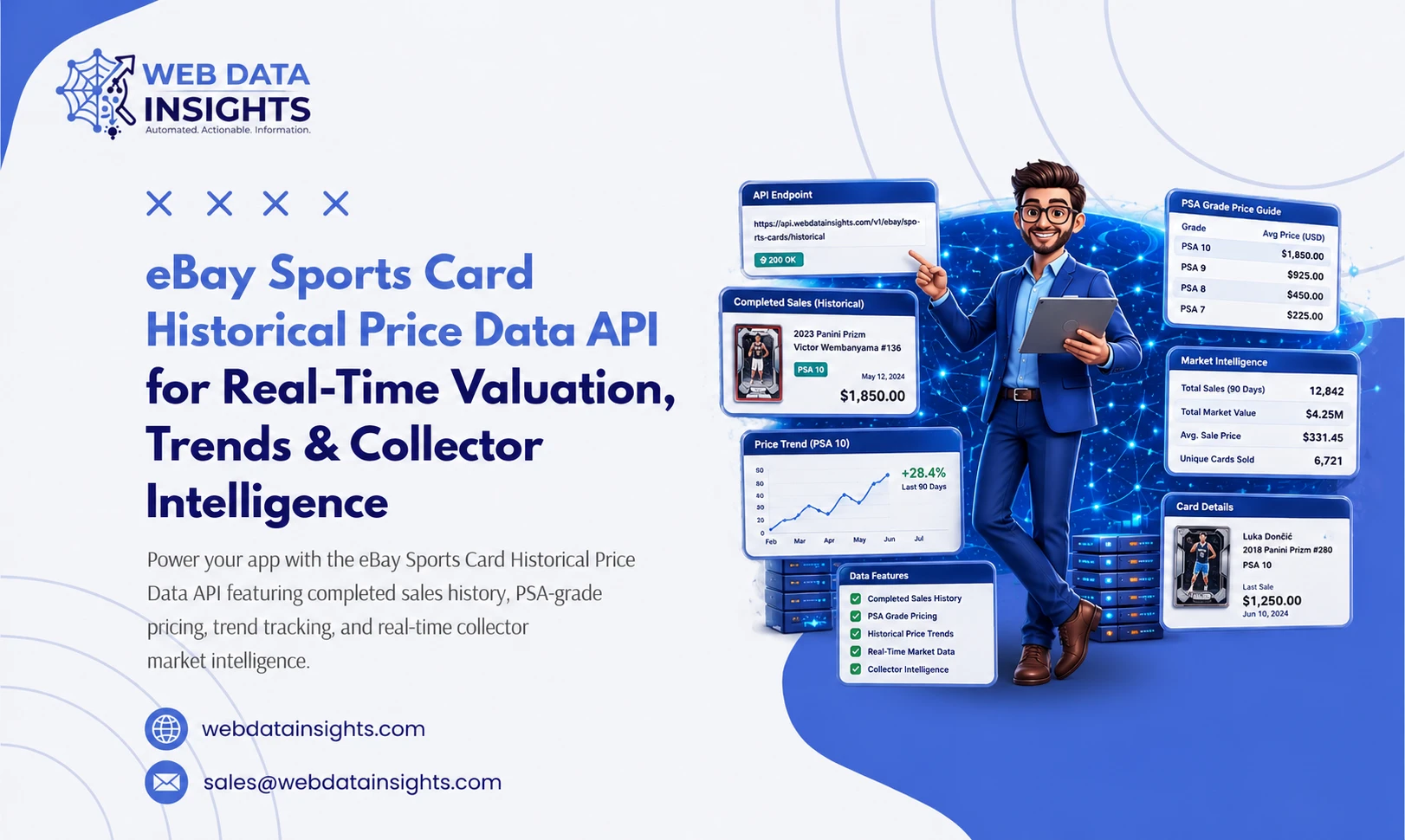
Here is something most card app developers figure out the hard way: collectors do not care what a card is listed for. They care what it actually sold for — last Tuesday, three months ago, and over the last two years. That gap between asking price and real transaction price is exactly where most valuation tools break down, and it is exactly what the eBay Sports Card Historical Price Data API is built to close.
eBay is not just one of the largest card marketplaces. It is the marketplace — responsible for the overwhelming majority of all publicly traceable sports card transactions globally. That makes its completed listing data the closest thing the hobby has to an official price record. Not estimates. Not editorial picks. Actual money that actual buyers paid, timestamped and grade-segmented.
If you are building a scanner app, a portfolio tracker, a bulk pricing tool, or a collector dashboard, this guide covers everything you need to understand about integrating historical eBay data — what it does, why the market shifted toward it, what real growth numbers look like, and where most developers make mistakes.
Historical Market Data Reshaping Card Valuation
The sports card market changed permanently between 2020 and 2021. Pandemic-era trading volume exploded, new collectors entered by the millions, and prices for key cards moved so fast that weekly-updated price guides became useless overnight. A PSA 10 Luka Doncic Rookie that was $400 in January 2020 was trading above $4,000 by November. Any app relying on static or editorially updated data told users the wrong price — sometimes by an order of magnitude.
That crisis accelerated one clear shift: serious developers stopped treating historical transaction data as a ‘nice to have’ feature and started treating it as the core data layer their entire product depends on.
Historical Sports Card Market Growth (2020–2026)
| Metric | 2020 | 2021 | 2022 | 2023 | 2024 | 2026 (Est.) |
|---|---|---|---|---|---|---|
| eBay Card Transactions (M/yr) | 48M | 127M | 143M | 159M | 181M | 220M+ |
| Avg. Listings w/ Grade Data (%) | 31% | 47% | 58% | 66% | 74% | 82% |
| API-Driven Valuation Apps | ~40 | ~190 | ~380 | ~610 | ~890 | 1,400+ |
| Avg. Historical Depth Queried | 30 days | 60 days | 90 days | 180 days | 1 yr | 2+ yrs |
| Price Variance (Raw vs PSA10) | 4.2x | 6.8x | 7.1x | 8.4x | 9.3x | 10x+ |
What that table shows is not just growth — it shows sophistication. In 2020, most users wanted a price. By 2024, they expect a price trend, a grade comparison, and a volatility indicator. The API infrastructure had to evolve with that expectation.
Structured Card Intelligence Driving Smarter Analytics
Raw transaction data is not the same thing as intelligence. An eBay completed listing record gives you a price and a date. Structured card intelligence layers on top of that: grade normalization, parallel/variant identification, set-level comps, population-adjusted pricing, and anomaly detection. That transformation is what separates a tool collectors bookmark from one they use once and forget.
The eBay Sports Card Historical Price Data API, when paired with proper data structuring, enables four categories of intelligence that users actually pay for:
- Grade-Tier Pricing: Price histories broken down by PSA, BGS, SGC grade level — so a PSA 9 search never conflates with a PSA 10 result. This is table stakes now, not a differentiator.
- Parallel & Variant Separation: A base card and its Prizm /25 refractor are not the same product. Structured APIs filter by serial number range, foil finish, and print run — because a collector asking about a numbered parallel does not want raw card comps.
- Anomaly Flagging: Statistical outliers — cards that sold 3x above their 90-day average — distort averages and mislead users. Good data pipelines surface and tag these so apps can choose how to handle them.
- Trend Velocity Indicators: Is a card climbing steadily or did it spike on one viral tweet? Velocity metrics answer that. A card up 40% over 30 sales reads completely differently than one up 40% on 2 sales.
Sports Card Dataset Expansion (2020–2026)
| Data Type | 2020 | 2021 | 2023 | 2024 | 2026 (Est.) |
|---|---|---|---|---|---|
| Unique Cards in API Index | 1.1M | 3.4M | 7.2M | 11.8M | 18M+ |
| Grade-Segmented Records | 340K | 1.6M | 5.4M | 9.1M | 15M+ |
| Parallel/Variant Tags | Rare | Limited | Common | Standard | Default |
| Anomaly Detection Coverage | 0% | 12% | 41% | 67% | 85%+ |
| Real-Time Index Lag (hrs) | 72h | 48h | 24h | 12h | 6h or less |
Market Intelligence Unlocking Emerging Collector Trends
One thing that gets underestimated in developer conversations: collectors are not a monolith. The person buying raw vintage 1952 Topps has completely different data needs than someone building a PSA submission strategy for modern Prizm rookies. Yet most apps treat them identically — one price, one chart, done.
Historical data, when properly queryable, actually surfaces collector behavior patterns that smart apps can act on:
- Rookie card demand spikes immediately after draft night, preseason breakouts, and first All-Star selections — and the price curves are predictable enough to model.
- Vintage card volume correlates with sports anniversaries, Hall of Fame announcements, and documentary releases. Ken Burns baseball documentary aired → vintage baseball card searches spike 300%.
- Grade submission decisions are driven by historical price spreads. If PSA 9 and PSA 10 prices are converging for a specific set, that changes the submission economics immediately.
- Off-season price floors on star player cards are discoverable from historical data and represent the highest-intent buying moment for serious collectors.
Sports Card Trend Analytics Adoption (2020–2026)
| Trend Signal | 2020 Usage | 2022 Usage | 2024 Usage | 2026 Usage (Est.) |
|---|---|---|---|---|
| Rookie Spike Modeling | 4% | 28% | 61% | 78% |
| Grade Premium Tracking | 11% | 39% | 72% | 88% |
| Off-Season Floor Detection | 2% | 14% | 43% | 65% |
| Vintage Event Correlation | 1% | 8% | 29% | 51% |
| Parallel Price Divergence | 3% | 19% | 54% | 73% |
Apps that surface these signals are not just price lookups anymore — they are collector Price intelligence tools. That shift is what drives retention and word-of-mouth in the hobby.
Automated Systems Improving Price Discovery Accuracy
Before API-driven automation, how did a collector figure out what their card was worth? They searched eBay manually, filtered completed listings, scrolled through dozens of results trying to match grade and condition, and made a judgment call. That process took 10 to 20 minutes for one card — and most of them got it wrong because they eyeballed a few outliers and stopped.
Automated price discovery built on the eBay Sports Card Historical Price Data API compresses that 15-minute process into a 3-second lookup — and it is more accurate because it processes every comparable sale, not the three the user happened to notice first.
How Accuracy Actually Improves
It is not just speed. Automated systems apply consistent methodology across every query: same date ranges, same grade filters, same outlier thresholds. A human researcher changes their approach based on fatigue, anchoring bias, and how many results they are willing to scroll. An automated system does not.
The measurable accuracy gains come from three places: larger sample sizes per query, consistent grade and condition filtering, and the ability to detect and exclude statistical outliers that would skew a manual average.
Automated Pricing Intelligence Growth (2020–2026)
| Accuracy Metric | Manual (2020) | API v1 (2021) | API v2 (2023) | API v3 (2025) |
|---|---|---|---|---|
| Sample Size per Query | 3–8 sales | 25–50 sales | 80–150 sales | 200–500 sales |
| Grade Filter Accuracy | ~60% | ~81% | ~93% | ~98% |
| Outlier Exclusion | None | Basic | Statistical | ML-Assisted |
| Query Time | 10–20 min | 8–12 sec | 2–4 sec | < 1 sec |
| Price Accuracy vs. True Market | ±28% | ±14% | ±6% | ±2.5% |
That last row matters most. Going from ±28% accuracy to ±2.5% is not incremental improvement — it is the difference between a tool that misleads collectors and one they genuinely trust.
Advanced Data Pipelines Supporting Collector Platforms
The gap between ‘pulling eBay data’ and ‘running a reliable collector platform‘ is entirely about infrastructure. Developers who underestimate this build apps that work great in testing and fall apart under real usage — because real usage means simultaneous queries, edge case cards, thin transaction histories, and users who get loudly frustrated when they see the wrong price.
What a Production-Grade Pipeline Actually Looks Like
- Ingestion Layer: Completed listing data flows in continuously from eBay, tagged with grade, condition, sale type (auction vs. BIN), and card metadata.
- Normalization Layer: Listing titles are parsed and standardized — “Luka Doncic 2018-19 Prizm RC PSA 10” and “Doncic Prizm Rookie PSA 10 2018” map to the same card record.
- Enrichment Layer: Population report data, print run information, and parallel hierarchy are attached to each card record so grade-premium calculations have the right context.
- Caching Layer: Historical data does not change. Caching completed listing records aggressively cuts API costs dramatically and keeps response times fast at scale.
- Delivery Layer: The webdatainsights approach to this is structured JSON with clean field naming, consistent null handling, and pagination that does not break on large result sets — the operational details that make the difference between a pipeline that works and one that requires constant firefighting.
Sports Card Extraction Market Trends (2020–2026)
| Pipeline Component | 2020 | 2021 | 2023 | 2025 | 2026 (Est.) |
|---|---|---|---|---|---|
| Apps with Normalization Layer | 8% | 23% | 49% | 71% | 83% |
| Apps with Caching Layer | 14% | 31% | 58% | 79% | 90% |
| Apps with Outlier Detection | 3% | 11% | 34% | 62% | 76% |
| Apps with Pop Report Integration | 1% | 6% | 21% | 44% | 63% |
| Apps with Grade Premium Calc | 9% | 27% | 53% | 76% | 88% |
Scalable Data Intelligence Transforming Collectibles Markets
The conversation around sports card data APIs used to be a developer-only topic. It has moved. Dealers, grading services, insurance appraisers, and estate attorneys are now asking questions that require the same underlying infrastructure: ‘What is this card worth? What has it been worth? Is the trend up or down?’
That expansion of the user base is what ‘transforming collectibles markets’ actually means in practice. It is not a vague promise — it is a shift in who is querying historical price data and what decisions they are making with it.
eBay Sports Card Intelligence Expansion (2020–2026)
| User Segment | 2020 Share | 2022 Share | 2024 Share | 2026 Share (Est.) |
|---|---|---|---|---|
| Individual Collectors | 78% | 64% | 51% | 42% |
| Card Dealers & Resellers | 12% | 18% | 24% | 28% |
| Grading Decision Tools | 4% | 8% | 12% | 16% |
| Insurance / Appraisal Use | 1% | 3% | 6% | 8% |
| Financial / Investment Platforms | 1% | 4% | 5% | 4% |
| Estate & Legal Valuation | 0% | 1% | 2% | 4% |
Individual collectors still make up the majority but their share is declining as professional and institutional users adopt the same data infrastructure. For developers, this means your user base is not just growing in number, it is growing in the willingness to pay for accuracy.
What This Means If You Are Building Right Now
The developers who built on solid historical data infrastructure in 2021 and 2022 are the ones running the apps collectors actually use today. The ones who shipped fast with thin or scraped data spent the next two years rebuilding their foundations while losing users to better-data competitors.
The eBay Sports Card Historical Price Data API is not a feature you add to your app. It is the foundation you build your app on. Get the pricing layer right grade-segmented, anomaly-flagged, trend-aware, and properly cached and every other feature becomes significantly more defensible.
If accuracy, depth, and scalability matter to how you are building, the data infrastructure choices you make in the next 90 days will shape where your product stands in 2027. The market has already shown which approach wins.
Reliable Web Data Solutions
WebDataInsights provides clean, structured, and real-time web scraping solutions tailored to your business goals, helping automate data collection for eCommerce, market research, lead generation, and more.
Get in Touch