





Why 82% of Amazon Sales Go Through the Buy Box – And How Price Scraping Changes the Game
If you sell on Amazon, you already know the brutal truth: whoever owns the Buy Box, owns the sale. In 2026, over 82% of Amazon purchases are completed through the Buy Box — that small yellow ‘Add to Cart’ button that only one seller gets at a time. Miss it, and your competitors collect the revenue that should have been yours.
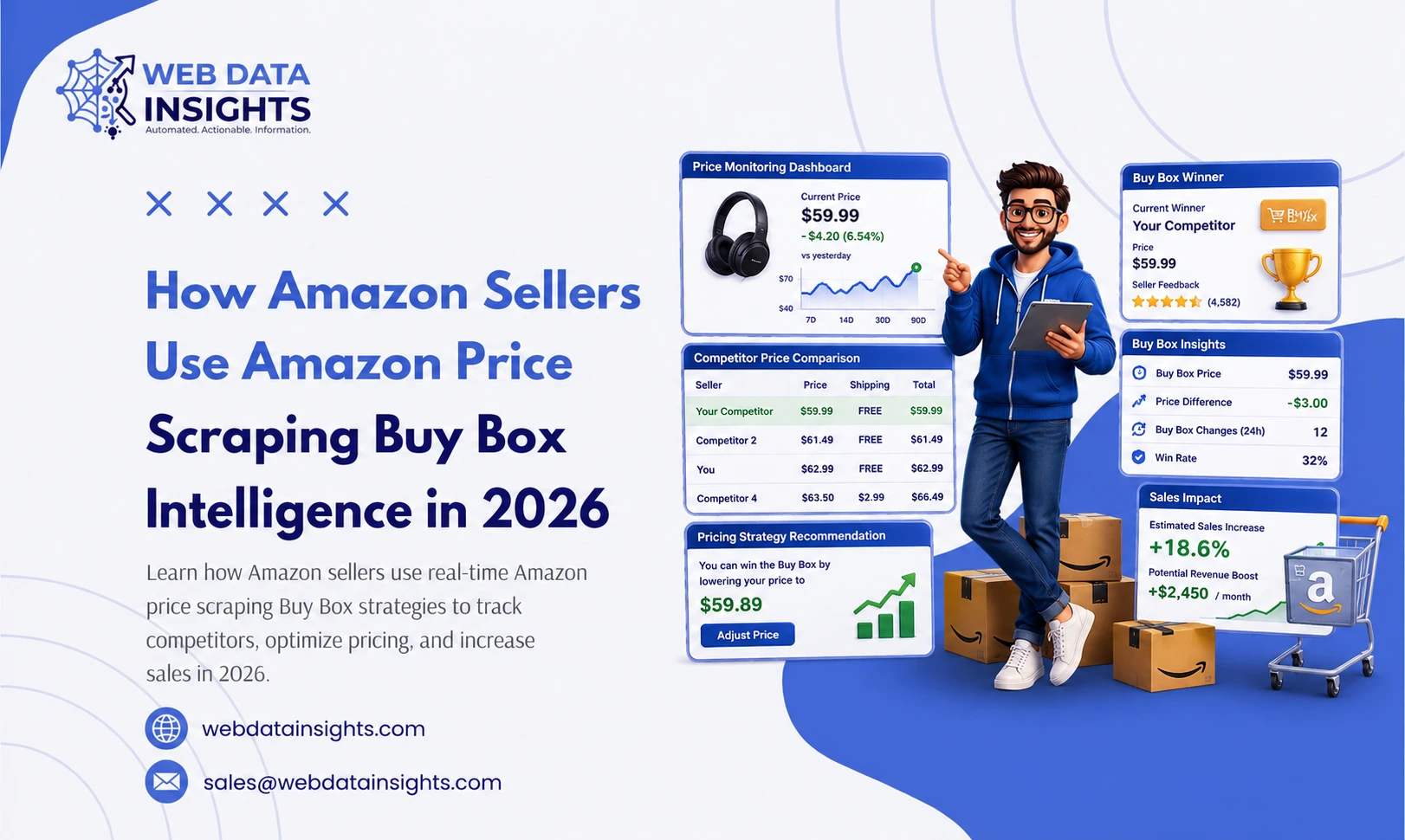
Amazon price scraping Buy Box strategies have become one of the most powerful ways for sellers to stay competitive on Amazon in 2026. By systematically collecting real-time competitor pricing data, businesses can optimize pricing decisions, react faster to market changes, and improve their chances of winning the Buy Box consistently. In this guide, WebDataInsights explains how Amazon price scraping works, why it directly impacts your sales performance, and the proven strategies sellers use to scale revenue with smarter pricing intelligence.
Whether you are a private label seller, wholesale distributor, or retail arbitrage operator, Amazon price scraping for Buy Box domination is no longer optional – it is the baseline of competitive selling in 2026.
Quick Stat: Amazon sellers who use automated price scraping and dynamic repricing win the Buy Box up to 63% more often than those who update prices manually. (Source: Feedvisor 2025 Amazon Seller Report)
What Is Amazon Price Scraping – And Why Every Serious Seller Needs It
What does ‘Amazon price scraping for the Buy Box’ actually mean?
Amazon price monitoring scraping is the automated process of extracting real-time pricing data from Amazon product listings – including competitor prices, shipping costs, seller ratings, and Buy Box status – and feeding that data into a repricing engine that adjusts your prices automatically.
Think of it as having a team of analysts watching every competitor on every ASIN you sell, 24 hours a day, 7 days a week. When a competitor drops their price by $0.50, your repricer knows within minutes. When they go out of stock, you know instantly and can adjust to maximize margin rather than just matching the lowest price.
The 4 Data Points Price Scraping Captures
- Competitor listed price (before and after shipping)
- Fulfillment method (FBA vs. FBM vs. Amazon itself)
- Seller feedback rating and feedback count
- Current Buy Box holder and their price threshold
Is Amazon price scraping legal? What sellers need to know in 2026
This is the question every seller asks first, and rightfully so. The short answer: scraping publicly available pricing data from Amazon for your own business intelligence and repricing is legal under U.S. and EU law as of 2026, consistent with the hiQ Labs v. LinkedIn ruling and subsequent case law affirming the legality of scraping publicly accessible data.
However, there are important boundaries. Violating Amazon’s Terms of Service by scraping using fake accounts, bypassing CAPTCHA systems in ways that damage Amazon’s servers, or reselling scraped data commercially without permission can result in account suspension. Use reputable repricing tools with built-in compliance guardrails.
Best Practice: Always use API-based repricing tools (Seller Central MWS/SP-API) or TOS-compliant scrapers that operate within Amazon’s rate limits. Avoid grey-market scraping tools that require fake Amazon accounts.
How the Amazon Buy Box Algorithm Works in 2026
What factors does Amazon use to decide who wins the Buy Box?
Amazon’s Buy Box algorithm is a weighted scoring system. It does not simply give the Buy Box to the cheapest seller. In 2026, Amazon’s algorithm has become increasingly sophisticated — rewarding overall customer experience, not just the lowest price. Here are the key factors, ranked by influence:
| Buy Box Factor | Weight (Approx.) | How Price Scraping Helps |
| Landed Price (Price + Shipping) | ~35% | Know exactly what competitors charge all-in |
| Fulfillment Method (FBA prioritized) | ~25% | Identify if FBA competitors undercut you |
| Seller Performance Metrics | ~20% | Benchmark your metrics vs. Buy Box winners |
| Shipping Time | ~10% | See if slow shippers hold the box — and undercut |
| Order Defect Rate / Feedback | ~10% | Identify weak competitors you can displace |
Why the cheapest price does NOT always win the Buy Box
This is the most misunderstood aspect of Buy Box optimization. Amazon actively protects its marketplace from race-to-the-bottom pricing. In 2026, the algorithm weights fulfillment reliability and customer experience heavily. An FBA seller priced $0.30 higher than an FBM seller with slow shipping will frequently win the Buy Box.
This is where price scraping intelligence becomes a genuine profit multiplier: instead of blindly lowering your price, you can identify the exact price point where you win the Buy Box while maintaining healthy margins.
Key Insight: Price scraping reveals the minimum price needed to win the Buy Box — not just the lowest price in the market. Sellers using dynamic repricing based on scraped data report average margin improvements of 8–14% compared to sellers using floor-price repricing only.
Step-by-Step: How Amazon Sellers Use Price Scraping to Win the Buy Box
Step 1: Set up your ASIN monitoring list
Before any repricing can happen, you need a clean list of every ASIN you sell or plan to sell. Export your active inventory from Seller Central and tag each ASIN by category, margin sensitivity, and competitive density. ASINs with 10+ active sellers require more aggressive scraping frequency (every 15–30 minutes). ASINs with fewer than 5 sellers can be monitored hourly.
Step 2: Choose your price scraping method
There are three primary methods for Amazon price scraping in 2026:
Amazon SP-API (Most Compliant)
Amazon’s Selling Partner API provides official access to competitive pricing data via the Get Competitive Pricing and Get Lowest Offer Listings endpoints. This is the safest method — fully TOS-compliant — but data refresh rates are limited (typically every 15–60 minutes depending on category).
Custom Scraping Infrastructure (Maximum Control)
Enterprise sellers and agencies build proprietary scraping pipelines using rotating proxy networks, headless browsers (Playwright/Puppeteer), and custom parse rules. This approach provides real-time data (sub-5 minute refresh) but requires engineering resources and ongoing maintenance.
| Method | Cost | Speed | Compliance Risk | Best For |
|---|---|---|---|---|
| Amazon SP-API | Free | 15–60 min | None | Any seller |
| Repricing SaaS | $50–$500/mo | 5–15 min | None | 100–10K SKUs |
| Custom Infrastructure | $1,000–$10K/mo | 1–5 min | Medium if misconfigured | Enterprise / Agency |
Step 3: Configure your repricing rules
Raw price data is useless without intelligent repricing rules. This is where most sellers make critical mistakes — they configure rules that win the Buy Box but destroy their margins. Here is the proven rule framework:
- Set your floor price based on COGS + all fees + minimum acceptable margin (never go below this)
- Set your ceiling price at your current price or the MAP price if applicable
- Configure a ‘Beat by X%’ rule for FBA competitors — typically 0.1% to 0.5% is sufficient
- Set a separate rule for Amazon-as-seller situations — competing with Amazon directly on price is almost never profitable
- Add a ‘Raise to ceiling when Buy Box uncontested’ rule — when competitors go out of stock, maximize your margin automatically
Step 4: Monitor Buy Box percentage and adjust
Your Buy Box percentage — the share of time your listing holds the Buy Box — is the single most important metric to track. Access it in Seller Central under Reports > Business Reports > Detail Page Sales and Traffic by ASIN. A healthy Buy Box percentage for a competitive ASIN is 40–70%. Consistently above 70% may indicate you are underpricing; consistently below 30% requires rule adjustment or investigation of your seller metrics.
Pro Tip: When your Buy Box percentage drops suddenly on an ASIN, the first thing to check is not your price — it is your seller metrics. A dip in your Order Defect Rate or Late Shipment Rate will cost you the Buy Box regardless of how competitive your price is.
Advanced Price Scraping Strategies That Top Sellers Use in 2026
Competitor out-of-stock detection: the highest-margin Buy Box opportunity
When a major competitor goes out of stock, your repricing tool should automatically raise your price toward the ceiling — capturing maximum margin during the window when you face less competition. This single strategy alone can increase total profit by 15–25% for sellers in competitive categories.
Sophisticated sellers set up alerts when any top-3 competitor’s listing goes out of stock. They then manually review whether to raise prices further than the automated ceiling allows, especially for seasonal or high-demand products.
Velocity-based repricing: pricing by demand signal
Advanced repricing in 2026 goes beyond competitor price matching. Velocity-based repricing adjusts prices based on your own sales velocity data — automatically raising prices when your sales rate is high (indicating strong demand) and lowering them when velocity drops. Combined with price scraping, this creates a dynamic pricing software model that optimizes for total profit, not just Buy Box win rate.
Buy Box suppression detection and response
Amazon suppresses the Buy Box on listings where all available prices are deemed too high relative to historical pricing or external market data. This means if all sellers raise prices simultaneously, Amazon removes the Buy Box entirely — forcing customers to compare offers manually, which dramatically reduces conversion.
Price scraping helps you detect Buy Box suppression early. When scraped data shows the Buy Box field as empty across multiple monitoring checks, you know suppression has been triggered. Experienced sellers maintain a ‘suppression alert’ rule in their repricing tool that automatically adjusts price downward to reactivate the Buy Box before significant sales are lost.
How to handle MAP (Minimum Advertised Price) policies in your scraping strategy
If you sell branded products with MAP agreements, price scraping serves a dual purpose: it helps you reprice competitively up to MAP, and it helps you identify MAP violators — competitors undercutting the minimum and distorting the Buy Box. Many brands use scraping tools specifically to monitor MAP compliance across their authorized seller network.
The Best Price Scraping and Repricing Tools for Amazon Sellers in 2026
Which repricing tool is best for Amazon Buy Box in 2026?
The right tool depends on your SKU count, technical capabilities, and budget. Here is a comparative overview of the leading solutions:
| Repricing Solution Type | Best For | Typical Pricing | Key Advantage |
|---|---|---|---|
| AI-Based Repricing Platforms | Large Amazon sellers | $250+/month | Advanced pricing automation |
| Multi-Channel Repricing Tools | Omnichannel brands | $75+/month | Marketplace integrations |
| Budget Repricing Software | Small sellers | $25+/month | Lower entry cost |
| Enterprise Pricing Intelligence Platforms | Large brands & agencies | Custom pricing | Analytics + automation |
| Buy Box Optimization Tools | Amazon-focused sellers | $97+/month | Faster Buy Box reactions |
Can I build my own Amazon price scraper in 2026?
Yes — and for sellers managing high-volume, high-margin catalogs, a custom scraper provides data freshness and granularity that no SaaS tool can match. The typical stack in 2026 uses Python with the requests-html or Playwright library, a rotating residential proxy service (Bright Data, Oxylabs, or SmartProxy), a data pipeline to PostgreSQL or BigQuery, and a custom repricing logic layer connected to Amazon SP-API for price updates.
The key technical challenges are: proxy rotation to avoid IP blocks, CAPTCHA handling, Amazon’s dynamic JavaScript rendering, and parsing product data across Amazon’s inconsistent ASIN page templates. For most sellers with fewer than 5,000 SKUs, a SaaS repricing tool delivers better ROI than building custom infrastructure.
Common Mistakes That Cost Sellers the Buy Box – And How Price Scraping Fixes Them
Mistake 1: Setting a floor price below your true landed cost
The most dangerous repricing mistake is setting a floor price without accounting for all costs: COGS, Amazon referral fee (8–17% depending on category), FBA fulfillment fee, FBA storage fee, return processing, and advertising cost of sale. Sellers who win the Buy Box at a negative margin are worse off than sellers who never had it. Use price scraping data to understand the market price floor — if the Buy Box winner is pricing below your break-even, it signals a structural cost disadvantage you need to address, not a pricing race you should join.
Mistake 2: Not repricing fast enough
Manual repricing — logging into Seller Central and updating prices once a day — is effectively useless on competitive ASINs. In high-competition categories, Buy Box holders can change dozens of times per hour. Price scraping with automated repricing responds in minutes, not hours. Sellers who switched from manual to automated repricing report Buy Box percentage improvements of 20–40 percentage points within the first 30 days.
Mistake 3: Competing on price when you should compete on fulfillment
FBA sellers have a structural Buy Box advantage over FBM sellers because Amazon weights its own logistics network heavily. If you are currently FBM and losing the Buy Box to FBA competitors despite having a lower price, switching to FBA — even at a higher landed cost — will often increase your Buy Box percentage and total revenue. Price scraping helps you quantify this: compare Buy Box win rates for FBA vs. FBM sellers on your key ASINs to decide whether the FBA premium is worth it.
Mistake 4: Ignoring the Amazon-as-seller scenario
When Amazon itself enters a listing as a seller — sourcing the product directly — most third-party sellers cannot profitably win the Buy Box through pricing alone. Price scraping immediately identifies when Amazon is the Buy Box holder. The correct response is not to lower your price to compete with Amazon; it is to investigate your supply chain for a differentiated product variation, or to focus repricing resources on ASINs where Amazon is not actively selling.
Price Scraping and the Future of Amazon Selling: What’s Coming in 2026 and Beyond
AI-powered dynamic pricing: the next evolution
The frontier of Amazon price scraping in 2026 is not just reactive repricing — it is predictive pricing. AI models trained on historical Buy Box data, demand signals, seasonality, and competitor behavior patterns are beginning to anticipate price movements rather than simply respond to them. Feedvisor and Seller Snap already offer early versions of predictive repricing; expect this to become the standard feature set within 24 months.
Amazon’s own AI pricing: what sellers need to know
Amazon launched its AI-based dynamic pricing engine — internally called ‘Project Nessie’ for external sellers and a broader algorithmic pricing initiative — that adjusts prices on its own inventory millions of times per day. In 2026, Amazon is also rolling out automated pricing suggestions for third-party sellers in Seller Central. While these suggestions are not mandatory, sellers who ignore them while competitors adopt them will find themselves at a structural disadvantage in Buy Box competition.
Multi-channel price parity: scraping beyond Amazon
In 2026, sophisticated sellers scrape pricing data not just from Amazon but from Walmart Marketplace, eBay, Shopify storefronts, and Google Shopping to maintain price parity and protect their Amazon Buy Box eligibility. Amazon’s algorithm penalizes sellers who list lower prices on competing channels — a policy enforced partly through Amazon’s own scraping of external prices. Tracking your own cross-channel price consistency has become as important as tracking competitor prices.
Conclusion: Price Scraping Is Not a Tactic — It Is the Infrastructure of Amazon Success in 2026
The Amazon marketplace in 2026 is a real-time price intelligence, algorithmic battleground. The Buy Box — which drives the overwhelming majority of sales on the platform — is won not by luck or by blindly undercutting competitors, but by sellers who have the best pricing intelligence and the fastest response time.
Amazon price scraping for the Buy Box is the mechanism that gives you that intelligence. It transforms pricing from a manual, reactive task into an automated, strategic advantage. Combined with smart repricing rules that protect your margins, it creates a compounding advantage: more Buy Box time, more sales, and stronger unit economics. The sellers who will dominate Amazon in 2026 and beyond are those who treat price scraping not as a shortcut, but as the operational foundation of a data-driven selling business. Start with a reputable repricing tool, set your floor and ceiling prices correctly, monitor your Buy Box percentage weekly, and iterate. The data will tell you exactly what to do next.
Looking for a custom Amazon Seller Dataset, a one-time pricing audit, or an always-on retail price compliance API? Contact Webdatainsights to scope a solution tailored to your goals.
Frequently Asked Questions About Amazon Price Scraping and the Buy Box
How often does Amazon update the Buy Box?
Amazon updates the Buy Box in near real-time for high-traffic ASINs — potentially every few minutes. For lower-traffic listings, updates may occur every 30–60 minutes. This is why repricing frequency matters: a tool that updates prices every 15 minutes will significantly outperform one that updates hourly on competitive ASINs.
Does lowering my price always help me win the Buy Box?
No. Price is one of several factors. If your seller metrics — Order Defect Rate, Late Shipment Rate, Cancellation Rate — are below Amazon’s thresholds, you may be ineligible for the Buy Box regardless of your price. Fix your metrics first, then use price scraping to optimize your pricing position.
What is the difference between repricing and price scraping?
Price scraping is the data collection process — gathering competitor pricing and Buy Box status. Repricing is the action taken based on that data — automatically adjusting your price. Price scraping without repricing gives you information; repricing without accurate price scraping means you are adjusting prices based on stale data. The two work together as a system.
Can Amazon ban my account for price scraping?
Amazon cannot ban you for reading their publicly available product pages — the same pages any customer can view. The risk arises if your scraping methods violate their Terms of Service, such as creating fake buyer accounts to access restricted data, using automated tools that cause server load issues, or accessing data that requires seller authentication without authorization. Using SP-API or TOS-compliant SaaS repricing tools eliminates this risk.
How do I know if my Buy Box percentage is good?
For a competitive ASIN with 3–10 active FBA sellers, a Buy Box percentage of 40–65% is healthy. Above 70% consistently may indicate you are leaving margin on the table by pricing too aggressively. Below 25% suggests a repricing rule problem, a seller metrics issue, or a cost structure that makes competitive pricing unsustainable on that ASIN.
Is price scraping the same as using Amazon’s API?
Not exactly. Amazon’s SP-API provides official, structured access to competitive pricing data within defined rate limits. Web scraping refers to parsing Amazon’s HTML pages directly. In practice, the best repricing tools combine SP-API data (for reliability and compliance) with supplementary web data (for faster refresh rates and data points not available via API). Most sellers never need to build their own scraper — reputable SaaS tools handle this complexity.
Action Step
Audit your current Buy Box percentage across your top 20 ASINs this week. For any ASIN below 40%, review whether your repricing rules are set correctly, whether your seller metrics are above Amazon’s thresholds, and whether a competitor with structural pricing advantages (lower COGS, better FBA rates) is dominating the Buy Box. This audit alone will surface your single highest-ROI pricing opportunity.
Reliable Web Data Solutions
WebDataInsights provides clean, structured, and real-time web scraping solutions tailored to your business goals, helping automate data collection for eCommerce, market research, lead generation, and more.
Get in Touch