





Executive Summary
The global web scraping market is projected to surpass $1 billion in 2025 and reach $2.87 billion by 2034, growing at a 14.3% CAGR — making data extraction one of the fastest-growing segments in enterprise technology.
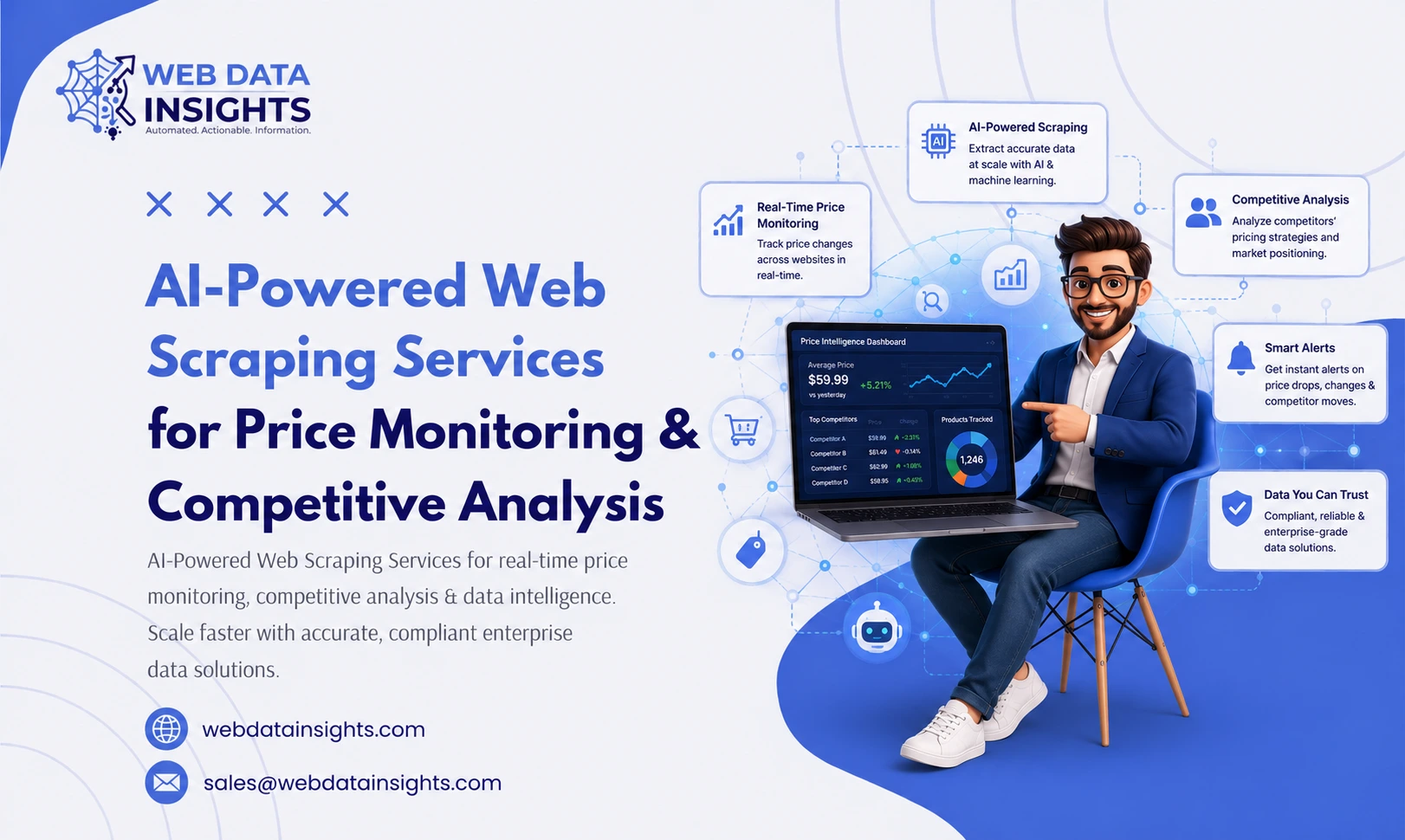
In 2026, the businesses that win are those that know more — faster. From price monitoring in retail to competitive analysis in finance and data intelligence in technology, AI-Powered Web Scraping Services have become the invisible engine behind informed strategy. This guide explores how organisations across the USA, UK, Canada, Switzerland, and the Middle East are leveraging managed web scraping services to outperform their competition — and why WebDataInsights stands as the definitive partner for businesses that demand accuracy, scale, and compliance.
What Is Enterprise Web Scraping? A 2026 Definition
Web scraping — also called web data extraction, web harvesting, or automated data collection — is the process of programmatically retrieving structured information from publicly available websites at scale. Unlike consumer-grade tools or manual copy-paste approaches, enterprise web scraping is a managed, compliant, and continuously maintained service designed to handle the complexity of modern websites: JavaScript rendering, anti-bot systems, CAPTCHAs, geo-restrictions, and dynamic content structures.
At an enterprise level, web scraping encompasses:
- High-frequency, high-volume data pipelines (millions of records per day)
- Intelligent anti-detection and browser fingerprint management
- Structured data delivery via APIs, webhooks, databases, or BI-ready flat files
- Compliance frameworks aligned with GDPR, CCPA, UK Data Protection Act, and UAE PDPL
- Dedicated infrastructure with guaranteed uptime SLAs
“65% of enterprises used web scraping to feed AI and machine-learning projects in 2024, signalling a foundational shift from rule-based scripts to intelligence infrastructure.”
— Mordor Intelligence, 2025
The distinction between a basic scraping script and a production-grade scraping service is the same as the difference between a spreadsheet and an ERP. One is a workaround; the other is infrastructure.
The 2026 Web Scraping Market: By the Numbers
To understand the opportunity — and the urgency — consider the data:
Market Size & Growth
- The global web scraping market was valued at approximately $754–$782 million in 2024 and is forecast to surpass $1 billion in 2025.
- By 2034–2035, projections range from $2 billion to $2.87 billion at a consistent 13–15% CAGR.
- The AI-driven web scraping market (a subset) was estimated at $6.2 billion in 2024, projected to reach $46 billion by 2035 at a 20% CAGR — fuelled by LLM training and predictive analytics demands.
- 81% of US retailers now use automated price scraping for dynamic repricing — up from 34% in 2020 (Actowiz Solutions, 2025).
- 94% of enterprise scraping users plan to increase their data budgets in the next fiscal year.
Web Scraping Market Share by Region (2024–2030 Forecast)
| Region | 2024 Market Share | Projected CAGR | Key Driver |
|---|---|---|---|
| North America (USA, Canada) | ~42–45% | 14.2% | AI/ML adoption, e-commerce, finance |
| Europe (UK, Switzerland, DACH) | ~24% | 13.5% | GDPR compliance-driven ethical scraping |
| Middle East & Africa | ~8% | 17.1% | Digital transformation & Vision 2030 |
| Asia-Pacific | ~22% | 18.0% | E-commerce boom, tech investment |
| Rest of World | ~6% | 12.8% | Emerging digital markets |
North America (USA + Canada) accounts for 42–45% of global web scraping revenue, driven by the most mature technology ecosystem and the highest per-enterprise data budgets on the planet.
Europe — led by the UK, Switzerland, and Germany — is the second-largest region, with GDPR-compliant data pipelines now a regulatory imperative rather than a differentiator. Meanwhile, the Middle East is accelerating fastest among mature economies, powered by Vision 2030 in Saudi Arabia, UAE smart city initiatives, and Bahrain’s FinTech Bay investments.
Top Enterprise Use Cases for Web Scraping in 2026
Web scraping is not a single-use technology. It is a horizontal data infrastructure layer that powers dozens of mission-critical workflows across industries. Below are the highest-value applications — each representing a concrete revenue or cost-savings opportunity for enterprise buyers.
Price Monitoring & Dynamic Competitive Pricing
Price monitoring — the automated, continuous tracking of competitor pricing across e-commerce platforms, marketplaces, and branded websites — is the single largest use case for web scraping, accounting for 25.8% of total market activity (Market.us, 2024).
For retailers in the USA and UK, where Amazon, Walmart, and platform-native brands reprice items thousands of times per day, manual price checking is commercially indefensible. WebDataInsights delivers hourly or sub-hourly pricing feeds — covering SKU-level prices, promotional markdowns, bundle deals, and stock status — enabling revenue management teams to react before the market moves.
- Track competitor prices across Amazon, Noon (UAE), Argos (UK), Walmart, Zalando, and 500+ retailer sites
- Monitor MAP (Minimum Advertised Price) compliance across reseller networks globally
- Integrate directly with repricing engines, ERP systems, or Google Sheets via API
- Receive alert-triggered notifications for price drops, out-of-stock events, and promotional launches
Competitive Intelligence & Market Analysis
Competitive analysis powered by web scraping gives business strategy teams a live, data-verified picture of the market — rather than quarterly analyst reports that are outdated before they’re published.
- Scrape competitor product catalogues, feature lists, and pricing tiers on a weekly cadence
- Track competitor hiring patterns (job boards) to predict strategic pivots before public announcements
- Monitor competitor content marketing, SEO keyword strategies, and backlink profiles
- Aggregate customer reviews across Trustpilot, G2, Capterra, and App Store for sentiment benchmarking
- For Middle East markets: monitor competitors on Souq, Talabat, Careem, and regional B2B directories
Lead Generation & B2B Data Enrichment
For B2B sales teams in the USA, Canada, UK, and Switzerland, prospecting is the highest-cost, lowest-efficiency activity in the sales funnel. Web scraping automates the identification, qualification, and enrichment of leads at scale.
- Extract company profiles, contact data, and firmographics from LinkedIn, industry directories, and company websites
- Monitor procurement intent signals from public tenders (UK Contracts Finder, EU TED, SAM.gov)
- Enrich CRM records with real-time data: headcount changes, funding rounds, executive movements
- Build hyper-targeted account lists for ABM (Account-Based Marketing) campaigns
Financial Data & Alternative Investment Intelligence
Web scraping underpins 67% of US investment advisers’ alternative data programmes — a figure that jumped 20 percentage points during 2024 alone (Mordor Intelligence). For hedge funds, family offices, and fintech companies in the UK and Switzerland, scraped data represents a significant and growing share of investment alpha.
- Aggregate earnings call transcripts, SEC/Companies House filings, and regulatory submissions
- Track commodity prices, shipping rates, and supply chain indicators from public sources
- Monitor ESG signals, litigation filings, and executive disclosure events
- Build proprietary sentiment indices from news, social media, and sector forums
Real Estate & Property Intelligence
Real estate professionals across the Middle East (Dubai, Riyadh, Abu Dhabi), UK, and North America use scraping to build comprehensive property databases that no single listing platform provides.
- Aggregate listings from Rightmove, Zoopla, Bayut, PropertyFinder, Zillow, and 200+ portals
- Track rental yield trends, days-on-market, and price-per-sqft changes by neighbourhood
- Monitor new development announcements, planning permissions, and zoning changes
AI Training Data & LLM Dataset Curation
The AI training data market is one of the fastest-growing end-markets for enterprise web scraping. As organisations build proprietary large language models, vertical AI assistants, and domain-specific ML pipelines, the demand for high-quality, domain-specific web data is unprecedented.
- Structured text extraction from news archives, academic publishers, and industry resources
- Multi-language dataset construction for global model deployment
- Custom data schemas to meet specific model architecture requirements
- Compliant data sourcing with robots.txt adherence and licensing documentation
Web Scraping Use Cases by Industry — Value Matrix
| Industry | Primary Use Case | Data Types Extracted | Business Impact |
|---|---|---|---|
| E-Commerce & Retail | Price monitoring, SKU tracking | Pricing, reviews, availability | Margin protection, repricing agility |
| Finance & Banking | Alternative data, sentiment analysis | News, filings, social signals | Alpha generation, risk reduction |
| Travel & Hospitality | Fare aggregation, hotel pricing | Rates, availability, reviews | Dynamic yield management |
| Real Estate | Listing aggregation, valuation | Listings, prices, neighborhood data | Faster deal sourcing |
| Healthcare & Pharma | Drug pricing, trial monitoring | Formularies, clinical data, news | Compliance & market entry speed |
| AI / LLM Training | Training dataset curation | Web text, structured records | Model quality & differentiation |
The Business Case: Quantifying the ROI of Enterprise Web Scraping
Procurement teams in the USA, Canada, UK, and Switzerland rightly demand a clear return on investment before committing to a managed data service. The following scenarios represent typical outcomes experienced by WebDataInsights clients across verticals.
Illustrative ROI Scenarios — WebDataInsights Client Profiles
| Business Scenario | Before Scraping | After WebDataInsights | Typical ROI |
|---|---|---|---|
| Retail price competitiveness | Manual checks, weekly cycle | Automated, hourly refresh | 12–18% margin improvement |
| B2B lead generation | Manual prospecting, slow | Daily enriched lead feeds | 3× pipeline velocity |
| Investment research | Analyst labour, 40 hrs/week | Automated alerts, dashboards | 60% analyst time saved |
| Brand monitoring | Ad-hoc brand audits | 24/7 MAP enforcement data | 35% fewer violations |
Rule of thumb: Enterprises that invest in real-time competitive data pipelines typically recover their investment within 90 days — primarily through pricing optimisation and faster sales cycles. For investment firms, the payback period can be as short as the first successful trade informed by scraped alternative data.
Beyond direct financial returns, the indirect value of a mature web scraping programme includes reduced analyst and research headcount cost, elimination of third-party data vendor subscriptions (many of which are themselves built on scraping), and faster go-to-market decision cycles.
Why WebDataInsights? The Enterprise Data Partner Built for Scale
WebDataInsights was founded on a single conviction: enterprise data buyers deserve a service partner that operates with the rigour of a financial institution — not the casualness of a freelance developer. Our infrastructure, compliance framework, and client model are built for the demands of regulated industries and global operations.
Our Infrastructure & Technology Stack
- Distributed residential and datacenter proxy network spanning 195+ countries
- AI-powered CAPTCHA solving and dynamic fingerprint rotation
- Headless browser rendering for JavaScript-heavy SPAs and React applications
- 99.9% SLA-backed uptime with redundant failover architecture
- Real-time pipeline monitoring with auto-recovery and alerting
- Sub-60-second data latency for time-critical price and financial feeds
Compliance & Legal Framework
Data compliance is not an afterthought at WebDataInsights — it is the foundation of our service design. Our legal and data engineering teams work in tandem to ensure every pipeline we operate adheres to:
- GDPR (European Union & UK): Scraping of only publicly available, non-personally-identifiable web data; audit trails maintained for data provenance
- CCPA (California, USA): Consumer data respect protocols and opt-out signal adherence
- UAE PDPL & Saudi PDPP: Region-specific privacy requirements for Middle East deployments
- PIPEDA (Canada): Canadian privacy law alignment for enterprise clients in Toronto, Vancouver, and Montreal
- robots.txt adherence and rate-limiting protocols to prevent server strain on target sites
WebDataInsights was among the first enterprise scraping firms to introduce a Compliance Audit Certificate – issued to clients quarterly – documenting the legal basis, data scope, and ethical standards governing each active pipeline.
Delivery Formats & Integration
Data is only valuable when it’s where your team needs it, in the format they can use. WebDataInsights delivers structured data via:
- REST API — real-time or scheduled polling, JSON/XML
- Webhook Push — zero-latency event-driven delivery for price alerts and triggers
- Cloud Storage — AWS S3, Google Cloud Storage, Azure Blob for batch transfers
- Database Direct — PostgreSQL, MySQL, BigQuery, Snowflake, Redshift write access
- Business Intelligence Ready — pre-formatted for Tableau, Power BI, Looker, and Metabase
- Flat File — CSV, XLSX, JSON for teams without technical integration requirements
Global Coverage for Our Core Markets
- United States: E-commerce (Amazon, Walmart, Target, Shopify stores), finance, SaaS, healthcare, real estate
- United Kingdom: Retail (Argos, John Lewis, ASOS), financial services, property (Rightmove, Zoopla), government procurement
- Canada: Financial data (TSX/TSX-V), real estate (Realtor.ca, REW.ca), e-commerce, immigration & recruitment data
- Switzerland: Banking & wealth management data, pharmaceutical (Roche, Novartis ecosystem), precision manufacturing pricing
- Middle East (UAE, Saudi Arabia, Qatar, Bahrain, Kuwait, Oman): E-commerce (Noon, Namshi, Souq), real estate (Bayut, PropertyFinder), government digital services, fintech
What Sets WebDataInsights Apart
WebDataInsights vs Generic Alternatives — Capability Comparison
| Capability | WebDataInsights | Generic DIY / Basic Vendor |
|---|---|---|
| Uptime SLA | 99.9% guaranteed | Best effort / undisclosed |
| Anti-Bot Bypass | ✔ AI-driven, adaptive | Limited / manual intervention |
| GDPR / CCPA Compliance | ✔ Full legal framework | Client’s responsibility |
| Delivery Format | JSON, CSV, API, Webhook, BI-ready | Raw HTML / basic CSV |
| Dedicated Account Manager | ✔ Included | ✖ Not available |
| Global Geo-Targeting | ✔ 195+ countries | Limited regions |
| Real-Time Data Latency | < 60 seconds | 15–60 minutes typical |
| Custom Schema Design | ✔ Full-service | ✖ Fixed templates |
Every WebDataInsights engagement begins with a free Data Discovery Session — a structured consultation in which our senior engineers map your target data sources, define the optimal schema, and deliver a feasibility report before any contract is signed. No obligation. No boilerplate. Just answers.
Data Intelligence: From Raw Scraping to Strategic Insight
Raw scraped data is not intelligence. It is a raw material. The transformation of web data into actionable competitive advantage — what we call data intelligence — requires enrichment, normalisation, entity resolution, anomaly detection, and delivery in context. This is the layer that most data providers skip; it is the layer WebDataInsights obsesses over.
The Data Intelligence Pipeline
- Extraction: Structured retrieval from target URLs, handling JavaScript rendering, pagination, and session management
- Normalisation: Entity matching, currency conversion, unit standardisation, and duplicate deduplication
- Enrichment: Appending firmographics, geolocation, sentiment scores, or product taxonomy classifications
- Validation: Statistical outlier detection, source cross-referencing, and human QA spot-checks for critical feeds
- Delivery: Format-optimised, SLA-governed push to your data destination of choice
- Monitoring: Continuous uptime tracking with schema-drift alerts when target websites change structure
Custom Dashboards & Visualisation
For clients without in-house data engineering resources, WebDataInsights offers optional dashboarding services — delivering a live, branded competitive intelligence portal that aggregates all active data feeds into a single pane of glass. Delivered via Tableau, Power BI, or our proprietary web interface.
AI-Augmented Scraping
WebDataInsights integrates large language models into its extraction pipelines for tasks that traditional CSS or XPath selectors cannot handle reliably: unstructured product description parsing, legal text summarisation, multi-language content classification, and image-to-data workflows for product catalogues.
- Automatic schema adaptation when target site structure changes — reducing maintenance overhead by up to 70%
- Semantic data classification for unstructured text fields (e.g., categorising product descriptions automatically)
- Multi-language extraction and translation for global competitive monitoring (Arabic, French, German, Mandarin, and 40+ languages)
Legal & Ethical Web Scraping: What Enterprise Buyers Must Know
One of the most persistent barriers to adoption of enterprise web scraping is uncertainty around legality. This section provides a clear, factual summary of the legal landscape across our primary markets — and explains how WebDataInsights navigates each jurisdiction responsibly.
Is Web Scraping Legal?
In the vast majority of cases involving publicly available data, yes — web scraping is legally permissible. The landmark hiQ Labs v. LinkedIn decision in the United States (upheld in 2022) confirmed that scraping publicly accessible data does not violate the Computer Fraud and Abuse Act (CFAA). UK courts and EU legal frameworks similarly distinguish between scraping of public web data and unauthorised access to private systems.
The key legal principles that define compliant scraping are:
- Accessing only publicly accessible, non-authenticated web content
- Not circumventing technical protection measures in violation of the DMCA or equivalent
- Respecting robots.txt directives (as a matter of best practice and, increasingly, contractual commitment)
- Not extracting personally identifiable information (PII) that would trigger GDPR or equivalent obligations
- Rate-limiting requests to avoid server disruption (avoiding tortious interference claims)
Regional Legal Summary
- USA: Web scraping of public data is generally lawful (hiQ v. LinkedIn, 2022). CCPA applies if PII of California residents is incidentally collected.
- UK: UK GDPR and the Data Protection Act 2018 apply; public data scraping is permissible with appropriate safeguards.
- Canada: PIPEDA governs data handling; public web data scraping is lawful when PII is excluded or appropriately handled.
- Switzerland: Swiss Data Protection Act (nFADP, in force since 2023) applies; public data scraping of non-PII is permissible.
- UAE / Middle East: UAE Federal Decree-Law No. 45 of 2021 (PDPL) and Saudi PDPP both follow a public-data exemption for non-PII web scraping.
WebDataInsights maintains a live Legal Compliance Register – updated quarterly by our in-house legal team – covering web scraping law across all active jurisdictions. Clients receive access as part of every enterprise engagement.
How to Choose the Right Enterprise Web Scraping Partner: 8 Questions to Ask
Not all web scraping vendors are created equal. Before signing a contract, enterprise buyers should demand clear answers to the following:
- What is your guaranteed uptime SLA, and how is downtime compensated?
- How do you handle anti-bot protections, IP bans, and CAPTCHAs at scale?
- What compliance certifications or legal frameworks govern your data collection?
- Can you provide data in our preferred format (API, database, BI tool) without additional integration work?
- What is your schema change detection process when target websites update their structure?
- Do you offer a dedicated account manager with domain expertise in our industry?
- What geographic coverage do you support, including geo-specific proxy locations?
- What is your data freshness guarantee — and what is the true latency between source update and our data feed?
WebDataInsights provides documented, SLA-backed answers to every question above — because enterprise buyers deserve certainty, not salesmanship.
Regional Spotlight: Web Scraping Applications Across Our Core Markets
United States — The World’s Largest Web Data Market
The US market represents the most sophisticated and highest-spending enterprise web scraping ecosystem on the planet. Key verticals driving adoption:
- Retail & E-Commerce: Walmart, Amazon, and direct-to-consumer brands use price monitoring as a core revenue management function. 81% of US retailers now deploy automated price scraping.
- Investment Management: Hedge funds and asset managers on Wall Street treat alternative data (scraped web data) as table stakes. 67% of US investment advisers rely on scraped data for alternative data programmes.
- Healthcare: Drug pricing surveillance, clinical trial monitoring, and insurance formulary tracking are growth areas.
- Real Estate & PropTech: Zillow, Redfin, and iBuyer platforms are built on data aggregation — and so is their competition.
United Kingdom — Compliance-First Data Intelligence
The UK’s strong regulatory environment — post-Brexit UK GDPR, FCA oversight for financial data, and ICO enforcement activity — means that enterprise buyers place compliance at the top of their vendor evaluation criteria. WebDataInsights’ full UK GDPR compliance framework and UK-based legal support make us the preferred partner for regulated UK institutions.
- Financial Services (City of London): ESG data scraping, bond market signals, and analyst coverage aggregation
- Retail (ASOS, Tesco, Marks & Spencer): Competitor price tracking, review aggregation, and stock monitoring
- Property: Rightmove and Zoopla data pipelines for PropTech, REIT portfolio management, and mortgage lenders
Canada — A Data-Hungry Enterprise Market
- Financial sector (Bay Street): TSX-listed company data, ETF pricing, and earnings data aggregation
- Real estate (Toronto, Vancouver, Calgary): MLS-adjacent data pipelines for property investment firms
- Healthcare: Drug formulary monitoring and provincial health policy tracking
- Immigration & HR: Labour market data and salary benchmarking for HR tech platforms
Switzerland — Precision Data for Precision Industries
Switzerland’s enterprise data needs reflect its industry profile: financial services, pharmaceuticals, and precision engineering. Swiss enterprises demand the highest standards of data accuracy, legal compliance, and information security — all of which align with WebDataInsights’ enterprise service model.
- Private banking & wealth management: Macro data aggregation, sentiment tracking, and ESG scoring
- Pharma (Basel–Geneva corridor): Competitor drug pricing, regulatory submission monitoring, and clinical trial tracking
- Luxury & watches: Grey market price monitoring, resale platform tracking, and counterfeit signal detection
Middle East — The Fastest-Growing Enterprise Data Market
The Middle East is undergoing a once-in-a-generation digital transformation. UAE’s National AI Strategy, Saudi Arabia’s Vision 2030, and Qatar National Vision 2030 are channelling billions into data infrastructure — and the enterprise web scraping market is a direct beneficiary.
- UAE (Dubai, Abu Dhabi): Real estate portals (Bayut, Property Finder), e-commerce (Noon, Amazon.ae), FinTech competitive monitoring
- Saudi Arabia: Retail (Jarir, Extra, Noon.sa), Vision 2030 project tracking, government procurement monitoring
- Qatar: Hospitality & travel data (pre- and post-World Cup market normalisation), financial services
- Bahrain: FinTech Bay ecosystem data, banking product comparison, and regulatory filing monitoring
Arabic-language scraping is a native capability at WebDataInsights — not an afterthought. Our pipelines handle right-to-left text, Arabic numerals, and regional platform idiosyncrasies that most global providers fail to address.
Getting Started with WebDataInsights: Our Engagement Model
Step 1: Free Data Discovery Session (Week 1)
Our senior solutions engineers meet with your team to understand your data objectives, target sources, delivery requirements, and compliance constraints. We produce a written Data Feasibility Report within 5 business days — at no cost and with no obligation.
Step 2: Proof of Concept (Weeks 2–3)
We build and run a limited pilot pipeline covering your highest-priority data targets. You receive real data — not a demo, not a sample dataset — within your agreed delivery format. This de-risks your investment before full contract signature.
Step 3: Production Deployment (Week 4+)
Full pipeline goes live. Your dedicated account manager briefs your team on the data schema, monitors quality metrics, and conducts weekly check-ins for the first 90 days. After 90 days, we conduct a formal Data Programme Review — assessing coverage, quality, and expansion opportunities.
Step 4: Scale & Evolve
As your data strategy matures, WebDataInsights grows with you. Add new data sources, expand geographies, integrate AI augmentation, or build custom dashboards — all within your existing account relationship.
Our Service Tiers
- Starter: Up to 5 data sources, weekly cadence, CSV/JSON delivery — ideal for SMEs beginning their data intelligence journey
- Professional: Up to 25 data sources, daily or hourly cadence, API delivery, dedicated account manager — for scaling businesses
- Enterprise: Unlimited sources, real-time pipelines, full BI integration, compliance certification, custom SLA — for global operations
- Bespoke: For regulated industries (finance, pharma, government) with specific legal, security, or infrastructure requirements
All tiers include a 30-day satisfaction guarantee. If WebDataInsights does not deliver the data quality and uptime committed in the SLA within your first 30 days, you receive a full refund — no questions asked.
Frequently Asked Questions
Is web scraping legal for my business?
In the vast majority of enterprise use cases — involving publicly available, non-PII web data — yes. WebDataInsights provides a Jurisdiction Compliance Report specific to your industry and target data sources as part of every engagement. We do not proceed with any pipeline that our legal team has not cleared.
How is your service different from building an in-house scraping team?
In-house scraping requires significant ongoing investment: developers, proxy infrastructure, legal counsel, anti-bot maintenance, and QA. The average cost to maintain a production-grade in-house scraping stack is $180,000–$400,000 per year in fully-loaded developer cost alone — before infrastructure. WebDataInsights delivers superior results at a fraction of the total cost, with guaranteed SLAs that an internal team cannot provide.
What happens when a target website changes its structure?
Our AI-augmented schema monitoring detects structural changes on target websites within minutes of deployment and triggers automatic adaptation or human engineer review, depending on severity. Most changes are resolved within 2–4 hours with zero client impact. This is included in all service tiers — not a premium add-on.
Can you scrape sites that require login or authentication?
We only scrape publicly accessible, non-authenticated web content. If target data requires authentication, we work with clients to explore legitimate data partnerships, licensed data programmes, or alternative public data sources. We will not facilitate access to private or restricted content.
How quickly can I receive data after contract signature?
Standard pipelines are live within 5–10 business days of contract signature. Complex multi-source enterprise pipelines typically take 15–20 business days for full deployment. Our Proof of Concept phase, which begins before contract signature, typically produces your first real data within 1–2 weeks of engagement start.
Conclusion: Data Is the New Competitive Moat
In 2026, the question is no longer whether your business should invest in web data intelligence — it is how fast you can build the pipeline before your competitors do. Price monitoring, competitive analysis, lead generation, AI training data, and market intelligence are not optional enhancements. They are the operating infrastructure of the modern data-driven enterprise. WebDataInsights exists to give ambitious businesses in the USA, UK, Canada, Switzerland, and the Middle East a permanent, compliant, and scalable advantage in the data economy. Our service is not a tool. It is a strategic partnership — one in which your data objectives become our operational mandate.
Reliable Web Data Solutions
WebDataInsights provides clean, structured, and real-time web scraping solutions tailored to your business goals, helping automate data collection for eCommerce, market research, lead generation, and more.
Get in Touch