





Introduction
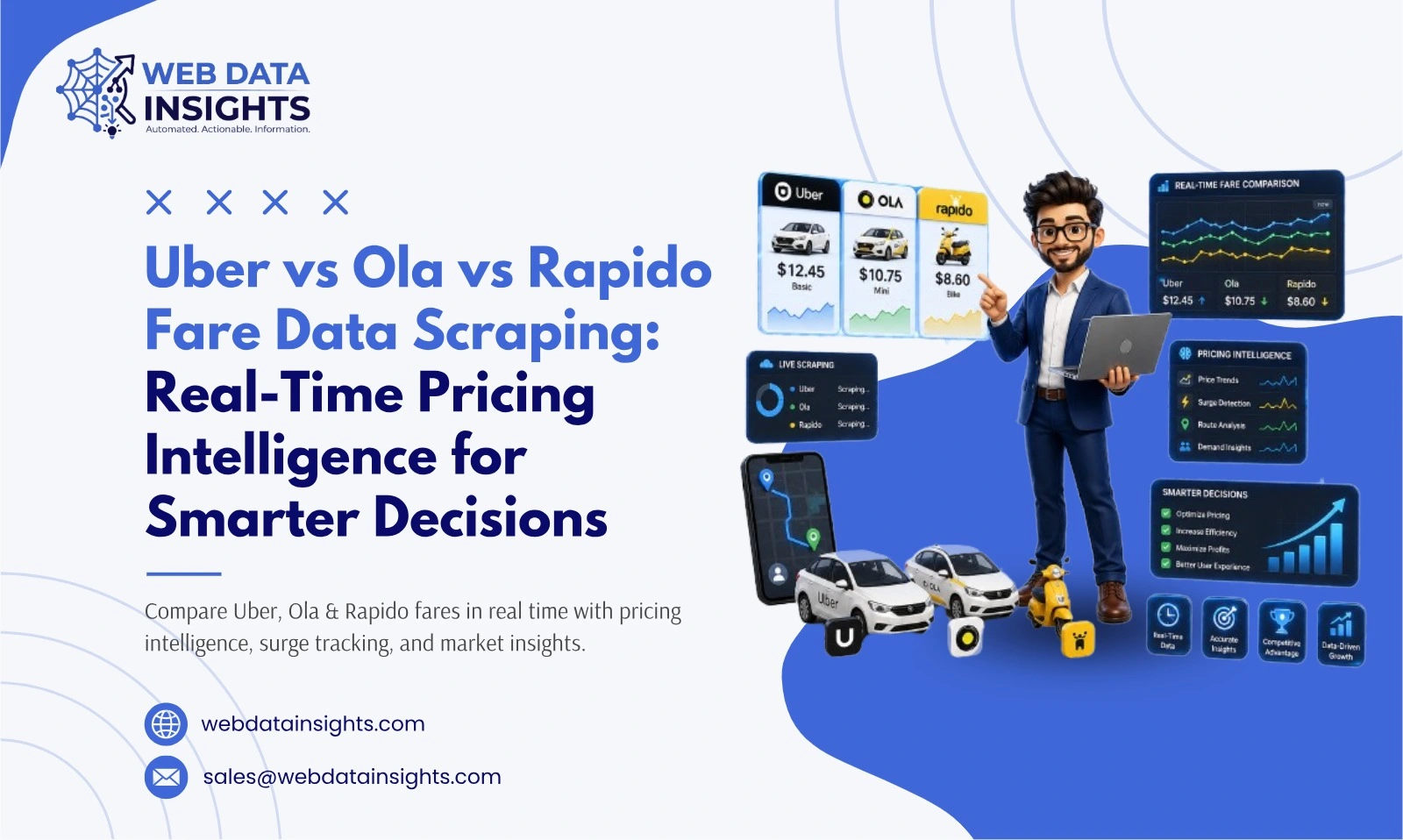
The Indian ride-hailing market is one of the most dynamic and price-sensitive transportation ecosystems in the world. With three dominant players — Uber, Ola, and Rapido — competing aggressively for millions of daily rides across hundreds of Indian cities, fare pricing has become a critical battleground. Prices shift every few minutes based on demand surges, driver availability, traffic conditions, time of day, and promotional campaigns.
For businesses, researchers, investors, and platform aggregators trying to stay ahead in this landscape, manually tracking fares is not just inefficient — it is impossible. This is where structured, automated, and real-time cab fare data scraping becomes indispensable.
This case study explores how Webdatainsights, a leading web data extraction and pricing intelligence company, systematically scrapes, structures, and delivers Uber vs Ola vs Rapido fare comparison data at scale — empowering clients to make smarter, data-driven decisions in the ride-hailing sector.
Why Compare Uber vs Ola vs Rapido?
Understanding how Uber, Ola, and Rapido price their services — and how those prices differ across routes, vehicle categories, cities, and time periods — is no longer just a consumer curiosity. It has become a strategic necessity for an entire ecosystem of businesses and researchers.
Here is why this comparison matters at scale:
Fragmented Pricing Strategies
Each platform adopts a distinct pricing philosophy. Uber relies on algorithmic surge pricing driven by real-time demand-supply ratios. Ola uses a combination of base fares, per-km rates, and time-of-day multipliers. Rapido, primarily a bike taxi and auto platform, competes aggressively on low-cost fares to capture price-sensitive riders.
These differences mean that for the same 5-kilometre route in Bengaluru at 9 AM on a Monday, the fare gap between the three platforms can be anywhere from ₹30 to ₹120. Aggregating and comparing this data at scale uncovers meaningful pricing intelligence that is invisible to anyone relying on manual observation.
High Ride-Hailing Market Growth
India’s ride-hailing market is projected to exceed $15 billion by 2030. The number of active riders is growing, the geographic penetration is deepening into Tier 2 and Tier 3 cities, and the product categories offered — sedans, SUVs, autos, and bike taxis — are multiplying. In this environment, competitive fare data is as valuable as market share data.
The Real-Time Pricing Factor
Uber, Ola, and Rapido all employ dynamic pricing models. Fares are not static — they respond to demand spikes, local events, weather, and supply fluctuations within minutes. A dataset captured today may not reflect tomorrow’s pricing reality. This makes continuous, automated scraping of cab pricing data the only reliable method for tracking fare behaviour over time.
The Strategic Value of Real-Time Cab Pricing Data
Real-time cab fare data is not just a snapshot of what a rider pays today. When collected consistently over time, across cities and vehicle categories, it becomes a powerful intelligence asset with applications across industries.
Competitive Intelligence at Scale
Businesses operating in the mobility space — whether as aggregators, fleet operators, or platform competitors — need to know how rival platforms are pricing at any given moment. Real-time Uber vs Ola vs Rapido pricing data reveals when platforms are running promotions, when surge pricing is active, and how base fare structures compare across geographies.
Market Research and Trend Analysis
Researchers studying consumer behaviour in the gig economy, economists modelling urban transportation demand, and consulting firms building mobility reports all require clean, structured, and longitudinal fare datasets. Historical ride-hailing Price Monitoring data allows trend identification — how fares have shifted post-pandemic, how new entrants have disrupted pricing, and how seasonal demand cycles affect price floors and ceilings.
Price Monitoring for Travel and Expense Platforms
Corporate travel management platforms, employee commute optimisation tools, and B2B travel aggregators use real-time fare data to recommend the lowest-cost option for each trip. Without a reliable data pipeline from platforms like Uber, Ola, and Rapido, these systems cannot function at full accuracy.
Investment and Due Diligence Research
Venture capital firms and private equity investors evaluating mobility investments use pricing data to understand competitive moats, fare elasticity, and platform-specific pricing power. Clean, structured ride-hailing fare datasets from Webdatainsights serve as primary research inputs for investment theses.
Who Benefits from Uber vs Ola vs Rapido Fare Comparison Data?
The demand for structured cab pricing intelligence spans a remarkably wide range of industries and use cases. Below are the primary beneficiary segments:
| Beneficiary Segment | Primary Use Case |
|---|---|
| Travel Aggregator Platforms | Surface cheapest ride options to users in real time |
| Corporate Travel Management Tools | Optimise employee commute costs and reimbursements |
| Market Research Firms | Build mobility market reports and trend analyses |
| Venture Capital & PE Investors | Evaluate competitive positioning and pricing power |
| Urban Mobility Startups | Benchmark fare structures before product launch |
| Academic Researchers | Study dynamic pricing behaviour and gig economy models |
| Government & Think Tanks | Analyse public transportation pricing and affordability |
| Insurance & FinTech Companies | Model ride frequency and spend patterns for products |
| Fleet Operators & Taxi Unions | Understand how app-based pricing affects their earnings |
| Ad Tech & Geo-Intelligence Firms | Combine location data with pricing for contextual targeting |
Data Points Captured by Webdatainsights
Webdatainsights captures a comprehensive set of structured data fields from each platform — going beyond just the final fare number to deliver complete pricing intelligence. Every scraping cycle collects the following data points:
| Data Field | Description | Example Value |
|---|---|---|
| Platform | Ride-hailing app name | Uber / Ola / Rapido |
| Vehicle Category | Type of ride product | UberGo / Mini / Bike |
| Origin City | City of pickup | Mumbai |
| Origin Location | Pickup point name or coordinates | Andheri Station |
| Destination Location | Drop point name or coordinates | BKC, Bandra |
| Route Distance (km) | Point-to-point distance in kilometres | 8.2 km |
| Base Fare (₹) | Flat starting charge | ₹49 |
| Per KM Rate (₹) | Cost per kilometre | ₹11/km |
| Estimated Total Fare (₹) | Full ride cost estimate shown to rider | ₹138 |
| Surge Multiplier | Dynamic pricing factor applied | 1.4x |
| Estimated Pickup Time (min) | ETA for driver to arrive | 4 min |
| Estimated Trip Duration (min) | Predicted travel time | 22 min |
| Promo / Discount Applied | Any active discount code or offer | 10% Weekend Discount |
| Data Timestamp | Exact date and time of data capture | 2025-04-28 08:47:31 |
| Day of Week | Weekday or weekend classification | Monday |
| Time Slot | Morning, Afternoon, Evening, Night | Morning Peak |
| Weather Condition (if available) | Weather context at time of scrape | Rainy |
| Driver Availability Score | Proxy indicator of supply in area | Low / Medium / High |
Sample Data: Uber vs Ola vs Rapido Fare Comparison
The table below illustrates a representative sample of fare comparison data captured by Webdatainsights for a single route — Koramangala to MG Road in Bengaluru — across vehicle categories, at a single point in time. This is the kind of structured data delivered to clients through APIs, CSV exports, or database integrations.
Route: Koramangala to MG Road, Bengaluru | Date: 28 April 2025 | Time: 08:45 AM | Distance: 6.8 km
| Platform | Vehicle Type | Base Fare (₹) | Per KM (₹) | Surge | Estimated Fare (₹) | ETA (Min) |
|---|---|---|---|---|---|---|
| Uber | UberGo | ₹49 | ₹11 | 1.2x | ₹142 | 3 min |
| Uber | UberXL | ₹79 | ₹18 | 1.2x | ₹226 | 6 min |
| Uber | Auto | ₹30 | ₹9 | None | ₹91 | 5 min |
| Ola | Mini | ₹49 | ₹10 | 1.3x | ₹138 | 4 min |
| Ola | Prime Sedan | ₹79 | ₹17 | 1.3x | ₹218 | 7 min |
| Ola | Auto | ₹25 | ₹8 | None | ₹79 | 6 min |
| Rapido | Bike | ₹20 | ₹5 | None | ₹54 | 2 min |
| Rapido | Auto | ₹25 | ₹7 | None | ₹73 | 4 min |
| Rapido | Cab | ₹49 | ₹10 | None | ₹117 | 5 min |
Key Insight: For this morning-peak route, Rapido Bike offers the lowest fare at ₹54 — 62% cheaper than the most expensive option (UberXL at ₹226). Even for cab-category comparison, Ola Auto at ₹79 undercuts Uber Auto at ₹91 by 13%. This data, captured every 15 minutes over weeks, would reveal how these gaps widen or narrow during peak hours, rain events, and platform-specific promotional periods.
Sample JSON Output
Webdatainsights delivers structured data in multiple formats. Below is a sample JSON record representing a single scraped data point — the format used when clients consume data via API or integrate it into their own analytics pipelines:
{
  "request_id": "ACTZ-IN-BLR-20260422-0915-001",
  "city": "Bengaluru",
  "pickup": {
    "address": "MG Road Metro Station",
    "lat": 12.9756,
    "lng": 77.6068
  },
  "drop": {
    "address": "Kempegowda International Airport",
    "lat": 13.1986,
    "lng": 77.7066
  },
  "distance_km": 35.4,
  "results": [
    {
      "platform": "Uber",
      "vehicle_class": "UberGo",
      "base_fare": 480,
      "surge_multiplier": 1.0,
      "final_fare": 685,
      "eta_minutes": 4,
      "currency": "INR"
    },
    {
      "platform": "Ola",
      "vehicle_class": "Mini",
      "base_fare": 470,
      "surge_multiplier": 1.0,
      "final_fare": 660,
      "eta_minutes": 3,
      "currency": "INR"
    },
    {
      "platform": "Rapido",
      "vehicle_class": "Auto",
      "base_fare": 410,
      "surge_multiplier": 1.0,
      "final_fare": 545,
      "eta_minutes": 7,
      "currency": "INR"
    }
  ],
  "captured_at": "2026-04-22T09:15:00+05:30"
}
This JSON structure is fully schema-consistent across all three platforms — Uber, Ola, and Rapido — allowing clients to directly run cross-platform queries, build dashboards, or feed the data into machine learning models without any normalisation overhead.
How Webdatainsights Scrapes Uber, Ola & Rapido Data
Scraping live fare data from ride-hailing platforms is fundamentally different from scraping a static e-commerce website. Uber, Ola, and Rapido are highly Dynamic Pricing Software, JavaScript-rendered, geolocation-dependent mobile applications. They employ sophisticated anti-bot systems, session management, and rate limiting to prevent automated access.
Webdatainsights has engineered a proprietary multi-layer scraping architecture specifically designed for ride-hailing data extraction. Here is how the process works:
Geolocation Simulation and Route Parameterisation
Each data capture begins by simulating a user located at the exact origin coordinates of the desired route. Our system uses real GPS coordinates mapped to the precise pickup and drop points. This ensures that the fare estimates returned are authentic and not based on approximated locations, which would produce inaccurate results.
Browser Automation and JavaScript Rendering
Since all three platforms — Uber, Ola, and Rapido — render fare data dynamically through JavaScript, Webdatainsights uses headless browser automation to fully render each platform before extracting data. This approach captures fares exactly as a real user would see them on a mobile device, including surge pricing overlays, discount badges, and vehicle availability indicators.
Rotating Proxy Infrastructure
To ensure uninterrupted data access across hundreds of cities and thousands of routes, our scraping infrastructure uses rotating residential and mobile proxy pools. IP rotation, request throttling, and session management protocols mimic natural user behaviour, preventing IP-level blocking and ensuring high data availability.
Anti-Detection and Human Behaviour Simulation
Uber, Ola, and Rapido deploy bot-detection systems including CAPTCHA challenges, device fingerprinting, and behavioural analysis. Webdatainsights counteracts these measures through randomised request timing, realistic browser fingerprinting, and device emulation that replicates genuine mobile app sessions.
Scheduled and Real-Time Scraping Cadence
Clients specify their data freshness requirements — whether they need fare snapshots every 15 minutes, hourly aggregates, or daily summaries. Our infrastructure schedules scraping jobs accordingly, ensuring data delivery matches the client’s operational cadence without any manual intervention on their end.
Data Parsing, Normalisation, and Structuring
Raw scraped content is passed through a custom parsing layer that normalises fare values, extracts structured fields, resolves inconsistencies across platforms (such as different fare field labels), and maps each record to a unified data schema. The result is clean, consistent, and analysis-ready data delivered in the client’s preferred format — JSON, CSV, Excel, or via API.
Challenges in Ride-Hailing Data Scraping (and How We Solve Them)
Scraping live fare data from Uber, Ola, and Rapido presents a unique and constantly evolving set of technical challenges. Every platform update, UI change, or anti-bot measure upgrade can disrupt a scraping pipeline overnight. Below are the key challenges Webdatainsights faces — and the solutions we have built to address them:
| Challenge | Impact | Webdatainsights Solution |
|---|---|---|
| Dynamic JavaScript rendering | Fares not accessible via simple HTTP requests | Headless browser automation with full JS execution |
| Aggressive CAPTCHA systems | Blocks automated session initiation | CAPTCHA-solving integrations and smart session management |
| IP rate limiting and blocking | Frequent IP bans disrupt data pipelines | Rotating residential and mobile proxy pools |
| Frequent UI/API changes | Scraper logic breaks without notice | 24/7 monitoring with automated change detection alerts |
| Geolocation dependency | Incorrect location = incorrect fare data | Precise GPS coordinate simulation per route |
| Surge pricing volatility | Data captured seconds apart can vary significantly | Timestamped records with surge multiplier field captured |
| Platform-specific data structures | Inconsistent field names and fare formats | Unified normalisation layer across all three platforms |
| App-only pricing for some features | Certain fares are exclusive to mobile apps | Mobile device emulation for accurate data capture |
Industry Applications and Real-World Impact
The ride-hailing fare data collected and delivered by Webdatainsights is not an academic exercise. It is actively used across industries to drive decisions that have real commercial and operational impact.
Travel Aggregator and Cab Comparison Platforms
Some of the fastest-growing use cases for our data come from cab comparison apps — platforms that want to show users the cheapest available ride across Uber, Ola, and Rapido for any given trip. These platforms use our real-time fare feed to power their core comparison engine, displaying live pricing rather than cached approximations.
The result is a significantly better user experience, higher retention, and trust built on accurate, up-to-date pricing data.
Corporate Expense and Travel Management
HR teams and finance departments at large Indian enterprises use ride-hailing fare data from Webdatainsights to build reimbursement benchmarking models. Instead of accepting employee-submitted fare receipts at face value, they cross-reference submitted amounts against scraped fare data for the same route, time, and vehicle category — reducing expense fraud and over-claims.
Urban Mobility and Transportation Policy Research
Think tanks and government-adjacent research bodies studying affordable urban transportation use our longitudinal fare datasets to analyse how ride-hailing pricing compares to public transit alternatives, how fares differ across income neighbourhoods, and how surge pricing affects low-income commuters. This type of research feeds directly into urban planning and transportation policy discussions.
Competitive Intelligence for Mobility Startups
New entrants in the Indian mobility market — whether micro-mobility startups, EV fleet operators, or niche cab aggregators — use Uber, Ola, and Rapido fare data to position their own pricing. Understanding where incumbents are priced helps new players identify underserved segments and price-sensitive route corridors where they can offer a competitive alternative.
Investment Research and Due Diligence
Investment analysts tracking the Indian mobility sector use our historical fare data to model revenue trajectories, understand pricing elasticity, and evaluate the competitive dynamics between platforms. When Rapido entered the cab segment or when Ola launched Ola Electric, fare data told a story that earnings calls could not — showing in real time how pricing shifted, where promotions were deployed, and how market share battles played out at the fare level.
Compliance, Ethics, and Data Quality
Webdatainsights operates with a firm commitment to legal compliance, ethical data collection, and rigorous quality standards. Every scraping project is evaluated against applicable legal frameworks before execution.
Publicly Available Data Only
All fare data collected by Webdatainsights is sourced exclusively from publicly accessible fare estimation interfaces — the same screens any user sees when they open the Uber, Ola, or Rapido app. We do not access private user accounts, ride history, personal data, or any information behind authentication walls. Our data collection is strictly limited to anonymised, publicly displayed pricing information.
No Personal Data Collection
Webdatainsights does not collect, store, or transmit any personally identifiable information (PII) related to riders, drivers, or transactions. Our datasets contain only fare estimates, route parameters, and platform metadata. GDPR and India’s Digital Personal Data Protection Act (DPDPA) compliance is built into our data architecture.
Data Quality Assurance
Every scraped record passes through a multi-stage quality assurance pipeline before delivery. This includes validation checks for fare range plausibility, null field detection, duplicate removal, timestamp integrity verification, and anomaly flagging. Clients receive clean, deduplicated, and validated datasets with a documented quality score per batch.
- Fare range validation against historical baselines for the same route and time slot
- Duplicate record detection across scraping cycles
- Null and incomplete field alerts with automatic re-scraping triggers
- Surge multiplier consistency checks across concurrent data points
- Delivery format validation ensuring schema integrity for every JSON or CSV export
Transparent Methodology
Webdatainsights provides full methodology documentation to clients — including scraping frequency, geographic coverage, vehicle category inclusion criteria, and known data limitations. We believe that transparency in data sourcing builds client trust and enables better downstream use of the data.
Why Choose Webdatainsights?
There are several web scraping service providers in the market, but ride-hailing data extraction is a niche that demands deep domain expertise, a purpose-built technical infrastructure, and the operational maturity to deliver data reliably at scale. Here is what sets Webdatainsights apart:
| Capability | Webdatainsights Advantage |
|---|---|
| Ride-Hailing Domain Expertise | Built specifically for Uber, Ola, Rapido data — not a generic scraping tool |
| Real-Time Data Delivery | 15-minute to hourly data cadence with API access for live consumption |
| Multi-City Coverage | 150+ Indian cities across Tier 1, Tier 2, and Tier 3 geographies |
| Unified Schema Across Platforms | Single normalised data structure for cross-platform analysis |
| 99.5%+ Data Uptime SLA | Guaranteed data delivery with automated failover and recovery |
| Custom Route Configuration | Clients specify any origin-destination pair; we configure and deliver |
| Flexible Delivery Formats | JSON, CSV, Excel, PostgreSQL, BigQuery, or REST API |
| Dedicated Account Management | Single point of contact for onboarding, support, and data queries |
| Scalable Infrastructure | From 10 routes to 10,000 routes — our system scales without performance drop |
| Compliance-First Approach | All data sourced ethically from public interfaces with full documentation |
Conclusion
The Indian ride-hailing market is moving fast — and so is the pricing data that defines it. Uber, Ola, and Rapido are engaged in a continuous, algorithm-driven pricing war that plays out differently in every city, every hour, and every vehicle category. Keeping pace with this pricing intelligence manually is not feasible. Structured, automated, and real-time cab fare data scraping is the only viable path.
Webdatainsights has invested years of technical development and domain expertise into building the most reliable Uber vs Ola vs Rapido fare comparison data pipeline in the Indian market. From geolocation-accurate scraping and anti-bot resilience to unified data normalisation and compliance-first delivery, every aspect of our infrastructure is designed to deliver one thing: clean, accurate, and timely ride-hailing pricing intelligence that drives real business value.
Whether you are building a cab comparison platform, optimising corporate travel costs, conducting mobility market research, or evaluating an investment in India’s transportation sector — Contact Webdatainsights is your trusted partner for ride-hailing fare data.
Reliable Web Data Solutions
WebDataInsights provides clean, structured, and real-time web scraping solutions tailored to your business goals, helping automate data collection for eCommerce, market research, lead generation, and more.
Get in TouchReady to Turn Your Data into Revenue Growth?
Partner with WebDataInsights for enterprise-grade B2B data scraping, real-time price monitoring, supplier benchmarking intelligence, and seamless API data delivery.
Solve My Problem