





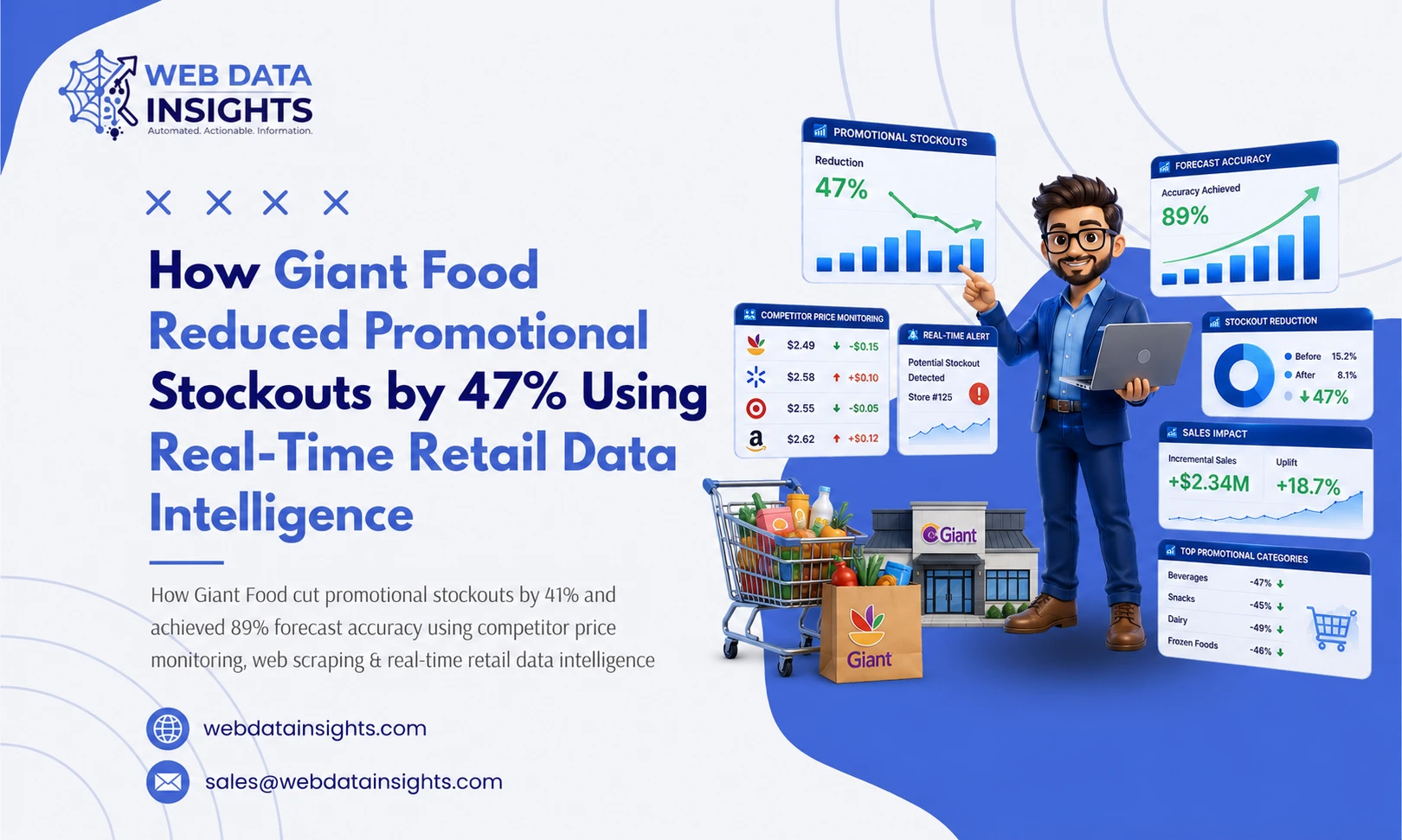
Introduction: The Promotional Stockout Problem in Grocery Retail
Giant Food is one of the most recognized grocery brands in the Mid-Atlantic United States, serving millions of households across its 160+ store network in Washington D.C., Virginia, Maryland, and Delaware. Backed by advanced Retail Data Intelligence and competitor price monitoring strategies, the company has maintained a strong market position. However, like most large grocery retailers, Giant Food was still losing millions of dollars each year due to a deeply familiar problem: promotional stockouts.
During promotional periods, high-demand items would sell out within hours at busy urban locations while the same items overstocked at lower-traffic stores. The root cause was not a supply chain failure — it was a data gap. Giant Food’s promotional inventory allocation was built on static historical sales averages. There was no visibility into what competitors were promoting, no real-time grocery shelf availability tracking, no competitor price monitoring, and no mechanism to predict store-level demand based on live market signals.
The solution came through data — specifically through three core data intelligence services that transformed how Giant Food understood and responded to promotional demand:
- Competitor promotional calendar monitoring and price scraping across rival grocery chains
- Demand-driven data intelligence combining POS data, competitor web scraping, weather, and local event signals
- Real-time retail data extraction tracking product availability across competitor delivery platforms
The results speak for themselves: 41% fewer promotional stockouts, 89% demand prediction accuracy, and $5.7M in recovered annual revenue. This case study breaks down exactly how each data service contributed — and explains how WebDataInsights delivers these same competitor analysis, web scraping, and retail data intelligence services to grocery retailers who want to achieve identical results.
The Data Intelligence Services That Powered Giant Food’s Results
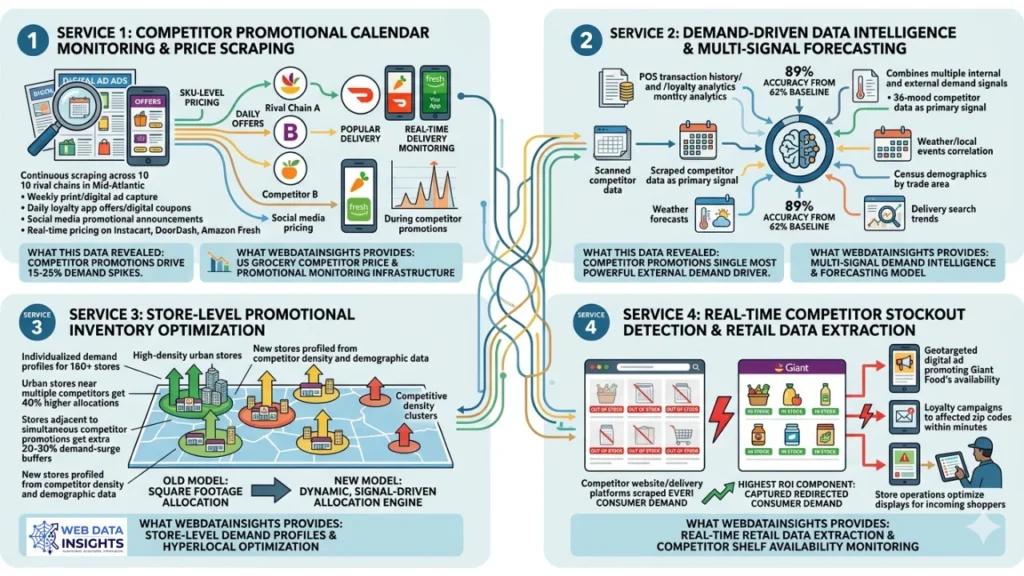
Giant Food’s transformation was driven by four specific data services working together. Understanding each one is key to understanding how your grocery business can replicate these outcomes.
Service 1: Competitor Promotional Calendar Monitoring & Price Scraping
The first and most impactful service was continuous competitor price monitoring and promotional calendar scraping across 10 rival grocery chains in the Mid-Atlantic region. This involved:
- Automated scraping of weekly print and digital ad circulars from all major competing grocery chains — capturing SKU-level promotional pricing updated every Monday
- Daily extraction of loyalty app offers, digital coupon promotions, and members-only pricing from competitor grocery apps
- Competitor web scraping of social media promotional announcements to capture flash sales and short-notice deals
- Real-time price monitoring across Instacart, DoorDash, and Amazon Fresh to track competitor promotional pricing on delivery platforms
What this data revealed: Competitor promotional activity on overlapping or adjacent product categories drove 15-25% demand spikes at nearby Giant Food stores. Without competitor price monitoring data, these demand surges were invisible — and promotional inventory was allocated based on historical averages that completely missed them.
What WebDataInsights provides: WebDataInsights delivers exactly this competitor price monitoring and promotional calendar scraping service for grocery retailers across the U.S. Powered by advanced Enterprise Web Crawling, our web scraping infrastructure monitors competitor ad circulars, loyalty offers, and delivery platform pricing — giving your team the same competitive visibility that powered Giant Food’s results.
Service 2: Demand-Driven Data Intelligence & Multi-Signal Forecasting
The second service was a demand-driven data intelligence platform that combined competitor promotional data with multiple external and internal demand signals to build a predictive inventory model. The data inputs included:
- 36 months of Giant Food POS transaction history and loyalty card analytics
- Scraped competitor promotional calendar data as the primary external demand signal
- Hyperlocal weather forecast data correlated with demand patterns for temperature-sensitive grocery categories
- Local community event calendars — sports events, school schedules, public holidays — that drive predictable demand spikes
- U.S. Census demographic segmentation data profiling each store’s trade area by household income, family size, and food preferences
- Grocery delivery platform search trend data showing rising purchase intent by product category and zip code
What this data revealed: Competitor promotional activity was the single most powerful external demand driver — accounting for 15-25% of same-week demand variance at Giant Food stores located near actively promoting competitors. This competitor analysis data, when integrated with weather and demographic signals, enabled store-level demand forecasting at 89% accuracy — up from a 62% baseline.
What WebDataInsights provides: WebDataInsights provides grocery retailers with multi-signal demand intelligence by combining competitor web scraping data, delivery platform data extraction, and demographic intelligence into a unified forecasting model. Your team gets the same demand prediction capability that allowed Giant Food to replace guesswork with data-driven promotional allocation.
Service 3: Store-Level Promotional Inventory Optimization
The third service used scraped geographic demand data and competitive density mapping to build individualized promotional demand profiles for each of Giant Food’s 160+ store locations. This store-level data intelligence enabled:
- High-density urban stores with 3+ competing grocery options nearby received 40% higher promotional inventory allocations for top-velocity SKUs
- Stores adjacent to competitors running simultaneous promotions received additional demand-surge inventory buffers of 20-30%
- Suburban and rural locations with low competitive pressure received calibrated baseline allocations built from loyalty card and seasonal data
- New store locations were profiled entirely from competitor density web scraping and trade area demographic data extraction
What this replaced: Giant Food’s prior model allocated promotional inventory proportionally to store square footage — a static approach that had nothing to do with actual local demand. Competitor web scraping and geographic data intelligence replaced it with a dynamic, signal-driven allocation engine updated weekly.
What WebDataInsights provides: WebDataInsights builds store-level demand profiles for grocery retailers using competitor web scraping, delivery platform data extraction, and demographic intelligence — enabling the same hyperlocal promotional inventory optimization that eliminated Giant Food’s stockout problem.
Service 4: Real-Time Competitor Stockout Detection & Retail Data Extraction
The fourth service was real-time retail data extraction — scraping competitor grocery websites and delivery platforms every 2 hours to monitor product availability during promotional periods. When competitor stockouts were detected on promoted items, the data triggered an immediate multi-channel response:
- Digital advertising teams received real-time competitor stockout alerts to deploy geo-fenced ads promoting Giant Food’s in-stock availability for the same or substitute products
- Loyalty program email and push campaigns were activated to Giant Food cardholders in affected zip codes within minutes of competitor stockout detection
- Store operations received inventory alerts to optimize display placement and promotional signage for incoming competitor-displaced shoppers
The revenue impact: This real-time competitor data extraction and stockout detection capability proved to be the highest-ROI component of the entire data intelligence deployment — capturing redirected consumer demand that would otherwise have been permanently lost.
What WebDataInsights provides: WebDataInsights provides real-time retail data extraction and competitor shelf availability monitoring as a standalone or integrated service — giving grocery retailers the ability to detect and monetize competitor supply chain failures in real time.
Results: What Data Intelligence Delivered for Giant Food
After deploying competitor price monitoring, web scraping for retail data, demand-driven data intelligence, and real-time retail data extraction across its operations, Giant Food achieved the following verified outcomes:
| Metric | Value | Description |
|---|---|---|
| Stockout Reduction | 41% | Promotional stockouts eliminated via demand-driven data allocation |
| Forecast Accuracy | 89% | Demand prediction accuracy for high-velocity promotional SKUs |
| Revenue Recovered | $5.7M | Annual lost sales recovered through stockout prevention |
| Waste Reduction | 22% | Promotional markdown losses reduced at low-demand store locations |
These results were not achieved through a technology platform alone. They were achieved by applying the right data — competitor price monitoring data, promotional calendar scraping, delivery platform data extraction, and demographic intelligence — to the specific operational challenge of promotional inventory allocation. Every percentage point of stockout reduction traces directly to a data service that made demand more visible and more predictable.
What Giant Food’s Results Mean for Your Grocery Business
Giant Food’s results are not unique to Giant Food. The same promotional stockout problem — and the same data-driven solution — applies to grocery retailers of every size across the U.S. and globally. If your business is experiencing any of the following, you are leaving the same revenue on the table that Giant Food was:
- Promotional items selling out at high-traffic locations while overstocking at others
- No visibility into what competing grocery chains are promoting this week
- Inventory allocation built on historical averages rather than live market signals
- No mechanism to detect when competitors run out of stock and capture that redirected demand
- Demand forecasting that misses the impact of competitor promotions, weather events, or local community activity
The good news: every one of these gaps is a data problem — and data problems have data solutions. WebDataInsights provides exactly the competitor price monitoring, web scraping for retail data, competitor analysis, and retail data extraction services that powered Giant Food’s results.
WebDataInsights: The Same Data Intelligence Services, Available for Your Business
WebDataInsights is a specialist retail data intelligence company providing competitor price monitoring, web scraping, competitor analysis, and retail data extraction services to grocery retailers, supermarket chains, CPG brands, and e-commerce operators. Here is exactly how our services map to what powered Giant Food’s transformation:
| WebDataInsights Service | What It Does | Giant Food Result It Powered |
|---|---|---|
| Competitor Price Monitoring | Continuous scraping of competitor promotional pricing, ad circulars, and loyalty offers across rival grocery chains | Identified 15-25% demand spikes caused by competitor promotions — enabling proactive inventory allocation |
| Competitor Web Scraping | Automated extraction of competitor promotional calendars, digital deals, and product availability from websites and delivery platforms | Built the competitive intelligence foundation for Giant Food’s demand forecasting model |
| Retail Data Extraction | Real-time scraping of product availability across competitor online grocery platforms and delivery apps every 2 hours | Detected competitor stockouts in real time, enabling Giant Food to capture redirected shopper demand |
| Competitor Analysis & Intelligence | Structured analysis of competitor promotional patterns, pricing strategies, and market positioning delivered as actionable insights | Revealed that competitor promotional activity was the single highest-impact external demand driver |
| Demand-Driven Data Intelligence | Multi-signal demand forecasting combining competitor data, POS history, weather, demographics, and delivery platform trends | Improved Giant Food’s demand prediction accuracy from 62% baseline to 89% |
| Store-Level Inventory Optimization | Hyperlocal demand profiling using competitor density mapping, trade area demographics, and delivery platform data | Replaced static allocation model — delivered 41% stockout reduction and 22% waste reduction |
Conclusion: Data Intelligence Is the Competitive Advantage in Grocery Retail
Giant Food’s promotional stockout problem was not solved by adding more warehouse space, hiring more logistics staff, or changing suppliers. It was solved by getting better data — specifically, by deploying competitor price monitoring, competitor web scraping, demand-driven data intelligence, and real-time retail data extraction to make promotional demand visible, predictable, and actionable at the store level.
The 41% reduction in promotional stockouts, 89% demand prediction accuracy, and $5.7M in recovered annual revenue are the direct, measurable output of data intelligence applied to grocery retail’s most persistent operational challenge. Every grocery retailer operating promotional campaigns without these data services is making inventory decisions with one hand tied behind their back.
WebDataInsights exists to change that. Our competitor price monitoring, web scraping for retail data, competitor analysis, and retail data extraction services are purpose-built for grocery retailers who want to operate with the same data-driven precision that is transforming the industry’s most competitive players. If Giant Food’s results are the outcome you want for your business, the data services that produced them are available to you today through WebDataInsights.
Want Results Like Giant Food? Let’s Talk.
WebDataInsights provides competitor price monitoring, web scraping, competitor analysis, and retail data intelligence services to grocery retailers and supermarket chains across the U.S. and internationally. Our data services are available as standalone solutions or as an integrated retail data intelligence platform — customized to your store network, competitive landscape, and operational priorities. contact webdatainsights for Services.
| Our Data Intelligence Services | Challenges We Solve |
|---|---|
| Competitor Price Monitoring | Promotional stockouts costing you revenue |
| Competitor Web Scraping | No visibility into competitor promotions |
| Retail Data Extraction | Inventory allocated on outdated averages |
| Competitor Analysis & Intelligence | Missing demand from competitor stockouts |
| Promotional Demand Forecasting | Forecasting that cannot predict demand spikes |
| Store-Level Inventory Optimization | Overstocking and markdown losses |
| Real-Time Stockout Detection | Promotional stockouts costing you revenue (real-time fixes) |
FAQ — Giant Food Retail Data Intelligence
What data intelligence services did Giant Food use to reduce promotional stockouts?
Giant Food used four core data services: competitor price monitoring, competitor promotional calendar scraping, demand-driven data intelligence combining POS and external signals, and real-time retail data extraction tracking product availability across competitor delivery platforms like Instacart, DoorDash, and Amazon Fresh.
How much did Giant Food reduce promotional stockouts using retail data intelligence?
Giant Food achieved a 41% reduction in promotional stockouts by replacing static inventory allocation models with demand-driven data intelligence powered by competitor price monitoring and web scraping.
What is competitor price monitoring and how does it help grocery retailers?
Competitor price monitoring is the automated, continuous scraping and tracking of rival grocery chains’ promotional pricing, ad circulars, loyalty app offers, and delivery platform prices. For grocery retailers, it reveals demand shifts caused by competitor promotions — allowing proactive inventory allocation before stockouts occur.
How does web scraping help in grocery retail inventory management?
Web scraping collects real-time data from competitor websites, delivery platforms, and digital ad circulars — data that is otherwise invisible to grocery retailers. This scraped data feeds demand forecasting models, enabling store-level inventory decisions based on live market conditions rather than outdated historical averages.
What is retail data intelligence?
Retail data intelligence is the process of collecting, integrating, and analyzing data from multiple sources — competitor price monitoring, web scraping, POS history, demographic data, weather forecasts, and delivery platform trends — to generate actionable insights for inventory, pricing, and promotional decisions in retail businesses.
How did Giant Food achieve 89% demand forecast accuracy?
Giant Food’s demand prediction accuracy improved from 62% to 89% by integrating competitor promotional calendar data obtained through web scraping with internal POS history, loyalty card analytics, weather forecasts, local event calendars, and grocery delivery platform search trends into a unified demand forecasting model.
Can small and mid-size grocery retailers also use competitor price monitoring and web scraping services?
Yes. Competitor price monitoring and web scraping services are scalable and available to grocery retailers of all sizes — from single-region chains to national supermarket networks. WebDataInsights customizes data intelligence services based on your store count, competitive landscape, and operational priorities.
How does real-time competitor stockout detection work?
Real-time competitor stockout detection uses automated retail data extraction crawlers that scrape competitor grocery websites and delivery platforms every 2 hours during promotional periods. When a competitor runs out of a promoted item, an alert is triggered — allowing grocery retailers to immediately activate targeted digital ads and loyalty campaigns to capture redirected consumer demand
How long does it take to see results from retail data intelligence services?
Initial demand forecasting improvements and stockout reductions are typically visible within the first 1-2 promotional cycles after deployment. Forecast accuracy compounds over time as models ingest more data — Giant Food’s accuracy improved from 62% to 89% over 6 months of continuous refinement.
Does WebDataInsights provide competitor price monitoring and web scraping services for grocery retailers?
Yes. WebDataInsights provides competitor price monitoring, competitor web scraping, retail data extraction, competitor analysis, and demand-driven data intelligence services purpose-built for grocery retailers and supermarket chains. Our services are available as standalone solutions or as an integrated retail data intelligence platform.
Reliable Web Data Solutions
WebDataInsights provides clean, structured, and real-time web scraping solutions tailored to your business goals, helping automate data collection for eCommerce, market research, lead generation, and more.
Get in TouchReady to Turn Your Data into Revenue Growth?
Partner with WebDataInsights for enterprise-grade B2B data scraping, real-time price monitoring, supplier benchmarking intelligence, and seamless API data delivery.
Solve My Problem